















Singapore’s business sector is embracing technology at an impressive pace, with many companies implementing ERP systems to streamline processes and optimize resources. From my experience advising businesses, I often explore how such software can genuinely improve a company’s performance.
IT teams are also focused on security and reliability. Questions like “Is our data safe? Can the vendor guarantee system security?” are common, while employees worry, “Is it user-friendly, or will it complicate my daily tasks?”
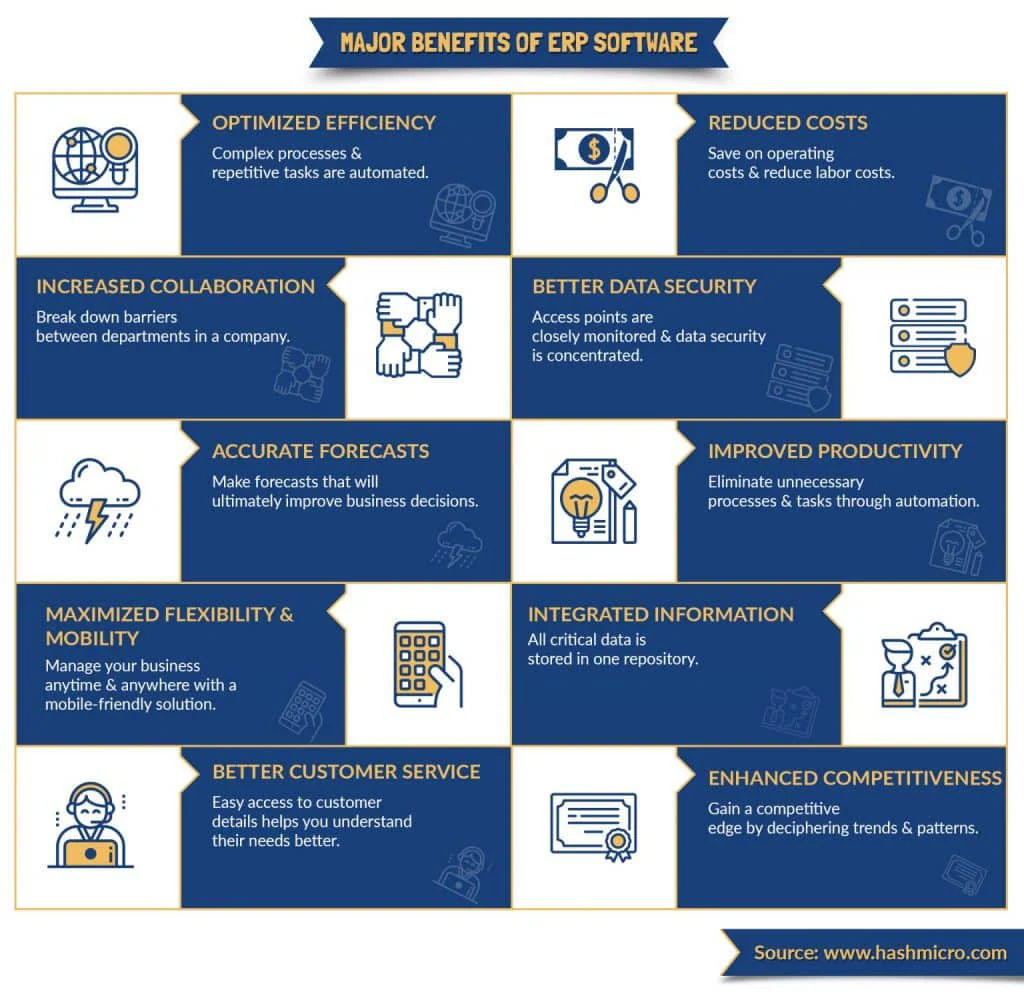
If these questions sound familiar, you’re in the right place. From my perspective, a centralized platform can transform day-to-day operations. ERP systems provide this, offering reporting that boosts productivity and cuts costs. We’ll explore 15 key benefits that can help your business decide if it’s time to adopt this intelligent technology.
Key Takeaways
An ERP system safeguards and simplifies company data, enhancing security and standardizing information.
ERP software automates tasks, boosts productivity, and reduces the need for additional staff.
ERP provides business operation visibility and fosters interdepartmental collaboration, enhancing efficiency.
ERP reduces operational costs, identifies high expenditures, and offers more accurate forecasting for more efficient management.
The ERP system assists companies in measuring Return on Investment (ROI) more accurately, ensuring that the investment adds significant value.
15 Main Benefits of ERP System for Businesses
According to Statista, the projected revenue for the Enterprise Resource Planning (ERP) Software market in Singapore is expected to increase steadily in the coming years. By 2023, the market’s revenue is forecasted to grow significantly, with a continuation of this growth trend expected until 2028.
Roughly 80% of medium to large businesses in the country have incorporated or partially implemented ERP systems into their operations to run their businesses more smoothly, particularly in industries like manufacturing, logistics, and finance.
So, here are 15 advantages that businesses in Singapore can gain by using ERP solutions:
1. Centralized Data Management Boost
This eliminates data silos and ensures every department works from the same accurate and up to date information. With a single source of truth, employees can collaborate more effectively, reduce duplication, and avoid costly mistakes caused by inconsistent records. Ultimately, centralized data improves transparency, accountability, and organizational alignment.
ERP systems bring all core business data into a single, unified platform. Instead of information being scattered across spreadsheets, emails, and disconnected tools, ERP centralizes finance, operations, sales, inventory, and HR data in one place.
This eliminates data silos and ensures every department works from the same accurate and up to date information. With a single source of truth, employees can collaborate more effectively, reduce duplication, and avoid costly mistakes caused by inconsistent records. Ultimately, centralized data improves transparency, accountability, and organizational alignment.
Moreover, automation allows us to complete tasks more swiftly. The ERP system for IT departments streamlines workflows and reduces time spent searching for necessary information.
2. Cost Savings
This is the primary reason many Singaporean business owners adopt ERP systems. By cutting business expenses, you can increase profits, often significantly!
The automation mentioned earlier is among the ways key ERP functionalities save or even eliminate administrative and operational costs. For instance, manual data entry that consumes considerable paper can be eliminated with an integrated system.
That’s not all. The system’s ability to identify higher-than-usual expenditure sources enables you to swiftly adjust costs and reduce the potential for employee fraud.
Overall, ERP implementation often yields substantial cost savings by streamlining operations, reducing manual labor, and minimizing errors, resulting in a more cost-effective business model.
ERP systems also come equipped with business intelligence features to create more accurate planning, preventing urgent orders, excessive production, or over-ordering, all of which tend to inflate costs.
3. Workflow Standardization
Similar to standardizing data, another benefit of enterprise resource planning is to standardize workflows. Each department may handle specific processes differently.
It might even happen that two employees within the same department don’t follow the same steps. Adopting digital business management tools ensures that every employee follows the same best practices when working on something.
Often, work is carried out in a certain way simply because it has been a habit for years, not because that method is the best or most efficient. The introduction of ERP into your business will streamline processes and make work faster and more straightforward.
3. Better Financial Visibility and Control
ERP gives businesses real time insight into their financial position. With integrated accounting, budgeting, and reporting tools, leaders can monitor cash flow, expenses, revenue, and profitability with accuracy. Instead of waiting for end of month reports, decision makers can see financial data as it happens. This allows companies to identify risks early, control costs, and plan investments more strategically. Clear financial visibility strengthens governance and supports smarter long term planning.
5. Higher Mobility
In several companies, employee mobility is no longer just a facility but a necessity, especially in industries, like construction.
Fieldworkers and employees frequently moving from one construction site to another would face difficulties using computers or laptops to access the latest company data, such as raw material availability, project progress monitoring, and workforce counts.

Furthermore, the best ERP software should be mobile-friendly, allowing access anytime, anywhere through employees’ mobile phones. As users access the cloud system via the web, they can view dashboards, reports, and other information from their mobile browsers.
Many ERP system vendors offer mobile applications for convenient usage on smaller screens.
6. Stronger Regulatory Compliance
ERP systems help organizations meet legal and industry regulations by maintaining structured, audit ready records. Built in controls, approval workflows, and documentation trails ensure that all activities follow standard procedures.
Whether it is financial reporting, quality standards, or data protection, ERP simplifies compliance by organizing information in a traceable and transparent way. This reduces the risk of penalties, legal issues, and reputational damage while improving accountability across the organization.
7. Real-Time Reporting
Accurate reporting is among the most sought-after benefits of an ERP system. The system can tailor reports for various functions—finance, inventory, procurement, sales and marketing, and HR.
With this, you can not only track the performance of each business component but also identify departments driving business growth and those hindering it.
To obtain accurate reports, you need the most recent or real-time data. If generating income reports takes weeks, the information may become outdated without data enrichment software solutions to process data efficiently.
8. Enhanced Scalability
Have you ever felt that the current software you’re using can’t handle the expanding operations of your company? If so, it means the software lacks good scalability.
The best ERP systems should be capable of growing alongside your company. They should offer optimal functionality while leaving room for additional modules in the future.
Cloud-based ERP systems are the top choice for business owners seeking easy resource additions. This system also reduces the workload on IT teams who would otherwise have to manually add servers if using an on-premise system.
9. Data Security
Undoubtedly, data is the most valuable asset for any company. With data, business owners can make informed decisions for their company’s future. An ERP system can help protect this asset.
With data centralization from an ERP system, rather than data being scattered across various systems with varying security levels, the protection of company data can be heightened. This system replaces spreadsheets and other documents scattered across individual devices or emails.
Security layers are bolstered with cloud-based ERP systems. This way, company information is typically distributed across remote servers to avoid hacking into sensitive customer data.
To understand the benefits of implementing cloud ERP or on-premise ERP, you can read a comprehensive explanation in the following article: Choosing the Best ERP Systems for Your Business Management.
Another benefit of cloud-based ERP systems is the ability to limit who can view and edit data. ERPs usually have easily controlled authorization systems to ensure employees only see the data they need, reducing the chance of fraud.
10. Data Management Standardization
Without centralized data, staff would struggle to find the information they need. This is because data from each division is spread across various applications and spreadsheets. Unfortunately, this method often results in duplicate data with inconsistent formats.
An ERP system helps standardize all crucial company data. Since all data is stored within one system, each piece of data is created in a consistent format, making it easier to generate reports or perform real-time data analysis with ERP.
Such information standardization allows you to gather all necessary data and make decisions based on more accurate information. This way, you can save more time and money.
11. More Accurate Forecasting

How many times have you found your business unprepared for sudden changes? For instance, surges in demand at certain times or conversely, decreased demand resulting in excessive inventory storage?
This can occur due to a lack of accurate forecasting. We’re not talking about mystical forecasting, but rather predictive insights based on historical data of demand, costs, and other figures to anticipate future changes.
With the aid of an ERP system, forecasting becomes significantly more accurate and comprehensive because all the necessary data is in one place. This forecasting makes you better equipped to handle various possibilities.
For example, if the ERP system’s forecast indicates a 30% sales increase, you could purchase more inventory or ramp up production. For service-based businesses, hiring additional staff might be an option to anticipate increased demand.
However, if the forecast predicts that expenses will surpass sales, you can prepare to find the best ways to cut costs.
Ultimately, accurate forecasting can help your business gain more profits and reduce expenses by not overspending in the wrong areas.
12. Increased Visibility
One of the most sought-after benefits of an ERP system by business owners is visibility. Let’s take an example of ERP visibility benefits in the manufacturing industry.
If the purchasing team or procurement division can see the status of purchase orders, they can estimate delivery times to avoid excess or insufficient inventory.
This smoothens production operations. No more production halts due to material shortages, which can be detrimental to the company.
Visibility into task statuses and data managed by other departments can help all teams and employees perform their duties more efficiently.
Is your company involved in manufacturing? Have you faced issues as described? For a more comprehensive understanding of how ERP software can assist manufacturing businesses, explore the following article: Main Benefits of ERP Software for Manufacturing Industry.
13. Enhanced Collaboration

The ERP system facilitates collaboration between departments. Having visibility into how other teams operate and knowing what information they’re seeing makes it easier for your employees to collaborate or even offer assistance to colleagues if possible.
No longer do teams work in isolation, using applications with restricted access solely for their department, and disconnected from systems used by other teams or departments. Everyone uses the same system, with the same standards.
As communication and collaboration among divisions improve, the entire business benefits. With an integrated system’s help, teams can identify duplicate work that can be eliminated or find more efficient ways to accomplish daily tasks.
In addition to this, integrating ERP with existing business software can significantly enhance workflow efficiency and data consistency across platforms.
14. Flexibility
ERP systems are designed to assist various companies, regardless of their shape and size. This is why several leading ERP vendors prioritize flexibility as a key feature in their systems.
This flexibility allows users to adapt the system to the unique needs of each company, such as unique workflows and metrics uncommon in other companies.
It’s crucial because as companies grow, workflows and company KPIs may change unexpectedly. This flexibility ensures the system can still work for your business without needing replacement due to misalignment with evolving business processes.
15. Risk Management
ERP systems can gather data from various business divisions. With this data from ERP, companies can easily and quickly identify various potential risks in financial, supply chain management, operational risks, and more.
Once identified, the ERP system can assist in risk evaluation. This process involves data analysis and potential risk calculations. For instance, if your ERP system is equipped with accounting software, it can help identify credit risks by analyzing customer data and payment histories.
After data is gathered and analysis is conducted, it becomes easier to create risk mitigation plans. For example, in supply chain management, your company can create alternate supply plans in case the primary supplier encounters issues, ensuring production remains uninterrupted.
Choose the Right ERP System
The right ERP system for your company should encompass most of the benefits we’ve outlined earlier. When considering which ERP system examples are best for your business, it’s wise to conduct thorough research and ask detailed questions about how the offered ERP system can aid your company.
The suitable ERP system will heavily depend on the specific needs of the business, such as the company’s size, industry, business model, and future goals. Additionally, consider which modules are suitable for current use and allow for future additions.
Therefore, it’s crucial to ensure that your chosen ERP solution not only meets the company’s current needs but also possesses scalability and flexibility. This is because the scalability and flexibility of ERP systems make them ideal for businesses looking to grow and adapt, providing scalable solutions that evolve with the company’s needs.
HashMicro stands as one of the leading ERP solutions companies in Singapore. With over 1700 clients, HashMicro offers integrated solutions suitable for various industries and companies. Its ERP solutions are integrated with emerging technologies such as AI and IoT that open up new possibilities for automation and data intelligence, enhancing the system’s capabilities and future-proofing business operations.
With HashMicro’s ERP system, companies can manage all aspects of their business on one platform. Industries ranging from retail, manufacturing, finance, services, to technology can benefit from HashMicro’s ERP system. With a multitude of features and modules, HashMicro’s ERP system can be tailored to meet your business needs.
Get a free demo of HashMicro’s ERP software to discover more about how our solutions can assist your business. Click the image below to get information about our top product, HashCore ERP:
After understanding the benefits of an ERP system for your company, the next step is to select which modules your business needs. For a more detailed discussion, you can read about it in the following article: The Most Important ERP System Modules.
Frequently Asked Questions About the Benefits of ERP
An ERP system integrates various business functions into a single platform, eliminating job duplications, automating processes, and enhancing inter-departmental collaboration, thus boosting operational efficiency.
An ERP system provides real-time visibility into data and business processes, enabling better monitoring of company performance, inventory, and customer demands.
Cost reduction through ERP implementation is done by optimizing processes, minimizing excess inventory, improving calculation accuracy, and minimizing human errors. It also aids in negotiating raw material prices and monitoring operational expenses.
An ERP system provides accurate and relevant real-time data to decision-makers, assisting them in analyzing business performance, identifying trends, and making more informed and strategic decisions.