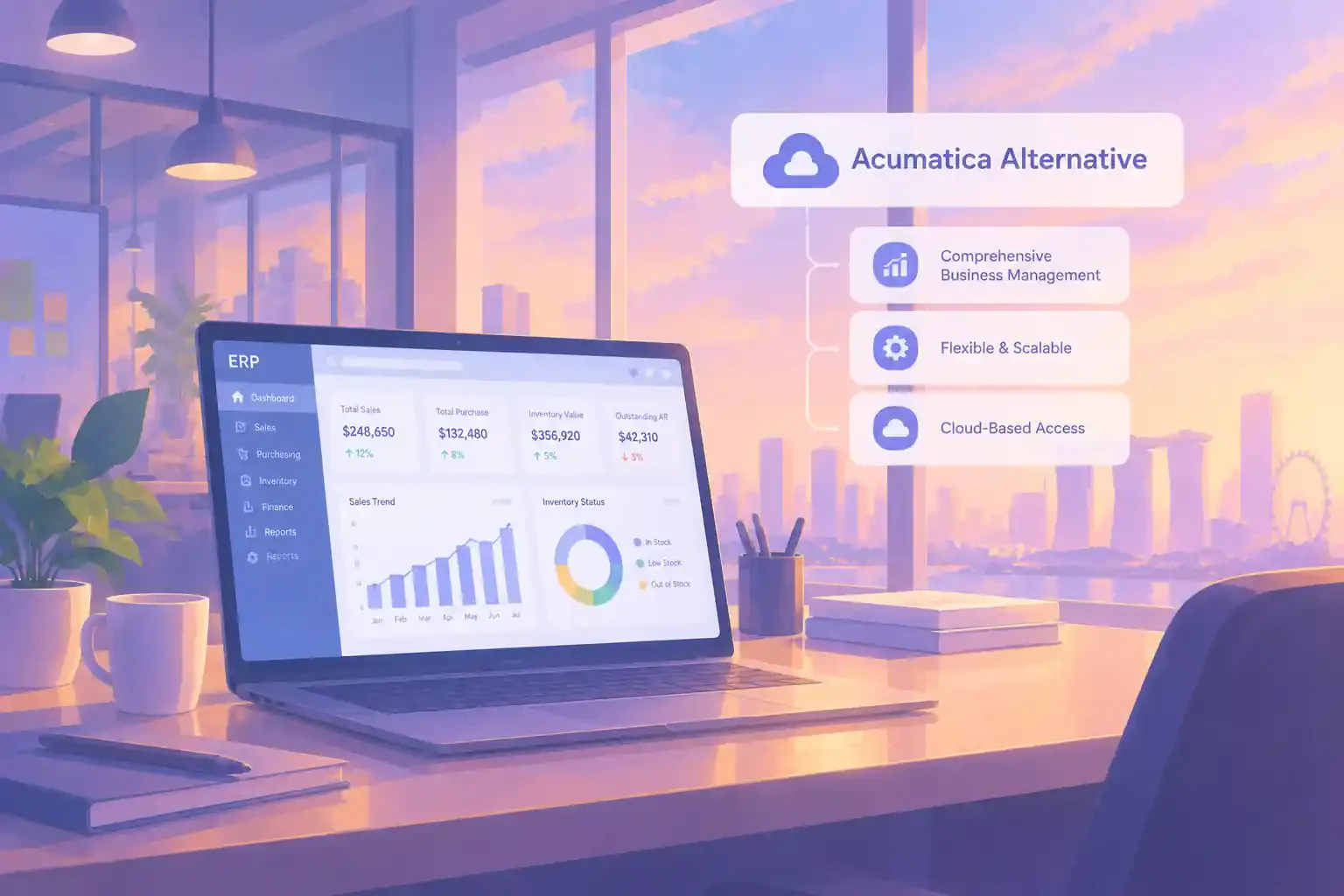








Key Takeaways
Infor ERP is an ERP software developed by Infor to help companies integrate main business processes.
The benefits of using Infor ERP include improved efficiency and reduced operational costs.
Despite its advanced features, Infor ERP has several drawbacks that need consideration.
HashMicro is one of the alternative software solutions to Infor ERP that can meet your business’s unique needs.
The verdict: choose the scope your business can control
ERP alternatives include ways to avoid full ERP adoption or replace an existing system. Retain accounting for a contained gap, phase adoption around available capacity, or replace connected functions together.
For businesses reviewing Infor ERP, begin with the required business scope. This comparison examines approaches rather than ranking vendors. SME owners, finance managers and operations leads can use the same evaluation method.
Keeping accounting depends on demonstrated data transfers and reliable reconciliation. Phased adoption requires an agreed ledger of record throughout coexistence. Full replacement needs clear ownership across the functions being replaced.
Start by identifying where work breaks down between departments. A purchasing gap may need a narrower response than disconnected sales, stock and finance records. Choose the approach your team can operate and control.
HashMicro supports master-data and open-document imports through templates, followed by reconciliation. Opening balances use imported journal entries. Assess those import steps against your proposed migration scope.
Compare three approaches to replacing disconnected systems
| Approach | Suitable trigger | Accounting system of record | Data handoffs | Migration scope | Implementation responsibilities | Cost components | Principal risk |
|---|---|---|---|---|---|---|---|
| Retain accounting and add operational tools | A defined inventory, order or purchasing gap | Existing accounting system | Demonstrated connector, scheduled files or scoped custom integration | Required master data and operational documents | Business owners approve mappings; providers configure transfers; finance reconciles | Subscriptions, setup, data work, integration maintenance and reconciliation | Unresolved transfers and duplicate entry |
| Adopt ERP in phases | Connected requirements with limited transition capacity | Agreed ledger of record during every phase | Defined transfers between retained and introduced functions | Master data, balances and outstanding documents for each phase | Named owners control shared records, balances, testing and phase acceptance | Subscriptions, implementation, migration, overlap and integration work | Conflicting records during coexistence |
| Replace the existing system with integrated ERP scope | Requirements spanning sales, inventory and finance | Replacement ERP ledger after accepted cutover | Configured workflows within the agreed replacement scope | Agreed records, balances and outstanding documents | Business and implementation teams share discovery through hypercare | Subscriptions, configuration, migration, training and transition work | Broad scope without sufficient business ownership |
A connector demonstration should show your actual document types. Scheduled file exchange needs separate arrangements for timing, failures and reconciliation. Custom integration needs its own scope, responsibilities and maintenance terms.
During phased adoption, assign ownership of shared master data and balances. For full replacement, cover discovery, fit-gap, configuration, migration, UAT, training, cutover and hypercare. A broader implementation still needs clean data and timely business decisions.

A worked SGD example: compare cost and control over three years
Consider a hypothetical Singapore distributor replacing disconnected sales, inventory and finance workflows. Every approach must handle the same required work. Compare each over 36 months.
All figures below are illustrative planning assumptions, excluding GST. They are neither vendor quotations nor market averages. They do not represent promised savings or typical implementation costs.
The required workflow covers quotation, order confirmation, delivery, invoicing and customer receipt. Each approach must also support agreed stock and accounting reconciliations. Holding these requirements constant makes the comparison useful.
Three-year total = one-off costs + 3 × annual recurring costs + 36 × monthly reconciliation hours × hourly cost. Annual recurring costs include subscriptions and separately billed integration maintenance. Internal reconciliation time uses an assumed hourly cost.
| Approach | Illustrative assumptions and calculation |
|---|---|
| Retain accounting | S$12,000 annual subscriptions; S$8,000 initial setup and data work; S$6,000 annual integration maintenance; 12 monthly reconciliation hours at S$40 per hour. Calculation = S$8,000 + 3 × S$18,000 + 36 × 12 × S$40 = S$79,280. |
| Phased adoption | S$18,000 annual subscriptions; S$18,000 combined implementation and migration; six monthly reconciliation hours at S$40 per hour. Calculation = S$18,000 + 3 × S$18,000 + 36 × 6 × S$40 = S$80,640. |
| Full replacement | S$24,000 annual subscriptions; S$30,000 implementation and migration; three monthly reconciliation hours at S$40 per hour. Calculation = S$30,000 + 3 × S$24,000 + 36 × 3 × S$40 = S$106,320. |
Separately billed integration maintenance is assumed to be zero for phased adoption and full replacement. This is an example assumption, requiring confirmation in actual quotations. The phased subscription covers every planned phase throughout the comparison period.
Five extra reconciliation hours each month add S$7,200 over three years. The calculation is 36 × 5 × S$40. A modest change in monthly workload can therefore change the cost comparison.
Request additional quote lines for upgrade work, downtime, training time and scope changes where applicable. Identify internal staff time separately from supplier charges. Explain any exclusions before comparing totals.
Apply the same migration acceptance check across every approach. S$250,000 in source receivables must reconcile to S$250,000 after migration. Resolve document-level exceptions before accepting the migrated position.
Matching totals alone do not establish record accuracy. Check customer identities, invoice references, outstanding amounts and receipt allocations. Offsetting errors could leave an apparently correct total.
Use comparable scope and actual quotations for your decision. This illustration establishes neither a cheapest option nor a superior approach. Cost and operational control need to be assessed together.
Retain accounting when the operational gap is contained
Retaining accounting can suit a clearly defined operational requirement. The existing ledger remains authoritative while another application handles the selected workflow. Its transfers must be demonstrated and reconciled.
The example totals S$79,280 over three years under its stated assumptions. That amount includes integration maintenance and internal reconciliation work. It is not a typical price for this approach.
Map record ownership before discussing transfer technology. Assign an authoritative application for customers, products, invoices, receipts and stock records. Specify who approves changes affecting another application's records.
Finance might own customer billing details within the accounting application. Operations might maintain product descriptions and stock movements elsewhere. Document how changes reach the other application without creating conflicting versions.
Require representative documents in the proposed transfer demonstration. Include a normal sale, partial delivery, invoice correction and receipt allocation. Follow each document through to the accounting record.
Distinguish API or connector evidence from scheduled file imports. File exchange needs clear schedules, validation and exception handling. A custom integration project also needs ownership when either application changes.
HashMicro's opening balances use imported journal entries. That migration route does not establish a connector to retained accounting software. Ask for a separately scoped demonstration of any proposed coexistence arrangement.
Compare the subscription price with the work surrounding it. Duplicate entry, failed transfers and unresolved differences belong in the operating assessment. Assign someone to review that workload after implementation.
Agree an exit condition before committing to this design. Reconsider it when reconciliation and exceptions exceed the team's agreed capacity. Also reassess when new requirements cross additional departmental boundaries.
Adopt ERP in phases when transition capacity is limited
Phased adoption sequences the transition around business capacity. Agree scope, ownership and acceptance evidence before each phase. The sequence should follow workable business boundaries.
The example totals S$80,640 over three years. Temporary subscription overlap, repeated migration and additional integration could change that result. Request these items explicitly when comparing actual proposals.
Begin with discovery and select the first workflow. Identify its dependencies on finance, stock records and retained applications. Avoid choosing a module solely because its demonstration looks straightforward.
Clean shared master data before trial imports begin. Resolve duplicate customers, inconsistent product codes and unclear ownership. Agree how approved changes will reach every application during coexistence.
Choose the ledger of record before processing live transactions. Specify which application holds authoritative balances and outstanding documents. Define how transfers reach that ledger and who checks them.
HashMicro imports master data and open documents through templates. Opening balances use imported journal entries, followed by reconciliation. Assess this process without assuming a dedicated legacy migration wizard.
Run trial imports before user acceptance testing. Reconcile imported records, balances and outstanding documents against the source. Give each difference an owner and a resolution date.
Train users on the complete phase workflow. Include exceptions, approvals and tasks remaining in retained applications. Conduct a controlled phase cutover after the agreed checks pass.
Use measured acceptance criteria before expanding the scope. Check completed transactions, unresolved exceptions and reconciliation workload. A successful first phase does not prove later modules are ready.
Keep subsequent phases visible in the commercial agreement. Confirm subscription coverage, repeated data work and responsibility for temporary transfers. This helps distinguish a staged transition from an indefinite coexistence arrangement.
Replace the full scope when workflows need shared controls
Evaluate integrated replacement when requirements span sales, inventory and finance. Shared controls may need to follow transactions across departmental boundaries. Assess that need against the effort required for the agreed scope.
The example totals S$106,320 over three years. Its higher assumed upfront cost must be assessed against required controls and actual quotations. It does not establish higher or lower operating costs elsewhere.
Use an end-to-end transaction during evaluation. Follow a quotation through order confirmation, delivery, invoice and receipt. Ask each department to explain its decisions and required records.
HashMicro's described flow checks the credit limit when confirming a sales order. It supports full or partial delivery and invoicing under the configured invoicing policy. Customer receipt and reconciliation complete that flow.
Test the required configuration using your own transaction conditions. Confirm what happens when delivery and invoicing occur separately. Include credit decisions and receipt allocation in the acceptance script.
Plan discovery, blueprint and fit-gap before configuration begins. Continue through migration, UAT, training and controlled cutover. Include hypercare and the first month-end within the agreed implementation scope.
The business must supply decisions, data owners and available key users. The implementation team needs agreed requirements and timely answers. Assign responsibility for each handoff between these groups.
Address unclear scope before adding more functionality. Resolve dirty master data before relying on migrated reports. Protect key users' time for testing and operational decisions.
Review customisation requests against the required business outcome. Ask whether configuration or an agreed process change would meet the need. Include maintenance and upgrade implications when custom work remains necessary.
Go-live begins live operational use rather than ending acceptance work. Review critical issues during hypercare and test the first month-end. Agree exit criteria without assuming a fixed implementation duration.

Apply Singapore GST and data-protection requirements to every option
Assess Singapore GST obligations across every proposed architecture. Check registration, tax invoices, transaction records and return preparation against IRAS GST guidance. Software selection does not remove the business's applicable obligations.
GST F5 filing is generally quarterly. Confirm the business's assigned accounting period and current deadlines using IRAS filing guidance. Do not treat quarterly filing as universal.
Reuse the distributor's Singapore sales workflow for the GST assessment. Trace its source document into the accounting record. Then follow the figures used for the applicable GST return.
Apply this test within the same illustrative SGD comparison. Identify who checks transaction classification and reconciles supporting records. Include any manual preparation work within the operational assessment.
Ask whether the proposal produces supporting reports, export files or direct submission. These are distinct capabilities requiring separate demonstrations. A report alone does not establish submission functionality.
Assess personal-data arrangements against PDPC guidance on the PDPA. Review protection, retention and overseas transfers where relevant. The PDPA requires reasonable protection and limits unnecessary retention.
Overseas transfers require protection comparable to the PDPA under applicable requirements. Review these arrangements through PDPC's data-protection obligations. Ask how the proposed hosting and support arrangements address them.
During evaluation, inspect user access, export permissions and account removal. Ask who manages retained copies and scheduled deletion. Treat these as practical questions within the wider legal assessment.
Require the same acceptance evidence before choosing
Choose scope using demonstrated workflows, clear ownership and comparable costs. Apply the same acceptance requirements across the shortlisted approaches. Agree thresholds and exception owners before testing starts.
Use the following measures to structure acceptance discussions. Set thresholds around your business requirements rather than assumed benchmarks. Keep record-based and balance-based migration measurements separate.
| Measure | Formula or count | Acceptance evidence |
|---|---|---|
| UAT pass rate | scenarios passed / scenarios run | Approved scenario results and owned exceptions |
| Data migration accuracy | reconciled records or balances / migrated | Separate record and balance reconciliation results |
| User adoption | active users / licensed users, transactions in ERP vs outside | User activity alongside transactions completed outside the chosen system |
| Critical hypercare tickets | open critical tickets per week | Critical issues, business impact and agreed resolution owners |
For record-based measurement, identify the migrated record population being reconciled. For balance-based measurement, document the migrated balances and their reconciliation. Do not combine unlike measurements into an unexplained score.
Active-user counts alone cannot establish completed adoption. Review transactions still handled in spreadsheets or retained applications. Decide whether that activity follows the agreed design or indicates unresolved work.
Require a trial migration before approving cutover. Reconcile individual records alongside opening balances and outstanding documents. Resolve critical exceptions against the source records.
For HashMicro evaluation, include partial delivery in the quotation-to-cash script. Follow it through invoicing, customer receipt and reconciliation. Check the configured invoicing policy against the required business outcome.
Review integration evidence separately from workflow fit. Inspect transfer results, rejected records, duplicate handling and reconciliation ownership. Obtain comparable implementation and recurring-cost quotations for the accepted scope.
Link each unresolved issue to a business owner. Record a decision date and its effect on acceptance. Use those results to choose scope without adding arbitrary vendor scores.
How to evaluate HashMicro for phased or full adoption
Evaluate HashMicro through a workflow demonstration and trial migration. Use the same documents and acceptance checks applied elsewhere. Keep the requested demonstration aligned with the proposed Singapore scope.
HashMicro imports master data and open documents through templates. Opening balances load through imported journal entries, followed by reconciliation. These steps do not establish a dedicated legacy migration wizard.
Its quotation-to-cash flow starts with a quotation and confirmed sales order. Confirmation includes a credit-limit check before full or partial delivery. Invoicing follows the configured policy, then customer receipt and reconciliation.
Use these flows to assess the integrated ERP system for Singapore businesses. A phased design still needs an agreed ledger of record. Scope any transfers between retained applications and the proposed ERP separately.
Bring representative master data, outstanding documents and transaction exceptions. Ask the team to demonstrate the complete path and reconciliation results. Request a scoped demonstration using your own workflow and migration sample.
Frequently asked questions about ERP alternatives
What are the alternatives to implementing a full ERP system?
Retain accounting with operational tools or introduce ERP in phases. Evaluate full replacement when connected requirements justify broader scope. Choose according to workflow boundaries, ownership and implementation capacity.
Require demonstrated controls for whichever approach you select. A narrower scope still needs reliable handoffs and reconciliation. A phased approach needs explicit ownership throughout coexistence.
Is retaining accounting software cheaper than replacing it with ERP?
It depends on the complete scope and operating workload. Compare subscriptions, setup, migration, integration maintenance and internal reconciliation over the same period. Use the worked example's method with comparable quotations.
Check exclusions before drawing a cost conclusion. Include temporary overlap and repeated data work where applicable. A subscription price alone cannot settle the comparison.
Can we introduce ERP while keeping our existing accounting system?
Potentially, with a scoped coexistence design and agreed ledger of record. Demonstrate transfers using representative transactions before committing. Separate scheduled imports from connectors and custom integration.
HashMicro's import process does not establish a ready-made third-party accounting connector. Assess the proposed connection as a separate requirement. Agree responsibility for failed transfers and reconciliation.
Can data from spreadsheets or a legacy system be migrated?
HashMicro supports template imports for master data and open documents. Opening balances use imported journal entries, followed by reconciliation. This does not establish a dedicated legacy migration wizard.
Prepare source records for trial imports and review exceptions. Check individual documents as well as reconciled balances. Agree acceptance before moving live work.
Do ERP alternatives still need to support Singapore GST requirements?
The business must meet applicable GST obligations regardless of software architecture. Check registration, invoices, records and filing periods against IRAS guidance. Verify reporting, export and submission capabilities separately.
Test the complete transaction path with your finance team. Identify any preparation steps remaining outside the chosen software. Assign responsibility for those steps and their checks.
Frequently Asked Questions
Infor ERP is enterprise resource planning software that integrates core business processes such as finance, supply chain, manufacturing, and human resources.
Infor ERP can connect business functions, improve data visibility, and support more efficient planning, reporting, and operations.
Potential disadvantages include software complexity, higher implementation and maintenance costs, and limitations in customization for some businesses.
Suitability depends on the business’s processes, budget, implementation capacity, and need for industry-specific functionality. A requirements and cost assessment should come first.
Businesses can compare Infor ERP with solutions such as HashMicro, Microsoft Dynamics 365, Oracle, and other ERP platforms based on features, fit, support, and total cost.