




As businesses grow, managing operations becomes more complex, especially when using manual methods or disconnected systems. Fragmented data and limited visibility can slow decision-making and reduce efficiency.
An enterprise solution helps address these issues by unifying core business functions into a single platform. This allows data to flow seamlessly across departments, improving coordination and operational control.
More than a management tool, an enterprise solution supports scalability and long-term growth. It enables businesses to adapt to change, maintain efficiency, and stay competitive as operations expand.
Key Takeaways
|
What Exactly Is an Enterprise Solution?
An enterprise solution is an integrated software system designed to manage and connect processes across an entire organization. Unlike standalone applications that handle only one function, it serves as a centralized platform that links multiple business operations into one system.
By unifying data and workflows, an enterprise solution eliminates information silos and provides a comprehensive view of company activities. This enables smoother coordination between departments such as finance, human resources, sales, and supply chain.
Acting as a single source of truth, an enterprise solution ensures data accuracy and consistency across the organization. It supports automation and creates a scalable foundation that helps businesses adapt to growth and changing market demands.
Why Enterprise Solutions Are Key to Modern Business Growth in 2026?
In today’s competitive market, speed, adaptability, and data-driven decision-making are critical to business success. Enterprise solutions provide a strong technological foundation that supports efficiency and scalability as operations grow more complex.
As transaction volumes, workforce operations optimization, and processes increase, manual systems and disconnected software become less effective. Enterprise solutions are built to scale, allowing businesses to add users and functionalities.
Beyond efficiency, enterprise solutions support digital transformation by automating routine tasks and providing real-time insights. This enables teams to focus on strategic initiatives, respond faster to market changes, and build a more agile and sustainable business.
Key Types of Enterprise Solutions You Should Know
Understanding the main types of enterprise solutions helps companies choose systems that align with their operational needs and long-term goals. While each solution serves a different purpose, many businesses now prefer integrated platforms that connect multiple functions.
1. Enterprise Resource Planning (ERP)
ERP systems integrate core business functions such as finance, inventory, procurement, manufacturing, and human resources into one platform. By enabling real-time data sharing across departments, ERP improves operational visibility, and reduces manual work
2. Customer Relationship Management (CRM)
CRM systems focus on managing customer interactions across sales, marketing, and service teams. They centralize customer data, helping businesses personalize communication, improve sales performance, and strengthen customer relationships.
3. Supply Chain Management (SCM)
SCM systems manage the flow of goods from suppliers to customers. They help optimize inventory, reduce logistics costs, improve delivery times, and increase visibility across the supply chain to respond quickly to demand changes.
4. Business Intelligence (BI)
BI systems analyze business data and present insights through dashboards and reports. These tools help organizations track performance, identify trends, and make data-driven strategic decisions.
As technology evolves, these solutions are increasingly combined into unified platforms. This integration reduces system complexity, improves data consistency, and enables more efficient cross-department collaboration.
The Strategic Benefits of Implementing an Enterprise Solution
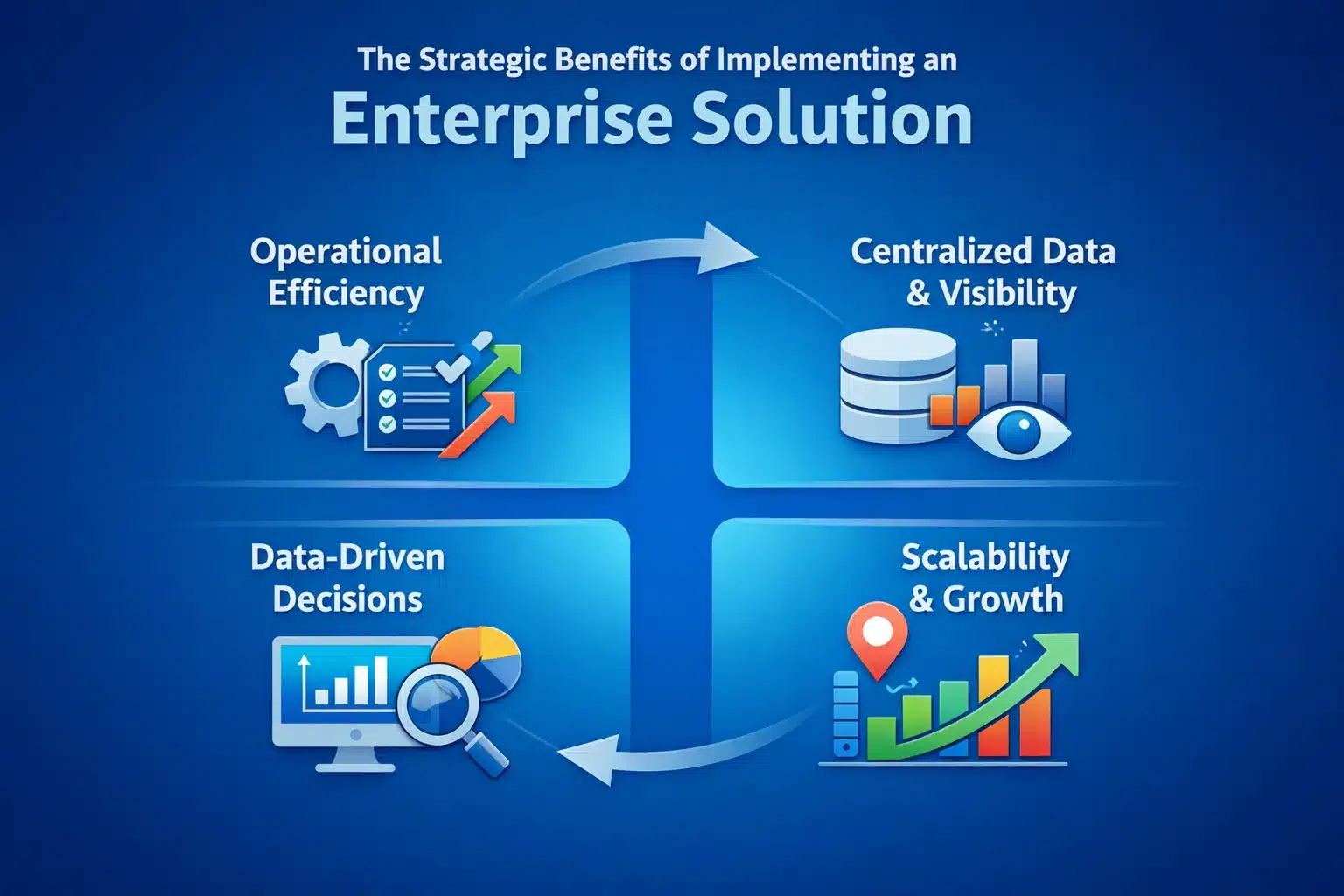
Adopting an enterprise solution delivers strategic value beyond administrative efficiency. It supports long-term competitiveness, innovation, and sustainable growth by improving how organizations operate and make decisions.
1. Increased operational efficiency and productivity
Enterprise solutions automate repetitive tasks and standardize workflows, reducing manual work and human error. This allows employees to focus on higher-value activities and improves overall productivity across departments.
2. Centralized data and visibility
By consolidating data into a single system, enterprise solutions eliminate information silos. Leaders gain real-time visibility into business workforce performance, ensuring decisions are based on accurate and consistent data.
3. Faster, data-driven decision-making
With integrated analytics and reporting tools, management can monitor KPIs, identify trends, and respond quickly to changes. Real-time insights support more confident and agile decision-making.
4. Scalability for business growth
Enterprise solutions are designed with a flexible and scalable architecture, meaning the system can easily adapt as the company grows. Whether it’s adding more users, expanding to new locations, launching new product lines, or handling increased transaction volumes.
A Guide to Choosing the Right Enterprise Solution for Your Business
Selecting an enterprise solution is a strategic decision that affects efficiency, profitability, and long-term competitiveness. It goes beyond choosing software and requires alignment with business goals, processes, and future growth plans.
1. Conduct a business needs analysis
Identify current challenges and objectives by involving stakeholders across departments. Map workflows, pinpoint inefficiencies, and prioritize essential features to guide the selection process.
2. Consider scalability and flexibility
Choose a solution that can adapt as the business grows, whether through expansion, additional users, or new processes, without disrupting performance.
3. Evaluate solution flexibility
Off-the-shelf systems offer faster deployment, while customizable solutions better fit unique workflows. The choice should reflect how specific and complex your operations are.
4. Ensure integration capabilities
Integration is critical in modern business environments. A study by MuleSoft highlights that integration challenges are a major barrier to digital transformation, making it essential to choose a solution that connects easily with existing systems through APIs.
5. Select a reliable implementation partner
The right partner provides industry expertise and end-to-end support, from implementation and training to ongoing assistance.
Involving users early through demos and evaluations improves adoption and ensures the solution supports daily operations. Treating this process as a long-term partnership helps maximize the value of the investment.

The Future of Enterprise Solutions: Trends to Watch
The enterprise solutions landscape is evolving rapidly as technology advances and business expectations change. Understanding these trends helps leaders ensure their technology investments remain relevant and competitive in the future.
1. Integration of artificial intelligence (AI) and machine learning
AI and machine learning are now core features in enterprise solutions, enabling predictive analytics, intelligent automation, and faster, more accurate decision-making across operations.
2. Growing cloud adoption
Cloud-based enterprise solutions continue to dominate due to lower upfront costs, remote accessibility, simplified maintenance, and flexible scalability through cloud-based subscription system.
3. Strong focus on user experience (UX)
Modern enterprise systems prioritize intuitive and user-friendly interfaces. Better UX improves adoption rates, shortens training time, and boosts productivity by reducing user errors.
4. Rise of industry-specific solutions
Enterprise platforms are increasingly tailored to specific industries, offering built-in workflows and compliance features that accelerate implementation and deliver faster value.
Conclusion
Enterprise solutions have become strategic assets that support efficiency, innovation, and sustainable growth in the digital era. By integrating processes and data, they help businesses remain agile and competitive in a rapidly changing market.
As operational complexity increases, a unified system becomes essential to maintain control and transparency across departments. It enables organizations to streamline workflows, reduce errors caused by fragmented data.
To begin this transformation effectively, businesses can start with a free consultation to evaluate their operational challenges and long-term growth plans. This initial step helps ensure the chosen enterprise solution aligns with business objectives.
Frequently Asked Questions
-
What is the main difference between an enterprise solution and regular business software?
The main difference lies in scope and integration. Regular business software typically serves a single function (e.g., only accounting), while an enterprise solution is an integrated platform covering various business functions (finance, HR, sales) in one unified system to eliminate data silos.
-
Are enterprise solutions only suitable for large companies?
Not anymore. While historically associated with large corporations, many providers, including HashMicro, now offer flexible and affordable solutions for small and medium-sized enterprises (SMEs). The cloud-based (SaaS) model allows SMEs to access advanced technology with a lower initial investment.
-
How is the ROI of an enterprise solution measured?
ROI is measured by comparing total benefits (both quantitative and qualitative) against the total investment cost. Quantitative benefits include cost savings from operational efficiency and increased revenue. Qualitative benefits include improved customer satisfaction and better decision-making.
-
How long does it take to implement an enterprise solution?
Implementation time varies greatly depending on project complexity, the number of modules implemented, the level of customization, and company readiness. Projects can take anywhere from a few months to over a year. An experienced partner is crucial for keeping the process on schedule.