













The food industry in Singapore is changing fast, and businesses must keep up to stay competitive. More people are ordering food online, and traditional restaurants are struggling with high rent and labor costs.
Ghost kitchens offer a solution by operating without dine-in spaces and focusing entirely on delivery. These kitchens allow businesses to expand quickly, reduce overheads, and reach a larger customer base. In Singapore, where space is expensive, this model provides an efficient way to run a profitable food business.
Key Takeaways
Ghost kitchens are delivery-only food prep spaces that cut costs and maximize efficiency. They let businesses focus on online orders, expand quickly, and adapt to changing customer preferences.
Ghost kitchens in Singapore have emerged as a practical response to a delivery-driven food culture and the rising cost of operating physical dine-in outlets.
The challenge of running a ghost kitchen in Singapore lies in managing platform commissions, building a strong brand without a physical storefront, maintaining food quality during delivery, and standing out in a crowded market
What Is a Ghost Kitchen?
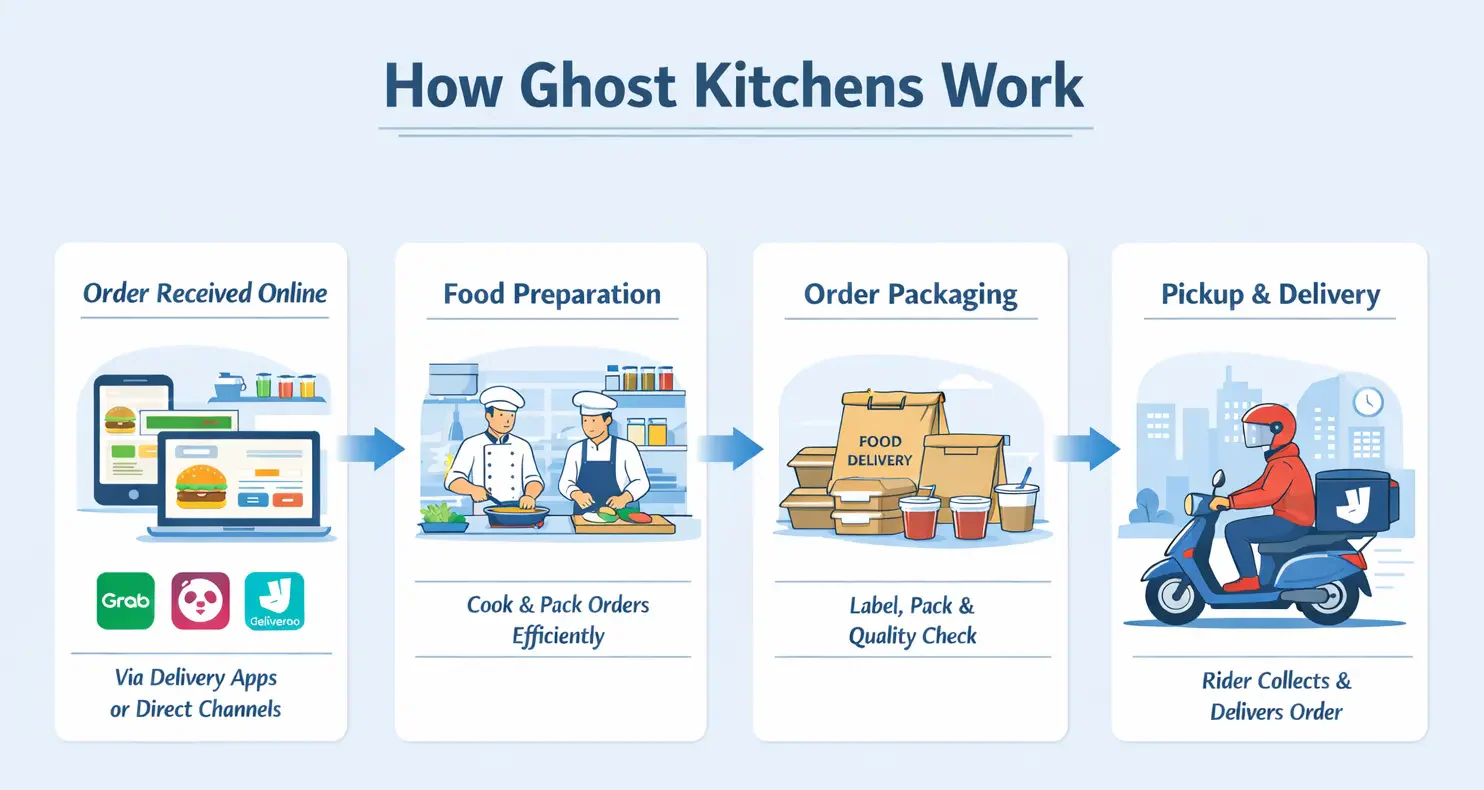
A ghost kitchen is a food production facility designed exclusively for delivery and takeaway orders, without a dine-in area for customers. Orders are received through online delivery platforms or brand-owned ordering channels, then prepared in a centralized kitchen space optimized for speed, consistency, and cost efficiency.
In Singapore, ghost kitchens have gained traction due to high commercial rental costs, dense urban demand, and the maturity of food delivery ecosystems. Rather than investing in storefront locations, operators use ghost kitchens to focus on menu execution, delivery reach, and operational scalability.
This model is commonly used by standalone delivery brands, multi-brand operators running several concepts from one kitchen, and established F&B businesses expanding into new areas without opening physical outlets.
Ghost Kitchen vs. Cloud Kitchen vs. Virtual Kitchen
| Aspect | Ghost Kitchen | Cloud Kitchen | Virtual Kitchen |
|---|---|---|---|
| Physical Location | Dedicated kitchen facility with no dine-in area | Centralized facility designed to host multiple brands or operators | No dedicated location; operates from an existing kitchen |
| Ownership Model | Usually owned or leased by a single operator | Often owned by a third-party provider leasing space to brands | Brand-based concept without owning kitchen infrastructure |
| Number of Brands | One or multiple brands under one operator | Multiple independent brands in shared infrastructure | Typically one brand, sometimes multiple concepts |
| Customer Presence | No customer-facing area | No customer-facing area | No customer-facing area |
| Primary Purpose | Fulfill delivery and takeaway orders efficiently | Enable scalable delivery operations at lower entry cost | Test or expand brands digitally with minimal investment |
| Operational Control | High control over kitchen layout and processes | Shared control; infrastructure standardized by provider | Limited control; depends on host kitchen setup |
| Cost Structure | Lower than dine-in restaurants, higher than virtual kitchens | Lower upfront cost, recurring rental/service fees | Lowest upfront cost, limited scalability |
| Typical Users | Delivery-first brands, F&B groups expanding locations | Startups, international brands, multi-brand operators | Restaurants launching delivery-only concepts |
| Common in Singapore | Yes, especially for delivery-focused F&B operators | Yes, often in industrial or shared kitchen hubs | Yes, widely used by existing restaurants |
Singapore’s Ghost Kitchen Market
Ghost kitchens in Singapore have grown in step with two realities: a delivery-first dining culture and high operating costs for dine-in concepts.
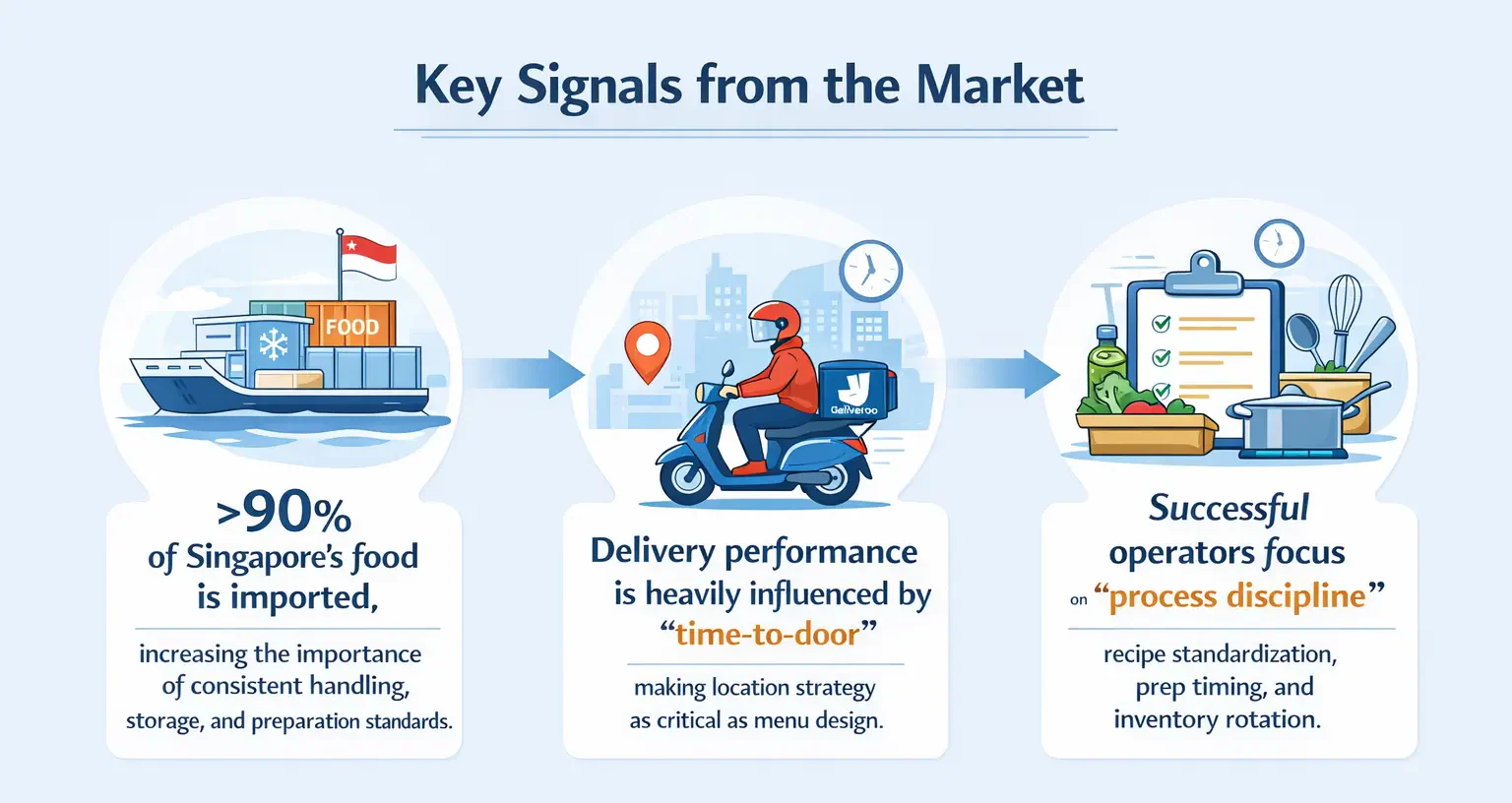
While market-size figures vary by paid research reports, the demand signal is clear: Singapore’s food ecosystem depends heavily on efficient, compliant, last-mile distribution, in a country that imports over 90% of its food supply.
Market Size and Growth
Singapore’s ghost kitchen market is best understood as part of the broader food delivery + foodservice supply chain rather than a standalone “kitchen rental” category. Growth is typically driven by:
-
Delivery order volume (more orders → more need for high-throughput production sites)
-
Brand portfolio expansion (one operator running multiple virtual brands from one kitchen)
-
B2B demand (centralized prep for outlets, caterers, and institutional buyers)
Why Ghost Kitchens Thrive in Singapore
Ghost kitchens work especially well in Singapore because they reduce the cost and complexity of launching and scaling:
-
High rents + limited space make dine-in footprints expensive, so operators shift capacity to production-focused sites.
-
Dense urban delivery routes improve unit economics, shorter travel distance means better time-to-door and fewer temperature deviations.
-
Multi-brand strategy is common: one kitchen can run several menus targeted at different demand windows (lunch bowls, tea-time snacks, late-night comfort food).
-
Compliance discipline matters: central kitchens make it easier to standardize food safety routines, labeling, and batch handling.
Use these Singapore-relevant signals (without overstating hard-to-verify “ghost kitchen market size” numbers):
Benefits of Adopting Ghost Kitchens
Running a ghost kitchen can significantly lower costs compared to traditional restaurant operations. Businesses save on rental fees, furniture, and large service teams, allowing them to allocate more budget to food quality and marketing.
Operational flexibility is another major advantage, as menus can be adjusted quickly based on customer preferences. Since ghost kitchens rely on online platforms, they can reach a wider audience without being limited to a single location. This model enables businesses to maximize sales while keeping expenses low.
Challenges and Considerations
While ghost kitchens lower entry barriers, they introduce a different set of operational and strategic challenges. In Singapore’s delivery-driven market, many of these issues stem from fragmented workflows and limited operational visibility, areas where a central kitchen system increasingly becomes part of the solution.
Platform Commission Impact
Food delivery platforms remain the main demand engine for ghost kitchens in Singapore, but commissions (often 20% to 35% per order) can quickly erode margins. The real challenge lies in understanding which menu items remain profitable after platform fees, discounts, and fulfillment costs.
Operators managing multiple brands often rely on centralized menu costing and performance tracking to monitor contribution margins by item and platform. With clearer visibility into food cost, packaging, and promotional impact, pricing decisions become data-led rather than reactive.
Brand Building Without a Physical Storefront
Without a dine-in presence, brand perception is shaped entirely through digital listings, food imagery, and delivery experience. In a crowded marketplace, inconsistent menus, delayed orders, or packaging errors can weaken brand trust almost immediately.
Central kitchen software helps standardize recipes, portion sizes, and prep instructions across outlets or kitchen locations. This consistency ensures that customers receive the same product experience regardless of where the order is fulfilled, an important foundation for long-term brand recognition.
Food Quality in Delivery
Not all dishes are delivery-friendly. Temperature drop, moisture buildup, and delayed dispatch can affect texture and presentation, leading to poor reviews even when demand is high.
Operators increasingly adapt menus based on hold-time data, batch preparation visibility, and dispatch coordination, often managed through a central kitchen system. When kitchen teams can track preparation timing alongside order volume, food is produced closer to dispatch, reducing quality loss during transit.
Competition in a Crowded Market
Singapore’s ghost kitchen ecosystem is highly competitive, particularly in popular segments such as fried chicken, Korean food, and rice bowls. Low setup costs mean new brands enter frequently, intensifying price pressure and promotion fatigue.
In this environment, sustainable operators focus less on rapid expansion and more on operational control. Centralized production planning, inventory visibility, and cross-brand resource allocation help kitchens operate efficiently without overextending staff or increasing waste, advantages that become critical when competition tightens.
Industry Insight: Central Kitchen Operations in Singapore
A Singapore-based delivery-first food operator managing multiple virtual brands faced rising food costs and inconsistent prep quality as order volumes increased.
By centralizing preparation and coordinating production through a central kitchen software, the team gained clearer visibility into ingredient usage, batch output, and per-brand performance.
The result was tighter cost control, more consistent food quality, and smoother peak-hour operations, without expanding kitchen space or headcount.
Steps to Establish a Ghost Kitchen in Singapore
Starting a ghost kitchen is mainly about building a smooth delivery operation, not opening a physical restaurant. Below is a simplified view of how most ghost kitchens in Singapore get started.
Phase 1: Planning
This stage is about testing the idea before spending money.
Operators usually begin by checking demand on delivery platforms like GrabFood or Foodpanda. The goal is to find cuisines, price points, or meal formats that customers are already searching for. At the same time, basic cost planning is done to make sure food costs, packaging, labour, and platform commissions still leave room for profit.
Planning also includes understanding SFA licensing requirements and deciding whether to use a shared kitchen or a private kitchen space.
Phase 2: Setup
Once the concept is clear, the focus shifts to execution.
This phase involves securing a licensed kitchen, sourcing ingredients, and setting up a workflow that supports fast and consistent food preparation. Menus are usually refined so dishes travel well and can be prepared efficiently during peak hours.
Operational tools are also set up here to manage orders, ingredients, and daily production, helping avoid delays or stock issues once orders start coming in.
Phase 3: Launch
The launch is usually done in stages.
Many ghost kitchens start with a soft launch on one or two delivery platforms. This allows operators to test preparation speed, order accuracy, and customer feedback before scaling up. Early data is used to adjust menus, pricing, or kitchen processes.
Marketing at this stage is typically focused on platform visibility rather than long-term brand building.
Timeline and Costs
In Singapore, a ghost kitchen can usually go from planning to launch within 4–8 weeks, depending on kitchen availability and licence approval.
Costs are lower than opening a full restaurant, but key expenses still include kitchen rent, equipment, initial ingredients, packaging, platform commissions, and staff wages. Long-term success depends on keeping operations efficient and adjusting quickly based on real order data.
Future Trends in the Ghost Kitchen Industry
The ghost kitchen landscape in Singapore is evolving beyond basic delivery efficiency. Operators are now focusing on long-term scalability, differentiation, and alignment with shifting consumer expectations.
Automation and artificial intelligence are becoming core enablers of this shift. Many kitchens are using data-driven tools to forecast demand, optimize preparation schedules, and reduce human error during peak periods. These technologies help kitchens maintain consistency and control costs in a labour-constrained environment.
Sustainability is also shaping operational decisions. Growing consumer awareness and tightening environmental standards are pushing ghost kitchens to adopt eco-friendly packaging, reduce single-use plastics, and minimize food waste. Packaging choices increasingly influence customer perception and repeat orders on delivery platforms.
Health-focused menus are gaining momentum as well. Singapore consumers are more attentive to nutritional value, ingredient transparency, and dietary preferences. Ghost kitchens that offer balanced meals, plant-based options, or clearly labeled nutritional information are better positioned to attract health-conscious customers and corporate catering demand.
Conclusion
Ghost kitchens are transforming the food industry, providing a cost-effective and innovative alternative to traditional restaurants. By leveraging technology, strategic planning, and customer insights, businesses in Singapore can streamline operations, cut expenses, and expand their market reach.
If you are looking to scale your F&B brand, now is the time to explore ghost kitchens with the right technology to stay ahead in Singapore’s competitive food delivery market. You can try a free consultation with our expert team to get insight about what your business needs in establishing the right solution.