





Procurement teams coordinate purchase requests, approvals, supplier information, purchase orders, receipts, and spending records every day. When these activities rely on email or spreadsheets, delays, incomplete records, and limited visibility can make cost control more difficult.
eProcurement software organizes these activities in a centralized digital workflow. For Philippine public procurement, the Philippine Government Electronic Procurement System (PhilGEPS) serves as the government’s primary electronic procurement portal. Businesses can also use eProcurement software to automate approvals, supplier management, purchase orders, receiving, and procurement reporting. The right solution depends on your approval structure, supplier processes, reporting requirements, integrations, budget, and implementation capacity.
This article compares 18 eProcurement software options available to businesses in the Philippines in 2026. Review their key features, strengths, limitations, pricing approach, and ideal use cases to identify the platform that best fits your purchasing process.
Key Takeaways
E-procurement is an essential tool that makes the procurement process quicker and saves money.
There are 6 benefits of procurement software that improve your business process.
There are 5 key features and 3 types of e-procurement in the Philippines.
As the best solution, you may consider HashMicro to be the top vendor. It provides you with comprehensive features and a free demo that is accessible starting today.
What is eProcurement Software?
eProcurement software is a digital platform that manages purchasing activities from requests and approvals to purchase orders, receipts, invoices, and payments. By keeping these records in one system, it helps procurement teams reduce manual work, improve accuracy, and monitor spending more effectively.
The software supports the procure-to-pay process by connecting purchase requests, supplier quotations, approvals, orders, receiving, and invoice matching. Automated workflows help route tasks to the right approvers and make each transaction easier to track.
Systems vary in scope. Dedicated platforms focus on sourcing and supplier management, EDI solutions exchange documents between trading partners, and ERP solutions connect procurement with finance, inventory, and other operations.
Businesses in the Philippines should consider their purchasing volume, approval structure, supplier processes, reporting needs, and required integrations when selecting an eProcurement solution.
Benefits of Electronic Procurement Software
After knowing what eProcurement software is, here’s a concise table that lists the benefits your business can gain from implementing this software in the Philippines.
| Category | Cloud ERP |
|---|---|
| Cost Savings | Reduces purchasing costs through streamlined processes and volume discounts. |
| Efficiency Improvements | Speeds up transactions and minimizes manual errors by automating routine tasks. |
| Enhanced Transparency | Improves oversight and accountability with real-time visibility into procurement. |
| Better Supplier Relationships | Strengthens partnerships through improved communication and management. |
| Compliance and Control | Ensures adherence to policies and regulations, enhancing control over spending. |
| Data-Driven Decisions | Enables informed decision-making with analytics and reporting tools. |
| Risk Reduction | Minimizes risks related to human error, fraud, and supplier non-compliance. |
| Scalability | Adapts easily to growing business needs without significant additional investment. |
Quick Comparison of the Best eProcurement Software
The following table compares 10 eProcurement platforms by their main capabilities and ideal use cases. Use it as a starting point, then review each platform’s pricing, integrations, implementation requirements, and availability in the Philippines.
| Software | Key Features | Best For |
|---|---|---|
| HashMicro Procurement | Purchase requests, approval workflows, RFQs, purchase orders, supplier management, inventory integration, and reporting | Philippine businesses seeking an integrated ERP procurement system |
| SAP Ariba | Strategic sourcing, supplier management, contract management, catalogs, and spend analysis | Large enterprises with complex supplier networks |
| Coupa | Procure-to-pay, spend management, supplier management, and business spend reporting | Mid-sized and large organizations focused on spend control |
| Oracle Procurement | Purchasing, sourcing, supplier qualification, contracts, and ERP integration | Enterprises already using Oracle applications |
| GEP SMART | Source-to-pay, spend analysis, supplier management, and procurement analytics | Global organizations requiring broad procurement coverage |
| Ivalua | Sourcing, supplier management, contract lifecycle management, and procure-to-pay | Enterprises with complex and highly configurable processes |
| JAGGAER | E-procurement, sourcing, supplier management, and contract management | Universities, healthcare organizations, and large institutions |
| Procurify | Purchase requests, approvals, budgets, purchase orders, and spend tracking | Small and mid-sized businesses |
| Precoro | Purchase requests, approval automation, purchase orders, budgets, and reporting | Growing companies that need straightforward procurement workflows |
| Odoo Purchase | Purchase orders, vendor management, RFQs, receipts, and integration with inventory and accounting | Businesses seeking a modular business management platform with purchasing tools |
18 Best eProcurement Software Philippines in 2026
As businesses in the Philippines look to streamline their procurement processes and enhance operational efficiencies, this software has become a critical tool for success. So here is a list of 18 best e-procurement examples in 2026 you need to know.
1. HashMicro
 HashMicro stands out as the leading e-procurement system provider in the Philippines, serving over 1750 clients with its highly customizable platform that meets the specific needs of various organizations. It provides a free demo that lets you know better about the system’s functionality.
You can sign up for its free consultation of HashMicro’s eProcurement management software and experience how HashMicro solutions can streamline your operations and reduce costs.
Dedicated to outstanding customer service, HashMicro AI procurement software ensures exceptional after-sales support, enhancing client satisfaction and optimizing software performance. Some of the key features HashMicro has are down below:
- Automatic vendor rating: Evaluates vendors automatically based on timeliness, cost-effectiveness, and delivery completeness, helping businesses partner with top-tier suppliers.
- Budget tracking & limit per purchase: Keeps a vigilant eye on expenditures and enforces established budgetary constraints per transaction to maintain fiscal discipline.
- Service work order tracking: Oversees service-based orders from inception to fulfillment, ensuring they are completed on time and according to specifications.
- Multi-purchase model: Accommodates various purchasing needs, from products and services to assets and rentals, enhancing procurement flexibility.
- In-depth purchase analysis: Provides detailed analytics on purchasing patterns, vendor preferences, and pricing, aiding strategic procurement decisions.
- Direct purchase management: Simplifies the direct purchase process, saving time and increasing efficiency for straightforward procurement tasks.
- OCR for RFQ: Employs Optical Character Recognition technology to automatically extract and process data from RFQ documents, increasing accuracy and processing speed.
| Strength | Weakness |
|---|---|
| Superior customizable user interface | The system implementation time varies, depending on your customization request |
| Seamless integration with ERP systems | Dedicated local support team |
| Free to add e-procurement users | Offers a free demo |
Pricing: HashMicro does not publish a fixed public rate. Contact the vendor for a custom quotation in Philippine pesos based on the modules, users, and implementation scope you need. A free demo is available.
See how HashMicro’s e-procurement software helps you control costs and improve efficiency, schedule a free demo to try it for yourself.
2. Jaggaer

Jaggaer offers a comprehensive electronic procurement system for educational institutions, government entities, and large enterprises.
Key Features:
- Strategic sourcing: Manages RFQs, supplier bids, and evaluations in one workflow.
- Supplier management: Centralizes supplier profiles and performance information.
- Spend analytics: Helps teams review purchasing patterns and identify sourcing opportunities.
| Strength | Weakness |
|---|---|
| Comprehensive coverage of the entire e procurement system. | Can be overly complex for small to medium-sized enterprises. |
| High-level of automation for procurement tasks. | Initial integration with existing systems can be challenging. |
| Strong support for compliance and risk management. | The interface is robust but can be overwhelming for new users. |
| Customer support is reliable but response times may vary during peak periods. |
Pricing: Request a quotation in Philippine pesos based on your organization’s users, modules, integrations, and implementation requirements.
3. Precoro
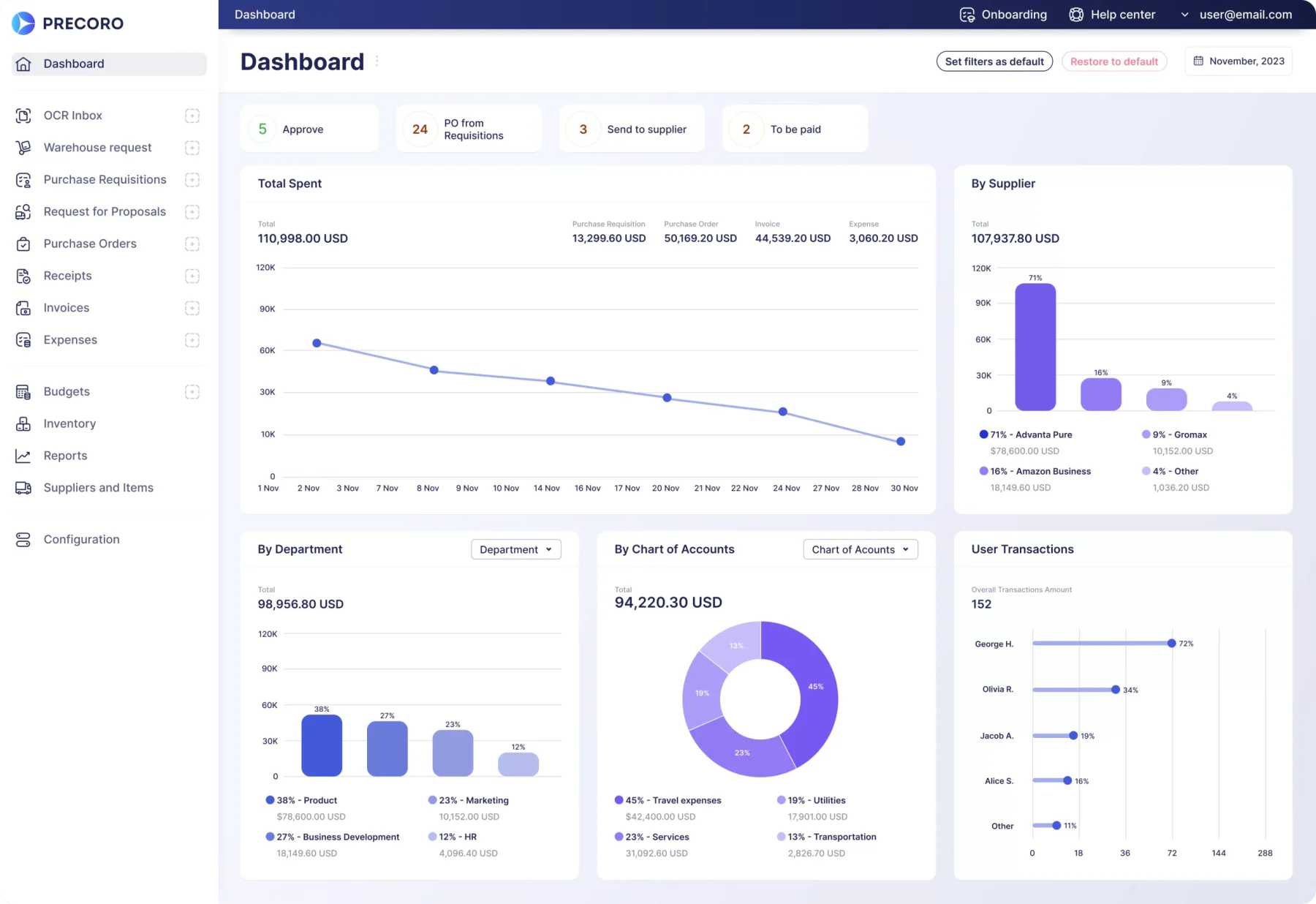
Precoro is an electronic procurement system vendor that simplifies purchasing and spending management for companies across various industries. This cloud-based platform is particularly effective in helping businesses reduce manual tasks and enhance transparency in e procurement software activities.
Key Features:
- Purchase requests: Lets employees submit purchasing needs through guided forms.
- Approval workflows: Routes requests and orders according to the company’s approval rules.
- Budget controls: Shows available budgets and helps prevent purchases above set limits.
| Strength | Weakness |
|---|---|
| Intuitive UI design, efficient expense reporting system. | Limited integration options with other platforms. |
| Strong customer support during local business hours. | Features can be overwhelming for new users. |
| Automated workflow capabilities for streamlined processes. | The mobile app lacks some features that are available on the desktop version. |
| Customer support response times can be slow during non-business hours. |
Pricing: Precoro’s published plans convert to approximately ₱31,500 per month for Core and ₱63,000 per month for Automation, before taxes and discounts.
4. Zycus
 Zycus eProcurement software Philippines is renowned for its ability to cater to the strategic needs of procurement with a robust and flexible system. This vendor offers applications that facilitate supplier management to contract lifecycle management and procurement intelligence.
Key Features:
- Guided buying: Directs employees toward approved purchasing options.
- Supplier management: Organizes supplier information and procurement interactions.
- Spend analytics: Analyzes purchasing data to support cost and compliance decisions.
| Strength | Weakness |
|---|---|
| Advanced analytics tools for in-depth procurement insights. | Complex initial setup process. |
| High configurability to suit various business needs. | The user interface can be unintuitive for first-time users. |
| Strong global supplier management system. | Occasional glitches in user interface updates. |
| Limited customization options for smaller enterprises. |
Pricing: Request a Philippine-peso quotation that includes the selected procurement modules, supplier network, integrations, and implementation services.
5. Kissflow

With its user-friendly interface, Kissflow allows companies to manage purchase requests, send purchase orders, conduct supplier management, and control spending under a single unified platform.
Key Features:
- Purchase requisitions: Captures employee requests before an order is placed.
- Supplier catalogs: Lets buyers select items from supplier catalogs.
- Contract management: Keeps purchasing agreements accessible within the procurement workflow.
| Strength | Weakness |
|---|---|
| A user-friendly interface facilitates easy adoption. | Mobile application performance is inconsistent. |
| Good workflow automation that simplifies processes. | Requires frequent updates to maintain functionality. |
| Responsive customer service for troubleshooting. | Can experience slowdowns with complex data sets. |
| Some integrations require manual adjustments. |
Pricing: Request a custom quotation in Philippine pesos; additional implementation and professional services may be priced separately.
6. Syspro
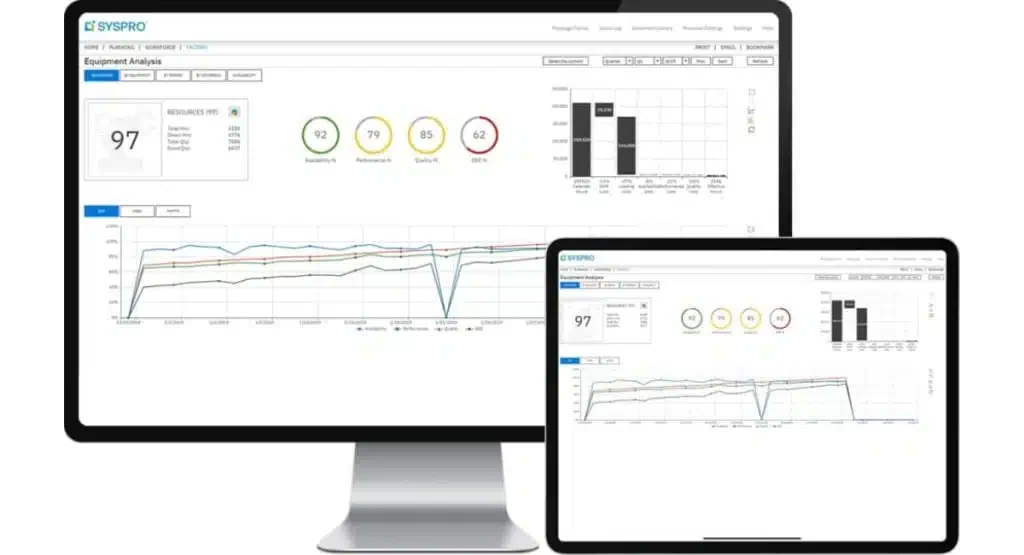
Syspro helps streamline procurement processes by automating the requisition-to-purchase order cycle and improving supplier collaboration.
Key Features:
- Requisition approvals: Routes purchase requests through configurable approval levels.
- RFQ management: Converts approved requests into supplier quotations for comparison.
- Supplier management: Tracks supplier details, contracts, and performance.
| Strength | Weakness |
|---|---|
| Integrated ERP features enhance overall functionality. | Complex user interfaces can deter new users. |
| Strong reporting capabilities for procurement data. | Integration with non-ERP systems can be challenging. |
| Reliable customer support with industry-specific expertise. | The setup process can be lengthy and requires technical knowledge. |
| Limited mobile functionality compared to the desktop version. |
Pricing: Pricing is quotation-based and normally depends on users, ERP modules, deployment, and support, so request a proposal in Philippine pesos.
7. SeaProc

SeaProc, a cloud-based e-procurement platform, is particularly tailored for the maritime industry. It connects ship operators with suppliers worldwide, facilitating the efficient management of maritime sourcing and procurement.
Key Features:
- Maritime RFQ distribution: Sends vessel purchasing requests to selected suppliers.
- Quote comparison: Collects supplier responses so buyers can compare offers.
- Fleet system integration: Exchanges RFQs, purchase orders, updates, and invoices with fleet management systems.
| Strength | Weakness |
|---|---|
| Tailored specifically for the maritime industry. | Niche focus limits applicability for non-maritime businesses. |
| Efficient management of maritime sourcing and procurement. | The user interface is not as intuitive as competitors. |
| Robust vendor management features. | Customization options are limited, restricting flexibility. |
| Customer support, while knowledgeable, can have slow response times. |
Pricing: Maritime operators should request a custom Philippine-peso quotation based on vessels, users, supplier connectivity, and selected modules.
8. TraceOne

TraceOne focuses on the retail and private label industries’ unique needs by providing an e procurement software platform that enhances transparency and collaboration between retailers and suppliers.
Key Features:
- Product lifecycle management: Organizes private label product information from development onward.
- Supplier collaboration: Helps retailers and suppliers exchange product specifications.
- Compliance tracking: Supports the review of product information against relevant requirements.
| Strength | Weakness |
|---|---|
| Specialized in retail and private label industries. | Limited utility for industries outside of retail and private labels. |
| Enhances collaboration between retailers and suppliers. | Complex features that require a steep learning curve. |
| Provides compliance tracking to meet industry standards. | Integration with external systems can be cumbersome. |
| Support is focused on large enterprises, smaller businesses may struggle to get timely help. |
Pricing: Request a Philippine-peso quote covering product lifecycle, supplier collaboration, compliance, users, and implementation.
9. Zoho

Zoho procurement software simplifies the process of purchasing by automating workflows, managing suppliers, and maintaining a central repository for all procurement documents.
Its integration with Zoho’s financial and CRM apps helps connect purchasing data across departments. For a closer look at its purchase order and inventory capabilities, read our Zoho Inventory review.
Key Features:
- Purchase requests: Lets employees submit and track requests for goods or services.
- Request for quotes: Invites vendors to submit bids before a purchase order is issued.
- Vendor portal: Gives suppliers access to their RFQs, orders, invoices, and payment status.
| Strength | Weakness |
|---|---|
| An extensive suite of integrated business apps enhances utility. | Occasionally complex for users unfamiliar with Zoho’s ecosystem. |
| User-friendly interface with customizable dashboards. | Some advanced features require a steep learning curve. |
| Reliable customer support with extensive online resources. | Performance can lag when integrating multiple Zoho apps. |
| Updates and new features sometimes disrupt existing setups. |
Pricing: Request a current quote in Philippine pesos for the required edition, users, add-ons, and billing term.
10. Digital Purchase Order (DPO)

Focused on creating a hassle-free e procurement system process, DPO is particularly well-suited for small to medium-sized businesses that need a straightforward approach to managing their purchases.
Key Features:
- Purchase order creation: Uses customizable forms to capture order details and attachments.
- Mobile approvals: Lets approvers review purchase orders by email or mobile app.
- Budget management: Tracks spending against budgets and applies rules to over-budget requests.
| Strength | Weakness |
|---|---|
| Highly accessible and easy to use for quick deployments. | Lacks advanced features found in more comprehensive systems. |
| Mobile-friendly design is suitable for on-the-go management. | The interface feels basic for users requiring more detailed information. |
| A streamlined approval process enhances efficiency. | Limited customization options restrict its use in complex environments. |
| Some users report slow response times from customer support. |
Pricing: DPO does not publish a standard public peso price. Ask the vendor for a Philippine-peso quotation based on the number of users, approval workflows, transaction volume, and support level.
11. ProcurEngine

ProcurEngine provides features like e-sourcing, e-tendering, contract management, and supplier relationship management. This vendor is designed to accommodate the needs of various sectors, including manufacturing, healthcare, and education.
Key Features:
- Competitive sourcing: Runs structured RFQs and electronic auctions.
- Supplier management: Keeps supplier records connected to sourcing and purchasing activity.
- Contract and invoice workflows: Links sourcing decisions to contracts, orders, and invoices.
| Strength | Weakness |
|---|---|
| Provides a robust suite of e-sourcing and e-tendering tools. | The interface can be complex for newcomers. |
| Effective contract management and supplier relationship management. | Some features may require additional training to utilize fully. |
| Advanced analytics capabilities for deeper insights. | Integration with third-party systems can sometimes be problematic. |
| Customer service is effective but can be delayed during high-demand periods. |
Pricing: Request a Philippine-peso proposal that covers e-sourcing, e-tendering, contracts, supplier management, integrations, and implementation.
12. TendersOnTime

TendersOnTime is a global platform that provides information on tenders, public procurement notices, project information, and procurement news. It helps businesses find new opportunities by accessing a vast database of global and local tenders.
Key Features:
- Tender search: Helps suppliers find published procurement opportunities.
- Tender alerts: Sends notices matched to selected countries, sectors, and keywords.
- Deadline tracking: Displays key notice details so teams can prioritize bids.
| Strength | Weakness |
|---|---|
| Offers a wide range of global and local tender information. | Focused more on information provision than full procurement management software. |
| Useful for businesses looking to expand into new markets. | Interface and search functions can be cumbersome and unintuitive. |
| Provides support services like document procurement and consultancy. | Lacks deep integration capabilities with procurement systems. |
| Support services are helpful but can be inconsistent in responsiveness. |
Pricing: Request the current plan price in Philippine pesos for your target countries, users, and alert coverage.
13. Odoo
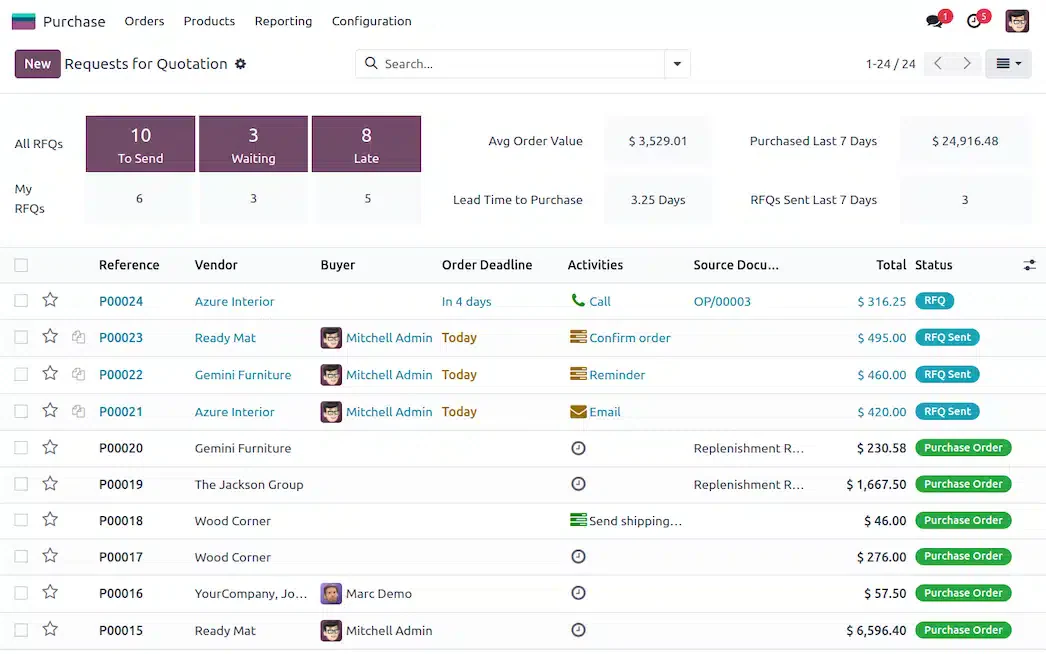 The e-procurement system within Odoo allows for seamless management of purchase orders, vendor contracts, and receipts. It provides automation capabilities for repetitive tasks, such as automatic reordering and invoice matching. For more details about its ERP capabilities, see our Odoo ERP review.
Key Features:
- Requests for quotations: Creates and sends RFQs to suppliers.
- Automated reordering: Generates purchasing activity based on stock rules.
- Three-way matching: Compares purchase orders, receipts, and vendor bills before payment.
| Strength | Weakness |
|---|---|
| Comprehensive integration with other Odoo business applications. | Can be resource-intensive, requiring robust hardware for optimal performance. |
| User-friendly interface with extensive customization options. | The complexity of features can overwhelm new users without proper training. |
| Excellent customer support with a wide network of professionals. | While versatile, it may require additional modules for complete functionality. |
| Updates can sometimes introduce bugs that temporarily disrupt business processes. |
Pricing: Odoo’s public plans convert to approximately ₱1,570 per user per month for Standard and ₱3,090 per user per month for Custom, before taxes, localisation, and implementation.
14. Expenzing

Expenzing offers tools to streamline e procurement system processes, enforce spending policies, and achieve compliance. Key features include strategic sourcing, contract management, and expense management.
Key Features:
- Strategic sourcing: Manages RFIs, RFPs, RFQs, and supplier selection in a structured workflow.
- Contract management: Connects sourcing decisions with supplier agreements.
- Expense management: Records employee expenses and routes them for approval.
| Strength | Weakness |
|---|---|
| Specializes in cost control and expense management. | The interface may lack intuitiveness compared to more modern solutions. |
| Strong capabilities in managing indirect spending and travel expenses. | Setup can be involved, requiring time to configure to specific needs. |
| Responsive customer service tailored to financial operations. | Integration with other non-financial systems can be challenging. |
| May require frequent updates to maintain security and functionality. |
Pricing: Pricing is customised around modules, users, integrations, deployment, and support, so request a Philippine-peso quotation.
15. CobbleStone
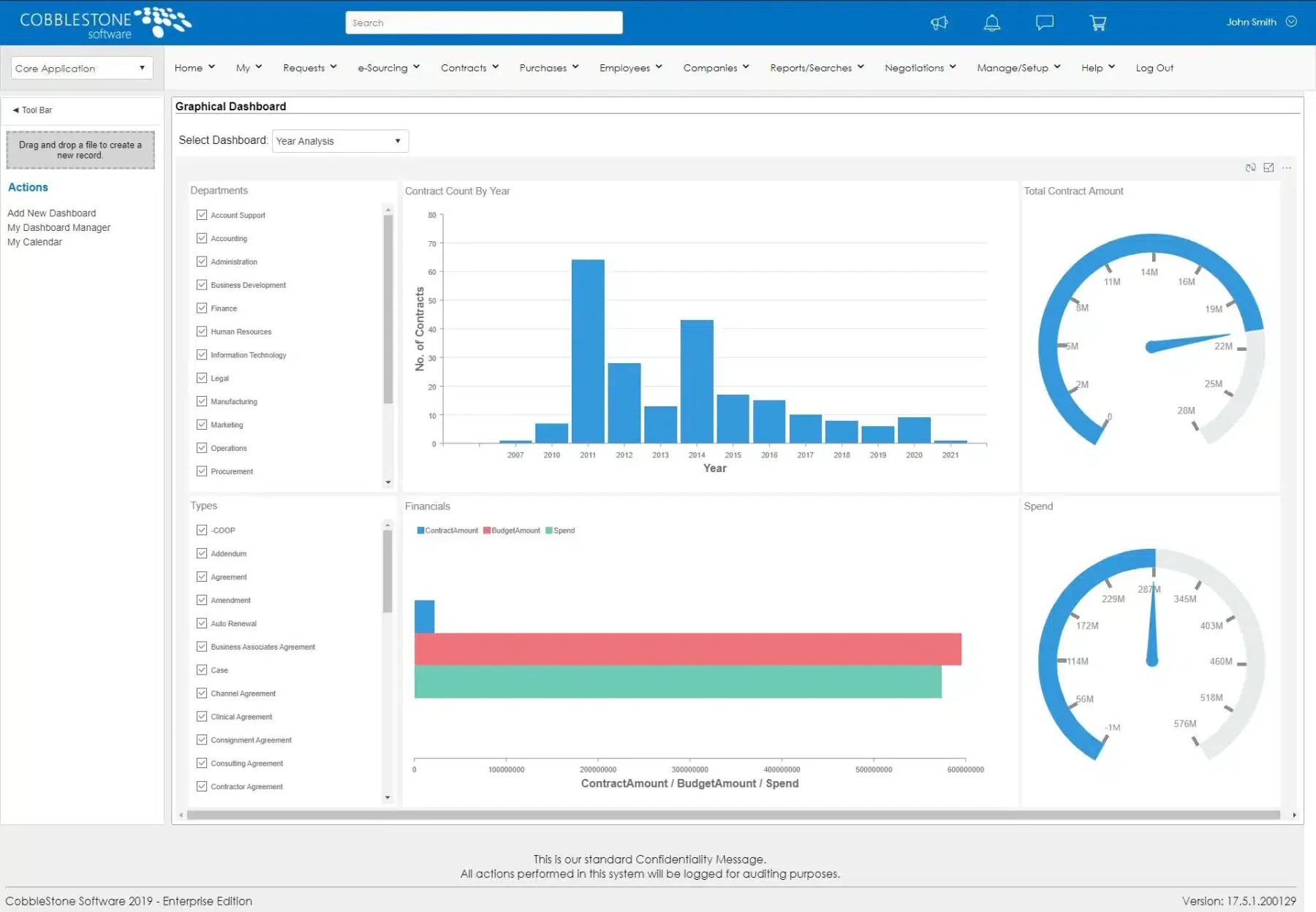
Cobblestone’s e procurement software functionality seamlessly integrates with the contract management process, ensuring that purchasing decisions are aligned with existing agreements and terms.
The software is ideal for organizations that manage many contracts and require a comprehensive system to maintain oversight and control over their procurement strategies.
Key Features:
- Purchase requisitions: Captures purchasing needs before orders are created.
- Approval workflows: Routes requests according to the organization’s purchasing rules.
- Contract-linked order tracking: Tracks purchase orders against contract terms and amounts.
| Strength | Weakness |
|---|---|
| Advanced contract lifecycle management integrated with e-procurement. | The interface may not be as modern or intuitive as newer market entrants. |
| Strong compliance and monitoring features ensure contract adherence. | Initial setup and customization can be complex and resource-intensive. |
| Offers a wide range of features for comprehensive management. | Smaller organizations might find the system too robust and difficult to navigate. |
| Customer support, while knowledgeable, can have slower response times. |
Pricing: Request a Philippine-peso quote based on contract volume, procurement scope, users, integrations, and implementation services.
16. SAP Ariba
 SAP Ariba offers a comprehensive suite of tools including procurement, sourcing, supply chain collaboration, and spend analysis. This enables companies to manage their procure-to-pay processes more efficiently, from sourcing goods and services to finalizing payments. Businesses comparing SAP solutions can also read our SAP Business One review.
Key Features:
- Strategic sourcing: Supports supplier discovery, bidding, evaluation, and award decisions.
- Contract management: Tracks agreements and helps teams follow negotiated terms.
- Guided buying: Directs employees toward preferred suppliers and purchasing policies.
| Strength | Weakness |
|---|---|
| Comprehensive procurement and supply chain management. | A complex system with a steep learning curve for new users. |
| An extensive global supplier network facilitates broad collaboration. | Time-consuming initial setup and integration. |
| Advanced analytics for strategic decision-making. | Resource-intensive, requiring significant IT support. |
| Strong compliance and risk management tools. | Feature-rich platforms may overwhelm smaller organizations. |
Pricing: SAP Ariba uses custom enterprise pricing and does not publish one standard peso rate. Request a Philippine-peso quotation that separates subscription, supplier-network, integration, and implementation costs.
17. Coupa
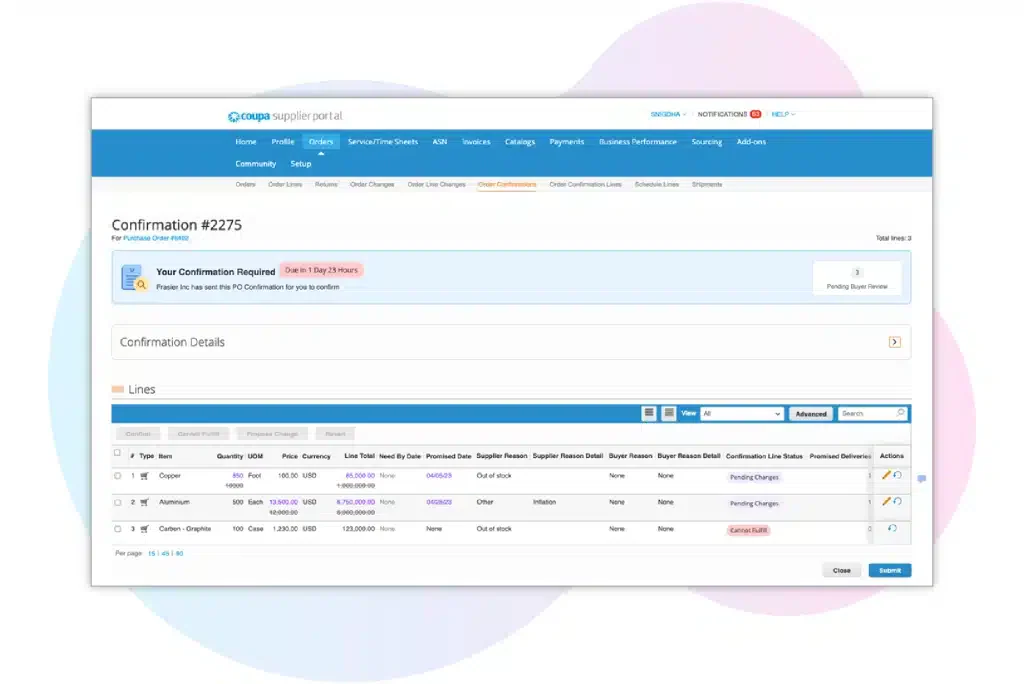
Coupa is a global leader in business spend management and offers a comprehensive e-procurement solution that delivers measurable value across procurement, invoicing, and expense management.
Key Features:
- Purchase requisitions and approvals: Routes requests for review before orders are placed.
- Purchase order management: Tracks orders and receipts throughout the purchasing process.
- Invoice processing: Connects invoices to purchasing records for review and approval.
| Strength | Weakness |
|---|---|
| Unified platform for managing business spending across procurement, invoicing, and expenses. | The breadth of features can be daunting for small teams without dedicated training. |
| Real-time visibility into spending data enhances decision-making. | Integration can be extensive, requiring significant IT support. |
| Strong analytics and reporting tools aid in proactive spend management. | Occasionally, the system may face performance issues with large data sets. |
| Updates are frequent, which while improving features, may disrupt ongoing work. |
Pricing: Ask for a Philippine-peso proposal based on spend scope, users, modules, integrations, and implementation services.
18. GEP Smart
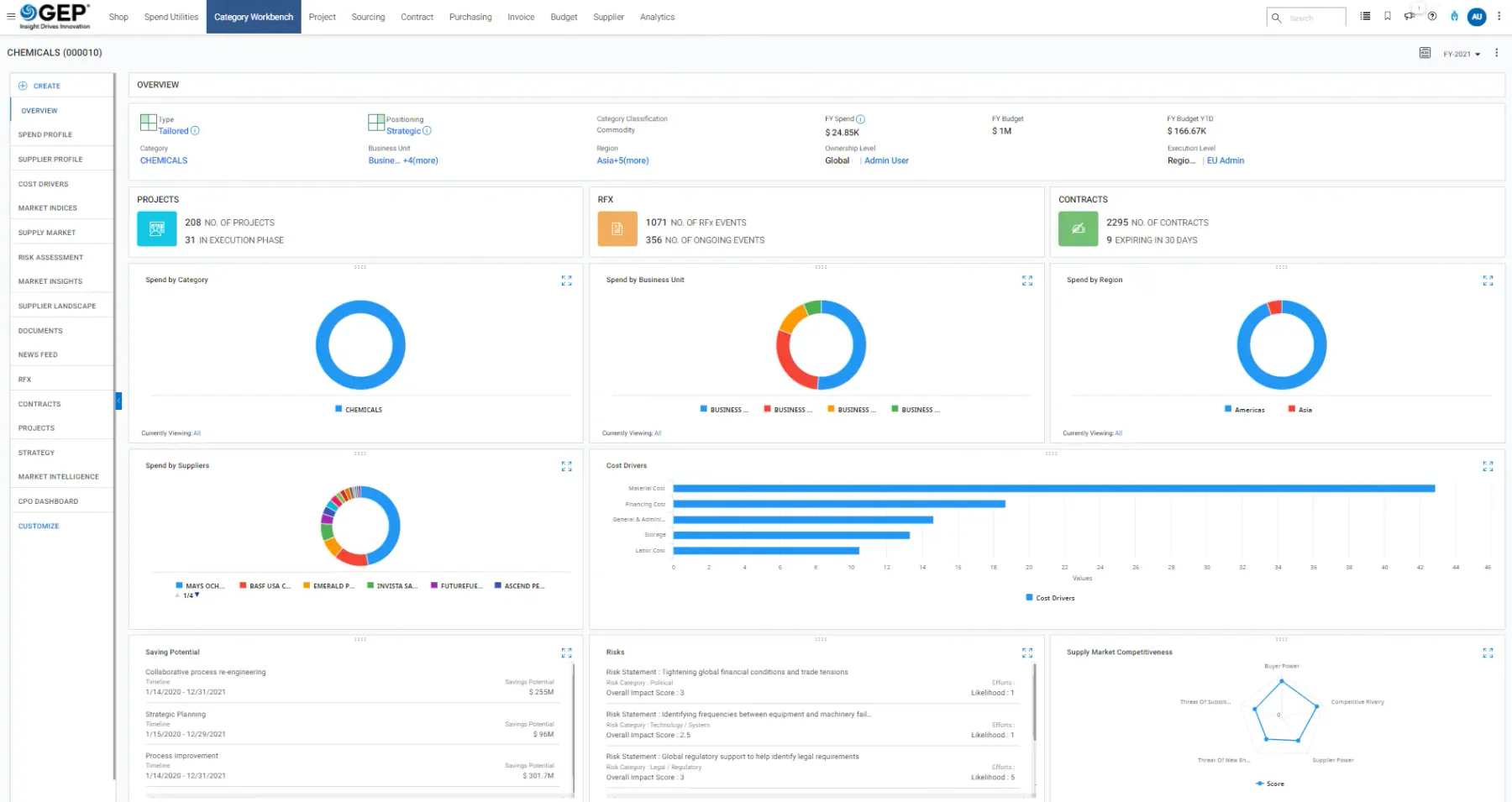 GEP Smart employs advanced AI technologies to automate and optimize procurement tasks, providing insights that help businesses make smarter, faster purchasing decisions.
Its comprehensive suite of tools is designed to meet the needs of large enterprises and complex procurement environments, offering scalability and high configurability.
Key Features:
- Spend analysis: Examines purchasing data to identify savings opportunities.
- Sourcing and supplier management: Supports supplier selection and performance monitoring.
- Procure-to-pay: Connects purchasing, purchase orders, and invoice management.
| Strength | Weakness |
|---|---|
| Cloud-native solution offering comprehensive direct and indirect procurement functionalities. | Can be cost-prohibitive for smaller businesses due to its comprehensive nature. |
| Uses advanced AI technologies for optimizing procurement tasks. | The user interface, while powerful, can be complex for average users. |
| Strong support for scalability and customization. | Integration with older systems can sometimes present challenges. |
| Customer support is robust but may not always be swift in peak times. |
Pricing: Request a Philippine-peso quote covering source-to-pay modules, users, integrations, analytics, and implementation.
How to Select the Best eProcurement Software for Your Business

Choose eProcurement software based on your purchasing volume, approval structure, supplier relationships, integration needs, reporting requirements, and budget. The platform should support your current workflow while remaining flexible as your business grows.
Required Features
- Purchase requisition management: Lets employees submit purchase requests with required details, budgets, and supporting documents.
- Automated approval workflows: Routes requests to the correct approvers based on department, amount, project, or purchasing category.
- Supplier management: Stores supplier profiles, contact details, documents, quotations, and performance records in one place.
- Request for quotation management: Helps teams send RFQs, compare supplier offers, and manage the request for quotation process before selecting a supplier.
- Purchase order management: Converts approved requests or quotations into purchase orders and tracks order status.
- Receiving and invoice matching: Records delivered goods and compares receipts with purchase orders and invoices to reduce discrepancies.
- Spend reporting: Provides visibility into purchasing activity, supplier spending, budgets, and approval performance.
- System integrations: Connects procurement with accounting, inventory, warehouse, finance, and other business systems.
Also evaluate the software’s usability, security, implementation process, customer support, scalability, and total cost of ownership before making a final decision. For another vendor shortlist, see our Philippine procurement software comparison.
Conclusion
In conclusion, while there are numerous eProcurement software options available in the Philippines, each with its unique set of strengths and challenges, HashMicro stands out as the best e-procurement system.
Given its comprehensive capabilities, HashMicro not only leads in functionality but also in user satisfaction. If you are interested in experiencing firsthand how HashMicro can transform its procurement operations, this vendor offers a free consultation.
This free demo allows you to explore the various features and benefits of our eProcurement software, ensuring that you can make an informed decision tailored to your specific business needs.
FAQ About eProcurement Software
An e-procurement system is a digital platform that automates every stage of the procurement cycle, from supplier selection and purchase requests to approvals, purchase orders, and invoicing.
The main types of e-procurement include procurement software that automates purchasing workflows, EDI systems that digitize document exchange such as POs and invoices, and ERP platforms that integrate procurement with finance, HR, and supply chain for complete organizational visibility.
Yes, ERP systems include built-in procurement modules, making them a type of procurement software. However, ERP goes further by integrating procurement with other core operations like finance, inventory, and supply chain management.