






Long lead times can create costly problems for Philippine businesses. When overseas orders arrive late, businesses may hold excess buffer stock or face stockouts. Production can also be delayed and rushed shipping may be needed to cover shortages. These delays make it harder to plan purchasing and manage inventory accurately.
The challenge is greater in the Philippines logistics performance because imported goods and inter-island shipping schedules can add delays. Goods may take longer to reach warehouses in Cebu, Davao, or other areas. Lead times can also change based on the supplier, location, season, and shipping conditions.
This article explains lead time, its types and formula, and five ways Philippine businesses can reduce delays. It also covers how inventory systems can track lead times across suppliers and locations.
Key Takeaways
Lead time covers the full process from placing an order to receiving goods ready for use or sale.
The main types of lead time cover different stages, from supplier processing and manufacturing to delivery and customer fulfillment.
The lead time formula combines each stage to calculate the total time from ordering to receiving goods.
What Is Lead Time?
Lead time is the total time from placing an order with a supplier, manufacturer, or warehouse to receiving goods that are ready to use or sell. It covers every step from order processing and production to customs clearance and final delivery. Shipping time alone is not lead time.
Lead time is the total time that passes from the moment you place an order — whether to a supplier, a manufacturer, or a warehouse — until the goods are in your hands and ready to use or sell. It spans every step between request and receipt: order processing, production where applicable, customs clearance, and final delivery. Shipping time alone is not lead time.
For Philippine businesses, lead time can vary due to the country’s archipelago geography and logistics infrastructure. Even a local supplier may take five to seven days to deliver across islands. Knowing the exact lead time helps businesses order at the right time without tying up cash in excess stock or risking stockouts before replenishment arrives.
Lead Time Meaning Across Business Contexts
Lead time means different things depending on where you stand in the supply chain. The term is the same; the clock starts and stops at different points.
Lead time means different things depending on where you stand in the supply chain. The term is the same, but the clock starts and stops at different points.
In Supply Chain Management
In supply chain management, lead time measures the gap between a purchase order being placed with a supplier and the moment that inventory arrives at your receiving dock. Supply chain managers track this figure per supplier and per SKU, because it directly anchors when to reorder.
A supplier consistently running two days past their quoted lead time is not a minor inconvenience, it is a systematic miscalculation baked into every reorder point in the system.
In Manufacturing
In manufacturing, lead time covers the full production cycle: from the moment raw materials are requisitioned to the moment the finished product is ready to ship. A food processor in Bulacan building ready-to-eat meals would count the time from ingredient sourcing through processing, packing, and quality inspection before a single unit leaves the facility.
In manufacturing, lead time covers the full production cycle: from the moment raw materials are requisitioned to the moment the finished product is ready to ship. A food processor in Bulacan building ready-to-eat meals would count the time from ingredient sourcing through processing, packing, and quality inspection before a single unit leaves the facility.
In Inventory and Retail
For retailers and FMCG distributors, lead time typically refers to the supplier-to-warehouse window: how many days after you submit a purchase order before stock is physically on your shelves. Philippine food and beverage distributors deal with this constantly. A supplier in Laguna may quote three days, but when you factor in order confirmation delays and provincial trucking, actual lead time often stretches to five or six. The gap between quoted and actual lead time is where most stockouts are born.
For retailers and FMCG distributors, lead time typically refers to the supplier-to-warehouse window. A supplier in Laguna may quote three days, but when you factor in order confirmation delays and provincial trucking, actual lead time often stretches to five or six. The gap between quoted and actual lead time is where most stockouts are born.
Lead Time vs. Cycle Time
Cycle time is the time it takes to complete one repetition of a specific internal process. Lead time is the total elapsed time a customer or buyer experiences, from request to delivery. Cycle time is one component inside lead time, it is never equal to it. A company can have a short cycle time (efficient packing team) and still have a long lead time (slow supplier fulfillment).
Types of Lead Time
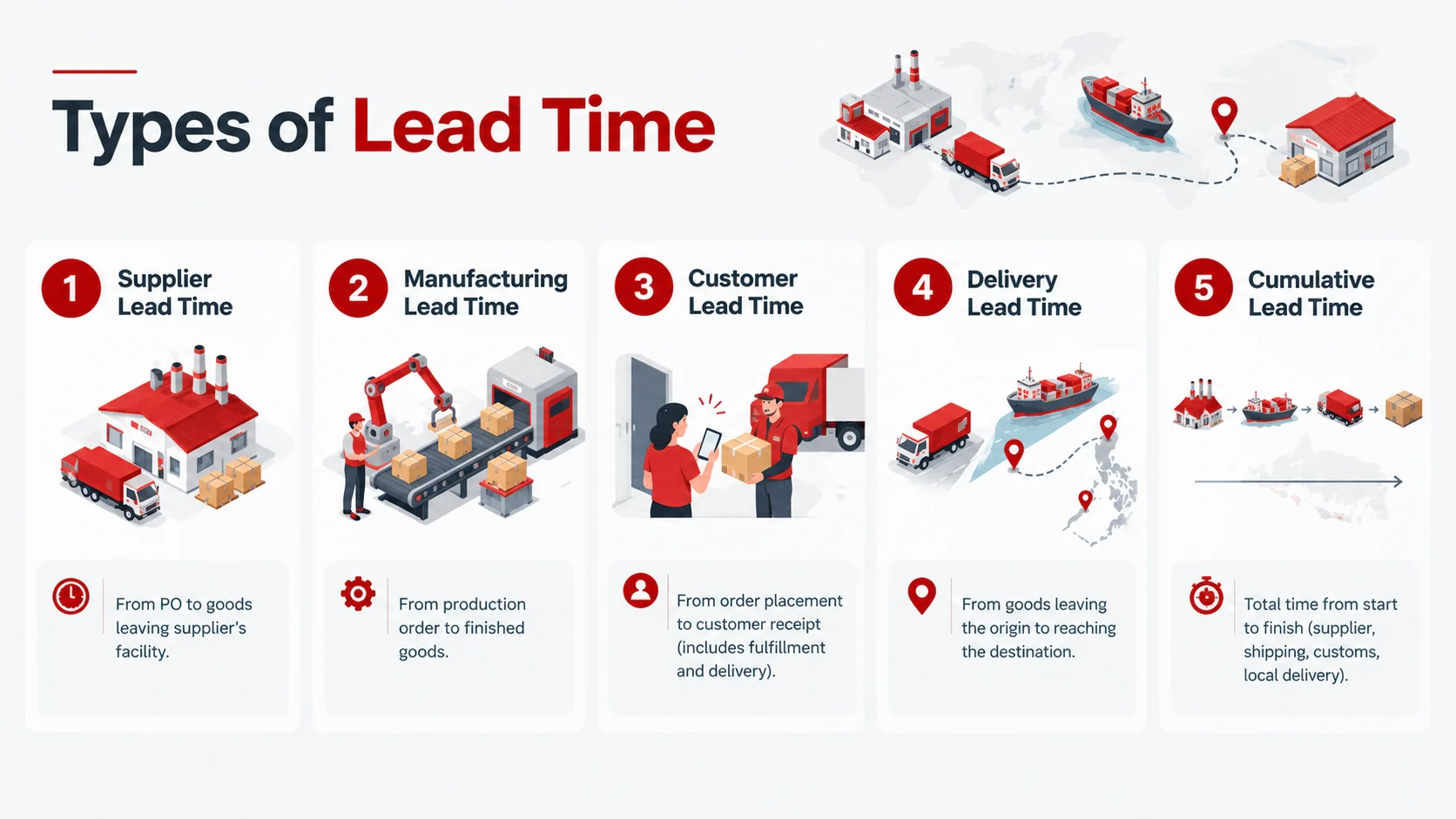
Lead time consists of several parts. Each one covers a different stage of the supply chain and can be managed by different teams.
Supplier Lead Time
Supplier lead time is the time from when a supplier receives your purchase order until the goods leave their facility. It can vary based on the SKU, order volume, and the supplier’s production schedule. Tracking this time helps businesses set more accurate reorder points.
Manufacturing Lead Time
Manufacturing lead time is the time needed to turn a production order into finished goods. It applies to businesses that manufacture their own products, such as food processors, garment manufacturers, and contract packagers. Knowing this time helps businesses plan production and meet customer orders.
Customer Lead Time
Customer lead time is the time from when a customer places an order until they receive it. It includes fulfillment and delivery time. Businesses need to consider both when setting realistic delivery promises and managing customer expectations.
Delivery Lead Time
Delivery lead time is the time from when goods leave the origin until they reach the destination. In the Philippines, it can vary by route. Land routes are often more predictable, while sea routes between Luzon, Visayas, and Mindanao can be affected by vessel schedules, weather, and port congestion.
Cumulative Lead Time
Cumulative lead time is the total time needed to source or produce a product from start to finish. It can include supplier production, international shipping, customs processing, and local delivery. For Philippine importers, sea freight from China or Taiwan to Manila can take 14–28 days, while customs processing may add one to three weeks. This figure helps businesses plan safety stock more accurately.
How to Calculate Lead Time (Formula + Example)
Lead time is easier to manage when each stage is measured separately. The formula below combines these stages to show the total time from placing an order to receiving the goods.
Lead Time Formula
The standard lead time formula is:
Lead Time = Order Processing Time + Production or Manufacturing Time + Delivery Time
For a purely purchased item (no internal manufacturing involved):
Lead Time = Supplier Processing Time + Shipping and Transit Time
For a full end-to-end supply chain view:
Total Lead Time = Pre-processing Time + Processing Time + Post-processing Time
Pre-processing covers everything before active work begins: order review, approval routing, queue time. Processing is the active fulfillment or production work. Post-processing is handoff, packing, and transit.
Philippine Worked Example
A beverage distributor in Metro Manila sources bottled water from a supplier in Laguna. Here is a realistic, step-by-step lead time calculation:
| Step | Duration |
|---|---|
| Purchase order review and approval (internal) | 1 day |
| Supplier order confirmation | 1 day |
| Production and bottling run | 2 days |
| Quality inspection and packing | 1 day |
| Trucking: Laguna → Metro Manila | 1 day |
| Total lead time | 6 days |
The distributor orders 5,000 cases at ₱85 each, worth ₱425,000 per order. If the actual lead time is six days but the team plans for four, the reorder comes two days late. At 400 cases per day, this creates a shortage of 800 cases and around ₱14,400 in lost contribution margin at ₱18 per case. Repeated mistakes can create significant losses over time.
Lead Time and Reorder Point: Why They're Inseparable
Lead time is meaningless in isolation. Its practical purpose is to anchor your reorder point, the inventory level at which you must place a new purchase order to avoid running out before the next replenishment arrives.
The reorder point formula is:
Reorder Point = (Average Daily Demand × Lead Time) + Safety Stock
Using the example above: if the distributor sells 400 cases per day and lead time is six days, the reorder point is 2,400 cases plus whatever buffer the safety stock calculation adds to cover demand spikes and lead time variability. If lead time is underestimated by even one day, the reorder point drops by 400 cases and every order cycle carries a stockout risk.
This is the direct mechanical link: an inaccurate lead time produces an inaccurate reorder point, and an inaccurate reorder point produces stockouts, regardless of how well the rest of the inventory system is managed. For a full walk-through of how to set this trigger level, refer to the reorder point formula guide.
This is why operations teams in Philippine distribution companies treat lead time as a live, measured figure, not a rough estimate from a supplier's sales sheet. It belongs in the system, updated with every completed delivery.
What Causes Long Lead Times? (Including Philippine Context)
Lead times are not always fixed. Identifying the cause of each delay helps businesses find where they can reduce waiting time and improve replenishment planning.
Supplier and Procurement Delays
Slow purchase order approvals, late orders, and manual procurement processes can add days before suppliers even start processing. Supplier delays can also occur when production capacity is limited or order volumes are higher than expected. Tracking supplier lead times helps businesses identify recurring delays and plan around them.
Port, Customs, and Logistics
For Philippine importers, port and customs processing can add unexpected delays. Congestion at major ports such as the Port of Manila and MICP can increase waiting times during busy periods. Customs inspections may also add days depending on the shipment and its contents.
Inter-island shipping can create additional delays. RORO routes depend on fixed vessel schedules, while typhoons from June to November can disrupt shipments. Businesses serving Luzon, Visayas, and Mindanao should track lead times by route instead of relying on one national average.
Poor Demand Forecasting
Poor demand forecasting can cause businesses to reorder too late. Waiting until stock is almost empty leaves little time for replenishment and increases the risk of stockouts. Accurate sales forecasts help businesses place orders earlier and use lead time data to plan purchasing more effectively.
5 Proven Ways to Reduce Lead Time

Reducing lead time requires action across suppliers, procurement, logistics, and inventory planning. The following five strategies can help businesses shorten delays and keep replenishment more predictable.
1. Diversify Your Supplier Base
Single-supplier dependency is the fastest path to unpredictable lead times. When your only approved supplier runs late, your effective lead time extends indefinitely. Philippine businesses that maintain two or three qualified suppliers for their highest-volume SKUs can route orders to whichever supplier has available capacity and the shortest lead time on a given week.
Relying on one supplier can make lead times unpredictable. Philippine businesses can work with two or three qualified suppliers for high-volume SKUs. This gives them more options when a supplier faces delays or limited capacity.
2. Automate Reorder Triggers
Manual reorder processes introduce two to five days of delay before the supplier's lead time clock even starts. Automated reorder triggers, set at the calculated reorder point, eliminate that window. When stock falls to the threshold, the system generates the purchase order draft and routes it for approval without waiting for a human to notice the level drop. For businesses running hundreds of active SKUs, this is not an efficiency gain.
Manual reordering can add two to five days before a supplier even starts processing an order. Automated reorder triggers can create purchase order drafts when stock reaches the reorder point. This helps businesses reorder on time and avoid unnecessary delays.
3. Improve Demand Forecasting Accuracy
Lead time is only as useful as the demand forecast it is paired with. A business that knows its six-day lead time but cannot forecast weekly demand within ±20% will still carry too much or too little stock. Improving forecast accuracy using historical sales data, seasonal indices, and promotional calendars converts lead time from a defensive number into a precision planning tool.
Lead time planning depends on accurate demand forecasts. Using historical sales, seasonal trends, and promotional schedules helps businesses estimate future demand and plan orders more accurately.
4. Optimize Safety Stock Levels
Safety stock helps protect against changes in demand and lead time. Many Philippine SMEs either carry too little and face a high stockout risk or keep too much and increase carrying costs. Using actual lead time data helps businesses set a more suitable safety stock level.
5. Use Real-Time Inventory Tracking
Businesses need accurate stock data to manage lead time effectively. Real-time tracking provides a current view of current stock levels, open purchase orders, and expected stockouts. This allows teams to act before inventory runs out.
How Inventory Management Software Helps Manage Lead Time
Inventory management software cannot shorten a supplier’s production schedule. However, it can reduce avoidable delays and give businesses better visibility into lead time data.
A purpose-built inventory management system can help Philippine businesses manage lead time in three ways.
- First, it records lead times by supplier and SKU. This helps businesses calculate reorder points based on actual lead times instead of using one general estimate. If a supplier consistently delivers later than expected, the data can be used to adjust purchasing plans.
- Second, it automates purchase orders. When stock reaches the reorder point, the system can generate a purchase order for approval. This reduces delays caused by manual order processing and helps businesses reorder on time.
- Third, it tracks lead time performance. Businesses can compare actual delivery times with supplier estimates and identify recurring delays. This creates a reliable history that can support better safety stock and purchasing decisions.
For businesses managing multiple SKUs across warehouses in different Philippine regions, accurate lead time tracking can prevent missed reorders and reduce avoidable stockouts.
Conclusion
Lead time is a practical tool for Philippine businesses looking to manage inventory without tying up too much working capital. When tracked by supplier, route, and SKU, it helps businesses make better reorder decisions and reduce the risk of stockouts.
The five strategies covered in this guide work best together. Supplier diversification reduces supply risk, automated reorder triggers prevent manual delays, and better demand forecasting supports timely purchasing. Right-sized safety stock can also control carrying costs, while real-time inventory tracking keeps lead time data accurate and visible.
For businesses looking to improve lead time tracking, HashMicro’s inventory management software helps monitor suppliers, automate reorder points, and track inventory across locations. Schedule a free demo to see how it works.

FAQ about Lead Time
Cycle time measures the duration of one internal process repetition, such as picking and packing a single order. Lead time is the total elapsed time experienced by the buyer, from request to delivery. Cycle time is one component inside lead time. A short cycle time does not guarantee a short lead time if supplier or transit delays dominate the total.
Reorder Point = (Average Daily Demand × Lead Time) + Safety Stock. A longer lead time requires triggering replenishment earlier, which means holding more inventory at any given time. Lead time variability increases the required safety stock buffer. An inaccurate lead time produces an inaccurate reorder point and increases stockout risk regardless of other inventory controls.
Common causes include slow internal PO approval workflows, supplier capacity constraints, port and customs processing delays (especially relevant for Philippine importers), inter-island logistics variability, and reactive rather than planned ordering driven by poor demand forecasting.
Inventory software stores per-supplier lead time records for accurate reorder point calculations, automates purchase order creation at the reorder trigger to eliminate manual pre-processing delays, and tracks actual vs. promised lead time by supplier, giving procurement teams the data to identify chronically late suppliers and adjust safety stock accordingly.