







From business owners to operations teams, they face the same pressure every time a major purchase lands on the table. That is buying new equipment, another branch, a system upgrade, or a warehouse expansion. A study of Philippine manufacturing firms found that reliance on payback period rather than NPV or IRR leaves debt-heavy balance sheets exposed for years.
Capital budgeting is the process businesses use to evaluate, compare, and approve long-term investments such as equipment purchases, expansion projects, new facilities, or technology upgrades. The real challenge is not whether the company can afford the investment today, but whether the project will generate enough future value to justify its cost.
Structured evaluation methods, cash flow projections, and consistent approval criteria close that gap, turning large spending decisions into measurable financial cases. A disciplined process helps companies fund projects that deliver real returns, not ones that only look attractive. This article covers what capital budgeting is, why it matters, its formulas, process, common mistakes, and how software supports investment planning.
Key Takeaways
Capital budgeting helps companies evaluate long-term investments before committing funds.
Discount each year's cash flow at your required rate, total them, then subtract the initial investment cost.
Common methods include NPV, IRR, payback period, profitability index, and ARR.
Accounting software supports capital budgeting by improving budget visibility, approvals, expense tracking, and reporting.
What Is Capital Budgeting
Capital budgeting is the process businesses use to evaluate, compare, and approve long-term investments. These investments usually require significant funds and are expected to deliver benefits across more than one accounting period. In simple terms, capital budgeting answers one question: is this investment worth the cost?
Common capital budgeting examples include buying machinery, building or upgrading facilities, opening a new store, expanding warehouse capacity, purchasing fleet vehicles, and funding technology upgrades such as ERP business software. Each of these commits cash today in exchange for returns the company expects to earn over several years.
It differs from daily expense planning because it deals with long-term assets that shape future performance. Capital budgeting decisions are most effective when integrated into a company's broader financial budgeting process, ensuring long-term investments align with annual financial targets. That is why companies follow a defined capital budgeting process and apply capital budgeting methods such as payback period, net present value, and internal rate of return to weigh potential returns against risk before releasing funds.
The Importance of Capital Budgeting for Businesses
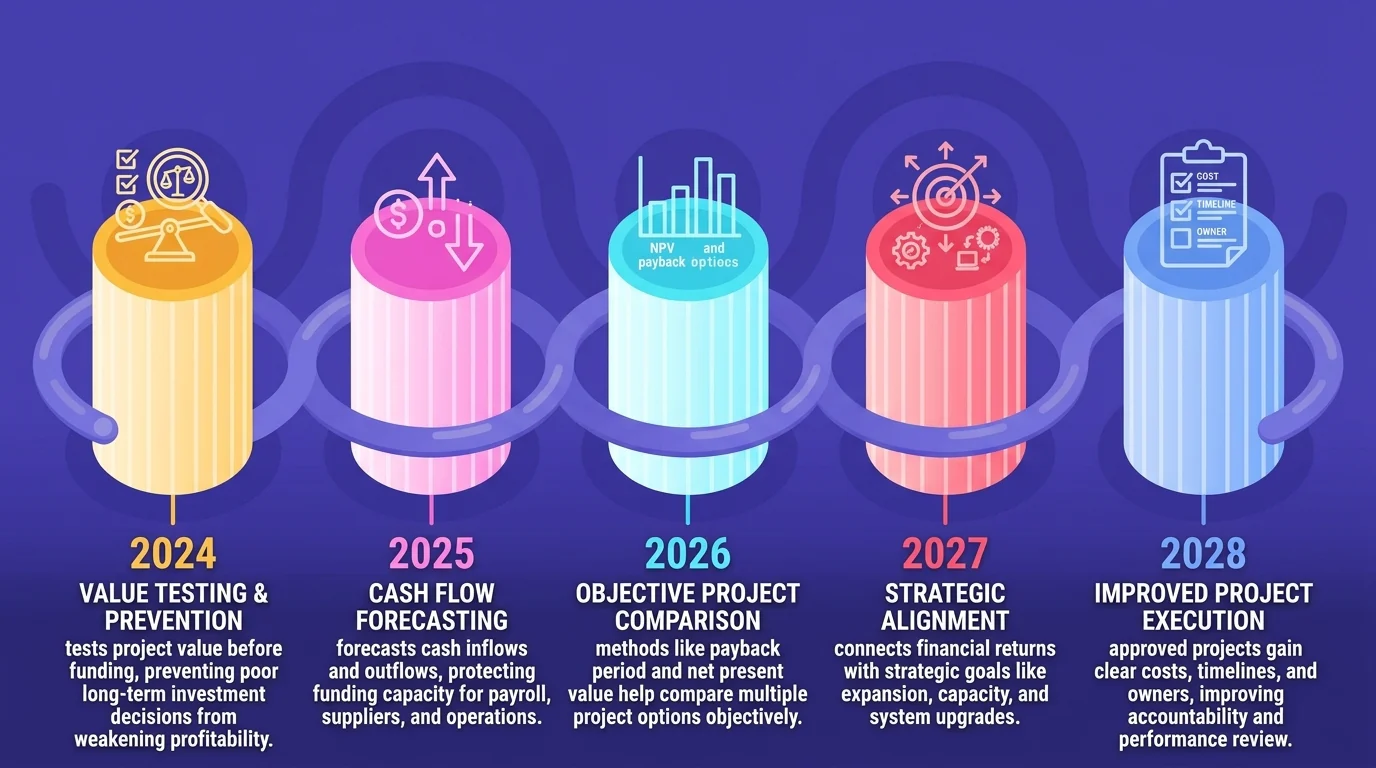
Capital budgeting helps Philippine businesses decide which long-term projects deserve limited funds, from branch expansion to equipment purchases and system upgrades. Finance can approve investments that protect cash flow while also supporting growth by comparing expected costs, returns, risks, and timing.
1. Prevents Poor Long-Term Investment Decisions
A capital budgeting process forces teams to test whether a project can generate enough value before funds are committed. This helps business owners avoid approving machinery, facilities, or software investments that look urgent but may weaken profitability over time.
2. Protects Cash Flow and Funding Capacity
Large projects often require upfront payments, loans, or staged funding. Capital budgeting helps finance teams forecast cash inflows and outflows. Determining cash flows helps businesses decide whether the business can still cover payroll, supplier payments, taxes, and daily operations after approving the investment.
3. Compares Multiple Project Options Objectively
When several investment ideas compete for the same budget, capital budgeting methods such as payback period, net present value, and internal rate of return help compare them using consistent financial criteria. This makes it easier to prioritize the project with stronger returns and lower risk.
4. Connects Financial Returns with Strategic Goals
Capital budgeting is not only about choosing the cheapest option. It helps executives decide whether a project supports wider business goals. It could be expanding to new locations, increasing production capacity, improving service speed, or upgrading systems for long-term competitiveness.
5. Improves Accountability After Project Approval
Clear capital budgeting examples include branch expansion, equipment purchases, warehouse upgrades, and ERP implementation. Once approved, each project should have expected costs, timelines, returns, and responsible teams. These expectations make it easier to review performance and correct issues before losses grow.
Capital Budgeting Formula: How to Calculate Investment Value
Capital budgeting uses financial formulas to estimate whether a long-term investment can create enough value to justify its cost. Before discussing the capital budgeting process or capital budgeting methods, readers should first understand discountedcash flow analysis cash flow analysis. This analysis compares future cash inflows with today’s investment value.
One common capital budgeting formula is Net Present Value, or NPV:
In this formula, CFt means the expected cash flow in each period, r is the discount rate or required rate of return, t means the time period, and initial investment means the upfront project cost paid before the investment begins.
For example, a company may invest PHP 500,000 in new equipment that is expected to generate PHP 180,000 in annual cash inflow for four years. Using a 10% discount rate, the company discounts each year’s cash flow to present value, adds the results, and subtracts the initial investment.
If the final NPV is positive, the project may add value because expected returns exceed the upfront cost. If the NPV is negative, the investment may not justify the spending. This is why many capital budgeting examples use NPV to show how time, risk, and future cash flow affect investment decisions.
How Does the Capital Budgeting Process Work?
A capital budgeting process gives finance teams a structured way to turn long-term investment ideas into approved, measurable projects. For Philippine businesses, the process connects expansion plans, equipment purchases, software upgrades, and other capital budgeting examples with cost estimates, cash flow forecasts, risk review, and post-approval monitoring.
Here is the step-by-step process:
- Identify the investment opportunity: Start by defining the business need, such as replacing machinery, opening a branch, improving compliance, or reducing operating costs. This gives the investment a clear purpose.
- Estimate project costs and expected cash flows: List the upfront price, installation, training, maintenance, financing, and implementation costs. After that, forecast the income, savings, or productivity gains the project may generate over time.
- Assess risks, timing, and assumptions: Review whether the forecast depends on stable demand, supplier availability, tax or compliance changes, implementation speed, or maintenance costs that could reduce future returns or delay benefits.
- Apply capital budgeting methods: Measure the projected benefits and justify the initial investment under the company’s return target by using NPV, IRR, payback period, profitability index, or accounting rate of return.
- Compare alternatives and prioritise projects: When several proposals compete for the same budget, compare their returns, risks, funding needs, and strategic value before choosing which project should move forward first.
- Approve, monitor, and review performance: After approval, track actual spending, project progress, and realized benefits against the original plan. If results fall short of expectations, then adjust funding or operations.
Capital Budgeting Methods and Techniques
Capital budgeting methods help finance teams evaluate long-term investments from more than one angle before approval. Philippine businesses may use these techniques to compare capital budgeting examples such as equipment purchases, branch expansion, or warehouse upgrades. The table below summarizes each method.
| Method | How It Works | What It Measures | Best Used For | Limitation |
|---|---|---|---|---|
| Net Present Value (NPV) | Discounts future cash flows to their present value, then subtracts the initial investment. A positive NPV means the project may create more value than it costs. | Present value of future cash flows minus upfront cost | Measuring value creation | Requires a reliable discount rate and accurate cash flow forecast |
| Internal Rate of Return (IRR) | Shows the estimated percentage return from an investment. Businesses usually compare IRR with their required rate of return before approving a project. | Expected project return percentage | Comparing investment returns across projects | Can be misleading when cash flows are irregular or change direction |
| Payback Period | Calculates how long it takes to recover the initial investment. For example, a PHP 600,000 project with PHP 200,000 annual cash inflow has a three-year payback period. | Time needed to recover the investment | Checking liquidity and recovery speed | Ignores cash flows earned after the payback period |
| Profitability Index | Compares the present value of future cash flows with the initial investment. A profitability index above 1 usually means the project may be worthwhile. | Value created per peso invested | Ranking projects when capital is limited | Depends heavily on accurate cash flow estimates |
| Accounting Rate of Return (ARR) | Compares average annual accounting profit with the initial investment. It is simple to understand because it uses accounting data that many businesses already track. | Average accounting profit against investment cost | Simple accounting-based comparison | Does not consider the time value of money |
Capital Budgeting Example
Imagine a Philippine retail company is considering whether to invest PHP 800,000 in a new inventory and warehouse system. The company expects the system to reduce stockouts, improve purchasing accuracy, and save PHP 260,000 per year for four years.
The capital budgeting example price list:
| Item | Amount |
|---|---|
| Initial investment | PHP 800,000 |
| Expected annual cash benefit | PHP 260,000 |
| Project life | 4 years |
| Discount rate | 10% |
| Present value factor | 3.1699 |
| Present value of cash inflows | PHP 824,170 |
| Estimated NPV | PHP 24,170 |
The calculation of NPV from this data is:
NPV = PHP 824,170 − PHP 800,000 = PHP 24,170
At a 10% discount rate, the present value of the four years of expected cash benefits is approximately PHP 824,170. After subtracting the PHP 800,000 initial investment, the project has an estimated NPV of PHP 24,170.
Since the NPV is positive, the investment may create value. However, the company should still review implementation risk, maintenance cost, user adoption, and strategic fit before approval.
Capital Budgeting vs Capital Expenditure vs Operating Budget
Capital budgeting, capital expenditure, and operating budget are related but not interchangeable. Capital budgeting is the evaluation process, capital expenditure is often its result, and the operating budget covers daily activities. A company may evaluate a new delivery vehicle, record it as capital expenditure, then budget fuel and maintenance. The table below compares all three.
| Concept | Meaning | Example |
|---|---|---|
| Capital budgeting | The decision-making process used to evaluate long-term investments | Comparing whether to buy equipment or expand a warehouse |
| Capital expenditure | The actual long-term asset or investment being purchased | Machinery, vehicles, buildings, software implementation |
| Operating budget | The short-term plan for regular income and expenses | Monthly rent, salaries, utilities, office supplies |
Common Mistakes in Capital Budgeting
One frequent mistake is using overly optimistic cash flow estimates. Forecasts built on best-case demand can make weak projects look profitable. A related error is underestimating total project cost, since businesses often budget the purchase price alone and overlook setup, training, financing, repairs, and implementation delays.
Another mistake is choosing projects only because payback is fast. A short payback period looks safe, but it ignores value created after recovery. Companies also fail to compare alternatives with consistent assumptions, using different discount rates, time horizons, or cost inclusions that make the comparison unreliable.
Ignoring risk is equally damaging. A project may look strong financially on the business performance while depending on uncertain demand, supplier reliability, staff adoption, or operational readiness. Finally, many businesses stop tracking after approval. Capital budgeting should include actual-versus-planned monitoring so finance teams can confirm spending and results match the original plan.
How Software Helps Manage Capital Budgeting
Software does not replace financial judgement. Capital budgeting methods still decide whether a project is worth funding. What software adds is control over the information around that decision, giving finance teams visibility over approved budgets, remaining balances, and spending progress instead of scattered spreadsheets and manual updates.
After approval, the capital budgeting process moves into execution. A good financial software tracks purchase requests, approval status, vendor bills, and supporting documents in one place. This matters when warehouse expansion or similar capital budgeting examples involve finance, procurement, operations, and management teams that each hold part of the record.
Software also compares budgeted costs with actual expenses as they are recorded. Finance teams can see overruns while the project is running and produce reports that show where money went. Those records make the next capital budgeting decision easier to justify.
How HashMicro Supports Better Budget and Investment Planning
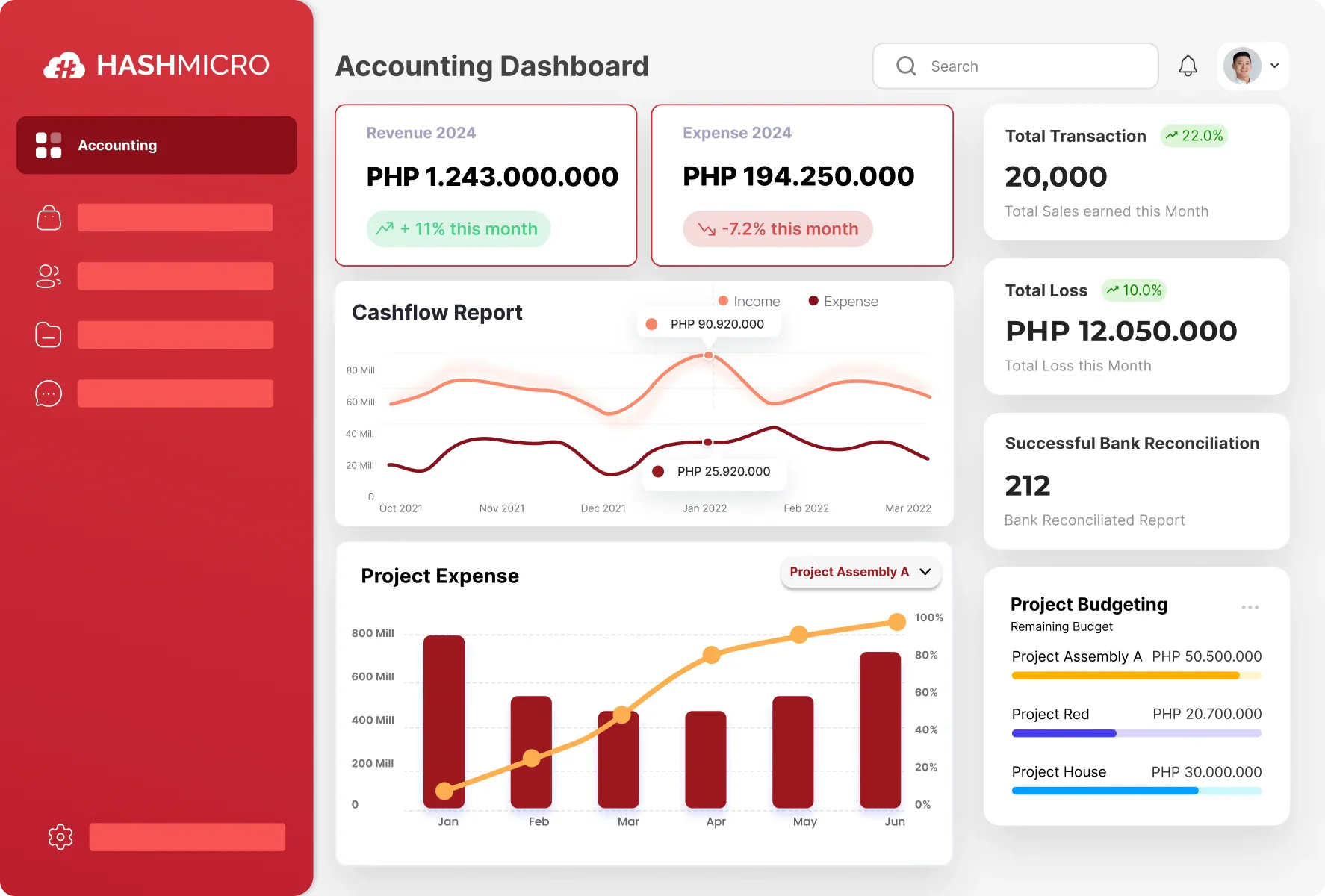
Finance teams approve a capital budget, then lose track of it. Spending sits in spreadsheets, approvals move through email, and no one sees the running balance until the project overruns. HashMicro's accounting software solves it all. It gives those teams one system to hold approved budgets, investment-related expenses, and the records behind every capital budgeting decision.
Key features of HashMicro:
- Budget planning and variance tracking: Set an approved budget per project, department, or cost center, then compare planned amounts against actual spending as transactions post.
- Multi-level approval workflow: Route purchase requests and vendor bills through the approvers your policy requires, with each decision recorded and timestamped.
- Expense and document control: Attach quotations, invoices, and receipts to the project they belong to, so cost evidence stays with the record instead of scattering across inboxes.
- Financial reporting and cost analysis: Pull spending reports by project, branch, or cost center to show management where the investment money actually went.
HashMicro does not replace your investment analysis, but it keeps the numbers behind that analysis accurate and current. With it, finance teams can see what they approved, what they spent, and what remains. Planning a major business investment? HashMicro's accounting software helps finance teams monitor budgets, approvals, expenses, and financial reports in one system, so capital decisions stay aligned with actual business performance

Conclusion
Capital budgeting helps businesses evaluate long-term investments with a structured financial process. Instead of approving major spending based on assumptions, companies can compare costs, future cash flows, risks, and expected returns.
Methods such as NPV, IRR, payback period, profitability index, and accounting rate of return help decision-makers understand different sides of an investment. When used together, these methods give a clearer view of whether a project supports cash flow, growth, and profitability.
For businesses planning major purchases, expansion, or system upgrades, capital budgeting is a practical way to reduce risk and make better financial decisions. Book a free consultation with the HashMicro expert team. It allows finance teams to monitor budgets, approvals, spending, and reports in one integrated system before and after investment decisions are made.

FAQ About Capital Budgeting
Capital budgeting is how a business decides whether a large, long-term investment is worth its cost. Finance teams compare what the project will spend against what it will return. Common capital budgeting examples include new equipment, a new branch, or a system upgrade.
Five capital budgeting methods dominate: net present value, internal rate of return, payback period, profitability index, and accounting rate of return. NPV measures value created, IRR shows percentage return, and payback measures recovery speed. Most finance teams apply several methods before approving a project.
Capital budgeting is the evaluation process; capital expenditure is the money a company actually spends on a long-term asset. A business runs capital budgeting first to test whether a delivery vehicle is worth buying. Once approved, the purchase becomes a capital expenditure in the accounts.
NPV matters because it accounts for the time value of money. It discounts every future cash flow to today's value, then subtracts the upfront cost, so a positive result means the project creates value. Most capital budgeting methods rank projects using this comparison.
Software controls the information around the decision, not the judgement itself. It holds approved budgets, tracks purchase requests and vendor bills, stores supporting documents, and compares planned costs with actual spending. Finance teams can then run the capital budgeting process without chasing scattered spreadsheets.