







For manufacturers, knowing how much it actually costs to produce one unit is harder than it sounds. Direct materials, direct labor, and manufacturing overhead can all blur together in a busy production environment, making it difficult to separate what truly belongs to the product from what simply runs the factory.
This is where the prime cost formula becomes useful. In manufacturing accounting, prime cost measures only the direct materials and direct labor that can be traced to a specific product, batch, job, or production order. It does not cover every cost on the factory floor.
This article covers the manufacturing prime cost formula, what it includes, how to calculate it step by step, and how it differs from conversion cost and total manufacturing cost. It also includes a Philippine peso example and explains how prime cost connects to the broader cost flow in manufacturing operations.
Key Takeaways
Prime cost is the sum of direct materials and direct labor used to produce a specific product, batch, or production order, calculated with the formula: Prime Cost = Direct Materials + Direct Labor.
Prime cost excludes manufacturing overhead, which means it is not the same as conversion cost, total manufacturing cost, or Cost of Goods Manufactured.
Manufacturers can use prime cost per unit (Total Prime Cost ÷ Units Produced) to compare direct production costs across products and periods, but it should always be interpreted alongside overhead, WIP, and accounting data before making pricing or profitability decisions.
What Is Prime Cost?
Prime cost is the total cost of direct inputs that can be traced to a specific product, batch, job, or production order. In manufacturing accounting, prime cost covers only two elements: direct materials and direct labor.
Direct materials are the raw materials or components that become part of the finished product and can be conveniently traced to it, such as the wood used to manufacture a table. Direct labor refers to the wages or labor costs of employees who work directly on manufacturing that product, such as the carpenter assembling it.
Prime cost is a subset of total manufacturing cost, not the whole of it. Total manufacturing cost also includes manufacturing overhead, which covers indirect costs such as factory rent, equipment depreciation, electricity, and supervisor salaries that cannot be traced directly to a single product.
Prime Cost Formula
Before putting numbers on the table, it helps to understand what the formula is actually capturing. Prime cost combines only the two costs you can directly trace to a product, nothing more. The standard prime cost formula is:
Each component represents a different type of direct production cost. The sections below break down how each one is defined and calculated.
Direct Materials
Direct materials are materials that:
- Become an identifiable part of the finished product
- Can be traced to a specific product, batch, or job
- Have a measurable cost per unit or production order
Examples include steel used to manufacture machinery, fabric used to make uniforms, wood used to produce furniture, flour and sugar used in a packaged food product, electronic components used in an assembled device, and glass used to manufacture bottles. One thing worth noting: the calculation should use materials actually consumed in production, not simply the value of materials purchased during the period.
This formula may need to be adjusted for purchase returns, freight-in, damaged materials, or items reclassified as indirect supplies depending on your company's costing policy.
Direct Labor
Direct labor covers the wages of employees who work hands-on in the production process. This includes assembly workers, machine operators, welders, tailors, bakers on a specific production line, carpenters, and production workers assigned to a particular job. The cost itself depends on hours worked and the applicable rate.
For example, if a production worker logs 2,000 hours manufacturing a product and the applicable labor rate is ₱150 per hour, the direct labor cost comes out to: 2,000 hours × ₱150 = ₱300,000.
What Is Included in Prime Cost?
Prime cost normally includes costs that are both direct and traceable to a product. The table below breaks down common manufacturing costs and whether each one is typically included.
| Cost item | Classification | Included in prime cost? |
|---|---|---|
| Steel used in a specific product | Direct materials | Yes |
| Wages of assembly workers | Direct labor | Yes |
| Fabric used for a production batch | Direct materials | Yes |
| Factory supervisor salary | Manufacturing overhead | No |
| Factory rent | Manufacturing overhead | No |
| Factory electricity | Manufacturing overhead | No |
| Machine depreciation | Manufacturing overhead | No |
| Small tools used across many products | Indirect materials | No |
| Product-specific design fee | Direct expense | Depends on costing policy |
Some cost accounting frameworks also discuss direct expenses as part of prime cost when those expenses can be traced directly to a specific product, contract, or job. For example, a special design fee or license fee may be treated as a direct expense if it exists solely for one production order.
How to Calculate Prime Cost Step by Step
Calculating prime cost is straightforward once you know which figures to pull and how to organize them. Here is a practical step-by-step approach that works for a single production order, a batch, or a full reporting period.
Step 1: Define the production period
Start by choosing the time frame or scope you want to measure. This could be a single production order, one batch, a month, a quarter, or a full financial year. The key rule is consistency: materials, labor, and output must all belong to the same period for the calculation to make sense.
Step 2: Calculate direct materials used
Find the value of raw materials and components that were actually consumed during production. Use materials consumed, not total purchases. Materials that were ordered and received but still sitting in the warehouse have not yet been used in production and should not be included here.
Step 3: Calculate direct labor
Identify the labor cost that is directly connected to the production order, batch, or product line being measured. Depending on how your payroll is structured, this may involve production hours logged, employee wage rates, overtime pay, labor allocation records, or production time tracking systems.
Step 4: Add direct materials and direct labor
Once both figures are ready, apply the formula:
Step 5: Calculate prime cost per unit
If you know how many units were produced during the same period, divide total prime cost by the number of units:
This per-unit figure is what makes prime cost practical. It lets manufacturers compare direct production costs across different products, batches, or time periods on an equal footing.
Prime Cost Example
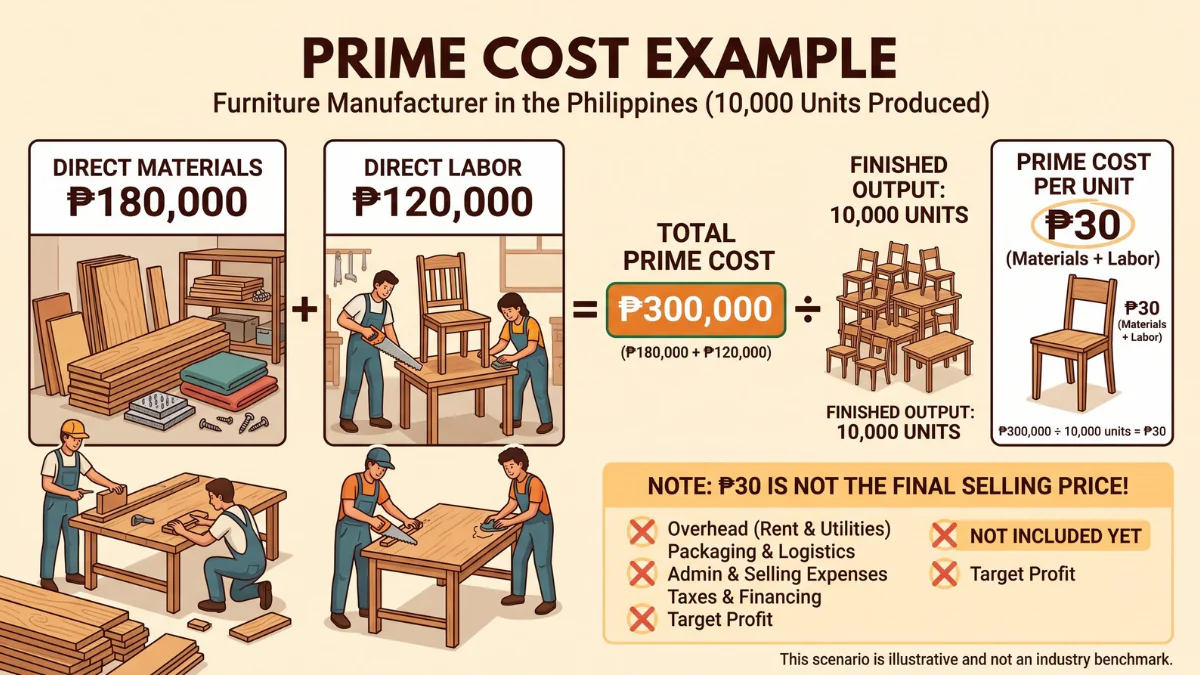
Suppose a furniture manufacturer in the Philippines produces 10,000 units during one production period.
The company records:
Direct materials: ₱180,000
Direct labor: ₱120,000
Finished output: 10,000 units
The total prime cost is:
Prime Cost = ₱180,000 + ₱120,000
Prime Cost = ₱300,000
The prime cost per unit is:
Prime Cost per Unit = ₱300,000 ÷ 10,000 units
Prime Cost per Unit = ₱30
This means the direct materials and direct labor used to produce each unit amount to ₱30 on average.
The ₱30 figure does not represent the complete cost of manufacturing or the required selling price. The business still needs to consider manufacturing overhead, packaging, logistics, selling expenses, administrative expenses, taxes, financing costs, and target profit.
Prime Cost and Conversion Cost
Prime cost and conversion cost are related but different measures.
Prime cost measures the direct inputs used to make a product. Conversion cost measures the cost required to convert raw materials into finished goods.
| Comparison point | Prime cost | Conversion cost |
|---|---|---|
| Main purpose | Measures direct production inputs | Measures processing and transformation cost |
| Includes direct materials | Yes | No |
| Includes direct labor | Yes | Yes |
| Includes manufacturing overhead | No | Yes |
| Common use | Job costing and direct cost analysis | Process costing and production efficiency analysis |
Direct labor appears in both formulas. This does not mean that direct labor should be added twice when calculating total manufacturing cost. Prime cost and conversion cost are two different ways of grouping manufacturing costs for analysis.
Prime Cost vs Total Manufacturing Cost
Prime cost and total manufacturing cost are two different figures, even though both measure production costs. Prime cost covers only direct materials and direct labor, while total manufacturing cost goes further by adding manufacturing overhead:
To see the difference in numbers, take a manufacturer with direct materials of ₱180,000, direct labor of ₱120,000, and manufacturing overhead of ₱90,000. The prime cost comes to ₱300,000 (₱180,000 + ₱120,000), while the total manufacturing cost comes to ₱390,000 (₱180,000 + ₱120,000 + ₱90,000). The ₱90,000 gap between the two figures is the overhead, which cannot be traced to a specific product but is still necessary to run the factory.
Manufacturing overhead typically includes factory rent, utilities, machine depreciation, maintenance, indirect materials, indirect labor, production supervisor salaries, factory insurance, and quality control costs shared across multiple products. Selling and administrative expenses, on the other hand, are kept separate because they are not incurred inside the production facility to manufacture the goods.
How Prime Cost Relates to WIP and COGM
Prime cost is one part of a broader cost flow in manufacturing accounting, and understanding where it sits helps clarify what it can and cannot tell you. To arrive at Cost of Goods Manufactured (COGM), total manufacturing cost alone is not enough. You also need to account for partially completed goods that were in process at the start and end of the period.
The formula works like this: COGM = Beginning WIP + Total Manufacturing Cost − Ending WIP, where beginning WIP is the value of partially completed goods carried over from the previous period, total manufacturing cost includes direct materials, direct labor, and manufacturing overhead for the current period, and ending WIP is the value of goods still in production at the close of the period.
To put numbers to it: if beginning WIP is ₱50,000, total manufacturing cost is ₱390,000, and ending WIP is ₱70,000, then COGM = ₱50,000 + ₱390,000 − ₱70,000 = ₱370,000. This is why prime cost should not be mistaken for COGM. Prime cost captures only direct materials and direct labor, while COGM reflects the full cost of goods that were actually completed during the period, including overhead and WIP adjustments.
Why Prime Cost Matters to Manufacturers
Tracking prime cost can help manufacturers understand their direct production performance. Because it focuses on only two controllable inputs, direct materials and direct labor, it gives a clearer picture of how efficiently a product is being made before overhead enters the equation.
1. Product Costing and Pricing Analysis
Prime cost provides a starting point for calculating the direct cost of a product, job, or production order. It can also help businesses understand how much direct input is required before considering overhead and profit margins. That said, prime cost alone should not be the only basis for setting a selling price, as it does not capture the full cost of production.
2. Material Usage Control
Comparing expected and actual direct materials can surface problems that might otherwise go unnoticed, such as excess consumption, production waste, scrap, incorrect bills of materials, or purchasing and inventory discrepancies. Catching these issues early helps prevent cost overruns from compounding over time.
3. Labor Efficiency Analysis
Manufacturers can track planned versus actual labor hours to identify where time is being lost. Common signals include production delays, rework, training gaps, labor allocation problems, and low productivity on specific lines or jobs.
4. Product Profitability Comparison
Prime cost can be compared across products to identify which items consume more direct input relative to others. A low prime cost does not automatically mean a more profitable product, since overhead and selling expenses still apply.
5. Cost Variance Review
When planned and actual prime cost differ, the gap typically points to changes in material prices, labor rates, production volumes, or operational efficiency. Manufacturers can use these findings to assess their production processes and explore the top manufacturing ERP systems that support better cost tracking and production planning.
How Manufacturing ERP Supports Prime Cost Visibility
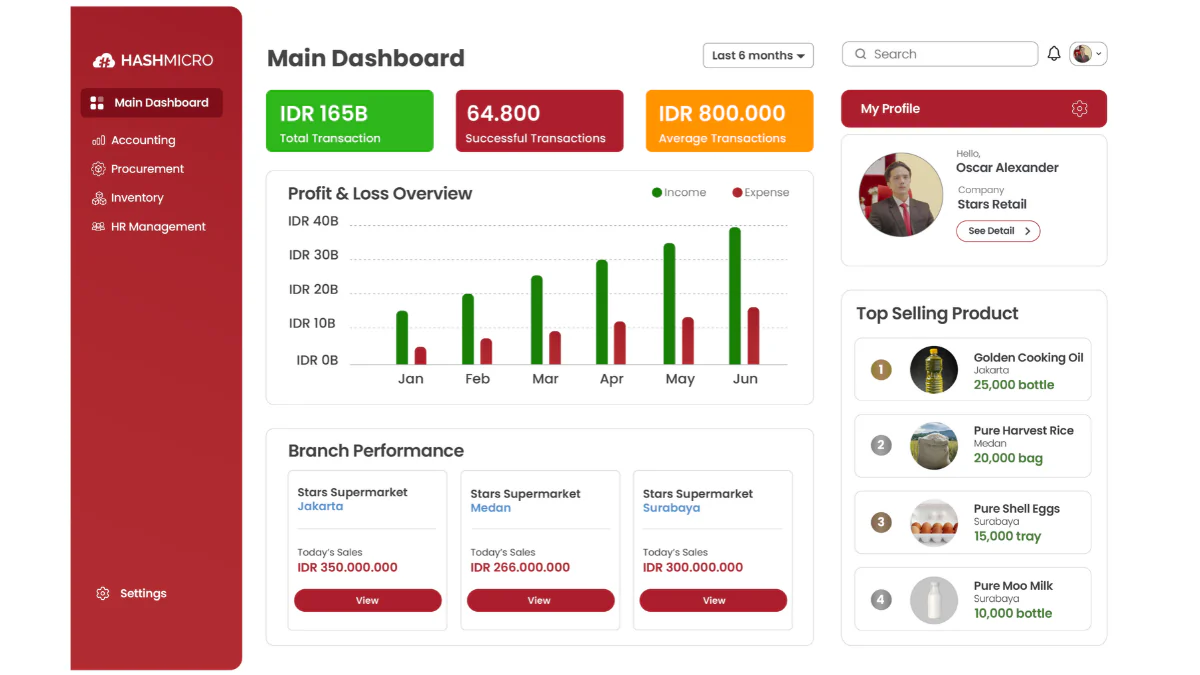
Calculating prime cost is rarely the hard part. The difficulty is getting reliable numbers in the first place, because material consumption sits in the warehouse system, labor hours sit in payroll, and production output sits in operations.
When those records live in separate files, a manufacturer cannot easily tell whether a rise in prime cost came from higher material prices, excess consumption, longer labor hours, or simply a larger production volume.
A manufacturing ERP closes that gap by keeping production, inventory, labor, and accounting data in one place. HashMicro Manufacturing is built for that kind of visibility, giving Philippine manufacturers a single source for the figures behind every production order:
- Bill of Materials management: Define expected material requirements for each product, then compare planned usage against actual consumption.
- Manufacturing orders and job orders: Record what was produced, how many units came out, and which operation handled it.
- MRP and Master Production Schedule: Line up demand, stock, and production plans before any material is committed to the floor.
- Real-time inventory tracking: Capture material consumption as it happens, rather than reconstructing it from period-end estimates.
- Work-in-process monitoring: See which orders are still incomplete and how much cost is sitting unfinished on the floor.
- Manufacture cost actualization: Post actual production cost and let the matching accounting entries generate automatically.
- Cost variance analysis: Compare planned cost against actual cost, with AI-generated insights to shorten the review.
- Integrated accounting: Connect production records straight to your financial reports, with no manual re-entry.
With these pieces connected, reviewing prime cost becomes a report you can open rather than a spreadsheet exercise you rebuild every month. The scope and available reports still depend on how the system is configured, so it is worth walking through your own costing workflow with the team before deciding what to implement.
Conclusion
Prime cost measures the direct cost of producing goods, calculated as Prime Cost = Direct Materials + Direct Labor. It tells manufacturers how much material and labor can be traced directly to a product, batch, job, or production order.
Prime cost should not be confused with conversion cost, which covers direct labor plus manufacturing overhead. It also differs from total manufacturing cost, which brings together all three categories: direct materials, direct labor, and manufacturing overhead.
For manufacturers in the Philippines, calculating prime cost in pesos is a practical starting point for reviewing product costs, material usage, and labor efficiency, as long as the result is read alongside WIP, COGM, overhead, and accounting data.
If pulling those figures together still takes days of spreadsheet work, book a free consultation and our team will show you how an integrated manufacturing system keeps the numbers ready whenever you need them.

accounts-receivable-software
Frequently Asked Questions
The standard prime cost formula is: Prime Cost = Direct Materials + Direct Labor It measures the direct production costs that can be traced to a product, batch, job, or production order.
Prime cost normally includes direct materials and direct labor. Some cost accounting approaches may also discuss traceable direct expenses, depending on the costing policy.
No. Manufacturing overhead is not included in the standard prime cost formula. It is included in total manufacturing cost and conversion cost.
Prime cost consists of direct materials and direct labor. Conversion cost consists of direct labor and manufacturing overhead. Direct labor is included in both categories.
Divide total prime cost by the number of units produced: Prime Cost per Unit = Total Prime Cost ÷ Units Produced
No. Total manufacturing cost includes direct materials, direct labor, and manufacturing overhead. Prime cost includes only direct materials and direct labor under the standard formula.
Some costing frameworks include direct expenses when they can be traced directly to a product, job, or production order. The business should clearly disclose the costing policy used.
Prime cost can support pricing analysis, but it should not be the only pricing input. A business should also consider manufacturing overhead, selling and administrative expenses, logistics, taxes, financing costs, market conditions, and desired profit.