









 Limited to 100 registrants

A commissary kitchen helps multi-brand food operators centralize preparation, improve consistency, and support outlet fulfillment at scale. However, centralizing food production alone does not create control. The real value comes from connecting demand, recipes, production, quality checks, transfers, and cost reconciliation in one operating loop.
For restaurant groups, franchise networks, hotel F&B teams, contract caterers, and institutional-food operators in the Philippines, a commissary kitchen can become the operational center that helps each outlet receive the right products, in the right quantity, at the right time, with traceable quality and visible cost. This article explains what a commissary kitchen is and how operators can control production, quality, inventory transfers, and costs.
This article explains what a commissary kitchen is and how operators can control production, quality, inventory transfers, and costs
This article explains what a commissary kitchen is and how operators can control production, quality, inventory transfers, and costs
Key Takeaways
A commissary kitchen centralizes food preparation and distribution for multiple outlets.
Effective management connects planning, production, inventory, quality control, and distribution.
Stock discrepancies must be recorded to keep commissary and outlet inventories accurate.
Integrated software provides one shared record for operational and financial control.
What Is a Commissary Kitchen?
A commissary kitchen is a centralized production facility where food is prepared, portioned, packed, and distributed to multiple outlets, brands, or service locations. It may produce sauces, marinades, ready-to-cook ingredients, baked goods, prepared meals, or finished products for outlets to heat, assemble, or serve.
Put simply, the commissary kitchen meaning is a shared or centralized food-production hub that supports more than one sales location.
What Is the Difference Between Commissary Kitchen vs Cloud Kitchen?
While a cloud kitchen prepares meals primarily for direct delivery orders, whereas a commissary kitchen centrally produces ingredients or finished products for multiple outlets, brands, or service locations. Commissary kitchens focus more on standardized production, batch control, quality checks, inventory transfers, and distribution across a wider operating network.
This is because several locations depend on one facility, production delays, incomplete quality releases, or unconfirmed outlet receipts can disrupt multiple operations simultaneously.
Owned Central Kitchen vs Shared Commissary Kitchen: Which Model Fits?
A commissary kitchen may be an owned central-production facility or a shared, rentable commercial kitchen. Neither model is automatically better. The right fit depends on demand stability, brand complexity, control requirements, and available investment capacity.
| Model | Best Fit | Advantages | Constraints |
|---|---|---|---|
| Owned or dedicated central kitchen | Established multi-brand operators with stable demand | Greater control over recipes, equipment, schedules, storage, QA release, and cost allocation | Higher fixed costs, capacity-planning responsibility, and direct food-safety accountability |
| Shared or rentable commissary kitchen | Seasonal production, market testing, or flexible-volume operations | Lower upfront investment and access to commercial facilities | Limited production slots, shared storage, dispatch restrictions, and less daily process control |
Questions to Assess Operator Fit
Is demand stable enough to justify dedicated equipment, storage, and dispatch capacity?
Do individual brands require separate recipes, allergen controls, packaging, or traceability records?
Can the operation work reliably within shared production and storage windows?
Is predictable outlet fulfillment essential to daily revenue?
Does leadership need cost-to-serve visibility by brand, outlet, or product category?
An owned facility can provide more control, but it also requires disciplined scheduling, maintenance planning, cost-center design, and quality governance. A shared commissary may reduce the initial investment, but operators must work within the facility’s available equipment, storage, and delivery constraints.
How Does a Commissary Kitchen Work for Multi-Brand Operations?
How Does a Commissary Kitchen Work for Multi-Brand Operations?
How Does a Commissary Kitchen Work for Multi-Brand Operations?
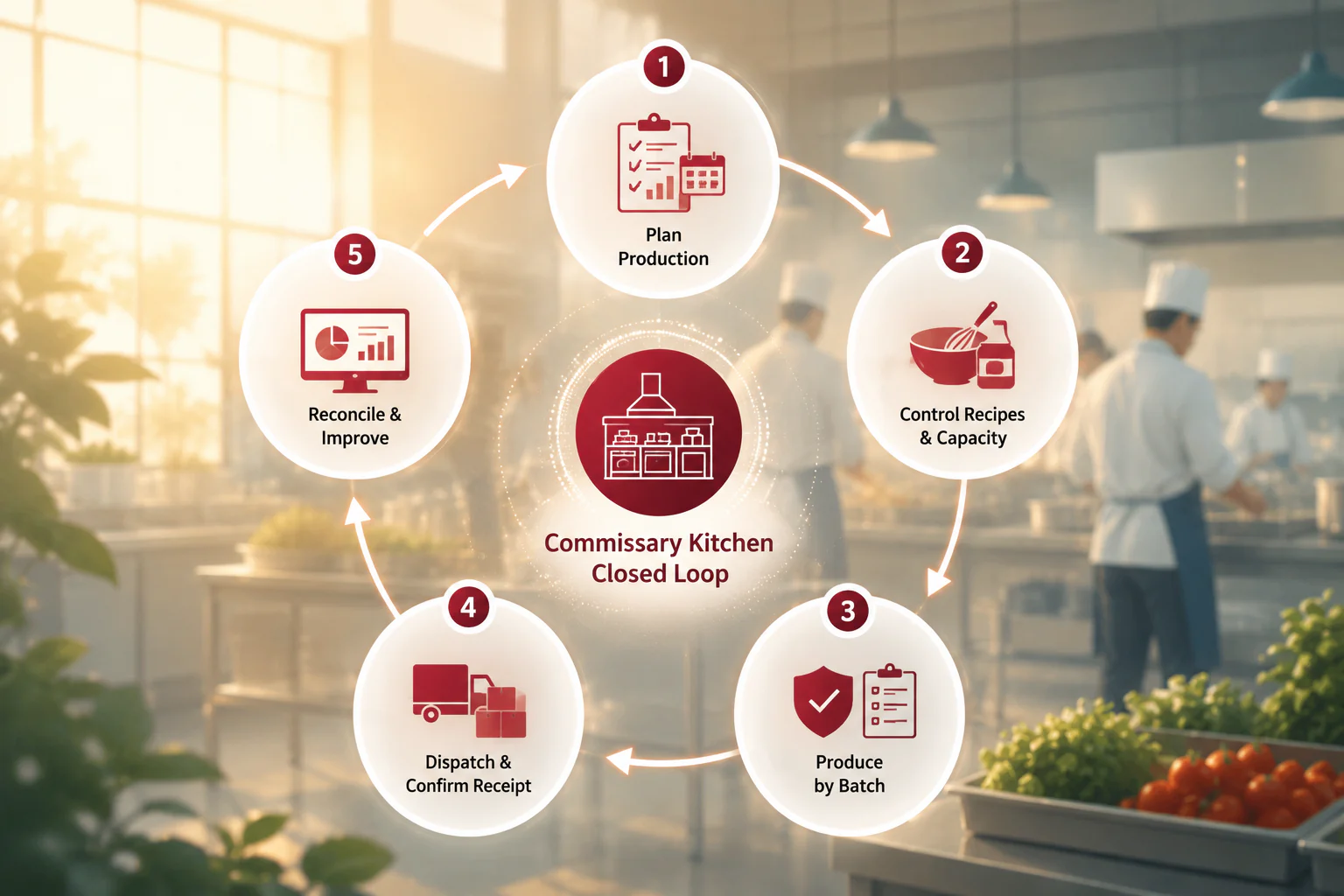
Effective commissary kitchen management works best when it is run as a closed operational and financial loop. Each handoff should preserve the information that matters around quantity, quality status, batch or lot reference, destination, food and beverage production planning, and cost.
This requires coordination across Operations, Procurement, Production, Quality Assurance, Dispatch, Outlet Teams, and Finance. When these teams rely on disconnected spreadsheets or paper records, visibility often stops as soon as products move from one location to another. Also, if production, transfer, and outlet receipt are managed in separate files, map where quantity, cost, or quality data stops moving with a batch.
1. Turn Outlet Demand Into a Feasible Production Plan
The commissary process should begin with demand, not production capacity alone. Demand forecasting, promotions, catering commitments, seasonal peaks, events, and replenishment needs should be consolidated into a production plan by brand, SKU, outlet, and delivery date. This gives the central kitchen a clear view of what must be produced and when it needs to leave the facility.
A feasible plan must also account for operational constraints:
Equipment throughput and availability
Labour shifts, skills, and changeover requirements
Minimum batch sizes and expected recipe yields
Dry, chilled, frozen, and staging capacity
Product shelf life and transport lead time
Packing and dispatch windows
Delivery routes and outlet receiving schedules
A commissary may have enough weekly production capacity in total but still fail if several brands require the same oven, chiller, packing line, or dispatch slot at the same time. Identifying bottlenecks before production begins helps teams avoid last-minute shortages and rushed fulfillment.
2. Control Recipes, Shared Inputs, and Capacity Before Production
Standardization is one of the main reasons to establish a commissary kitchen. Every batch should follow approved recipes, portions, yields, preparation methods, substitutions, and packaging specifications.
The commissary should distinguish between:
Brand-specific ingredients and packaging
Shared raw materials used by multiple brands
Shared labour, equipment, storage, consumables, and dispatch resources
Before production starts, management should define allocation rules for shared inputs:
Ingredients can follow recipe consumption.
Conversion labour can follow direct labour hours.
Equipment costs can follow machine time.
Chilled storage costs can follow pallet-days.
Delivery costs can follow route, drop count, shipment weight, or delivery distance.
Business need to also consider the approach, because without realistic cost drivers, management may overestimate its gross contribution.
3. Produce by Batch With Quality and Traceability Embedded
Batch-level control connects production activity to quality, inventory, and cost outcomes. For each batch, teams should record planned and actual output, yield, waste, ingredient use, production time, responsible personnel, and exceptions. Food-safety controls including HACCP checkpoints, allergen segregation, temperature checks, sanitation, and approved substitutions should be documented during production.
Finished batches must remain traceable to their ingredient lots, suppliers, and production records. Any batch requiring inspection, testing, or corrective action should remain on QA hold and unavailable for dispatch until formally released to avoid common quality control issues.
4. Dispatch Through Controlled Transfers and Confirmed Receipt
A transfer is not complete simply because goods leave the commissary kitchen. Dispatch teams using food distribution software should record the batch, quantity, destination, shipment reference, delivery schedule, and handling requirements.
Common exceptions should be anticipated and documented:
Partial dispatch because actual output is below plan
Partial receipt because the outlet receives less than expected
Rejection because of temperature, quality, damage, or quantity issues
Returns to the commissary, where operationally permitted
Delivery delays that affect product quality or outlet readiness
A controlled inventory transfer process requires two-sided stock confirmation. Inventory should leave the commissary based on confirmed dispatch, while the outlet’s inventory should reflect the quantity and condition actually received. Partial receipts, rejections, and returns must be recorded so both locations reflect the real movement of stock.
5. Reconcile Stock, Cost, Yield, and Service by Brand
Reconciliation closes the loop between the plan and the result. At the end of each production and fulfillment cycle, operators should compare:
Forecast demand and planned production
Actual batch output and yield
Dispatched quantity and outlet receipt
Returns, rejections, and waste
Expected and actual stock balances
Planned recipe cost and actual batch cost
On-time, in-full fulfillment performance
This should not be treated only as an end-of-month Finance task. Operations teams need timely information to improve production plans, adjust replenishment, investigate recurring shortages, and identify sources of waste or variance.
Build Cost Visibility Beyond Food Cost Percentage
Food cost percentage remains useful, but it does not fully explain commissary performance. A central kitchen also needs visibility into how shared resources are consumed across brands and outlets.
1. Set Up Cost Centres That Reflect Operations
Production lines or work areas
Brand or business unit
Dry, chilled, and frozen storage
Packing and quality assurance
Dispatch and delivery
The goal is to make costs visible where operating decisions are made.
2. Allocate Shared Resources Using Real Cost Drivers
Shared costs should follow the driver that best represents actual resource use. Allocating chilled storage by pallet-days may be more accurate than splitting the cost evenly across brands. Similarly, dispatch costs may be driven by delivery route, number of drops, shipment weight, or delivery frequency.
Clear allocation rules help management understand whether a brand remains profitable after the cost of producing, storing, and delivering its products is included.
3. Calculate Cost-to-Serve by Brand and Outlet
Cost-to-serve may include:
Ingredients and recipe consumption
Conversion labour
Packaging
Storage
Equipment usage
Dispatch and transfer costs
Waste and yield loss
Rejection and return costs
A high-volume brand may still be less profitable if it requires premium storage, short delivery windows, frequent replenishment, or complex production changeovers.
Food Safety, Release, and Recall Readiness
A commissary kitchen should maintain records that support HACCP controls, allergen management, ingredient-lot capture, finished-batch genealogy, QA release decisions, and the handling of blocked, rejected, or returned stock.
Recall readiness depends on answering practical questions quickly:
Which ingredient lot was used in the affected batch?
Which finished products used that batch?
Which outlets received those products?
What stock remains in the commissary, in transit, or at outlets?
Has relevant stock been blocked, returned, or disposed of appropriately?
Traceability is not only about identifying a product inside the central kitchen. It must continue through dispatch and confirmed outlet receipt.
Constraints That Commonly Disrupt Commissary Kitchen Performance
Even a well-designed commissary kitchen can struggle when constraints are not visible early enough.
Equipment bottlenecks and competing production windows
Labour shortages or uneven skill coverage
Limited chilled, frozen, dry, or staging capacity
Late demand changes and promotion-driven spikes
Brand-specific recipe, allergen, packaging, and quality requirements
Incomplete transfer documentation or outlet confirmation
Unrecorded waste, substitutions, or yield loss
Cost allocation methods that do not reflect actual resource use
These issues are often connected. A late forecast change can create a production bottleneck, leading to rushed packing, delayed dispatch, partial receipt, and avoidable product waste. Managing the commissary as a connected loop makes those dependencies easier to identify.
Metrics That Show Whether a Commissary Kitchen Is in Control
A practical dashboard should combine operational, quality, service, and financial indicators.
| Control Area | Metric | What It Shows |
|---|---|---|
| Planning | Forecast-to-production variance | Whether production matches expected outlet demand |
| Cost | Planned versus actual batch cost | Unexpected changes in ingredients, labour, or processing costs |
| Production | Yield and waste variance | Recipe, training, ingredient-quality, or equipment issues |
| Fulfillment | On-time, in-full dispatch rate | Whether outlets receive complete orders as scheduled |
| Receiving | Partial receipt and rejection rate | Packing, transport, quality, or receiving problems |
| Inventory | Inventory accuracy by location | Differences between recorded and physical stock |
| Stock Risk | Expiry exposure and blocked-stock value | Inventory at risk of waste or restricted use |
| Quality | QA hold-to-release cycle time | Delays in inspection, testing, or batch approval |
| Profitability | Cost-to-serve and gross contribution | The actual financial performance of each brand or outlet |
| Traceability | Mock-recall completion time | How quickly affected batches and destinations can be identified |
The right metrics should improve decisions, not simply generate more reports. For instance, recurring yield variance may point to recipe issues, training gaps, ingredient quality, or equipment performance. A rising rejection rate may signal transport, packing, or receiving issues rather than a production-quality problem.
How Integrated Systems Support Commissary Kitchen Control at Scale
How Integrated Systems Support Commissary Kitchen Control at Scale
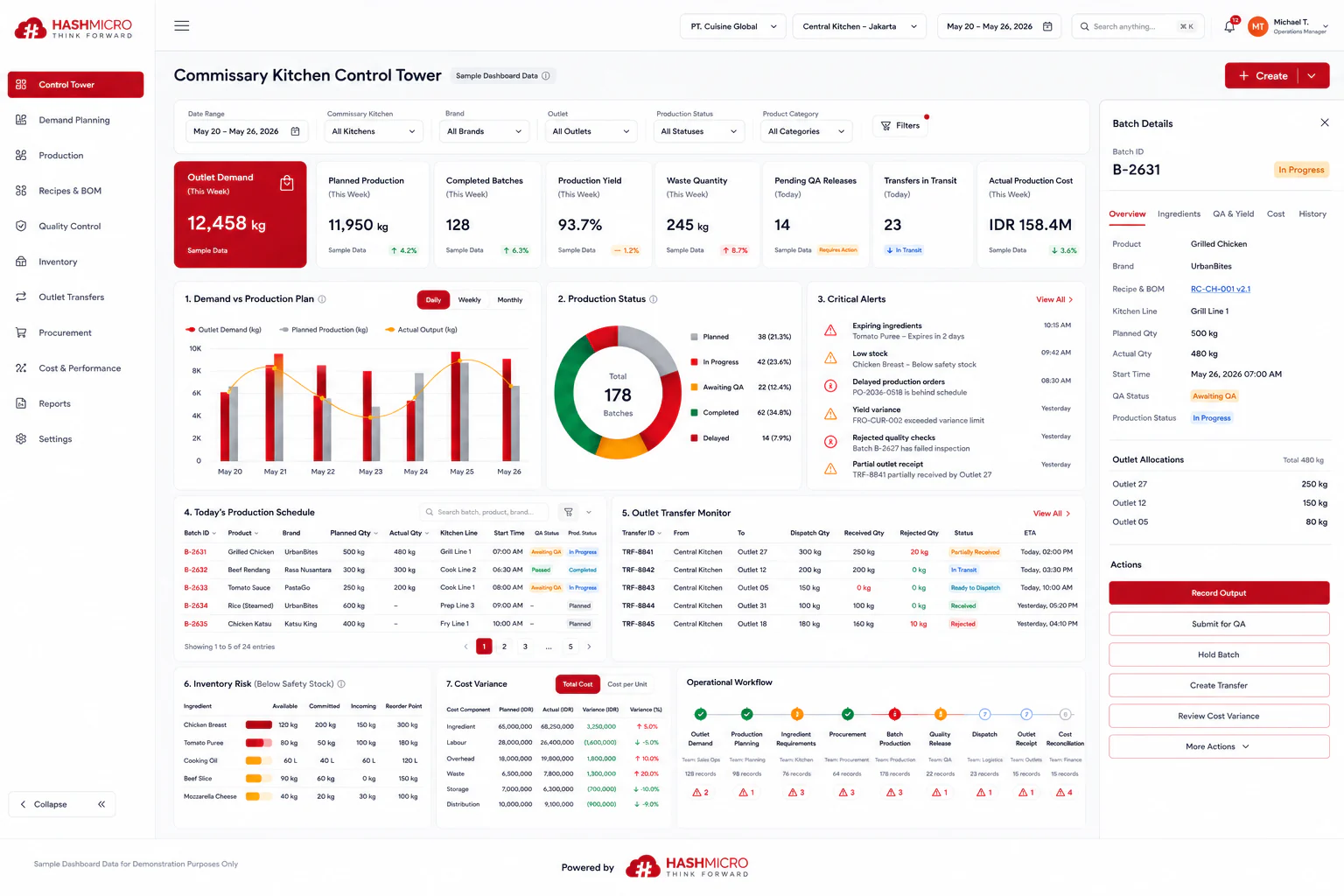
As the number of brands, outlets, SKUs, and stock transfers grows, disconnected records make commissary operations harder to control. Central kitchen management systems keep demand planning, production, inventory, quality, dispatch, outlet receipt, and financial reconciliation within one connected workflow.
As the number of brands, outlets, SKUs, and stock transfers grows, disconnected records make commissary kitchen management harder to control. An integrated system keeps demand planning, production, inventory, quality, dispatch, outlet receipt, and financial reconciliation within one connected workflow.
HashMicro provides an integrated ERP solution trusted by more than 3,000 companies and 875,000 users across Asia-Pacific. For multi-brand food operators, the software connects central-kitchen activities with procurement, inventory, outlet transfers, and cost reporting, giving every team a shared operational record.
Key capabilities include:
- Demand and production planning: Aligns outlet demand with batch schedules and kitchen capacity.
- Recipe and BOM management: Standardizes ingredients, quantities, portions, and approved substitutions.
- Batch, yield, and quality control: Tracks actual output, waste, lot and expiry information, and QA release status.
- Inventory and outlet transfers: Monitors stock across locations and records transferred and received quantities.
- Procurement and supplier management: Connects purchasing decisions with ingredient requirements and supplier records.
- Cost and performance reporting: Compares planned and actual costs by batch, brand, outlet, or cost centre.
Conclusion
A commissary kitchen gives multi-brand food operators a way to centralize standards, improve production efficiency, and support consistent outlet fulfillment. But centralization only works when the data behind every handoff remains connected.
From outlet demand to production planning, batch release, dispatch, receipt, and reconciliation, teams need clear ownership and accurate records. This helps operators protect food quality, manage inventory, understand cost-to-serve, and respond more effectively to exceptions.
For operators seeking a more connected operating model, HashMicro Central Kitchen Software provides a centralized framework for coordinating production, inventory, quality control, outlet transfers, and cost reporting across brands and locations.
Frequently Asked Questions Around Commissary Kitchen Management
It is the coordination of demand planning, recipes, procurement, batch production, quality control, inventory, transfers, outlet receipt, and financial reconciliation.
Use realistic drivers that reflect actual resource consumption, such as recipe usage for ingredients, labour hours for production labour, machine time for equipment, pallet-days for storage, and route or shipment weight for delivery.
The outlet should confirm the actual quantity and condition received. Partial receipts, rejections, damage, and returns should be recorded so both the commissary and outlet inventory records reflect the real stock movement.
A business should consider commissary kitchen management software when spreadsheets and separate records no longer provide reliable visibility across outlet demand, production, inventory, quality, transfers, and costs. A HashMicro product demonstration can help operators assess whether an integrated system fits their operational structure and control requirements.
Operators should evaluate how well the system matches their workflows, user roles, approval requirements, locations, reporting structure, and integration needs. A tailored demonstration using realistic operating scenarios can help determine whether HashMicro Central Kitchen Software is suitable for the business’s scale and control requirements.