







A Request for Quotation (RFQ) is one of the most frequently used documents in any procurement workflow, yet it’s often misunderstood or applied inconsistently. At its core, an RFQ is a formal request sent to potential suppliers inviting them to submit competitive price bids for clearly defined goods or services making it a foundational step in structured vendor selection processes.
Understanding how an RFQ works and how it differs from related documents like RFPs and RFIs helps procurement teams make faster, fairer sourcing decisions. This guide covers the RFQ definition, process steps, essential components, and common pitfalls to avoid.
Key Takeaways
An RFQ (Request for Quotation) is a formal procurement document sent to suppliers to invite competitive price bids for clearly defined goods or services, with price serving as the primary evaluation criterion.
Unlike an RFP (which asks suppliers to propose a solution) or an RFI (which gathers market intelligence), an RFQ is used only when requirements are already fully defined and the buyer’s main variable is price.
A well-structured RFQ process follows eight key steps from defining specifications and identifying suppliers, through issuing the document, managing Q&A, evaluating bids, and formally awarding the contract.
The most common mistakes in RFQ management include vague specifications, inviting only incumbent suppliers, ignoring total cost of ownership, and failing to maintain a complete audit trail of the process.
What Is a Request for Quotation (RFQ)?

A Request for Quotation (RFQ) is a formal procurement document issued by a buying organization to invite suppliers to submit competitive price bids for specific goods or services. It specifies exactly what the buyer needs including product specifications, quantities, delivery timelines, and commercial terms and asks suppliers to respond with their best price offers. The defining characteristic of an RFQ is its emphasis on price as the primary evaluation criterion, making it most appropriate when requirements are already fully defined and the main variable is cost. This makes it ideal for commodity items, standardized products, recurring purchases, and services with clearly defined scopes.
The term is sometimes used interchangeably with “Invitation to Bid” (ITB) or “Request for Tender” (RFT), particularly in public sector procurement, though in most private-sector contexts an RFQ is more streamlined by comparison. Today, RFQs are managed through digital procurement platforms and e-procurement portals that automate distribution, track responses, and facilitate comparison, but the fundamental purpose remains unchanged: create a controlled, competitive environment in which multiple suppliers compete for the buyer’s business, driving better value for the organization.
RFQ vs. RFP vs. RFI: Key Differences Explained
The procurement world is filled with acronyms, and three of the most commonly confused are RFQ, RFP, and RFI. Understanding the precise distinction between them is critical to choosing the right tool for each situation. Using the wrong document at the wrong stage can lead to wasted time, poor supplier selection, and contractual misalignments.
| Attribute | RFI | RFQ | RFP |
|---|---|---|---|
| Primary Purpose | Gather market information | Obtain competitive price quotes | Solicit full solution proposals |
| Requirements Clarity | (Low) still exploratory | (High) well-defined specs | (Medium to high) complex scope |
| Primary Evaluation Criterion | Capability fit | Price | Technical + commercial fit |
| Process Complexity | Low | Medium | High |
| Typical Use Cases | New categories, market mapping | Commodity goods, repeat purchases | IT, consulting, complex services |
| Commitment Level | None | Conditional on award | Conditional on award |
The Step-by-Step RFQ Process in Procurement
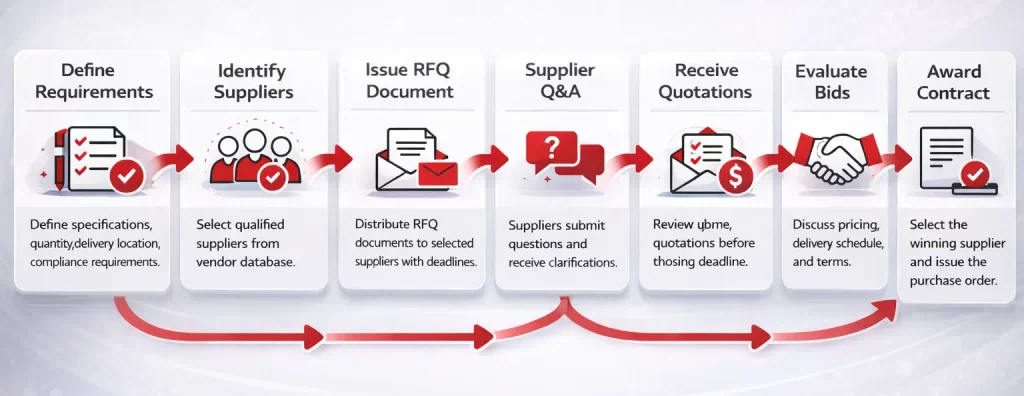
Running an effective RFQ process requires careful planning, structured communication, and disciplined evaluation. While the specific steps may vary slightly by organization and industry, the following framework represents the most widely accepted approach across both private and public sector procurement environments.
Step 1: Define the Need and Confirm Specifications
Before drafting any document, the procurement team must work closely with internal stakeholders to precisely define what is needed, specifying product dimensions, material grades, technical standards, service levels, and acceptable substitutes, along with quantities, delivery locations, timelines, and any pre-RFQ technical review requirements for complex items.
Step 2: Identify and Qualify the Supplier List
An RFQ is only as competitive as its supplier pool. Select between three and eight pre-qualified vendors segmented by category, capability, geography, and risk profile, enough to generate competitive pressure without creating unnecessary administrative burden for either side. In regulated or public procurement, minimum invitation counts are often mandated by policy.
Step 3: Draft and Issue the RFQ Document
With specifications confirmed and the supplier list ready, draft the formal RFQ document comprehensive enough for all suppliers to respond on equal footing, with no room for misinterpretation. Distribute it simultaneously to all invited suppliers with a defined submission deadline (typically five to twenty business days, depending on complexity).
Step 4: Manage Supplier Queries and Clarifications
After issuance, establish a formal Q&A window during which suppliers submit written questions. Compile all questions and answers and distribute them to every participating supplier simultaneously never bilaterally to maintain fairness. Deadlines for query submission and buyer response turnaround should be stated in the original RFQ.
Step 5: Receive and Open Submissions
Quotations are received by the specified deadline, logged with timestamps, and documented meticulously to confirm no supplier received preferential treatment. Late submissions are typically disqualified, though exceptions for documented technical difficulties may be permitted if covered by a consistent, written policy.
Step 6: Evaluate Quotations
Review submissions against a predefined scoring framework verifying technical compliance with specifications, delivery terms, payment conditions, warranty provisions, and certifications before comparing price. Evaluation matrices listing each supplier’s response side by side, reviewed by a cross-functional team for high-value purchases, produce the most defensible outcomes.
Step 7: Conduct Negotiations (If Applicable)
For higher-value items, a round of negotiations may follow initial evaluation, clarifying pricing assumptions, aligning payment terms, or discussing delivery schedules. The scope of work remains fixed; the goal is only to optimize commercial conditions within the boundaries already defined by the RFQ.
Step 8: Award the Contract and Notify Suppliers
Select the winning supplier based on evaluation results and issue a purchase order or formal contract award. Notify all participating suppliers of the outcome including those not selected. The contract formally documents the agreed price, quantities, delivery terms, and conditions established through the RFQ process.
Essential Components of a Well-Structured RFQ Document
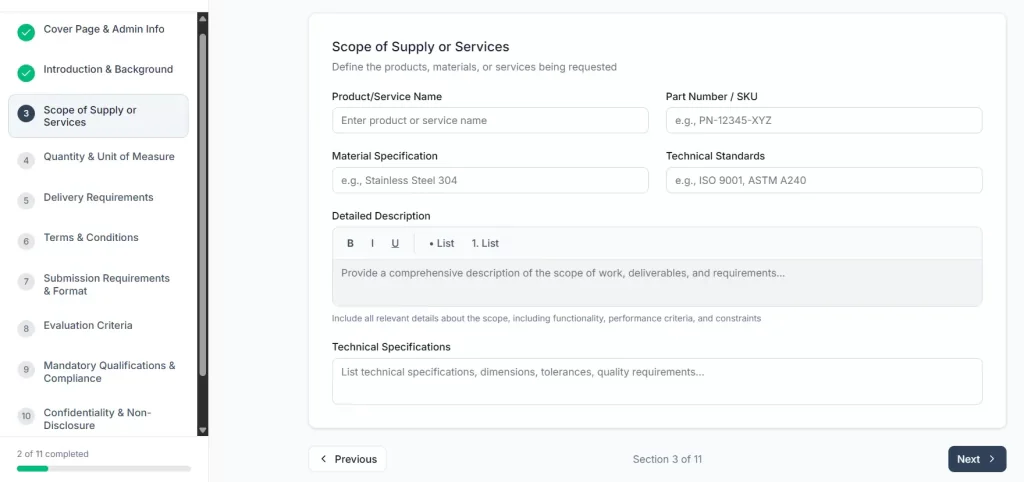
A poorly structured RFQ document produces inconsistent, incomparable responses and ultimately undermines the competitive procurement process it was designed to support. The following components are considered essential in any professionally drafted RFQ:
1. Cover Page and Administrative Information
The cover page should include the issuing organization’s name and logo, a unique RFQ reference number, the issue date, the submission deadline, and the name and contact details of the procurement officer managing the process. A version control section is also useful if the document is amended after initial issue.
2. Introduction and Background
A brief overview of the buying organization and the context for the purchase. This helps suppliers understand who they are bidding for and what the broader operational environment looks like. It need not be lengthy, two to three paragraphs is typically sufficient.
3. Scope of Supply or Services
This is the heart of the RFQ document. It defines precisely what is being procured including product names, part numbers, material specifications, technical standards, quality requirements, service descriptions, and acceptable substitutes. The scope must be unambiguous. Any standards or codes referenced (e.g., ISO, ASTM, or industry-specific certifications) should be cited explicitly.
4. Quantity and Unit of Measure
The required quantities and appropriate units of measure (pieces, kilograms, liters, hours, etc.) must be stated clearly. For orders with multiple line items, a structured line-item table is the most effective format.
5. Delivery Requirements
Specify the required delivery date or timeframe, the delivery location, Incoterms (for international procurement), and any special handling, packaging, or logistics requirements. If multiple delivery locations or phased deliveries are needed, these should be listed separately.
6. Terms and Conditions
The commercial terms under which the purchase will be made, including payment terms (e.g., net 30, net 60), currency, price validity period, warranty requirements, and applicable law. If the buying organization has standard procurement terms and conditions, these should be attached and referenced in this section.
7. Submission Requirements and Format
Clear instructions on how suppliers should submit their quotations, the format (e.g., completed price schedule, PDF, Excel), the submission method (email, portal upload, physical delivery), and the deadline. Some organizations require suppliers to submit a formal covering letter signed by an authorized representative.
8. Evaluation Criteria
Transparency about how submissions will be evaluated builds supplier trust and improves response quality. For an RFQ, the criteria typically include price per unit, total cost, compliance with specifications, delivery timeline, and payment terms. If a weighted scoring system is used, the weights should be disclosed.
9. Mandatory Qualifications and Compliance Documents
Any certifications, licenses, insurance documents, or compliance declarations that suppliers must include with their submission. Examples include ISO 9001 certification, health and safety compliance statements, trade licenses, and tax clearance certificates.
10. Confidentiality and Non-Disclosure Provisions
A clause confirming that all information shared in the RFQ is confidential and that suppliers must not disclose it to third parties. Similarly, supplier quotations should be treated as confidential by the buying organization.
11. Right to Accept or Reject
A standard clause noting that the issuing organization reserves the right to accept or reject any or all quotations without necessarily accepting the lowest price, and without obligation to provide reasons for its decision.
Best Practices for Running a High-Performance RFQ Process

The difference between an RFQ process that delivers excellent outcomes and one that creates more problems than it solves often comes down to a handful of disciplined practices. Here are the most impactful best practices adopted by high-performing procurement organizations:
-
Invest Time in Specification Quality
The single highest-return investment in any RFQ process is the quality of the specification document. A specification that is precise, complete, and internally consistent eliminates ambiguity, reduces supplier queries, improves comparability of bids, and reduces the risk of contract disputes later. Involve technical subject matter experts in specification drafting, and conduct a peer review before the RFQ is issued. The time spent upfront pays dividends throughout the entire procurement cycle.
-
Use a Structured, Standardized Price Schedule
Require suppliers to complete a standardized, structured pricing template rather than submitting bids in their own format. This ensures that all line items, quantities, and cost components are quoted consistently, making side-by-side comparison straightforward. An unstructured pricing submission forces evaluators to manually extract and normalize data, a process that is time-consuming and error-prone.
-
Set Realistic but Firm Deadlines
Give suppliers enough time to prepare a thoughtful, accurate quotation especially for technically complex or high-value items. Unrealistically short deadlines produce hasty, incomplete, or inaccurate bids. However, once a deadline is set, enforce it consistently. Routinely accepting late submissions undermines the integrity of the process and rewards disorganized suppliers at the expense of those who planned carefully.
-
Document Everything
Maintain a complete audit trail of every step in the RFQ process: distribution records, Q&A communications, submission receipts, evaluation worksheets, award rationale, and supplier notifications. This documentation is essential for internal governance, external audits, dispute resolution, and continuous improvement. In public sector procurement, documentation requirements are typically mandated by law or regulation.
-
Separate the Evaluation of Technical Compliance from Commercial Scoring
Evaluate technical compliance (does the supplier’s offering meet the specifications?) before reviewing pricing. This prevents evaluators from being influenced by price when assessing technical adequacy. Only technically compliant bids should advance to commercial evaluation. This two-stage review process is standard practice in rigorous procurement environments and dramatically reduces the risk of awarding to a non-compliant lowest bidder.
Common Mistakes That Undermine Your RFQ Process

Even experienced procurement teams make process mistakes that compromise the integrity, efficiency, or outcomes of their RFQ cycles. Awareness of these pitfalls is the first step to avoiding them.
- Incomplete or Ambiguous Specifications: Vague specs produce incomparable bids, inflate evaluation time, and increase the risk of contract disputes. Involve technical subject matter experts before issuing.
- Inviting only incumbent suppliers: Sending RFQs exclusively to existing vendors eliminates competitive pressure. Include at least one or two new suppliers in each cycle to keep pricing honest
- Mismanaging the Q&A process: Answering supplier queries bilaterally creates information asymmetry and compliance risk. All questions and responses must be distributed to every invited supplier simultaneously.
- Treating price as the only criterion: Awarding solely on lowest price without verifying technical compliance or total cost of ownership often results in poor supplier performance. Evaluate compliance first.
- Accepting deviations without documentation: Informal acceptance of non-compliant quotations (alternative products, different quantities, modified terms) causes scope confusion during contract execution. Document every accepted deviation formally.
- Neglecting total cost of ownership: For capital equipment or long-term services, the purchase price is only part of the cost. Factor in maintenance, consumables, energy, and termination costs before evaluating bids.
- Poor record keeping: Failure to maintain a complete audit trail of distribution, Q&A, submissions, and award rationale exposes the organization to governance failures and legal disputes.
How Technology Is Transforming the RFQ Process
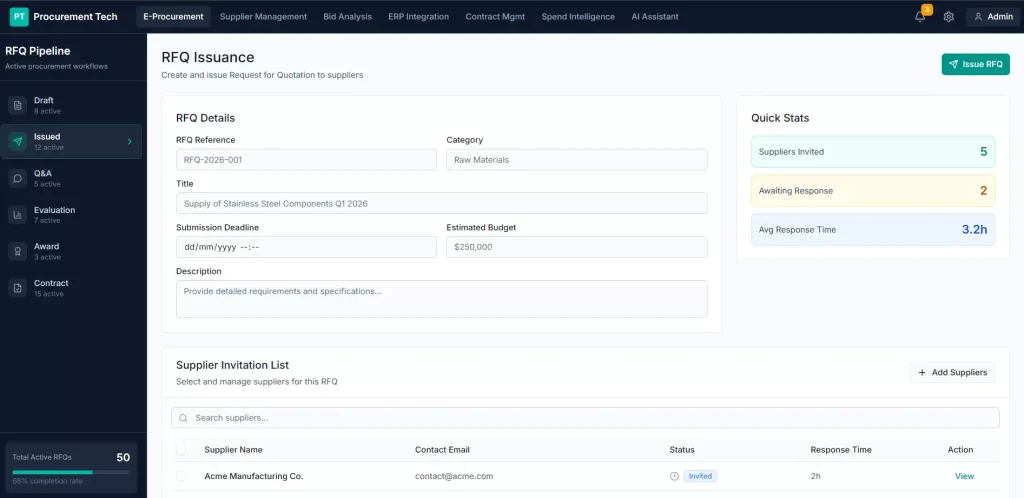
The traditional RFQ process: drafting documents in Word, distributing by email, receiving responses in varied formats, manually creating comparison spreadsheets is increasingly giving way to digitally powered approaches that dramatically improve efficiency, accuracy, and governance quality. Technology is reshaping every stage of the RFQ lifecycle.
E-Procurement Platforms and Supplier Portals
Modern e-procurement platforms provide centralized, browser-based environments where buyers can draft and issue RFQs, invited suppliers can submit structured responses through guided templates, and the system automatically compiles and presents a side-by-side bid comparison. This eliminates the manual data aggregation step, reduces transcription errors, and creates an automatic audit trail. Leading platforms also support configurable workflows, approval routing, and document management transforming what was once a chaotic email-driven process into a controlled, repeatable system.
Supplier Information Management Systems
Effective RFQ processes depend on having a well-maintained, segmented database of pre-qualified suppliers. Modern supplier information management (SIM) systems allow organizations to maintain comprehensive vendor profiles, track certification expiry dates, record performance history, and segment suppliers by category, geography, and capability. When an RFQ is needed, the procurement team can instantly identify and invite the most appropriate qualified suppliers rather than relying on memory or manually maintained spreadsheets.
Automated Bid Analysis and Comparison Tools
When suppliers submit quotations in a structured digital format, analytics tools can automatically calculate and visualize price comparisons, identify outliers, flag non-compliant responses, and model alternative award scenarios (e.g., splitting the award between two suppliers). These capabilities turn what was a labor-intensive manual evaluation into a rapid, data-driven analysis process. More advanced platforms incorporate machine learning to identify pricing patterns, predict market movements, and recommend sourcing strategies.
Integration with ERP and Financial Systems
One of the most significant technology-driven improvements in the RFQ process is seamless integration between procurement platforms and enterprise resource planning (ERP) systems. When an RFQ is awarded, the system can automatically generate a purchase order, update inventory forecasts, notify accounts payable, and trigger budget consumption tracking, all without manual re-entry of data. This integration reduces processing time, eliminates data errors, and provides real-time visibility into procurement commitments and spending against budget.
Integrated procurement platforms can manage the entire source-to-pay cycle within a unified system including RFQ management within a unified system that connects procurement data to financial reporting, inventory management, and supplier relationship workflows in real time.
Electronic Signatures and Contract Management
After the RFQ evaluation and award decision, the contract execution stage has traditionally involved physical document preparation, printing, courier delivery, and manual filing, a process that can take weeks and introduces multiple error points. Electronic signature platforms and digital contract management systems compress this timeline dramatically, allow remote execution, provide version control, and ensure that all stakeholders receive and can access the final executed documents instantly.
Data Analytics and Spend Intelligence
Organizations that run multiple RFQ cycles across categories accumulate rich datasets: historical pricing by supplier and category, award patterns, supplier participation rates, bid competitiveness ratios, and savings achieved versus budget. Spend analytics platforms aggregate and visualize this data, enabling procurement leaders to identify high-performing categories, underperforming suppliers, specification gaps, and strategic sourcing opportunities that would be invisible without digital aggregation.
Artificial Intelligence in RFQ Management
Emerging AI capabilities are beginning to influence several stages of the RFQ lifecycle. Natural language processing tools can assist in drafting specification documents by pulling from historical templates and identifying common gaps. AI-powered supplier discovery engines can identify new market entrants that match the buyer’s requirements, expanding the competitive pool beyond the known vendor database. Predictive analytics can forecast likely price ranges for common categories based on market data, helping procurement teams identify unusually high or suspiciously low bids that warrant further scrutiny.
Types of RFQs: Matching the Format to the Situation

Not all RFQs are created equal. Different procurement situations call for different RFQ formats and structures. Understanding the main types helps procurement professionals choose the most appropriate approach for each requirement.
Open RFQ
An open RFQ is published publicly on a procurement portal, company website, or government tender board and any qualified supplier may respond. This approach maximizes competitive reach and is commonly used in public sector procurement where transparency and equal opportunity requirements must be met. The trade-off is a higher volume of responses to evaluate and a greater need for structured evaluation processes to manage the volume fairly.
Closed (Selective) RFQ
A closed or selective RFQ is distributed only to a pre-selected list of invited suppliers typically from the buying organization’s pre-qualified vendor database. This is the most common format in private sector procurement. It is faster, more manageable, and more focused than an open RFQ, but relies on the quality and competitiveness of the pre-qualified supplier pool.
Standing RFQ / Blanket Order RFQ
For categories where the same products are purchased repeatedly in varying quantities over time, some organizations issue a standing RFQ that establishes a framework of prices valid for a defined period (e.g., 12 months). Suppliers submit prices for a catalog of items, and the buyer places call-off orders against the agreed prices throughout the period without re-running the full RFQ process for each purchase. This approach reduces administrative overhead for high-frequency, stable categories.
Reverse Auction
A reverse auction is a dynamic variant of the RFQ concept in which invited suppliers submit prices in real time through a digital platform, with each supplier able to see the current lowest price (but not the identity of the competitor offering it). Suppliers can lower their price during the auction window to compete for the award. This format is particularly effective for commodity categories with multiple fungible suppliers and has been shown to drive significant price reductions when used in appropriate contexts.
CONCLUSION
The RFQ remains one of the most practical instruments in procurement, straightforward in concept, but highly dependent on execution quality. Organizations that invest in clear specifications, structured supplier pools, and disciplined evaluation processes consistently achieve better pricing, stronger supplier relationships, and fewer contract disputes. Whether you’re issuing a simple closed RFQ for office supplies or running a multi-supplier competitive process for capital equipment, the fundamentals covered in this guide apply equally.
For teams looking to streamline the entire sourcing process from RFQ issuance to purchase order generation, exploring the leading eProcurement platforms available in the Philippines can help identify which tools best match your organization’s scale and workflow requirements.
FAQ Around Request For Quotation
Yes. A standard RFQ template typically includes a cover page with the RFQ reference number and submission deadline, a scope of supply section, a quantity table, delivery requirements, payment terms, and a structured price schedule for suppliers to complete. Many organizations maintain internal templates to ensure consistency across procurement cycles. Free downloadable templates are also widely available in Word, Excel, and PDF formats from procurement associations and government portals.
An RFQ email to a supplier should be concise and professional. It should clearly state what is being requested, attach the full RFQ document, specify the submission deadline and format, and provide a contact person for queries. The subject line should include the RFQ reference number and a brief description of the goods or services, for example, “RFQ-2025-047: Supply of Office Furniture.” Avoid negotiating terms in the email itself; all commercial conditions should be documented in the attached RFQ.
In government procurement, an RFQ follows stricter rules than in the private sector. It is typically governed by public procurement law or regulation (such as the Philippines’ Republic Act 9184), which mandates minimum supplier invitation counts, public posting requirements, sealed bid procedures, and full documentation of the award rationale. Government RFQs often have lower thresholds purchases below a certain value may be processed via simplified RFQ rather than a full public tender but transparency and audit trail requirements remain mandatory regardless of value.
A complete RFQ document includes: an administrative cover page (RFQ number, issue date, deadline), background and context, detailed scope of supply or services, quantity and unit of measure, delivery terms, commercial and payment terms, submission instructions, evaluation criteria, mandatory compliance documents, and a confidentiality clause. For complex purchases, technical specifications or engineering drawings may also be attached as appendices.