










 Limited to 100 registrants

An omnichannel retail strategy fails when a marketplace order claims the last unit your branch just sold. Staff then scan chat threads, POS logs, spreadsheets, and courier dashboards to decide who gets stock. The missed sale is the visible cost. Conflicting records and rules are the real problem.
A report by the Philippine Statistics Authority (PSA) shows that the digital economy reached ₱2.74 trillion Gross Value Added (GVA) in 2025. That equals 9.8 percent of the country's GDP. Digital growth alone does not build an omnichannel retail strategy. It multiplies the places where stock, price, and customer records disagree.
This guide gives you six implementation steps, cross-channel return rules, a 90-day sequencing template, and four measurement categories. Map one failing customer journey before you choose technology. That map shows whether your priority is data cleanup, stock allocation, order orchestration, fulfillment, or financial control.
Key Takeaways
An omnichannel retail strategy coordinates one shared record for stock, pricing, order status, and customer history across every channel.
Your system must connect seven things, and each one needs an accountable owner and a measurable output.
Build the strategy in six steps, and pass each acceptance check before you start the next one.
Measure completed journeys, channel contribution, fulfillment accuracy, and return reconciliation rather than channel count.
What an Omnichannel Retailing Strategy Actually Coordinates
An omnichannel retail strategy coordinates the shared records and rules behind every customer-facing channel. Branch, online, and marketplace transactions should share the same stock logic, pricing, average transaction value, order status, and customer history. The goal is to complete any customer journey without staff manually reconstructing the truth.
Assign one owner to each shared record: merchandising for SKU and price, operations for available stock, and finance for settlement. When channels compete for the last unit, an allocation rule reserves it first. For background on channel structures, see the guide to retail channel types.
Multichannel retail gives customers several ways to buy but keeps records separate by channel. Omnichannel retail connects those records so a customer journey moves between channels without hand-off failures. The table below shows the key operating differences.
| Operating characteristic | Multichannel | Omnichannel |
|---|---|---|
| Stock view | Separate quantities by channel | Shared availability with allocation rules |
| Order status | Channel-specific updates | One status record visible to authorized teams |
| Customer history | Repeated or fragmented profiles | Matched profile with consent controls |
| Pricing and promotions | Channel teams decide independently | Central rules with approved exceptions |
| Returns | Usually routed to the selling channel | Rules define where approval, stock, and refund occur |
| Reporting | Channel totals reviewed separately | Journey, contribution, and reconciliation views |
Your setup may be outgrown when staff reconciles stock after campaigns, customers see conflicting availability, or loyalty records are duplicated. The number of channels is not the test. See how HashMicro's retail software connects your channels, records, and decision rules in one place.

Where Channels Break for Philippine Retailers
An omnichannel retail strategy can fail at stock visibility, pricing consistency, order routing, or customer identity. Each of the four gaps looks manageable in isolation, but together they prevent a Philippine retailer from completing a customer journey without staff intervention or manual correction.
1. Separate stock per channel and the overselling that follows
A branch, website, marketplace, and social-selling team may each keep a separate quantity for the same SKU. The warning sign is an order accepted online after the branch has sold the last unit. The missing control is a shared available-to-promise calculation with a reservation timestamp.
2. Prices and promos that do not match across channels
In omnichannel retailing, a website coupon, marketplace voucher, and branch promotion can produce different selling prices. Staff explains exceptions manually, and finance struggles to separate a discount from a marketplace subsidy. The missing control is an approved price hierarchy and a contribution calculation that covers discounts, fees, and marketplace costs.
3. Orders arriving in five apps and re-typed by hand
A retailer may receive orders through a website, two marketplaces, a social inbox, and a messaging app. Re-typing each into a spreadsheet creates duplicate orders, missed cancellations, and unclear ownership. The missing record is an order queue with source, payment state, and fulfillment status.
4. Customer data split so loyalty never reads across channels
A changed mobile number, spelling variation, or guest checkout makes a branch customer appear as a new person online. Marketing cannot apply loyalty rules reliably, and service agents lack prior conversations when a return crosses channels. The missing control is a matching procedure, consent record, and role-based customer history.
7 Things Your System Must Connect
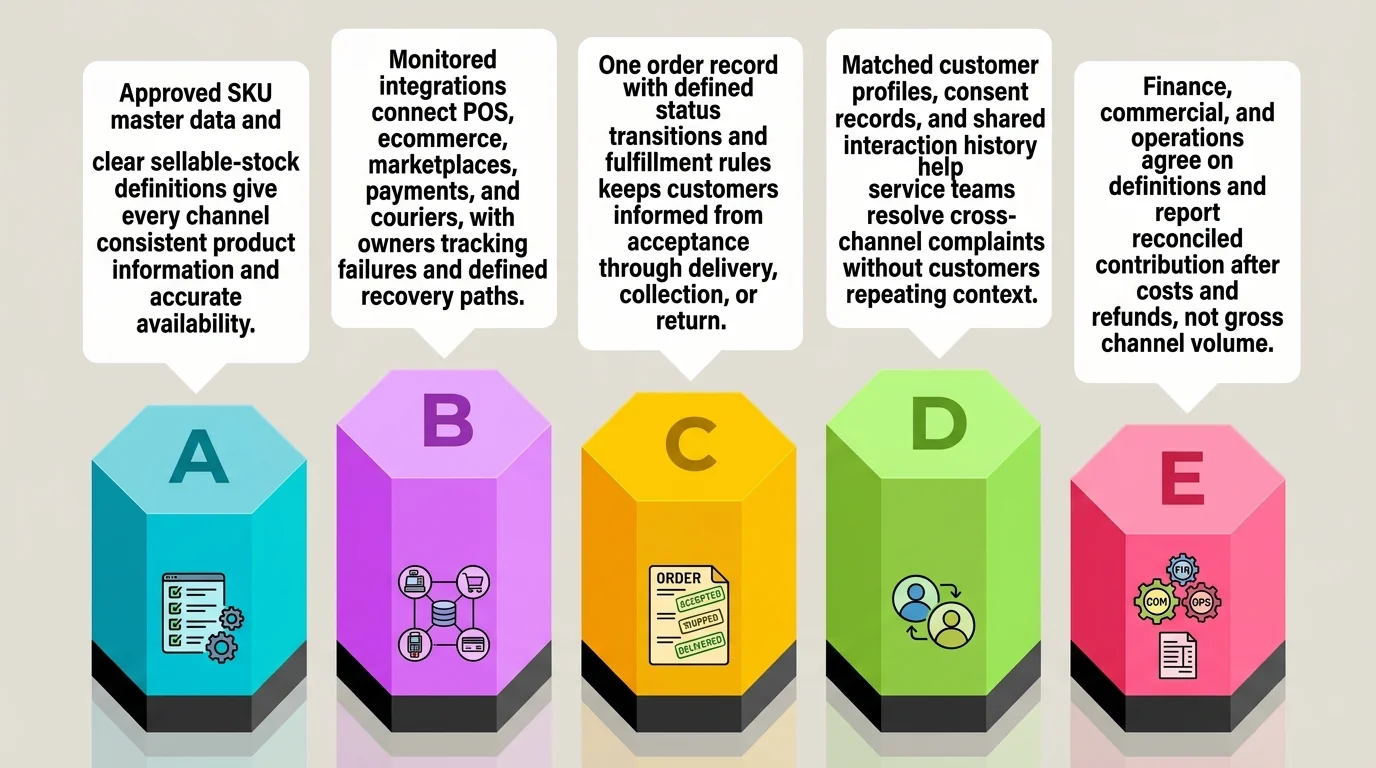
Seven connections form the operating foundation of an omnichannel retail strategy. They cover product data, stock availability, channel integration, order orchestration, fulfillment, customer data, and measurement. Each connection needs one accountable owner, a clear hand-off, and at least one measurable output. A gap in any connection breaks the customer journey.
1. Product and SKU master data
Approve one SKU structure, units of measure, variants, bundles, tax treatment, images, and channel descriptions. The merchandising or master-data owner should approve mappings before publication. A useful reference is this guide to stock keeping units.
2. Inventory visibility and available-to-promise
Define what is sellable, reserved, in transit, damaged, or awaiting inspection. Operations owns the calculation and the cycle-count procedure. The output is an availability view that channels can use without exposing stock that cannot be fulfilled.
3. Channel integration
Connect POS, ecommerce, Philippine marketplaces such as Shopee, Lazada, and TikTok Shop, payment services, and courier systems through monitored interfaces. The integration owner tracks failed messages, delayed updates, and duplicate transactions. Each point needs a recovery path. See How POS Integration Helps Philippine Businesses Boost Performance for channel-level detail.
4. Order orchestration
Create one order record with source, payment state, promised date, fulfillment location, status, cancellation reason, and exception owner. The order-management lead defines when a record moves from accepted to reserved, picked, dispatched, collected, completed, or returned.
5. Fulfilment options
Set rules for branch fulfillment, warehouse dispatch, click and collect, delivery, split shipment, and customer collection. The fulfillment manager owns cut-off times, hand-offs, proof of collection, and failed-delivery handling. Send customers a status update at each transition point.
6. Customer data and service
Match customer profiles, store consent, retain relevant interactions, and define who can view or amend data. Customer service owns the escalation path for cross-channel complaints, exchanges, and missing orders. A shared interaction history reduces the need to repeat context on every contact.
7. Measurement and reporting
Finance, commercial, and operations should agree on definitions before launch. Reports need channel costs, refunds, settlement timing, stock adjustments, and completed journeys rather than gross channel volume alone. A reconciled contribution report is more useful than channel totals that do not subtract costs.
| Connection | Business objective | Process integration required | Owner | Measurable outcome |
|---|---|---|---|---|
| Product and SKU data | Sell the correct item | Catalog approval and channel mapping | Merchandising | Approved SKU match rate |
| Inventory visibility | Promise only sellable stock | POS, warehouse, reservation, and count updates | Operations | Availability accuracy |
| Channel integration | Reduce duplicate entry | Monitored APIs or connectors | IT | Failed-message resolution time |
| Order orchestration | Make ownership visible | One queue and status model | Order operations | Orders with complete status |
| Fulfillment | Deliver or hand over reliably | Routing, picking, collection, and dispatch rules | Fulfillment manager | On-time, accurate completion |
| Customer data | Recognize and support customers | Matching, consent, and service history | Customer service | Matched profiles and resolved cases |
| Measurement | Support decisions | Shared definitions and reconciled reports | Finance and commercial | Trusted contribution report |
How to Build the Strategy Step by Step
Building a successful omnichannel retail strategy requires a disciplined sequence. Having the best inventory system is not enough to succeed. You must follow these six steps in order. Each step has a clear prerequisite, a tangible output, and an acceptance check. Skipping one creates downstream gaps in inventory, orders, or customer data that are harder to fix later.
Step 1: Clean the catalog and SKU master
A clean catalog is the foundation of any omnichannel retail strategy. Start with a catalog owner, duplicate review, variant rules, bundle definitions, and channel naming conventions. Deliver an approved SKU mapping. Accept the step when priority products share one approved identity across POS, website, marketplace, and finance records.
Step 2: Merge stock into one pool and set channel buffers
Define sellable, reserved, damaged, and in-transit quantities. Set channel buffers where branch operations or marketplace timing requires protection. Deliver allocation rules and an available-to-promise view. Accept the step when a test sale reduces availability in every connected channel according to the agreed rule.
Step 3: Pull every order into one queue
Omnichannel retailing requires a single order queue that captures every channel's sales. Record source, payment state, customer, promised date, location, and status. Deliver an order record that distinguishes orders from the website, marketplace, branch, and social. Accept the step when staff can trace any order and explain its status from one screen.
Step 4: Set fulfilment rules, including click and collect
Define routing, picking, packing, collection windows, identification checks, failed hand-offs, and cancellation points. Deliver routing and hand-off rules. Accept the step when a test order moves from reservation to dispatch with a named owner at each hand-off.
Step 5: Align pricing and absorb marketplace commission
Create a price hierarchy and calculate contribution after discounts, commissions, payment fees, shipping support, and fulfillment costs. Deliver a channel contribution calculation and approval rule. Accept the step when commercial and finance owners approve a sample promotion using the same assumptions.
Step 6: Unify customer data and loyalty
Unified customer data completes your omnichannel retail strategy. Define matching fields, consent capture, duplicate handling, guest orders, and loyalty eligibility. Deliver a customer-matching and consent procedure. Accept the step when staff can trace a test customer's authorized history across two channels without exposing restricted information.
Returns and Exchanges Across Channels
Every omnichannel retail return needs an approval owner and a stock-disposition rule before the customer arrives. The item may become saleable, damaged, or quarantined. The refund may wait for marketplace settlement or finance approval. A connected front end cannot compensate for an unclear back-office process.
When a customer returns an online order at a branch, the branch verifies the order, return reason, and product condition. Head office or customer service approves exceptions. The branch has recorded receipt, but we should not promise an immediate refund unless the payment and finance rules allow it.
Each return scenario assigns an approval owner and a stock treatment. Saleable items return to available stock after inspection. Damaged items go to quarantine. Marketplace returns are held until settlement clears, and exchanges need a replacement reservation. Keep the original order reference and return documents for every case.
Omnichannel Scenarios in Philippine Retail
The four scenarios below show where an omnichannel retail strategy breaks down in practice. Each one exposes a specific gap between what customers expect and what disconnected systems deliver. Philippine retailers operating across branches, marketplaces, and social channels face all four regularly.
1. Checking store stock before travelling to the branch
A customer who checks availability online and travels to a Trinoma branch may find the unit already sold. No omnichannel retail strategy works when branch stock and website data stay disconnected. The promise requires current stock, a reservation window, and staff confirmation.
2. Ordering online and collecting at a mall outlet
In omnichannel retailing, a shopper can pay online, arrive at SM Megamall, and find no pick list waiting for staff. The item sits in the stockroom while they wait at the counter. The scenario requires a collection window, identity check, and a completion status record at hand-off.
3. Selling live on social and reserving stock mid-stream
A Cebu-based brand host confirms two viewers for the same last-size blouse during a Facebook Live session. No reservation event fires, so the payment system charges both. One customer waits days for a refund. This requires real-time stock reservation that reduces available units under a stated rule.
4. Handling a return initiated through a different channel
A customer with a defective Lazada order messages the brand's Facebook page, but the agent has no order access. They visit a branch, which also has no record. Without shared status, the team lacks one return reference, and the refund takes two more weeks.
5. How the Scenarios Compare
| Journey | Channels touched | Capability required | What breaks without it |
|---|---|---|---|
| Check branch stock | Website, POS, branch | Location-level availability and reservation | Customer travels for unavailable stock |
| Collect mall order | Website, payment, branch | Pick, hold, identity check, completion status | Unclear hand-off or stale order status |
| Social live sale | Social channel, payment, inventory | Real-time reservation and expiry rule | Duplicate promises during the stream |
| Cross-channel return | Marketplace, service, branch, finance | Linked return, inspection, refund control | Repeated contacts or duplicate refunds |
How to Measure Omnichannel Retail Performance
Measuring an omnichannel retail strategy requires four metrics. The first checks whether promised journeys are completed. The second checks whether each channel contributes after costs. The third checks whether orders and stock move accurately. The fourth checks whether returns reconcile without leaving financial exceptions.
1. Customer experience metrics
Omnichannel retail performance starts with whether customers complete promised journeys. Cross-channel completion measures completed journeys as a share of eligible journeys. Define eligible journeys before reporting. Exclude cancelled requests only under an approved rule. Use order, service, and collection records to determine whether a journey was completed.
Formula:
Cross-Channel Completion Rate = Completed Eligible Journeys ÷ Eligible Journeys
2. Commercial metrics
Omnichannel retailing generates revenue across channels, each with its own costs. Contribution after channel costs takes net sales and subtracts discounts, commissions, payment fees, shipping support, and directly assigned fulfillment costs. Use reconciled order and settlement data, not gross marketplace sales alone.
Formula:
Contribution After Channel Costs = Net Sales − Discounts − Commissions − Payment Fees − Shipping Support − Assigned Fulfillment Costs
3. Inventory and fulfilment metrics
In omnichannel retail, order fulfillment accuracy measures orders delivered or collected correctly as a share of completed orders. Pair this with reservation accuracy, stock adjustment frequency, and order-status timeliness. A high completion rate can still hide incorrect items or late hand-offs.
Formula:
Order Fulfillment Accuracy = Correctly Fulfilled Orders ÷ Completed Orders
4. Financial control metrics
Return reconciliation time measures the elapsed time from returned-item receipt to approved stock and financial reconciliation. Track refund exceptions, settlement differences, and unresolved credit notes by owner and resolution deadline.
Formula:
Return Reconciliation Time = Date Reconciled − Date of Returned-Item Receipt
Mistakes That Stall an Omnichannel Rollout
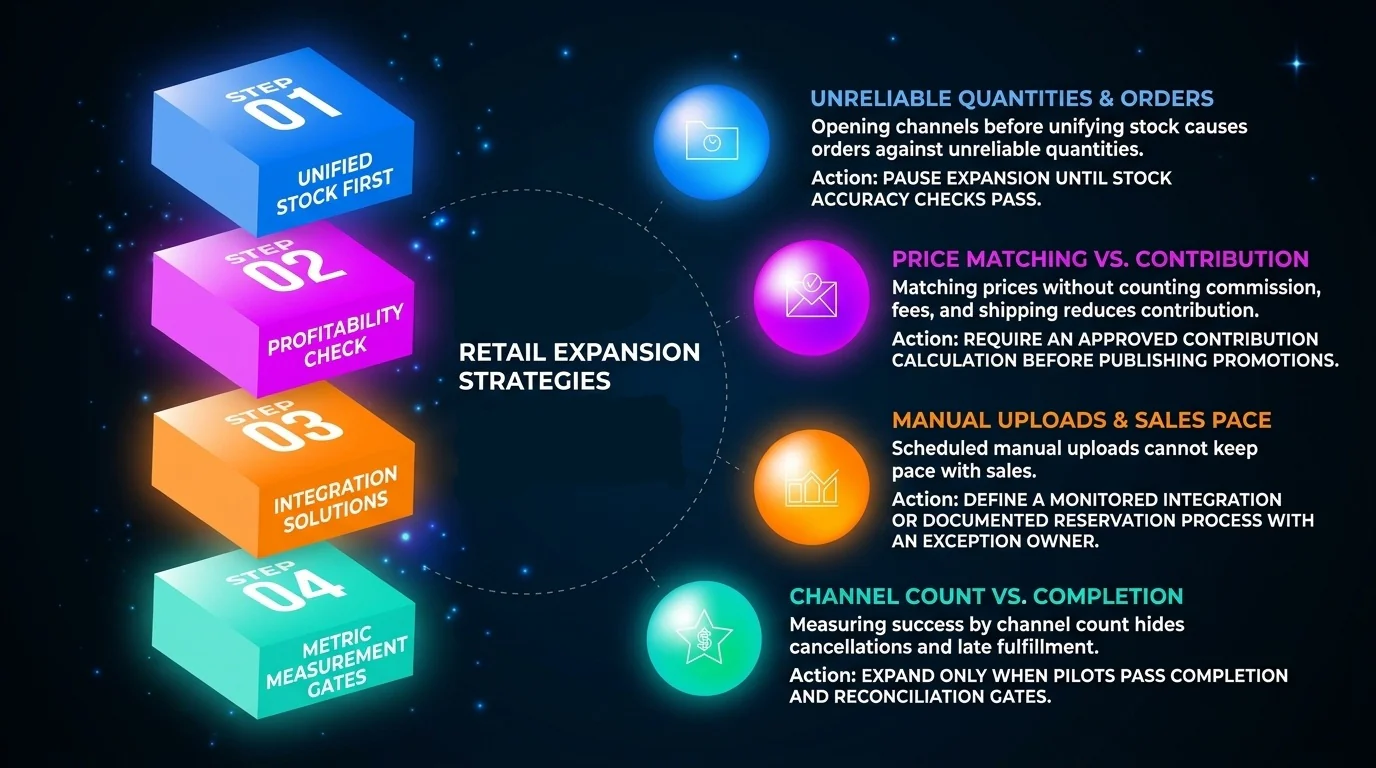
An omnichannel retail strategy fails most often because of execution errors, not planning gaps. Most rollouts stall on four recurring mistakes. Each can be caught early if teams monitor the right signals. Recognizing and correcting these four patterns protects the rollout from stalling.
1. Opening a new channel before stock is unified
Adding a new channel before stock is unified is one of the most common mistakes in omnichannel retail strategy. Orders flow in against unreliable quantities. Teams spend time correcting availability after each campaign instead of fulfilling orders.
- Failure: The new channel accepts orders against unreliable stock counts.
- Warning sign: Staff correct availability manually after each campaign.
- Corrective decision: Pause expansion and pass the stock-accuracy acceptance check first.
2. Matching prices without counting commission and shipping
A price that looks competitive may still reduce contribution after channel costs are applied. Commission, payment fees, and shipping support cut into margin. Without calculating net contribution first, the channel appears profitable when it is not.
- Failure: The channel appears competitive but reduces contribution.
- Warning sign: Finance cannot explain why net settlement differs from sales value.
- Corrective decision: Require an approved contribution calculation before publishing the promotion.
3. Relying on scheduled manual uploads to sync stock
Manual upload schedules cannot keep pace with omnichannel retailing. By the time a stock update arrives, customer promises may already conflict with actual availability. A monitored integration or a documented reservation process is needed to close this gap.
- Failure: Updates arrive after customer promises have already been made.
- Warning sign: Timestamps differ materially between POS, marketplace, and website records.
- Corrective decision: Define a monitored integration or a documented interim reservation process with an exception owner.
4. Measuring success by channel count instead of completed orders
Growing channel count feels like progress, but an omnichannel retail strategy advances only when orders complete correctly. Adding listings while customers experience cancellations, late fulfillment, or unresolved refunds is not growth. Measure completion and reconciliation before expanding.
- Failure: Management celebrates listings while customers experience cancellations, late fulfillment, or unresolved refunds.
- Warning sign: Channel reports grow, but cross-channel completion and return reconciliation remain undefined.
- Corrective decision: Use the metric categories above and expand only when the pilot passes its gates.
Conclusion
The Philippine digital economy reached ₱2.74 trillion in GVA in 2025, showing growth across the channels where customers buy. An omnichannel retail strategy connects those channels behind shared stock, pricing, and order rules. It is what makes digital growth complete orders rather than create conflicts.
An omnichannel retail strategy fails when these four patterns remain unchecked. Seven pillars give each shared decision an owner. Six steps build the operating foundation in the right order. Measure completion and contribution before expanding to more channels.
A working POS system is where omnichannel operations begin. Branch transactions need to reach shared stock, pricing, and order records in real time. HashMicro's retail software solves the problem by connecting these records into one system. Schedule a free consultation with our team to see how it fits your channels.
Frequently Asked Questions
Multichannel retailing adds sales points. Omnichannel retailing connects the records and rules behind them. The operational difference shows when a customer changes channels mid-journey. Multichannel stops there because each channel holds its own data. Omnichannel continues the journey because all channels read from the same record at the same time.
Set your channel buffers before a sale event opens, not during it. A shared calculation and reservation rule reduce the risk, but buffer size matters as much as the mechanism. Review prior event data to set a buffer that protects without creating unnecessary stockouts.
Yes. A two-branch retailer is often better positioned than a larger one with inconsistent data and no process owners. Branch count does not determine readiness. Data quality, stock-count procedures, and an owner for each shared record are the actual tests.
Click and collect removes the delivery partner from the equation. The customer absorbs the transit step, so the retailer owns one fewer failure point. Ship from store adds a dispatch leg, carrier hand-off, and proof of delivery. Start with click and collect unless branch hand-off capacity is the binding constraint.
Ninety days covers one pilot journey from catalog cleanup to a reviewed gate. Full deployment across channels typically takes longer because data cleanup alone can stall progress before integration work begins. The fastest rollouts start with a clear SKU owner, an approved stock count, and a single defined pilot journey.