







Completing an income tax return in the Philippines can be difficult for businesses that must reconcile sales, expenses, withholding records, BIR forms, payment channels, and supporting attachments before the deadline. A 2022 study of 400 BIR-registered micro and small enterprises in Bacolod City found that tax awareness correlates with higher compliance.
This shows how important tax awareness is for micro and small enterprises to comply when filing tax returns, as a misstep can ruin a business's financial plan.
An efficient tax return process helps businesses address this problem by organizing records early, selecting the correct BIR form, reconciling payments, and preserving submission evidence. Read further below to learn who should file the tax return, which BIR annual income tax to choose, and how tax preparation can be integrated with financial budgeting.
Key Takeaways
Single-employer compensation earners may qualify for substituted filing, while individuals, businesses, nonprofits, estates, and trusts must check their applicable BIR return requirements.
Choose your BIR annual income tax form based on taxpayer type, income source, filing status, and eligibility for specific tax rates or exemptions.
Avoid filing problems by choosing the correct BIR form, meeting the statutory deadline, completing payments and attachments, and using approved electronic filing channels.
What is a Tax Return?
A tax return is a comprehensive financial snapshot of a specific period, typically a fiscal or calendar year. It is the form you use to report income, deductions, credits, tax withheld, and tax still due for a taxable year.
In the Philippines, employees, freelancers, self-employed professionals, and corporations can all face annual filing obligations depending on how they earned income and whether they qualify for substituted filing. An efficient income tax return process helps businesses organize records, select the correct form, and reconcile payments.
Businesses handling numerous transactions need consistent financial records to reduce reconciliation gaps and filing errors. Use the best accounting software to centralize income, expenses, withholding records, and supporting documents before preparing a tax return.
Who Needs to File a Tax Return?
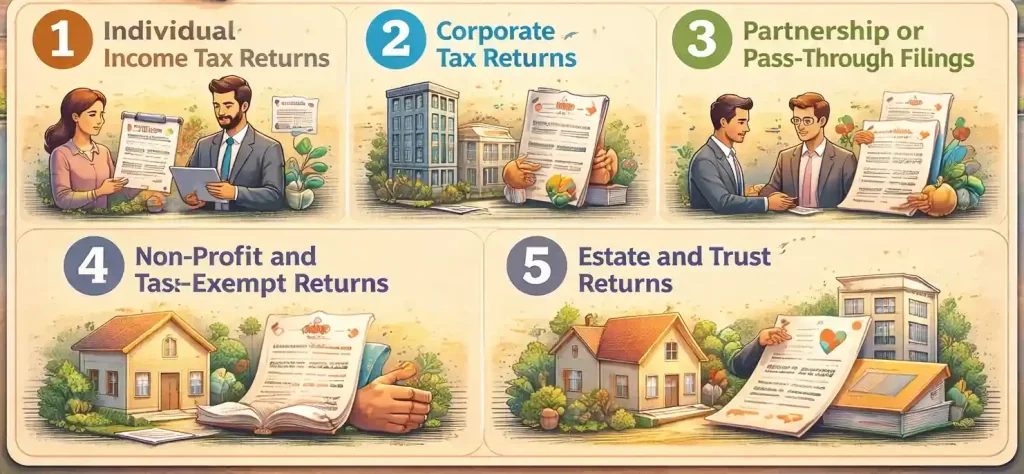
Income tax return Philippines rules allow some single-employer compensation earners to skip a separate annual income tax return through substituted filing when tax withheld equals tax due and the employer reports correctly. Other taxpayers must choose the appropriate BIR tax return based on whether the income belongs to an individual, corporation, partnership, nonprofit, estate, or trust.
1. Individual Income Tax Returns
This applies to employees, freelancers, self-employed professionals, and sole proprietors. Freelancers and sole proprietors filing for the first time should first check the BIR registration requirements for new businesses, since the TIN and Certificate of Registration issued there define what they must file. The return covers compensation, business income, and other reportable earnings.
Filing becomes more complex when taxpayers have multiple income sources, investments, or deductible expenses. Individuals following the calendar year must generally file their annual income tax return by April 15 of the following year in accordance with the BIR filing guidance.
2. Corporate Tax Returns
Corporations file their own tax returns on BIR Form 1702 because the business is treated as a separate legal entity from its owners. These filings usually require complete financial records, including revenue, cost vs expenses, assets, and other supporting schedules. The process is more detailed because the return must reflect how the company earned, spent, and reported its income.
3. Partnership or Pass-Through Filings
Some businesses do not pay income tax in the same way corporations do. Instead, income and losses may be assigned to the owners, who then report them on their own filings. Even so, the business may still need to submit an information return showing total income, deductions, and each owner’s share.
4. Non-Profit and Tax-Exempt Returns
Tax-exempt status does not remove the need to file, like non-stock, non-profit entities, need to file returns or information reports with the BIR to maintain their tax-exempt status. This helps prove that the group is operating within its stated purpose and following the rules tied to its tax status.
5. Estate and Trust Returns
An estate or trust may also need its own tax filing when it earns income. This usually happens when assets continue generating revenue before they are transferred to beneficiaries. These returns are used to report to BIR about that income and settle any tax obligations tied to the estate or trust.
Key Components of a Tax Return

Understanding how these three elements interact is the key to mastering tax compliance and strategy.
- Income Declaration: Taxpayers must report all taxable income, including wages, proportional salaries, dividends, other compensation, interest, rent, and capital gains from stocks, real estate, or cryptocurrency. Businesses must also declare total sales, deduct the cost of goods sold (COGS), and report other operating revenue.
- Deductions and Exemptions: Taxpayers can reduce taxable income by claiming eligible deductions. Individuals may deduct qualifying contributions or expenses, while businesses may claim operating costs such as salaries, office rent, and asset depreciation. Applying valid deductions accurately can lower the final tax liability.
- Tax Credits: Tax credits directly reduce the amount of tax taxpayers owe. Refundable credits can generate a refund when they exceed the tax liability, while non-refundable credits only reduce the tax due to zero.
Which BIR Annual Income Tax Form Should You Use?
| BIR Form | Who Should Use It | Key Condition |
|---|---|---|
| BIR Form 1700 | Individuals who earn purely compensation and other non-business or non-professional income. | Use this BIR form when substituted filing does not apply, such as when you worked for multiple employers during the year. |
| BIR Form 1701 | Self-employed individuals, professionals, mixed-income earners, estates, and trusts. | Use this form when you combine employment and business or professional income, claim itemized deductions, or do not qualify for Form 1701A. |
| BIR Form 1701A | Individuals who earn purely from business or professional practice. | You must use either graduated income tax rates with Optional Standard Deduction or the 8% income tax option. |
| BIR Form 1701-MS | Individual taxpayers whom BIR classifies as micro or small. | Eligible taxpayers may file manually or electronically through the applicable Offline eBIRForms package. They must confirm that their BIR classification and tax profile qualify. |
| BIR Forms 1702-RT, 1702-EX, and 1702-MX | Corporations, partnerships, and other non-individual taxpayers. | Use 1702-RT for regular-rate income, 1702-EX for exempt entities with no other taxable income, and 1702-MX for mixed income or special or preferential rates. |
Where to Pay and What Changes Under the Compressed Workweek
Filing and payment require separate confirmation. RMC No. 20-2026 directs taxpayers to pay through eFPS or BIR ePay channels, including LandBank Link.Biz, UnionBank, DBP PayTax, MyEG, and Maya, and retain proof. The guidance remains relevant because BIR still lists eFPS and ePay as active services.
However, BIR permits over-the-counter payment through Authorized Agent Banks only in limited cases such as when taxpayers filed through eBIRForms, their eFPS-AAB enrollment remains pending, or the eFPS system becomes unavailable. Taxpayers approaching the deadline should confirm their eligibility before paying manually and retain bank-validated proof of payment.
Taxpayers who need in-person filing assistance can visit an RDO eLounge. BIR prioritizes senior citizens, persons with disabilities, eligible compensation earners, and people without internet access. Revenue personnel must continue assisting taxpayers who enter the RDO by 5:00 p.m. until they complete their filing.
How to File an Income Tax Return in the Philippines
Knowing how to file a tax return correctly helps taxpayers avoid inaccurate entries, incomplete attachments, payment issues, and missing records. Follow each stage carefully because every step supports an accurate and verifiable filing:
- Prepare and reconcile your tax records: Gather invoices, receipts, bank statements, withholding certificates, and deduction documents. Compare every income source and expense before preparing your income tax return to identify missing or inconsistent figures. Use the top accounting software to assist your tax reconciliation.
- Identify the correct BIR form: Choose your annual income tax return based on your income type and taxpayer classification. Check whether Form 1700, 1701, 1701A, 1701-MS, or a corporate form applies.
- Select the applicable filing platform: Use eFPS if BIR mandates or approves your enrollment. Non-eFPS taxpayers can use Offline eBIRForms, while eligible taxpayers may submit specific returns through certified tax software.
- Complete and validate the return: Enter accurate taxpayer, income, deduction, withholding, and payment details. Review your calculations and use the platform’s validation function to identify errors before submitting your BIR tax return.
- Submit and save the confirmation: Submit through the designated platform and preserve the confirmation email or system message. Offline eBIRForms users should also capture the submission pop-up if the official email arrives late.
- Pay and submit attachments: Pay any tax due through an authorized electronic or eligible over-the-counter channel. Keep the payment confirmation and submit applicable financial statements or supporting documents through the required BIR facility.
- Retain the complete filing record: Store your return, submission confirmation, payment proof, attachments, and supporting calculations together. These documents support audits, amendments, financing applications, and future tax filing in the Philippines.
Mistakes That Can Create Trouble

Taxpayers may encounter several mistakes when preparing and submitting a tax return. Keep an eye on these common issues to avoid incorrect filings, missing documents, and payment problems:
- Choosing the wrong BIR form: Select the form based on your income type, not your job title. An employee with side-business or freelance income follows different requirements from a single-employer compensation earner who qualifies for substituted filing.
- Misunderstanding the filing deadline: Compressed-workweek arrangements change government office schedules, not statutory tax deadlines. Individual taxpayers required to file an annual return must generally submit it by April 15 of the following year.
- Ignoring payments and attachments: Submitting the return does not complete every filing obligation. Pay any tax due, submit the required attachments, and retain your filing confirmation, payment proof, and supporting records. Taxpayers claiming creditable withholding tax should also reconcile their BIR form tax credits before submission.
- Waiting to file manually: BIR generally directs taxpayers to eFPS, Offline eBIRForms, or certified tax software. RMC No. 20-2026 allows manual filing only under specified circumstances, such as an officially announced system outage.
Conclusion
Filing an income tax return in the Philippines requires accurate records, the correct BIR form, a suitable filing channel, timely payment, and complete supporting documents. By reconciling income and expenses early, validating every entry, and preserving filing evidence, taxpayers can reduce errors and manage their annual tax obligations more confidently.
Simplify your next tax return with HashMicro Accounting Software. Centralize transactions, track income and expenses, reconcile withholding records, and prepare BIR-related reports within one integrated system. Use HashMicro's free consultation with expert teams to make your tax preparation faster, more accurate, and easier to control.

FAQ for Tax Return
The return due now depends on your taxpayer type, registered obligations, and accounting period. For 2025 annual income tax returns, the BIR moved the 2026 filing and payment deadline to May 15. Check the 2026 BIR Interactive Tax Calendar to identify any return currently due.
There is no universal first tax return. Taxpayers follow the filing frequency assigned to each registered obligation, so monthly or quarterly returns may be due before the annual income tax return. Review your BIR registration and tax calendar to determine which form and period must be filed first.
The official BIR website is the best starting point for tax filing in the Philippines. It provides current forms, circulars, deadlines, and access to eFPS and Offline eBIRForms. Anyone researching how to file a tax return should confirm instructions there before relying on commercial guides or third-party summaries.
The best software depends on your BIR classification and filing requirements. Mandated eFPS taxpayers should use eFPS, while eligible non-eFPS taxpayers may use the latest Offline eBIRForms package. For complex business filings, verify that any third-party platform supports the required forms, payment channels, security controls, and submission evidence.
Missing the income tax return deadline can trigger a surcharge, interest on unpaid tax, and a compromise penalty; reduced rates may apply to qualified micro and small taxpayers. File and pay promptly, preserve your confirmation and payment proof, and verify the applicable charges with your RDO or current BIR guidance.