





Running a Philippine cafe takes more than serving good coffee. Effective cafe management helps owners coordinate staff, control costs, and standardize service. A 2025 study in International Journal of Research in Interdisciplinary Studies (IJRS) found that stronger resource management improved service efficiency and customer satisfaction. These findings show why owners need structured systems to stay profitable and grow.
Simply put, cafe management is the daily process of organizing people, money, inventory, and service so the business runs smoothly and earns consistently. Read on to learn how to manage staff while following labor laws, control inventory, set profitable prices, and keep your cafe running smoothly.
Key Takeaways
Cafe management coordinates daily operations, team performance, inventory, customer experience, and technology to deliver consistent service and protect profitability.
Set par levels, apply FIFO, monitor food cost percentage, and review ingredient prices to reduce waste while protecting cafe margins.
Cafe management software connects sales, inventory, staff scheduling, recipe costing, and reporting to replace manual tracking with faster, clearer decisions.
What Is Cafe Management?
Cafe management is the system that keeps a cafe profitable after opening day. Cafe management combines daily operations, team management, inventory control, customer experience, and technology use. It turns a cafe concept into a consistent business that can serve customers and protect its margins.
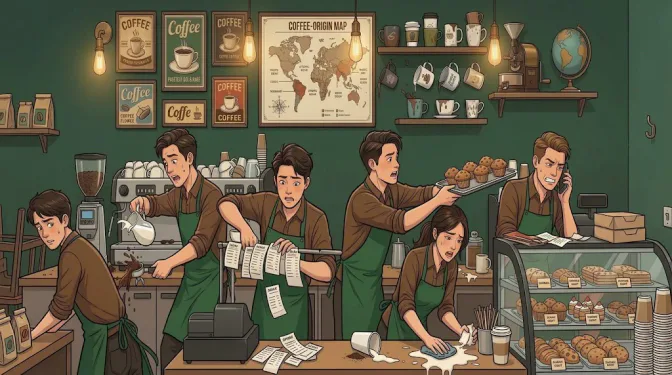
Opening a cafe focuses on launching the location, menu, and brand. It does not ensure steady sales, healthy margins, or consistent service. A strong product cannot offset poor scheduling, wasted stock, weak cost control, or staff turnover. Effective cafe management keeps these areas aligned and supports performance beyond the launch.
Owners in the Philippines must pay attention to DOLE labor compliance, local supplier relationships, and understanding what Filipino coffee drinkers actually want from their regular spot. Understanding these factors helps independent owners, aspiring entrepreneurs, shift managers, and SME F&B operators build cafes that remain competitive across NCR and the regions.
How to Keep Your Cafe Running Smoothly
A smooth shift starts before customers arrive and ends after the last receipt is reconciled. A cafe management system helps your team complete opening checks, assign peak-hour roles, monitor stock, and close accurately. These routines reduce delays and keep service, cash, and inventory under control throughout the day.
1. Opening Prep
Before opening, assign one team member to inspect equipment, prepare ingredients, verify stock against the par list, and count the cash drawer. Check the espresso machine, grinder, refrigeration units, syrups, portioned milk, and batch coffee. This 15- to-20-minute routine catches problems before the rush.
Opening checklist:
- Inspect the espresso machine, grinder, and refrigeration units.
- Prepare mise en place, including syrups, milk, and batch coffee.
- Verify stock against your par list.
- Open and count the cash drawer.
2. Managing Peak Hours
In Philippine cafes, weekday peaks often occur from 7 to 9 AM and 12 to 2 PM. Weekend traffic in SM and Ayala area cafes is significantly higher, so cafes should staff up on Fridays and Saturdays.
Assign clear roles for every shift, including bar, cashier, and floor coverage. Hold a five-minute huddle before service to review priorities, menu changes, and staffing gaps. During busy periods, protect speed and drink quality. One inconsistent order can quickly damage a regular customer's trust.
Typhoon season can cut foot traffic by 40% to 60%, especially when transport and mall operations face disruptions. Create a contingency plan for perishable stock by adjusting purchases, transferring ingredients between outlets, and promoting items before quality declines.
3. End-of-Day Close
At closing, count cash and reconcile it against the POS daily report. Count remaining perishables, run cleaning cycles on all equipment, and log waste or spillage. This routine keeps records accurate, highlights unusual variances, and helps your team extend equipment life.
Staff Management and Philippine Labor Compliance
Effective staff management starts with clear roles, practical training, and written service standards. A cafe measuring 40 to 60 square meters often needs two to three employees per shift. Larger outlets may add a shift leader. A cafe ordering system can clarify orders and reduce avoidable delays during busy service.
Train new hires on the menu, service SOP, cash procedures, and safety rules before their first solo shift. Use shadowing, role-play, and a sign-off checklist to make the training efficient. A poorly trained barista can slow Saturday service, increase waste, and weaken customer trust. Review performance after the first week.
1. Philippine Labor Compliance (DOLE Requirements)
Philippine cafe owners must track wages, statutory benefits, payroll records, and workplace safety. Small cafe owners often lack knowledge of the requirements. So here are the up-to-date DOLE requirements:
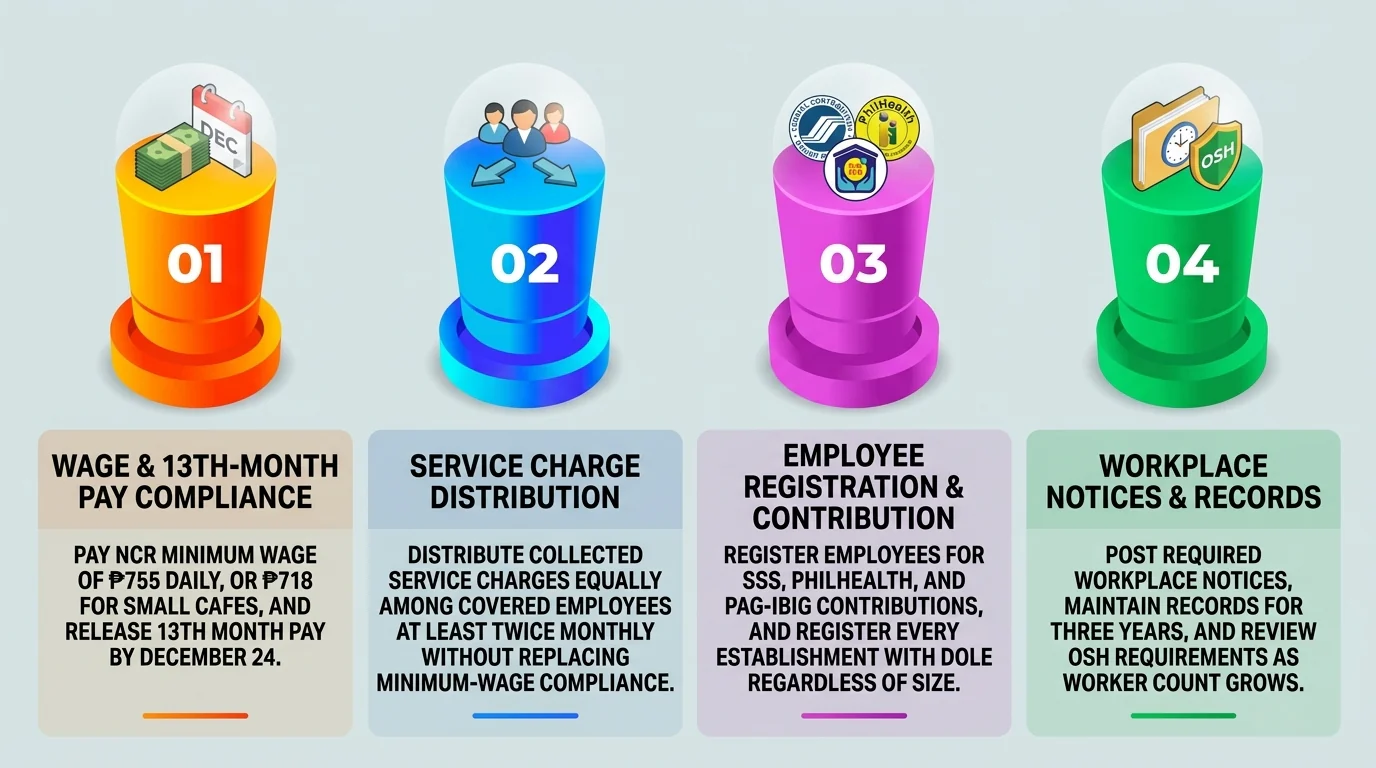
- Pay at least ₱755 per day for NCR non-agricultural workers under Wage Order No. NCR-28. Service and retail cafes with 15 or fewer workers follow the ₱718 rate.
- Pay 13th month pay in the Philippines to rank-and-file employees who complete at least one month of service. Release it by December 24, regardless of employment status.
- If collected, distribute service charges completely and equally among covered non-managerial employees, including contractual workers, at least twice monthly with intervals not exceeding 16 days. They cannot replace minimum-wage compliance. DOLE service-charge guidance
- Register employees and remit monthly SSS, PhilHealth, and Pag-IBIG contributions. Keep proof of registration, remittance, and employee deductions.
- Register every establishment with DOLE under Rule 1020, regardless of size. The 50-worker threshold applies to some OSH requirements, not basic establishment registration.
- Post minimum-wage, company-rule, and anti-sexual-harassment notices. Keep payroll and employment records for at least three years.
- Maintain the required OSH program and committee. At 50 or more workers, review additional OSH personnel and facility requirements with DOLE.
Keep digital records of schedules, attendance, payroll, contributions, and service-charge distribution. These records give owners clearer evidence during reviews and help managers identify staffing gaps, wage issues, or repeated service problems before they escalate.
2. Salary Benchmarks in the Philippines
Salary ranges vary by city, outlet format, experience, and benefits. These are the benchmarks as indicated by market estimates.
| Role | Monthly Range (NCR) |
|---|---|
| Barista | ₱19,630 to ₱25,000 |
| Shift Leader / Supervisor | ₱20,000 to ₱25,000 |
| Cafe Manager | ₱25,000 to ₱40,000 |
These ranges use ₱755 multiplied by 26 paid days, or ₱19,630, as a rough NCR monthly floor. The daily wage remains the legal reference, and actual monthly pay depends on paid workdays and payroll rules.
How to Control Your Inventory and Food Costs
If you are learning how to manage a cafe, start by tracking food cost percentage (FC%). FC% shows how much revenue goes toward ingredients. Consistent tracking gives Philippine cafe owners a clearer basis for daily decisions. Use this formula to identify pricing or purchasing problems before they weaken your margins:
Food Cost % = (Cost of Goods Sold ÷ Revenue) × 100
For Philippine cafes, target an FC% of 28% to 35%. If it stays above 35%, review prices, portion sizes, supplier costs, and waste. Your team can use a POS system that automatically updates inventory to connect sales with inventory movement and detect variances earlier.
For example, a caffe latte costs ₱55 to make, including milk, espresso, cup, and lid. If you sell it for ₱160, its food cost percentage is 34.4%. This figure falls within the target range, but you should review it regularly as ingredient prices change.
In formula form:
Food Cost = (₱55 ÷ ₱160) × 100 = 34.375% ≈ 34.4%
Set par levels for each ingredient and reorder at the minimum. Keep buffers based on shelf life and demand. Label arrivals, apply FIFO, and train staff to rotate stock every shift. Source beans from Benguet, Sagada, or Bukidnon when practical. Monitor milk costs and price premium alternatives carefully.
Tips for Building Customer Experience and Loyalty
Strong customer experience keeps Philippine cafes competitive beyond good coffee and interiors. Customers return when every drink tastes consistent, staff remembers their preferences, payments stay convenient, and complaints receive quick attention. These practical habits build trust, encourage repeat visits, and turn occasional guests into loyal customers who support steady sales.
- Deliver consistent drinks every time: Standardize recipes and train baristas to follow them during every shift. Consistent quality encourages customers to return.
- Build relationships through suki culture: Teach staff to recognize regular customers, remember preferences, and create the warm service that independent Philippine cafes can offer.
- Make payments convenient: Accept GCash, Maya, and other QR code payments to reduce queues and speed up transactions during busy periods.
- Offer a simple loyalty program: A stamp card such as “buy nine, get one free” can encourage repeat visits without requiring complex technology.
- Present every drink attractively: Clean presentation and well-poured drinks can encourage customers to share organic content on Instagram and TikTok.
- Resolve complaints quickly: Apologize, replace incorrect orders, and respond to Google Reviews professionally. Fast recovery can restore trust and protect your cafe’s reputation.
How Software Can Help with Cafe Management
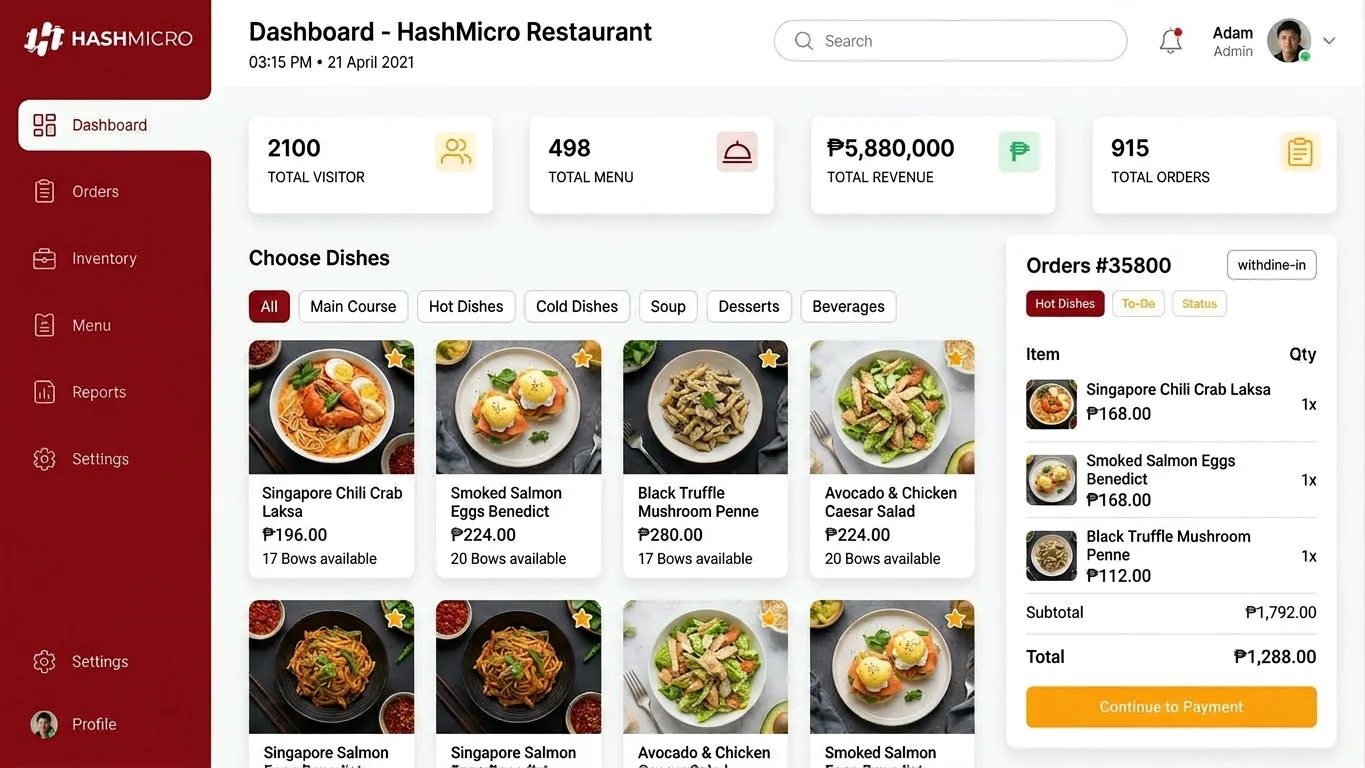
Manual tracking works for a small cafe, but it becomes harder as sales, stock, staff, and payments increase. When spreadsheets delay decisions or create reporting gaps, software can connect daily workflows. The right system helps owners reduce errors, protect margins, and manage service with clearer, more timely information.
A cafe management system can connect workflows that often run separately:
- Sync sales and inventory automatically: Each POS order updates stock, helping staff spot low ingredients and reduce manual counts.
- Simplify sales reporting: Managers can review peak hours, top-selling items, and daily revenue without manual calculations.
- Coordinate staff schedules: Managers can plan shifts, track attendance, and adjust coverage when demand changes.
- Update recipe costing: The system can recalculate food cost percentages when ingredient prices change.
Choose software that supports Philippine operations. Look for peso pricing, local tax settings, GCash and Maya payments, and reports that match your cafe’s needs. For a Philippine-focused option, explore the HashMicro restaurant POS system, which connects POS, inventory, and reporting in one platform.

Conclusion
Running a profitable cafe in the Philippines comes down to one thing: building systems that support consistent execution. Opening routines, compliant staffing, inventory controls, customer service, and accurate reporting help owners protect margins. These practices reduce daily confusion and let teams deliver reliable experiences without constant owner supervision.
The right technology strengthens these routines by connecting POS sales, inventory movement, staff activity, and business reports. Instead of relying on disconnected spreadsheets, cafe owners can use real-time information to identify waste, monitor demand, and make faster decisions. This gives managers more time to focus on quality and hospitality.
Ready to streamline your cafe operations? Explore HashMicro’s Restaurant Management System to manage sales, inventory, staff workflows, and reporting in one platform. You can request a free consultation to discuss your Philippine cafe’s needs and find a practical path forward.
FAQ About Cafe Management
A cafe manager turns business goals into reliable daily execution. They assign staff, review sales and food costs, control purchasing, resolve service issues, maintain safety standards, and coach employees. They also use reports to spot waste, adjust staffing, and protect margins while keeping the customer experience consistent across every shift.
An NCR cafe manager typically earns ₱25,000 to ₱40,000 per month in 2026, depending on outlet size, experience, responsibilities, and benefits. Smaller cities may offer less. Entry-level NCR barista roles should meet the ₱755 daily minimum for non-agricultural workers, while actual offers vary by schedule and benefits.
Yes, but the list depends on your business structure and location. Typical requirements include DTI or SEC registration, a barangay clearance, a mayor’s permit, BIR registration, and local health or sanitary approvals. Employers must also complete statutory registrations and DOLE establishment registration. Confirm the checklist with your LGU before opening.