









 Limited to 100 registrants

Philippine warehouses face rising labor costs, tight floor space, and faster delivery expectations. A DTI and World Bank assessment of 159 manufacturing firms put logistics costs at 27.16% of sales. That is more than double Thailand's 11.11%. Warehousing and inventory carrying absorb roughly half of that burden.
An automated storage and retrieval system, or AS/RS, ranks among the most established warehouse automation options. Some vendors write it as ASRS. It uses computer-controlled machines to store and retrieve goods from fixed locations. The system holds accuracy steady across every shift, SKU count, and throughput level.
This guide explains how an AS/RS works, which type fits your operation, and what it costs. You will also learn how to judge whether your Philippine warehouse is ready. Use it to decide before you commit capital.
Key Takeaways
An automated storage and retrieval system is a computer-controlled warehouse technology that stores goods in fixed locations and retrieves them on command.
AS/RS works by receiving an order, confirming the storage location, sending instructions to the S/R machine, moving goods by conveyor, and updating inventory records.
AS/RS helps warehouses improve space efficiency, pick accuracy, throughput, labor productivity, and inventory visibility when operational volume supports automation.
AS/RS fits businesses with high order volume, limited space, repetitive SKUs, and rising labor costs. Smaller operations may need WMS optimization first.
What Is an Automated Storage and Retrieval System?
An automated storage and retrieval system is a warehouse technology that stores goods in fixed locations and retrieves them on command. The AS/RS combines a warehouse storage system, motorized machines, and control software. It executes every movement in seconds and logs each transaction against inventory records automatically.
"The AS/RS business case in the Philippines holds when three conditions align. Active SKUs pass 3,000, daily order lines exceed 500, and the facility cannot expand outward. I see more companies reaching that point in Metro Manila and CALABARZON. Warehousing costs there have climbed over the past three years."
Core Components of an AS/RS
A complete AS/RS installation runs on five connected components. Each one covers a distinct part of the store and retrieve cycle. Together, they let an ASRS warehouse move goods from receipt to dispatch without manual handling.
- Rack and aisle structure: High-density racking extends vertically to maximize cubic space. Rails and aisle widths follow the retrieval machine's movement path.
- Storage and retrieval (S/R) machine: A motorized crane, shuttle, or extractor travels horizontally and vertically to reach each bin. Unit-load systems use aisle cranes, while VLMs use internal extractors.
- Conveyor and transport system: Conveyors link storage to pick stations, packing lines, and outbound dispatch. Items move between zones without a worker lifting them.
- WCS and WMS integration: The warehouse control system turns WMS pick orders into machine movements and manages traffic between units. The WMS holds inventory records, bin assignments, and order data.
- Sensors and barcode scanning: Position sensors and barcode or RFID scanners confirm each item and location. They feed live data back so inventory records stay accurate.
How Does an AS/RS Work? (Step-by-Step)
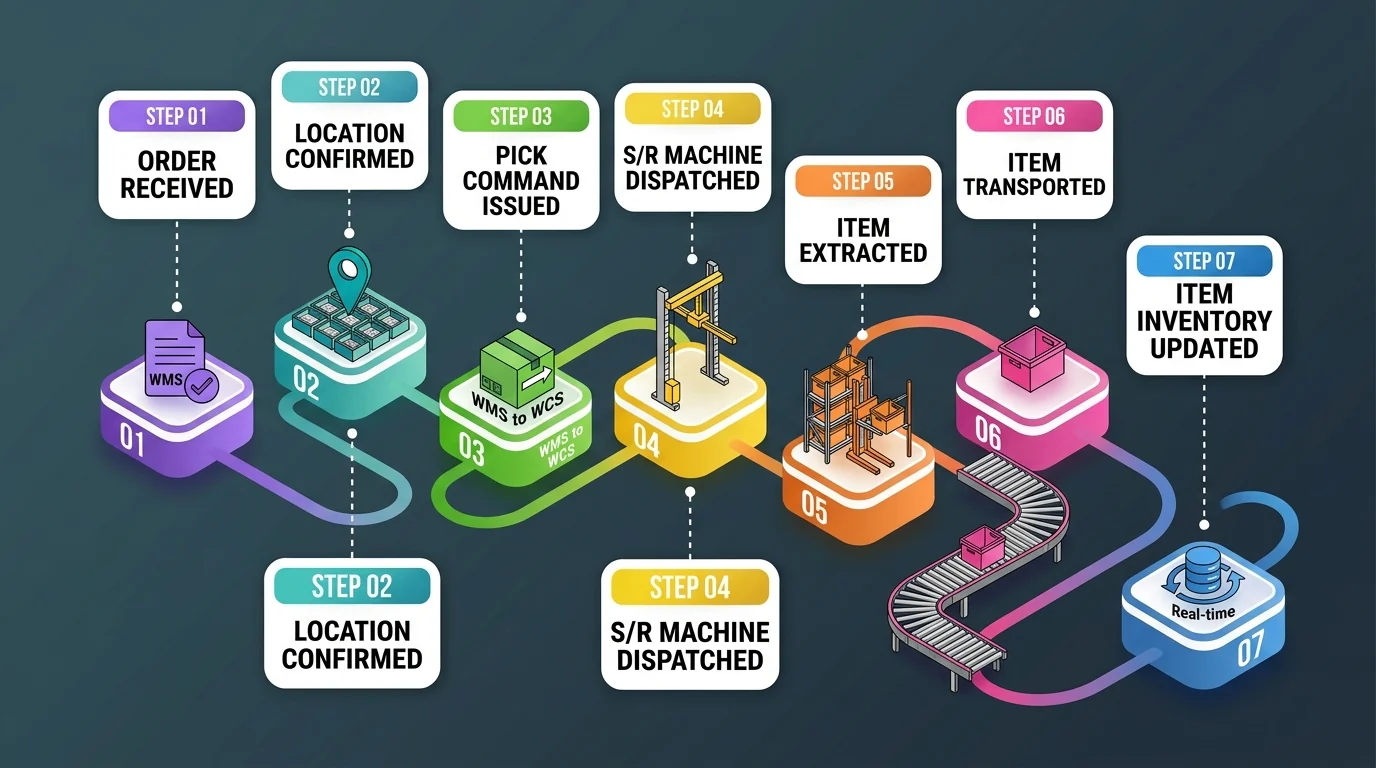
An automated storage and retrieval system runs on a tight, repeatable loop. It removes the navigation and identification steps where human error creeps in. The cycle below shows how an order moves from the WMS to the dispatch point in seven stages.
- Order received: The WMS behind the automated storage and retrieval system receives a customer order or internal replenishment request. It identifies the required SKUs and quantities.
- Location confirmed: The WMS pulls the current bin address for each SKU from its location master. Bin assignments follow pick frequency, weight, and product compatibility rules.
- Pick command issued: The WMS sends a retrieval instruction to the WCS. The command specifies the aisle, bay, level, and quantity.
- S/R machine dispatched: The retrieval machine travels to the specified location. Most systems complete this movement in 10 to 30 seconds, depending on distance.
- Item extracted: The machine extends its load handler, a fork, clamp, or belt conveyor, to pull the tote, pallet, or bin from the rack.
- Item transported: A conveyor carries the item to the assigned pick station, packing bench, or dispatch point.
- Inventory updated: The WCS reports the completed retrieval to the WMS. The system decrements the bin balance in real time.
This closed loop explains why an automated storage and retrieval system holds accuracy steady at scale. No worker walks an aisle or reads a label, so misidentification drops out of the process. The machine goes exactly where the WMS tells it, on every cycle.
4 Types of Automated Storage and Retrieval Systems
AS/RS is a category, not a single product. It spans compact units that fit inside an existing building and high-bay installations that fill a new one. Your choice depends on SKU size, throughput, ceiling height, and capital budget. The four types below cover most Philippine deployments.
Unit-Load AS/RS
Unit-load systems handle full pallets and large containers. A tall aisle crane serves each aisle and travels horizontally and vertically to reach bin positions. These systems carry the highest cost in any ASRS warehouse, but they deliver the strongest throughput and density.
- Best for: Cold storage, raw material warehouses, and distribution centers moving full pallets
- CAPEX range: ₱290 million to ₱1.2 billion and above
- Ceiling height: 12 meters minimum, 20 to 40 meters optimal
Mini-Load AS/RS
Mini-load systems handle totes, trays, and cartons rather than full pallets. A lighter crane or extractor serves each aisle in buildings with 8 to 15 meter ceilings. Most order-picking operations with high SKU variety choose this automated storage system.
- Best for: E-commerce fulfillment, spare parts distribution, pharmaceutical picking
- CAPEX range: ₱58 million to ₱290 million
Vertical Lift Module (VLM) and Carousel
VLMs store trays inside a sealed tower. An internal extractor locates the tray and delivers it to an opening at waist height, so the operator never enters storage. Carousels rotate shelving instead to bring the correct bin forward.
- Best for: Tool cribs, hospital pharmacies, small-parts warehousing, returns processing
- CAPEX range: ₱8.7 million to ₱29 million per unit
- Key advantage: Smallest footprint of any AS/RS type, and it fits buildings with 3 to 8 meter ceilings
Shuttle AS/RS
Shuttle systems run battery-powered vehicles on rails inside each racking lane. Unlike automated guided vehicles, they stay within the AS/RS rack structure instead of traveling across wider facility routes. Several shuttles work at once on different levels, so throughput scales as you add units to existing rails.
- Best for: High-density ambient storage, grocery distribution, fashion e-commerce
- CAPEX range: ₱58 million to ₱290 million
- Key advantage: Scales without new racking
| Type | Item handled | Ceiling needed | CAPEX range | Best for |
|---|---|---|---|---|
| Unit-Load | Full pallets | 12 m and above | ₱290M to ₱1.2B+ | Bulk and cold storage, high-volume DC |
| Mini-Load | Totes, cartons | 8 to 15 m | ₱58M to ₱290M | E-commerce, pharma picking |
| VLM / Carousel | Small parts, trays | 3 to 8 m | ₱8.7M to ₱29M | SMEs, tools, dispensing |
| Shuttle | Totes, cartons | 6 to 12 m | ₱58M to ₱290M | High-density scalable growth |
Key Benefits of Implementing an AS/RS
The business case for AS/RS rests on measurable outcomes, not theoretical efficiency gains. Five benefits carry the most weight for Philippine operations. Each one shows up in floor space, order accuracy, throughput, payroll, and stock records.
1. Space efficiency of up to 85%
According to MHI, an automated storage system compresses active floor space by 40% to 85% compared with conventional racking. The system uses ceiling height that forklifts cannot safely reach, and it removes wide clearance aisles. The warehouse costs in Philippine locations such as Metro Manila, Laguna Technopark, and Clark Freeport make that compression valuable.
2. Pick accuracy above 99.9%
MH puts AS/RS accuracy above 99.99% in its AS/RS fundamentals guide. Manual picking depends on a worker reading the right label every time. An automated retrieval system removes the walking, searching, and label reading where mistakes start. Fewer mispicks mean fewer complaints.
3. Throughput of 200 to 500 dual cycles per hour
A mini-load AS/RS completes 200 to 500 dual cycles per hour. One cycle covers a single retrieval and a single put-away. Human pickers in comparable operations finish 60 to 120 picks per hour. That gap decides whether you can promise same-day or next-day delivery.
4. Labor cost reduction of 30% to 70%
The NWPC sets minimum wage rates by region. NCR non-agricultural workers earn ₱695 per day under Wage Order NCR-26. A picking team of 20 to 50 workers on two shifts makes payroll a high fixed cost. An ASRS warehouse cuts that headcount by 30% to 70%.
5. Continuous inventory visibility
The WCS logs every movement and reconciles it against the WMS ledger in real time. Stock counts stay current by definition, so no drift builds between manual cycle counts. Discrepancies surface as exceptions the same day rather than as unexplained shrinkage at month end.
These numbers behave differently in every facility. Ceiling height, SKU profile, and order volume decide how much of each gain you capture. Model your own baseline before you treat any of these figures as a forecast for your warehouse.
"One benefit that consistently surprises clients is worker retention. When you remove the repetitive, physically demanding walk-and-pick cycle, you lower fatigue, improve job satisfaction, reduce turnover, and generate measurable five-year savings in the Philippine warehouse labor market."
Industries Using AS/RS in the Philippines
The automated storage and retrieval system serves industries that manage high SKU variety, strict traceability, or temperature-sensitive goods. Understanding ASRS meaning helps businesses connect the technology with faster movement and fewer manual touches. Five sectors stand out: F&B manufacturing, pharmaceuticals and healthcare, retail and e-commerce, cold chain logistics, and spare parts distribution.
1. F&B Manufacturing
F&B manufacturers in CALABARZON and Central Luzon manage ingredients, packaging, and finished goods across multiple zones. An automated storage and retrieval system can assign locations by batch or expiry date and deliver cases to dispatch. For example, it can move production-ready cartons from storage to outbound staging after quality approval.
2. Pharmaceutical and Healthcare
Pharmaceutical distributors and hospital pharmacies need accurate records for regulated inventory. An automated storage system can store medicines by product, batch, and expiration date while recording movements. For example, a hospital pharmacy can use a VLM to retrieve medicines after an authorized request and preserve an audit trail.
3. Retail and E-Commerce
Retailers and e-commerce centers in Metro Manila, Cavite, and Laguna handle many SKUs and parcel orders. An automated storage and retrieval system brings totes to pick stations instead of sending workers through aisles. A fashion warehouse can bring popular sizes and colors forward while linking each order to its bin.
4. Cold Chain Logistics
The Philippines' tropical climate raises the energy burden on refrigerated warehousing. PAGASA records show high mean temperatures and humidity across most regions throughout the year. An automated storage and retrieval system moves frozen pallets without workers entering the cold zone repeatedly. Fewer door openings mean less cold air loss and lower health risk for staff.
5. Spare Parts and Industrial Distribution
Automotive parts distributors and electronics suppliers hold thousands of small, high-value SKUs. A VLM or carousel retrieves the right part in seconds and logs the movement. Fast retrieval keeps dealer workshops running, so accuracy becomes a competitive advantage rather than an internal efficiency gain.
These five sectors share one need. They must move more inventory accurately without adding labor or floor space. An automated retrieval system links storage hardware to software. Choose by workflow, not industry label, since each sector prioritizes a different capability.
AS/RS vs. Manual Warehousing: A Side-by-Side Comparison
The choice between AS/RS and manual warehousing is first a financial modeling question first. AS/RS wins on space, accuracy, and throughput. Manual warehousing wins on capital outlay and speed to start. The table below shows both sides neutrally:
| Dimension | Manual warehousing | AS/RS |
|---|---|---|
| Space utilization | 40% to 60% of cubic volume | 70% to 90% of cubic volume |
| Pick accuracy | 97% to 99% | Above 99.9% (vendor spec) |
| Labor requirement | High, covering pickers, supervisors, and forklift operators | Lower, covering operators and maintenance technicians |
| Throughput | 60 to 120 picks per hour per worker | 200 to 500 dual cycles per hour |
| Upfront cost | Low, covering racking, forklifts, and onboarding | High, ₱8.7 million to ₱1.2 billion and above by type |
| Cost model | Ongoing OpEx, no large capital event | CapEx heavy, with annual maintenance on top |
| Payback period | Not applicable | 3 to 5 years, subject to sustained volume |
| Flexibility | High, reconfigure shelving and retrain staff in days | Limited, rack geometry and software are fixed at design stage |
| Downtime exposure | Pickers work around a single failure | One crane fault can stall an entire aisle |
| Maintenance | Forklift servicing and local parts | Specialist technicians and imported spare parts |
| Scalability | Add workers, constrained by floor space | Add modules or shuttles, constrained by WMS capacity |
| Implementation lead time | Weeks | 6 to 18 months |
AS/RS is not the right answer for every Philippine warehouse. The capital is large and the lead time runs 6 to 18 months. Payback also depends on volume you can actually forecast. Below a real throughput threshold, the numbers do not close.
Manual warehousing stays the better fit for many operations. It absorbs SKU changes quickly, starts within weeks, and keeps cost in OpEx rather than CapEx. Teams with seasonal or unpredictable volume often gain more from better layout and process discipline.
Run the model before you decide. Compare your current cost per order line against the projected AS/RS cost at the same volume. If the gap needs growth you cannot commit to, revisit the decision next year.
How Much Does an AS/RS Cost? (Philippine Business Perspective)
Cost is the most common barrier to adoption, and figures vary by system type, scale, and site conditions. The ranges below come from MTLI Group (2026), a systems integrator that aggregates installation cost data across multiple markets. All peso figures convert at ₱58 to US$1 and cover equipment only.
1. CAPEX by system type:
| System type | USD range | PHP range |
|---|---|---|
| VLM / Carousel (entry-level) | $150,000 to $500,000 | ₱8.7M to ₱29M |
| Mini-Load / Shuttle | $1,000,000 to $5,000,000 | ₱58M to ₱290M |
| Unit-Load (full installation) | $5,000,000 to $20,000,000+ | ₱290M to ₱1.2B+ |
2. Additional cost components:
- Installation: Add 20% to 30% above hardware CAPEX for civil works, electrical upgrades, conveyor integration, and commissioning.
- Annual maintenance: Budget 1% to 3% of installed CAPEX each year for preventive contracts, spare parts, and emergency service.
- WMS integration: Budget ₱2.9M to ₱17.4M and above ($50,000 to $300,000+) if your current WMS needs heavy customization or replacement.
- Payback period: MTLI Group puts typical payback at 3 to 5 years, citing MarketsandMarkets and BLS data.
3. What drives the price up in the Philippines:
Three local factors push automated storage and retrieval system costs above the converted figures. Import duties under HS Chapter 84 vary by origin country and FTA coverage, so engage a customs broker during planning. Local WMS integration adds cost when your system lacks a native AS/RS interface.
Technical availability is the third factor. Certified automated storage and retrieval system technicians cluster in Metro Manila and major economic zones. Provincial sites must budget technician travel time and longer response windows into the maintenance SLA, since an idle crane can stop the whole aisle.
Is an AS/RS Right for Your Business?
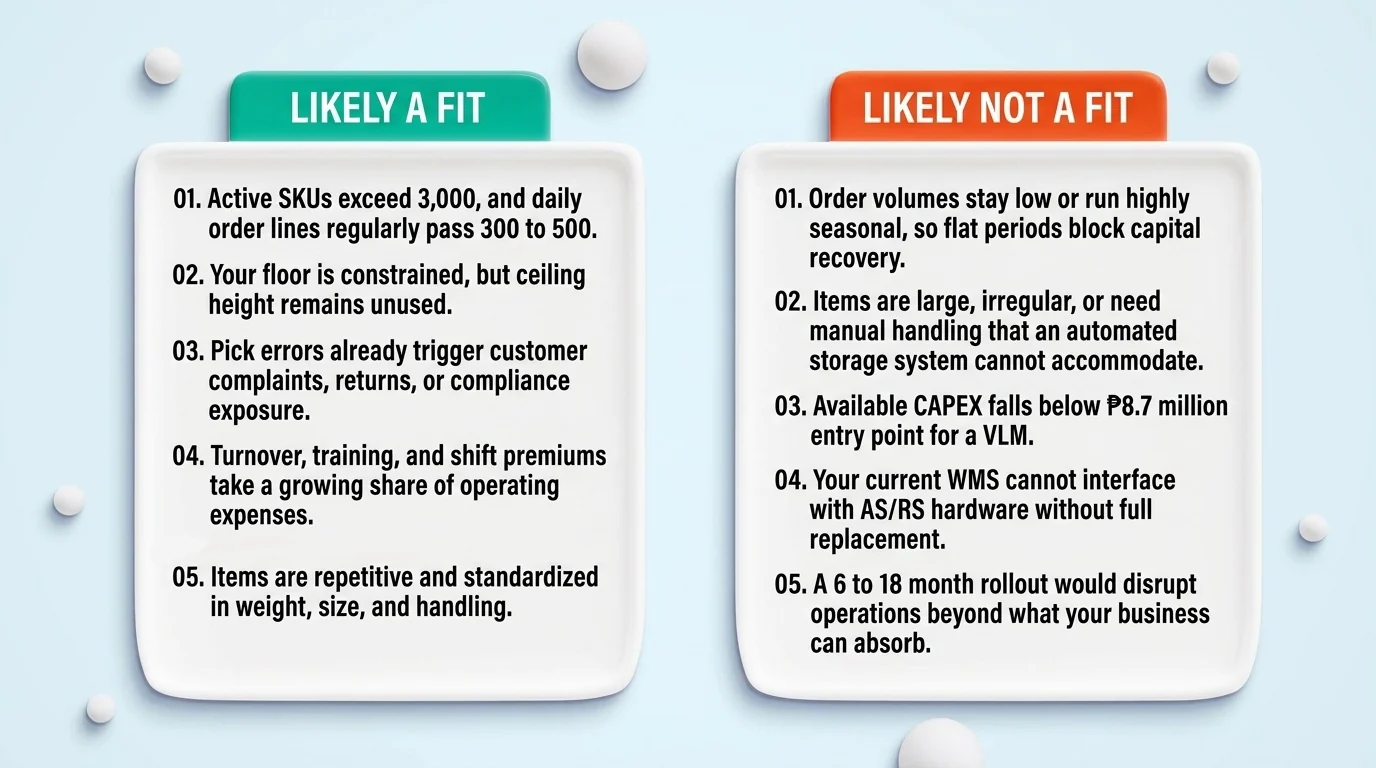
An automated storage and retrieval system pays back under a narrow set of conditions. The checklist below gives you a structured readiness assessment. Score your own operation against both lists before you request a single vendor quote.
AS/RS is likely a fit when:
- Active SKUs exceed 3,000, and daily order lines regularly pass 300 to 500.
- Your floor is constrained, but ceiling height remains unused.
- Pick errors already trigger customer complaints, returns, or compliance exposure.
- Turnover, training, and shift premiums take a growing share of operating expenses.
- Items are repetitive and standardized in weight, size, and handling.
AS/RS is likely not a fit when:
- Order volumes stay low or run highly seasonal, so flat periods block capital recovery.
- Items are large, irregular, or need manual handling that an automated storage system cannot accommodate.
- Available CAPEX falls below the ₱8.7 million entry point for a VLM.
- Your current WMS cannot interface with AS/RS hardware without full replacement.
- A 6 to 18 month rollout would disrupt operations beyond what your business can absorb.
Most Philippine warehouses land between the two lists. Businesses below the AS/RS threshold should start with a properly configured warehouse management system. A capable WMS improves location accuracy, optimizes pick paths, and generates the inventory performance data that builds a defensible AS/RS investment case.
"If picking labor costs exceed ₱3M monthly and errors exceed 1%, a VLM or mini-load system may pay back within four years. Below that threshold, optimize WMS setup and bin locations first to build a stronger AS/RS case."
How to Integrate AS/RS with Your Warehouse Management System
An automated storage and retrieval system needs a capable warehouse management system to act as its brain. The WMS tells the AS/RS what to store, where to move it, and when to release each task. Without that control layer, the equipment cannot reach its designed performance.
1. Location management
The WMS maintains the bin master for every SKU in the ASRS warehouse. It records each aisle, bay, level, and position. It also assigns storage locations based on pick frequency, product compatibility, and weight. Poor location data can send the automated retrieval system to the wrong bin.
2. Order orchestration
When an order arrives, the WMS breaks it into line picks and sends instructions to the WCS. It sequences tasks to reduce S/R machine travel, and releases pick waves based on current capacity. This is where AS/RS throughput becomes practical, not just theoretical.
3. Real-time inventory reconciliation
The WMS monitors every put-away and retrieval that the WCS reports. It reconciles each movement against the inventory ledger in real time. When a discrepancy appears, supervisors can resolve it during the shift instead of finding shrinkage during month-end counts.
Choosing a WMS that is compatible with your AS/RS is a critical step before investing. Confirm that it supports REST API, SOAP, or native vendor interfaces. It should also manage automated storage system locations and conventional rack locations in one hybrid warehouse.
For Philippine warehouses evaluating WMS options as part of AS/RS planning, review best warehouse management systems alongside your AS/RS vendor shortlist.
Conclusion
An automated storage and retrieval system is a warehouse technology that stores goods in fixed locations and retrieves them on command. It works best when hardware, WCS, and WMS data move together, so every bin, pick, and stock movement stays traceable.
Under the right conditions, AS/RS improves space utilization, pick accuracy, throughput, and inventory visibility. The cost reality remains significant. Entry-level VLM or carousel systems start around ₱8.7 million, while installation, maintenance, and WMS integration add more cost.
An automated storage and retrieval system fits businesses with high order volume, limited space, repetitive SKUs, and rising labor costs. If your operation is not ready yet, start with a compatible WMS. HashMicro WMS offers a free consultation to assess your warehouse data and automation readiness.
FAQ About AS/RS
An automated storage and retrieval system (AS/RS) is a computer-controlled warehouse setup. It stores goods in assigned locations and retrieves them on demand. It combines racks, retrieval machines, conveyors, and control software. MHI reports AS/RS accuracy can exceed 99.99% when the system matches the workflow.
The main AS/RS types are unit-load systems, mini-load systems, VLMs, carousels, and shuttle systems. Unit-load handles pallets, while mini-load and shuttle systems move totes or cartons. VLMs and carousels fit small parts. Choose by SKU size, throughput, ceiling height, and budget.
Philippine AS/RS costs start around ₱8.7M to ₱29M for VLMs or carousels. Mini-load and shuttle systems range from ₱58M to ₱290M, while unit-load projects reach ₱290M to ₱1.2B+. MTLI Group estimates installation at 20% to 30%, maintenance at 1% to 3% yearly, and payback at 3 to 5 years.
In the Philippines, AS/RS fits F&B manufacturing, pharmaceutical and healthcare distribution, retail and e-commerce fulfillment, cold chain logistics, and spare parts distribution. These sectors handle high SKU volumes, traceable batches, cold storage, or limited warehouse space. Each use case needs faster movement and stronger inventory control.
A small business can afford AS/RS only when the workload supports the investment. Entry-level VLM or carousel systems start around ₱8.7M. For smaller warehouses, WMS optimization, bin location rationalization, and layout fixes usually come before buying automated storage system hardware.
A WMS acts as the AS/RS brain. It stores inventory records, assigns bin locations, and sends pick instructions to the WCS. The WCS turns those orders into machine movements. Before procurement, choose a WMS that supports your AS/RS type, APIs, hybrid locations, and real-time reconciliation.