







Night shift payroll looks straightforward until a schedule crosses midnight, overlaps with overtime, or lands on a rest day or holiday. HR and payroll teams then have to decide which hours qualify, which premium applies first, and how the computation stacks. A single miscounted hour can understate an employee's pay, trigger a complaint, or leave the company's payroll records difficult to defend during an audit.
That is exactly why night shift differential pay deserves a clear computation process rather than a manual estimate each cutoff. In the Philippines, covered employees are entitled to a premium for every hour worked between 10 p.m. and 6 a.m., set at a minimum of 10% of the regular wage per covered hour.
This guide explains what night shift differential pay covers, who is entitled to it, how to compute it when overtime, rest days, and holidays overlap, and how HR teams can keep night shift payroll accurate as headcount and shift patterns grow.
Key Takeaways
Night shift differential pay generally covers work performed between 10 p.m. and 6 a.m.
The minimum statutory rate is 10% of the employee’s regular wage for every eligible hour
Payroll software can help connect schedules, attendance records, eligible hours, and pay calculations
What Is Night Shift Differential Pay?
Night shift differential pay is additional compensation for eligible employees who work during nighttime hours. In the Philippines, it applies to covered work performed between 10 p.m. and 6 a.m.
Under Article 86 of the Philippine Labor Code, employees must receive at least 10% of their regular hourly wage for each eligible nighttime hour, as outlined in the NWPC Workers’ Statutory Monetary Benefits Handbook. For an hourly wage of PHP 100, the minimum differential is PHP 10 per eligible hour.
An employee who works eight eligible hours would therefore receive PHP 80 in night shift differential pay, added to the regular wages for those hours. The actual rate may be higher if required by the employment contract, company policy, or collective bargaining agreement.
When Does Night Shift Differential Start and End?
The statutory night shift differential period runs from 10 p.m. to 6 a.m. the following day. Employees do not need to work the full eight hours to qualify, because the premium applies only to the hours that actually fall inside this window.
This is why shifts that begin in the evening or end in the morning rarely produce a clean eight-hour count. Any hour worked before 10 p.m. or after 6 a.m. is paid at the regular rate, so the eligible hours must be measured against the window rather than the total shift length.
| Work Schedule | Eligible Night Hours |
|---|---|
| 6 p.m. to 2 a.m. | 4 hours |
| 8 p.m. to 5 a.m. | 7 hours |
| 10 p.m. to 6 a.m. | 8 hours |
| 11 p.m. to 7 a.m. | 7 hours |
| 1 a.m. to 9 a.m. | 5 hours |
For a shift from 8 p.m. to 5 a.m., only the hours from 10 p.m. to 5 a.m. are covered, giving the employee seven eligible hours instead of nine. Companies should also confirm how meal breaks, unpaid breaks, attendance records, and rounding rules are treated under their payroll policy, since these directly change the final count.
Who Is Entitled to Night Shift Differential Pay?
Night shift differential pay generally applies to covered employees who work between 10 p.m. and 6 a.m. Eligibility depends on the employee’s actual duties, authority, work arrangement, and applicable labor rules, not the job title alone.
Covered private-sector employees: Employees who perform work during the statutory night period may receive at least 10% of their regular wage for every eligible hour worked.
Government employees: Government workers may follow separate rules, including provisions under Republic Act No. 11701. Do not apply private-sector rules without checking the regulations relevant to government employment.
Excluded managerial employees: Certain managerial employees and members of management may be excluded based on their authority, decision-making responsibility, and level of supervision.
Field personnel: Employees whose working hours and performance are not directly supervised by the employer may fall outside statutory coverage.
Specific excluded worker groups: Exclusions may also cover government employees, kasambahays, personal-service workers, and employees of retail or service establishments that regularly employ no more than five workers.
Before applying or excluding night shift differential pay, HR teams should verify each employee’s classification and review the latest labor guidance. When coverage is unclear, consult a qualified HR or labor-law professional.
How to Calculate Night Shift Differential Pay
Calculating night shift differential pay starts with identifying the employee’s regular hourly wage and the number of hours worked between 10 p.m. and 6 a.m. This step-by-step method helps HR teams apply the minimum 10% rate consistently before reviewing overtime, rest-day, or holiday premiums.
Step 1: Determine the Regular Hourly Wage
Start with the employee’s applicable regular hourly wage based on the company’s payroll policy and relevant wage rules. For this example, assume the employee earns PHP 100 per hour.
Step 2: Calculate the Night Differential Per Hour
Multiply the regular hourly wage by the minimum night shift differential rate of 10%.
The employee receives an additional PHP 10 for every eligible hour worked between 10 p.m. and 6 a.m.
Step 3: Count the Eligible Night Hours
Identify the hours that fall within the statutory night period. If the employee works from 10 p.m. to 6 a.m., all eight hours are eligible for the differential.
Step 4: Calculate the Total Night Shift Differential
Multiply the regular hourly wage by 10% to calculate the night shift differential per hour, then multiply that amount by the total eligible night hours. Formula:
Employees are entitled to a minimum night shift differential of 10% of their regular wage for eligible hours worked between 10:00 PM and 6:00 AM, subject to applicable Philippine labor regulations.
Night Shift Differential Examples
The scenarios below apply the 10% minimum rate to common Philippine shift patterns. Each example isolates the eligible hours first, because the total shift length rarely matches the number of hours that qualify for the premium.
Example 1: An 8 p.m. to 5 a.m. Shift
Example 1: 8 p.m. to 5 a.m.
An employee earning PHP 100 per hour works a nine-hour shift, but only seven hours fall within the 10 p.m. to 6 a.m. window. The night differential is PHP 100 × 10% = PHP 10 per hour, so:
The employee receives PHP 70 in night shift differential. The two hours worked from 8 p.m. to 10 p.m. are paid at the regular rate and are excluded from the computation.
Example 2: A 10 p.m. to 6 a.m. Shift
Example 2: 10 p.m. to 6 a.m.
This shift matches the statutory night period exactly, so all eight hours are eligible. At a PHP 100 hourly wage:
This shift matches the statutory night period exactly, so all eight hours are eligible. At a PHP 100 hourly wage:
The employee receives PHP 80 in night shift differential, the maximum amount available at this wage rate for a single shift.
Example 3: An 11 p.m. to 7 a.m. Shift
Example 3: 11 p.m. to 7 a.m.
An employee earning PHP 120 per hour works eight hours, but only seven are eligible because the final hour runs past 6 a.m. The differential is PHP 120 × 10% = PHP 12 per hour, so:
An employee earning PHP 120 per hour works eight hours, but only seven are eligible because the final hour runs past 6 a.m. The differential is PHP 120 × 10% = PHP 12 per hour, so:
The employee receives PHP 84 in night shift differential. The hour from 6 a.m. to 7 a.m. is paid at the regular rate.
Example 4: A Shift with Overtime
An employee works from 10 p.m. to 7 a.m., covering eight regular hours plus one additional hour. Payroll must separate the eligible night hours, the regular working hours, the overtime hours, and any rest-day or holiday premium before computing the total.
The eight hours from 10 p.m. to 6 a.m. qualify for the night differential. The extra hour from 6 a.m. to 7 a.m. falls outside the statutory night period, so it receives no night differential, although it may qualify as overtime if it exceeds the employee's regular daily hours. Apply the combined computation according to the applicable payroll rules and company policy.
Night Shift Differential vs Overtime Pay
Night shift differential and overtime pay are separate benefits, although an employee may qualify for both when the same work meets both conditions. Night shift differential applies to eligible hours worked from 10 p.m. to 6 a.m., while overtime pay applies to work beyond the regular daily schedule under applicable rules.
| Item | Night Shift Differential | Overtime Pay |
|---|---|---|
| Main purpose | Compensates work performed during nighttime hours | Compensates work beyond regular daily hours |
| Statutory trigger | Work between 10 p.m. and 6 a.m. | Work beyond eight hours in a day, subject to applicable rules |
| Minimum rate | At least 10% of regular wage per eligible hour | At least the applicable overtime premium |
| Can apply together | Yes, depending on the shift and applicable rules | Yes, depending on the shift and applicable rules |
| Main calculation factor | Eligible nighttime hours | Overtime hours and applicable base rate |
How Does Night Differential Work on Rest Days and Holidays?
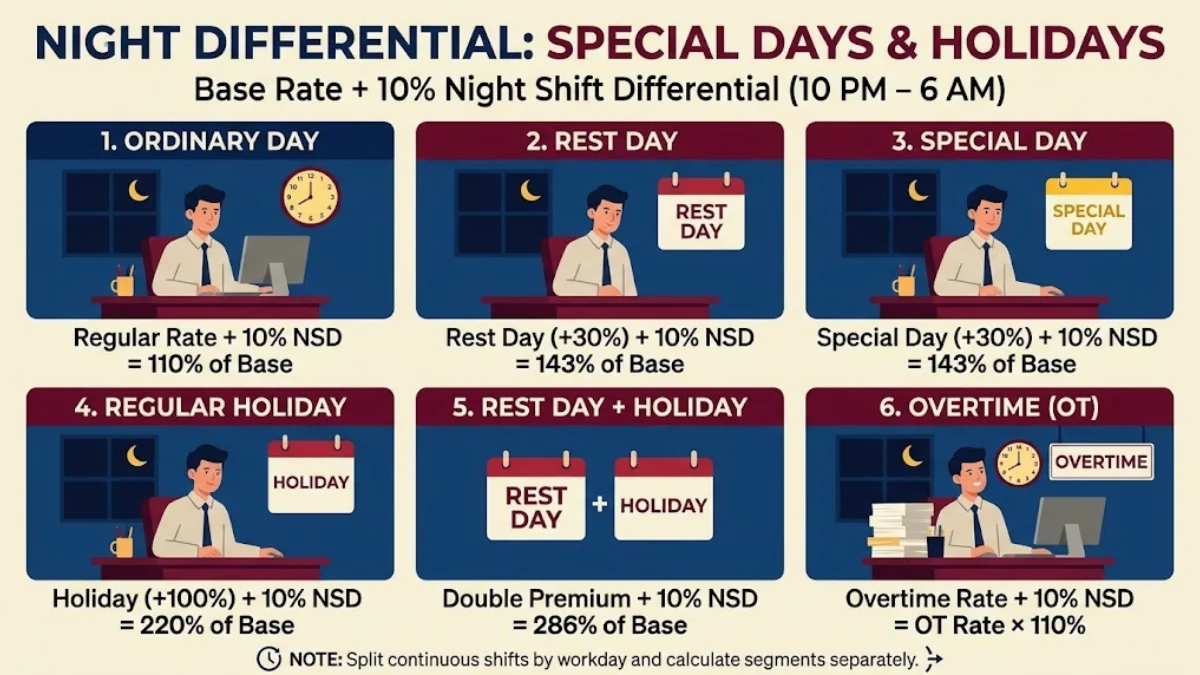
Night shift differential can overlap with rest-day, special-day, regular-holiday, and overtime premiums. Because each day type uses a different base rate, payroll teams must identify the day type first, then apply the night differential to the eligible hours.
Ordinary day plus night shift: The night differential applies to the hours worked between 10 p.m. and 6 a.m. using the regular hourly wage as the base rate.
Rest day plus night shift: Work performed on a rest day uses a higher base rate than an ordinary day. The night differential is then computed on that adjusted rate, not on the plain regular wage.
Special non-working day plus night shift: A special-day premium changes the base rate before the night differential is applied. Confirm the applicable premium for the specific day type declared.
Regular holiday plus night shift: Regular holidays carry the highest statutory premium. The night differential is calculated on the holiday-adjusted rate for the covered nighttime hours only.
Rest day and holiday plus night shift: When a holiday falls on an employee's rest day, both premiums may apply before the night differential is computed. Follow the guide computations in the NWPC handbook for the correct sequence.
Overtime plus night shift: Overtime hours that fall within 10 p.m. to 6 a.m. may qualify for both the overtime premium and the night differential. Separate the regular hours from the overtime hours before applying either rate.
A continuous shift that crosses midnight needs extra care, because one rate rarely applies to the entire shift. Split the hours by workday and applicable premium, compute each segment separately, then verify the result against the latest official guidance before releasing payroll.
How HR Software Helps Manage Night Shift Payroll
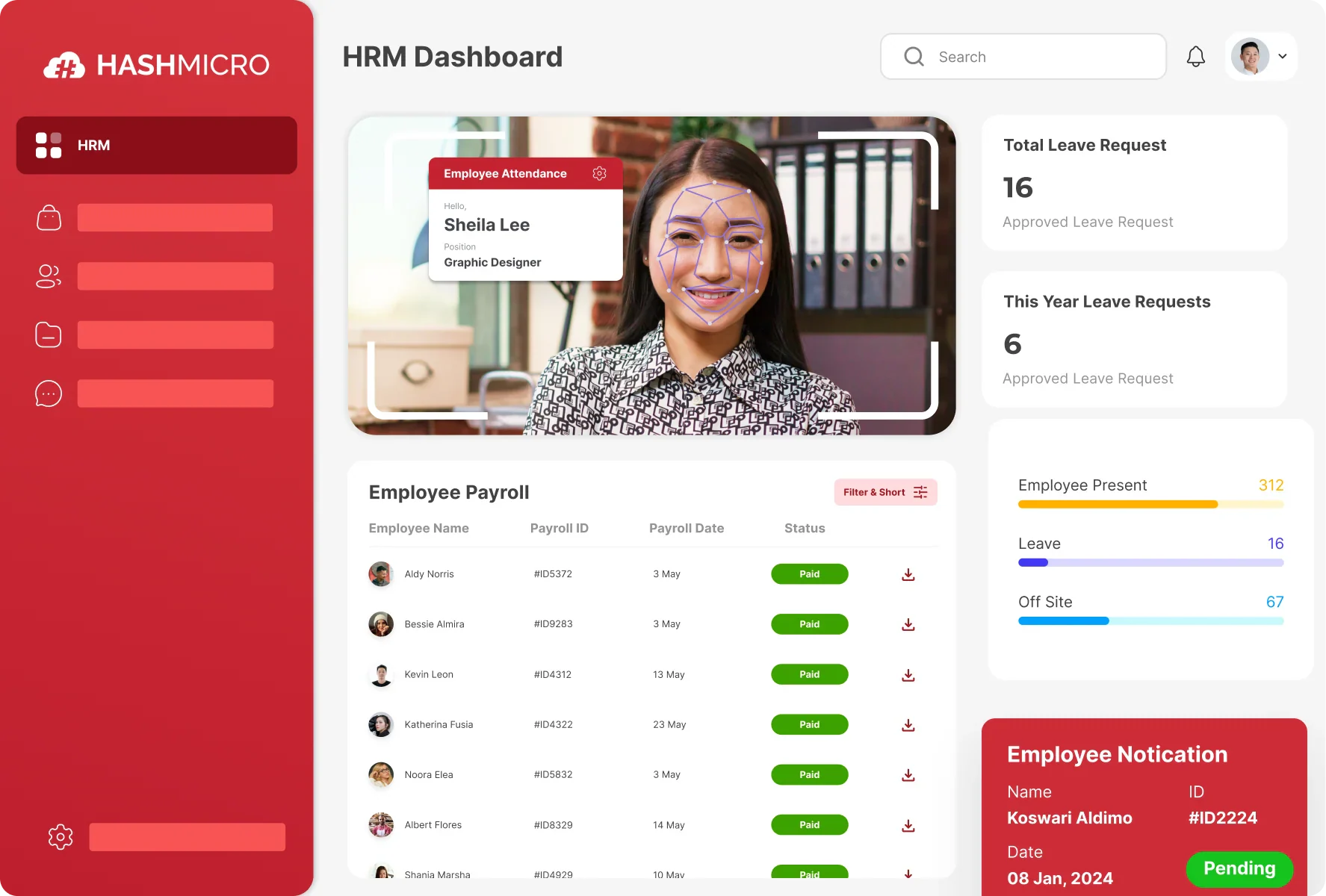
Night shift payroll becomes far easier to review when employee schedules, attendance records, approved overtime, and payroll calculations sit in one connected system instead of separate files. Manual tracking often breaks down when shifts cross midnight, overlap with rest days, or require last-minute time adjustments.
HashMicro HRM helps Philippine HR teams manage night shift payroll through capabilities such as:
- Shift and schedule management: Record employee schedules, shift patterns, rest days, and holiday assignments in one place.
- Attendance and time tracking: Capture clock-in and clock-out records, then identify the hours that fall between 10 p.m. and 6 a.m.
- Overtime and premium handling: Separate regular hours from overtime and apply the applicable rest-day or holiday treatment.
- Approval workflows: Route time corrections, overtime requests, and schedule changes to the right approvers before payroll processing.
- Payroll review and records: Check payroll calculations, payslips, and payroll registers against approved attendance data.
The real benefit is not only faster computation. HR teams can compare scheduled hours with actual attendance, investigate discrepancies before payroll is finalized, and keep a clear record of every adjustment.
If night shift computations currently require manual checking each cutoff, a free consultation can help you review your schedules, attendance sources, and payroll requirements, and see how HashMicro HRM would support them.
Conclusion
Night shift differential pay in the Philippines is calculated by applying at least 10% of the employee's regular wage to every eligible hour worked between 10 p.m. and 6 a.m. The key discipline is counting only the hours that fall inside that window, then reviewing overtime, rest-day, and holiday premiums as separate computations.
Accurate payroll, however, depends on more than the formula. It requires reliable schedules, complete attendance records, correct employee classifications, documented approvals, and a final payroll review before each cutoff is released.
If night shift computations still rely on manual checking every payroll period, book a free consultation with HashMicro. Our team can review your shift patterns, attendance sources, and payroll requirements, then show how an integrated HR and payroll system would handle night differential, overtime, and holiday premiums together.

Frequently Asked Questions
Covered employees must receive at least 10% of their regular hourly wage for every hour worked between 10 p.m. and 6 a.m. Employers may pay a higher rate if the employment contract, company policy, or collective bargaining agreement provides a more generous benefit.
The statutory night period starts at 10 p.m. and ends at 6 a.m. the following day. Hours worked before 10 p.m. or after 6 a.m. are paid at the regular rate.
Multiply the regular hourly wage by 10% to get the differential per hour, then multiply that amount by the number of eligible night hours. For example, a PHP 100 hourly wage gives PHP 10 per hour, so eight eligible hours equal PHP 80 in night shift differential.
Covered private-sector employees who work during the night period are generally entitled to the premium. Certain groups may be excluded, including government employees under separate rules, managerial employees, field personnel, kasambahays, and workers in retail or service establishments regularly employing not more than five workers.
An HR and payroll system can identify eligible night hours from attendance records, separate regular hours from overtime, and apply the configured premium rates during payroll processing. HR teams should still review the computation against approved schedules and time records before finalizing each payroll run.