







An employee resigns, and HR has weeks to answer one expensive question: how much does the company still owe? The stakes are real. According to the Daily Tribune, DOLE released ₱2.9 billion in monetary benefits to 58,212 workers through its Single Entry Approach program in 2024. Small and micro employers accounted for 63 percent of those cases.
If the math is off, you may overpay or give a former employee grounds for a complaint. This guide covers the exact final pay computation that Philippine employers must follow. The clock is also short. DOLE Labor Advisory No. 06, Series of 2020 sets a 30-day release deadline from the separation date.
The sections below break down what belongs in the final pay package. You get the formula for each component, a full sample computation in pesos, and the DOLE release timeline. We close with the errors that most often turn a clean exit into a compliance case.
Key Takeaways
Final pay covers all wages and monetary benefits due to an employee after separation, regardless of the reason.
Computing final pay follows five steps: last salary, pro-rated 13th month pay, SIL conversion, separation pay, then total.
Payroll software automates the five-step final pay computation, tracks SIL balances, and flags DOLE release deadlines.
What Is Final Pay in the Philippines?
DOLE Labor Advisory No. 06-20 defines final pay as all wages and monetary benefits due after separation. The advisory also recognizes last pay and back pay as equivalent terms. This rule applies regardless of the reason for separation, including resignation, retirement, contract completion, or termination. Use final pay as the primary compliance term.
Employers may hear last salary or separation package in conversations, but the advisory names final pay, last pay, and back pay as equivalent terms. Back pay does not mean only prior-period arrears. These payments may include unpaid salary, prorated 13th-month pay, convertible leave, applicable separation or retirement pay, tax refunds, contractual benefits, and refundable deposits, subject to eligibility rules.
Final Pay vs. Back Pay: What's the Difference?
HR teams often use these terms inconsistently, which creates confusion in payroll records and employee notices. The table below follows Labor Advisory No. 06-20 and separates official meaning from common workplace usage. It also corrects a frequent error that is treating back pay as only one component of final pay.
| Aspect | Final Pay | Last Pay | Back Pay |
|---|---|---|---|
| Meaning | All wages and monetary benefits due after separation. | The same meaning as final pay. | The same meaning as final pay. |
| Possible contents | Unpaid wages, prorated 13th-month pay, convertible leave, applicable separation or retirement pay, tax refunds, contractual benefits, and refundable deposits. | The same possible contents as final pay. | The same possible contents under official DOLE usage. |
| Common workplace usage | The preferred term for HR and payroll documents. | A common synonym for final pay. | Sometimes used narrowly for overdue wages or benefits, but this is not the advisory’s definition. |
| Recommended article usage | Use as the main term throughout the article. | Introduce it as an alternative term. | Explain its official equivalence before discussing informal usage. |
In practical terms, final pay is the complete amount due when employment ends. Last pay and back pay are alternative labels under the advisory, not separate statutory packages. HR teams should verify their back pay obligations against payroll records, company policy, the employment contract, and applicable law.
What Components Are Included in Final Pay?
Before computing final pay, HR should identify every amount due under the employee’s records, contract, company policy, and applicable law. The final pay components may include earned wages, statutory benefits, conditional separation or retirement pay, tax refunds, refundable deposits, and other promised compensation. The five sections below organize the line items used in Philippine payroll calculations.
1. Last Salary and Unpaid Wages: Pro-Rated Daily Rate
Calculate unpaid wages for days actually worked in the final pay period using the pro-rated salary formula: Monthly Salary ÷ 26 working days. Multiply that rate by the days worked, then add earned overtime, night differential, holiday premiums, commissions, and other unpaid wages.
2. Pro-Rated 13th Month Pay
Presidential Decree No. 851 governs this benefit for covered rank-and-file employees who worked at least one month during the calendar year, regardless of their resignation date. For a constant monthly basic salary, use: (Monthly Salary × months worked in the calendar year) ÷ 12; if the salary changed, divide the total basic salary earned during the year by 12.
3. Unused Service Incentive Leave (SIL)
Labor Code Article 95 grants eligible employees at least five days of paid Service Incentive Leave per year after one year of service. Convert unused SIL to cash upon separation; if company policy or a CBA grants more than five days, apply the higher entitlement.
4. Separation Pay, If Applicable
Voluntary resignation generally does not trigger statutory separation pay unless a company policy, contract, or CBA provides it. Under Labor Code Articles 298 and 299, redundancy and labor-saving devices use at least one month’s pay or one month per year, whichever is higher, while retrenchment and qualifying closure not due to serious business losses use at least one month’s pay or one-half month per year, whichever is higher.
5. Other Contractual Benefits
Add unused vacation or sick leave that company policy, a contract, or a CBA makes convertible, plus guaranteed bonuses and other earned contractual compensation. Include retirement pay due under Article 302 or an applicable plan, tax refunds, and refundable cash bonds or deposits; do not deduct unreturned equipment without signed employee consent and a lawful basis.
Because final pay combines salary, leave, statutory benefits, and conditional payments, manual checks can slow the offboarding process. A payroll management system with connected workflow helps HR calculate each applicable component and track the 30-day release deadline more consistently.
connected

How to Compute Final Pay in the Philippines: Step-by-Step
The final pay computation Philippines employers must run covers five components. Each step uses the same daily rate, so compute that figure first and apply it consistently. The final pay formula below covers earned wages, leave balance, and any applicable separation or contractual pay.
Step 1: Compute the Last Salary
If the employee completed the full final month, use the monthly basic salary. If they left mid-period, use the daily rate and multiply it by the days actually worked.
Last Salary = Daily Rate × Days Actually Worked
Add earned overtime, night differential, and any outstanding holiday premiums to the salary base.
Step 2: Compute the Pro-Rated 13th Month Pay
Presidential Decree No. 851 governs this benefit for all covered rank-and-file employees. Count every calendar month in which the employee worked at least one day.
Exclude allowances, overtime, and bonuses from the monthly basic salary figure.
Step 3: Convert Unused SIL to Cash
Apply only the leave days earned and not yet taken. Use the same daily rate from Step 1.
If company policy or a CBA grants more than the five-day statutory minimum, use the higher figure.
Step 4: Determine Whether Separation Pay Applies
Voluntary resignation does not trigger statutory separation pay unless a company policy or CBA provides it. For authorized cause terminations, the correct rate depends on the specific cause.
| Cause | Formula | Condition/Notes |
|---|---|---|
| Redundancy and labor-saving devices | At least 1 month's pay per year of service | Whichever is higher: 1 month or computed amount (Art. 298) |
| Retrenchment or closure not due to serious losses | At least ½ month's pay per year of service | Whichever is higher: 1 month or computed amount (Art. 298) |
| Voluntary resignation | None | Unless company policy or CBA provides otherwise |
Apply the one-month minimum and the whichever-is-higher rule to every authorized-cause computation.
Step 5: Total All Components
Add every applicable amount to arrive at the gross final pay. Include only the components the employee qualifies for based on contract terms, company policy, and applicable law.
Apply authorized deductions after totaling the components. Keep the computation consistent with payroll records for DOLE compliance documentation.
Example of Final Pay Computation (Mid-Year Resignation)
The scenario below turns the final pay formulas into a real case that HR teams can follow. Maria Santos joined on January 1 and resigned effective June 30 of the same year. Her monthly basic salary is ₱25,000, and she has 3 unused SIL days. She resigned voluntarily, so no separation pay applies.
Work through her final pay computation Philippines employers can copy line by line. Compute the daily rate first: ₱25,000 ÷ 26 = ₱961.54. That figure drives the SIL conversion. She worked the full month of June, so her last salary stays at the full monthly rate.
| Component | Calculation | Amount |
|---|---|---|
| Last salary (June) | Full month worked | ₱25,000.00 |
| Pro-rated 13th month pay | (₱25,000 × 6) ÷ 12 | ₱12,500.00 |
| Unused SIL (3 days) | 3 × ₱961.54 | ₱2,884.00 |
| Separation pay | Not applicable, voluntary resignation | ₱0.00 |
| Total final pay | Gross, before authorized deductions | ₱40,384.00 |
Maria's employer must release ₱40,384 no later than July 30, which falls 30 calendar days after her June 30 separation date. The company should issue her Certificate of Employment within the same period.
DOLE Rules on Final Pay: The 30-Day Release Requirement
DOLE Labor Advisory No. 06-20 sets the release deadline for final pay in the Philippines. Employers must release the amount within 30 calendar days from the date of separation. A shorter timeline in a company policy, employment contract, or CBA takes precedence. Treat the DOLE final pay rule as a ceiling, not a target.
The same advisory covers the Certificate of Employment. Employers must issue a COE within three working days of the employee's written request. Most companies release the COE alongside the final pay. However, the two obligations remain separate. Withholding the COE is its own violation, even when the employer meets the final pay 30 days Philippines deadline.
An employee whose final pay stays unreleased beyond 30 days may file a complaint at the nearest DOLE regional office. Cases usually enter the Single Entry Approach for mandatory conciliation first. Employers risk administrative sanctions and orders to release the full amount. An incomplete clearance process does not excuse the delay.
Common Final Pay Computation Mistakes Philippine Employers Make
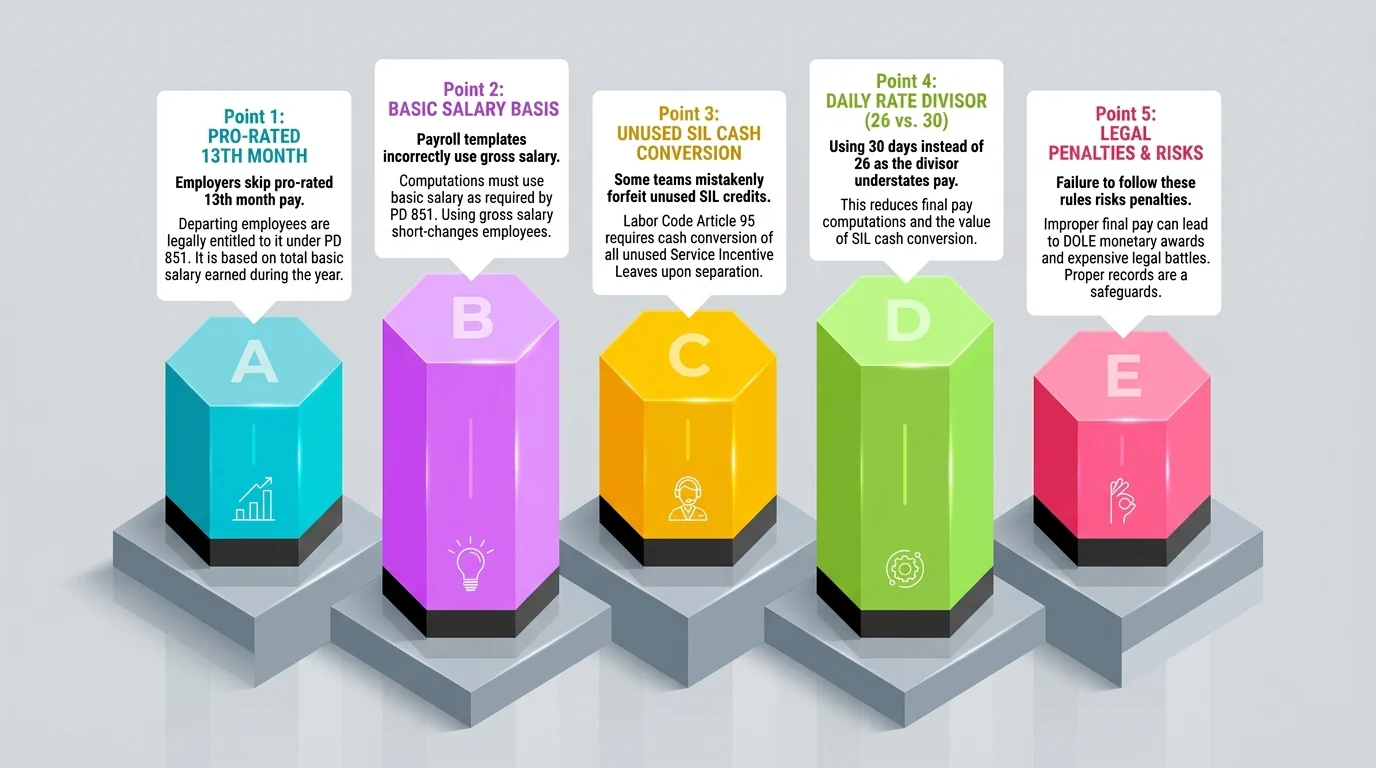
Even experienced HR teams overlook the same handful of computation details during offboarding. Most errors in payroll processing can be traced back to unclear internal policy, rushed clearance timelines, or outdated payroll templates rather than intent. The six items below cover the oversights that most often surface during a DOLE inquiry or a payroll correction.
- Skipping the pro-rated 13th month pay: Employers sometimes assume an employee who left mid-year forfeits the benefit. Presidential Decree No. 851 still requires the pro-rated portion for covered rank-and-file employees.
- Using gross salary instead of basic salary: Payroll templates often pull the gross figure by default. PD 851 bases the 13th month computation on basic salary only, so allowances, overtime, and night differential stay excluded.
- Not converting unused Service Incentive Leave to cash: Some teams treat leave credits as forfeited once the employee resigns. Labor Code Article 95 requires the cash conversion of unused SIL upon separation.
- Using the wrong daily rate divisor: Dividing the monthly salary by 30 calendar days instead of 26 working days lowers the daily rate. That single input flows into both the last salary and the SIL conversion, which understates the total.
- Releasing final pay past the 30-day mark without notice: A slow clearance cycle is the usual cause, not a deliberate delay. Documenting the reason and updating the employee keeps a routine holdup from turning into a complaint.
- Applying deductions without written consent: Employers occasionally net out unreturned equipment or cash advances during the final run. Each deduction needs a signed clearance or written authorization from the employee before it appears on the computation.
How Payroll Software Helps Automate Final Pay Processing
Final pay computation carries more variables than a regular payroll run. Each separation brings its own reason for leaving, months worked in the calendar year, remaining leave balance, and separation pay question. Add the 30-day release clock, and manual spreadsheet work becomes slow and error-prone for HR teams.
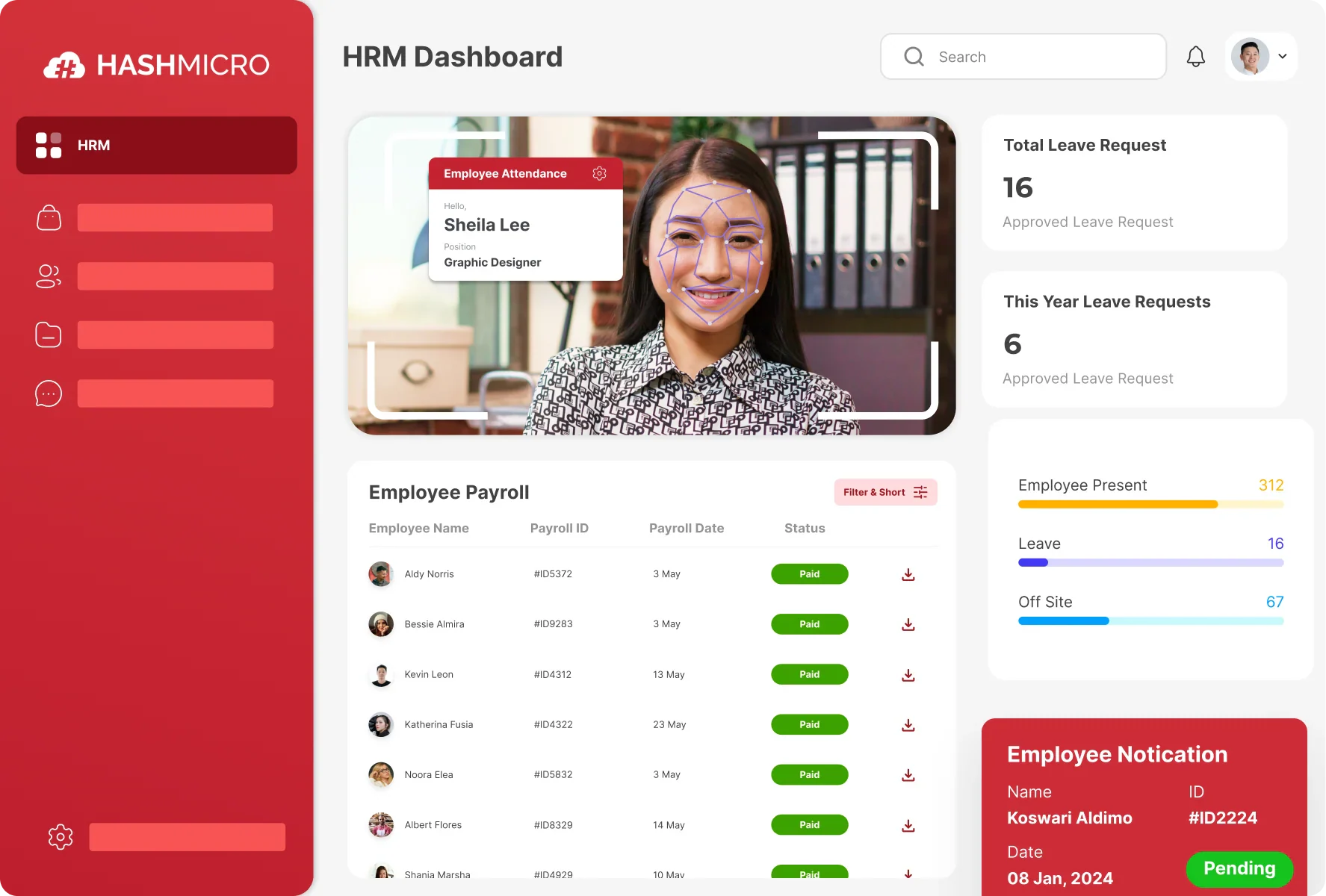
Payroll software for employers in the Philippines removes most of that manual effort. HashMicro Payroll Software computes prorated salaries from attendance and contract data, generates 13th month pay reports, tracks live SIL balances per employee, and flags release-deadline reminders. The figures stay consistent with each employee's actual payroll history.
Key features:
- Auto-computes every final pay component once HR marks an employee for offboarding
- Sends DOLE compliance reminders tied to the 30-day release deadline
- Exports SIL and leave balance reports for conversion and audit review
- Keeps a full computation and approval trail for DOLE documentation
Once HR identifies the final pay components, HashMicro's human resource management software can connect employee records, leave balances, and payroll data. This gives HR teams a clearer basis for accurate calculations and timely offboarding.
Conclusion
Final pay is a legal obligation, not a courtesy payment. DOLE ties it to a fixed formula and a fixed 30-day deadline, so employers who compute each component correctly and release on schedule protect both the departing employee's rightful compensation and the company's standing during a labor inspection.
The right payroll system makes this process consistent and repeatable as the team grows. Instead of rebuilding the computation in a spreadsheet for every resignation, an integrated system applies the correct divisor, salary base, and deadline automatically, so accuracy does not depend on who is running payroll that month. Start your search for a payroll system by scheduling a free consultation for HashMicro HR software.

FAQ About Final Pay Philippines
DOLE Labor Advisory No. 06-2020 requires employers to release an employee's final pay within 30 calendar days from the date of separation. This 30-day period is a maximum ceiling, not a target, unless the company's CBA or internal policy sets a shorter deadline for release.
Filipino employees often use these terms interchangeably, but DOLE distinguishes them. Final pay is the total package of entitlements upon separation, including last salary, 13th month pay, and SIL conversion. Back pay strictly refers to unpaid wages or overtime already earned but not yet released.
An employee whose final pay is not released within 30 days may file a complaint at the nearest DOLE regional office. The employer becomes subject to administrative sanctions for the delay. DOLE resolves these cases through its regional dispute mechanisms.
The formula is: (Monthly Basic Salary × Total Months Worked in the Calendar Year) ÷ 12. For example, ₱25,000 × 6 months ÷ 12 equals ₱12,500. Under PD 851, "basic salary" excludes allowances, overtime pay, and other monetary extras from this computation.
Yes, voluntary resignation does not forfeit an employee's right to final pay. The resigned employee remains entitled to their last salary, pro-rated 13th month pay, and cash conversion of unused SIL. Separation pay is not automatically included unless company policy or a CBA provides for it.