







The final mile of supply chain management is often the most challenging and costly, with proof of delivery playing a key role in confirming that goods reach their destination. Traditionally, this process relied on paper forms and manual signatures, leading to errors and delays.
Today, proof of delivery is a digital tool that improves tracking, reduces disputes, and enhances billing accuracy. This article will explore how proof of delivery has evolved, the technology behind it, and best practices for ensuring efficient and reliable deliveries.
Key Takeaways
Proof of Delivery (POD) confirms goods receipt, while electronic POD (ePOD) enhances verification with digital records like signatures, photos, and GPS data.
ePOD is crucial in modern supply chains, ensuring accurate delivery data, resolving disputes, speeding up invoicing, improving cash flow, and enabling real-time inventory updates for better decision-making.
ePOD works in five phases: dispatch, real-time tracking, arrival verification, proof capture (signatures/photos), and cloud synchronization for invoicing and inventory updates, ensuring smooth delivery and accurate data.
What is Proof of Delivery (POD)?
 Proof of delivery (POD) is a receipt that confirms goods have been received by the intended recipient, serving as proof that the carrier has completed the delivery. It traditionally involved physical signatures on paper, marking the carrier’s fulfillment of their responsibility.
With the rise of digital technology, electronic proof of delivery (ePOD) has replaced paper methods. ePOD captures signatures, photos, timestamps, and GPS location data through mobile devices, providing faster, more accurate delivery verification and seamless integration with logistics and inventory systems.
The Importance of Proof of Delivery in Modern Supply Chains
Accurate delivery data is essential in today’s complex supply chain, confirming goods have arrived and shifting liability from the carrier to the recipient. ePOD helps resolve disputes with digital evidence like signatures, GPS data, and photos, protecting companies from fraud.
ePOD also speeds up invoicing, improving cash flow, and ensures real-time inventory updates, preventing stockouts and enabling better decision-making across the supply chain.
How Electronic Proof of Delivery (ePOD) Works
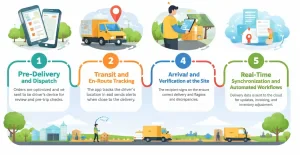 The transition from a physical document to a seamless digital workflow involves a sophisticated orchestration of hardware, software, and telecommunications infrastructure. Understanding how an electronic system operates requires breaking down the process into sequential phases, from the initial dispatch to the final data synchronization.
Phase 1: Pre-Delivery and Dispatch
Orders are optimized and sent to the driver’s device for review and pre-trip checks.
Phase 2: Transit and En-Route Tracking
The app tracks the driver’s location in real-time and sends alerts when close to the delivery.
Phase 3: Arrival and Verification at the Site
The driver scans items to ensure correct delivery and flags any discrepancies.
Phase 4: Capturing the Proof of Delivery
The recipient signs on the device or the driver takes photos for contactless deliveries.
Phase 5: Real Time Synchronization and Automated Workflows
Delivery data is sent to the cloud for updates, invoicing, and inventory adjustment. Data syncs once the connection is restored.
Step by Step Guide to Implementing an ePOD System
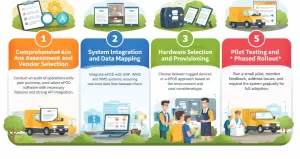 Transitioning from a legacy, paper-based tracking method to a sophisticated electronic proof of delivery framework is a major operational undertaking. To ensure a seamless rollout that maximizes return on investment, organizations should follow a structured, phased implementation approach.
Step 1: Comprehensive Needs Assessment and Vendor Selection
Conduct an audit of operations, identify pain points, and select ePOD software with necessary features and strong API integration.
Step 2: System Integration and Data Mapping
Integrate ePOD with ERP, WMS, and TMS systems, ensuring real-time data flow between them.
Step 3: Hardware Selection and Provisioning
Choose between rugged devices or a BYOD approach based on the environment and cost considerations.
Step 4: Change Management and Driver Training
Communicate the benefits of the new system, provide hands-on training, and support drivers in adopting the technology.
Step 5: Pilot Testing and Phased Rollout
Run a small pilot, monitor feedback, address issues, and expand the system gradually for full adoption.
Common Pitfalls in Delivery Verification and How to Avoid Them
Digitizing the final mile offers benefits but comes with challenges. ePOD systems should work offline and sync when connected, avoiding reliance on constant cellular coverage. The system should also be simple, with only essential fields to prevent slowing down drivers.
Additionally, clear exception management is needed, with predefined codes triggering alerts for issues. Integrating ePOD with back-office systems ensures automatic updates to invoices and inventory, eliminating manual data entry.
Advanced Practices and the Future of Proof of Delivery
Advanced technologies are transforming delivery verification. Contactless and biometric methods, like OTPs and facial recognition, offer secure, frictionless confirmations. Blockchain ensures transparency by recording proof of delivery on an immutable ledger, while smart contracts automatically release payments, improving efficiency.
AI and Machine Learning optimize delivery routes and predict accurate windows, while AI image recognition verifies package location and condition. IoT and smart packaging further enhance accuracy by enabling cargo to self-verify using GPS and sensors, ensuring security across the supply chain.
Conclusion
ePOD systems are transforming supply chain management by replacing paper methods with digital solutions. This shift improves efficiency, reduces disputes, and accelerates billing cycles, offering a more streamlined and reliable process for both businesses and customers.
Advancements like contactless verification, blockchain, AI, and IoT further enhance ePOD systems. These technologies improve accuracy, transparency, and security, making ePOD a crucial tool for businesses looking to stay competitive in the rapidly evolving logistics landscape.
For companies that want faster billing, fewer disputes, and more accurate delivery records, investing in a reliable ePOD software is a practical next step.
FAQ About Proof of Delivery (POD)
Proof of Delivery (POD) is a receipt or confirmation that goods have been delivered to the intended recipient. It verifies that the carrier has completed the delivery and the recipient has accepted the goods.
Traditional POD relies on paper-based signatures, while ePOD (electronic Proof of Delivery) uses digital systems to capture signatures, photos, timestamps, and GPS data, offering faster and more accurate verification.
An ePOD system uses mobile devices to capture digital signatures, scan barcodes, and take photos. It integrates with logistics and inventory systems, ensuring real-time updates and accurate delivery records.
ePOD improves delivery tracking, reduces disputes, speeds up invoicing, and ensures accurate inventory updates. It also shifts liability from the carrier to the recipient, enhancing transparency and operational efficiency.
Yes, ePOD can be used for both domestic and international deliveries. It provides real-time visibility and accurate proof of delivery regardless of the delivery location, although international systems may involve additional considerations such as customs documentation.