







Most retailers in the Philippines track sales and margins, but they may overlook how efficiently their inventory generates profit. A product can have a healthy 40% margin but still tie up cash if it sells slowly. GMROI (Gross Margin Return on Investment) shows how much gross profit a business earns for every peso invested in inventory.
For example, a GMROI of 2.5 means the business earns ₱2.50 in gross profit for every ₱1 invested in stock. This matters for Philippine retailers that hold extra inventory to manage shipping delays between Luzon, Visayas, and Mindanao while also keeping inventory records aligned with BIR requirements.
This article explains the GMROI formula, shows a simple calculation in Philippine pesos, compares it with inventory turnover and sell-through, and explains how businesses can track it more easily.
Key Takeaways
GMROI helps retailers measure how much gross profit their inventory generates for every peso invested, showing whether stock is being used efficiently to support profitability.
The GMROI formula shows how much gross profit a business earns for every peso invested in inventory, while understanding the formula used is important when comparing results and industry benchmarks.
A step-by-step GMROI calculation shows how retailers can measure the profitability of their inventory using real sales, COGS, and inventory cost figures.
What Is GMROI?
GMROI is a metric that measures how much gross profit a business earns for every peso invested in inventory. It helps retailers understand whether their stock is generating enough profit relative to the capital tied up in it.
Retailers, wholesalers, and merchandise planners can use GMROI to compare different product categories, even when they have different prices, margins, and sales volumes. This is especially useful for businesses managing merchandise inventory, where products can vary widely in cost and sales performance.
GMROI connects inventory management with profitability. Unlike inventory turnover, which focuses on how quickly stock sells, GMROI shows whether the inventory is generating a worthwhile return.
The GMROI Formula
The primary GMROI formula is:
GMROI = Gross Profit ÷ Average Inventory Cost
Gross Profit is Revenue minus Cost of Goods Sold. Average Inventory Cost is calculated by adding beginning and ending inventory costs and dividing the total by two.
A GMROI of 3.0 means that every ₱1 invested in inventory generates ₱3.00 in gross profit. This formula and scale are used throughout this article.
Some sources calculate GMROI using Gross Margin % × Stock Turnover Rate instead. While this approach measures the same underlying concept, it can produce results on a different numerical scale
| Formula | Calculation | Typical Output |
|---|---|---|
| Version A (primary) | Gross Profit ÷ Average Inventory Cost | 1.0 to 5.0 for most retailers |
| Version B (alternative) | Gross Margin % × Stock Turnover Rate | Can reach 100–500+ |
Because different sources may use different calculation methods, always check the formula and measurement scale before comparing GMROI benchmarks. This ensures that the figures are being compared on a consistent basis.
Because different sources may use different calculation methods, always check the formula and measurement scale before comparing GMROI benchmarks. This ensures that the figures are being compared on a consistent basis.
How to Calculate GMROI: A Step-by-Step Example
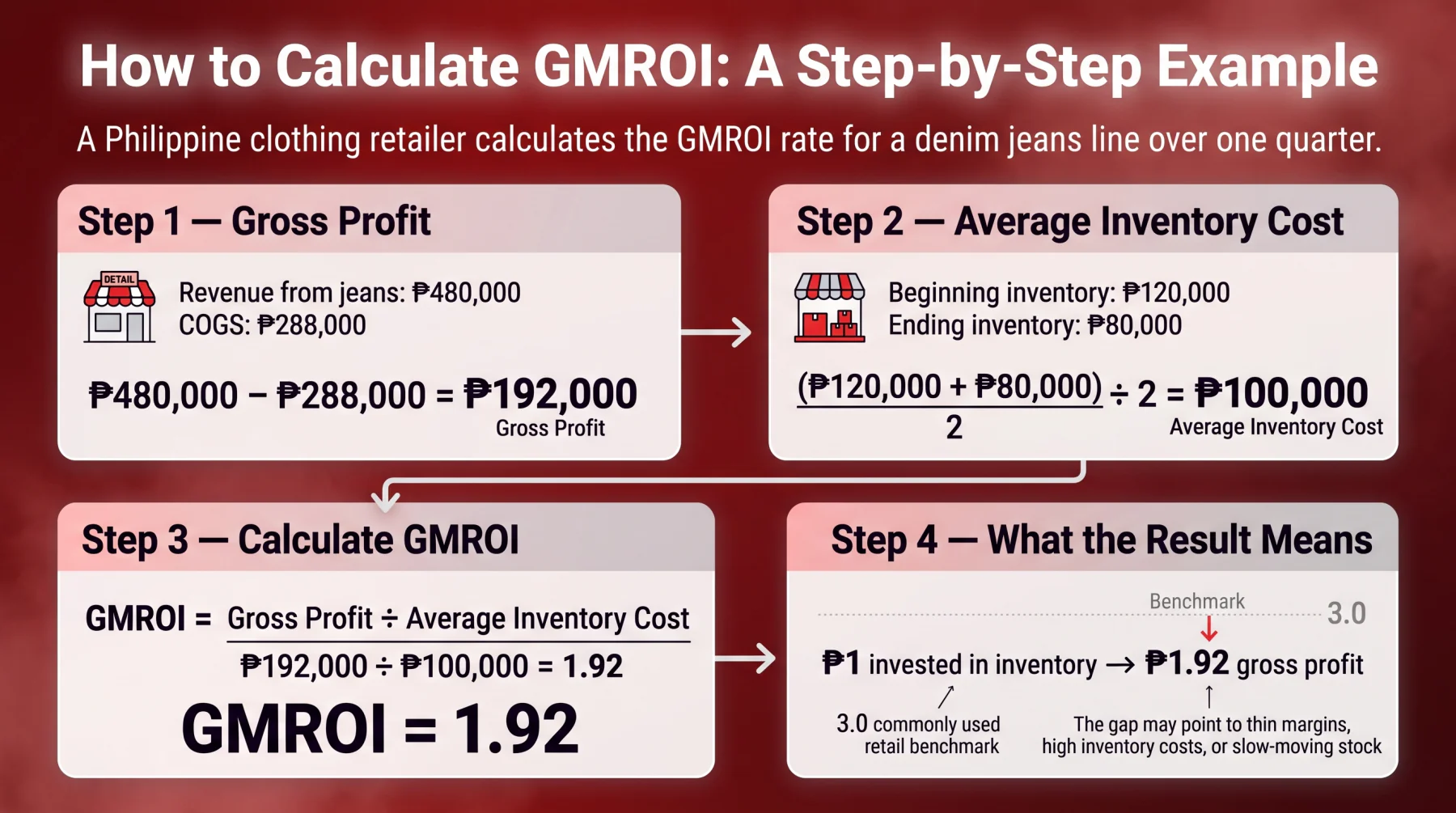
Here's a complete calculation using a Philippine retail scenario. Say you run a clothing store in Manila and want to measure GMROI for your denim jeans line over the last quarter.
Revenue from jeans: ₱480,000
COGS (what you paid for the jeans): ₱288,000
Beginning inventory cost (start of quarter): ₱120,000
Ending inventory cost (end of quarter): ₱80,000
Steps:
Calculate Gross Profit: ₱480,000 − ₱288,000 = ₱192,000
Calculate Average Inventory Cost: (₱120,000 + ₱80,000) ÷ 2 = ₱100,000
Calculate GMROI: ₱192,000 ÷ ₱100,000 = 1.92
Our jeans line earned ₱1.92 in gross profit for every ₱1 invested in stock. That means the inventory is profitable, but still below the commonly used 3.0 benchmark. The gap can point to issues such as thin margins, high inventory costs, or slow-moving stock that needs further investigation.
What Is a Good GMROI? Benchmarks by Retail Category
GMROI benchmarks vary across retail categories because margins, inventory turnover, and business models differ. The table below provides general benchmarks to help retailers assess inventory performance by category.
GMROI benchmarks vary across retail categories because margins, inventory turnover, and business models differ. The table below provides general benchmarks to help retailers assess inventory performance by category.
GMROI benchmarks vary across retail categories because margins, inventory turnover, and business models differ. The table below provides general benchmarks to help retailers assess inventory performance by category.
GMROI benchmarks vary across retail categories because margins, inventory turnover, and business models differ. The table below provides general benchmarks to help retailers assess inventory performance by category.
GMROI benchmarks vary across retail categories because margins, inventory turnover, and business models differ. The table below provides general benchmarks to help retailers assess inventory performance by category.
GMROI benchmarks vary across retail categories because margins, inventory turnover, and business models differ. The table below provides general benchmarks to help retailers assess inventory performance by category.
GMROI benchmarks vary across retail categories because margins, inventory turnover, and business models differ. The table below provides general benchmarks to help retailers assess inventory performance by category.
| GMROI Score | Interpretation | Typical Retail Context |
|---|---|---|
| Below 1.0 | Inventory is losing money | Overstocked slow movers, poor margin management |
| 1.0–2.0 | Breaking even to marginal | High-volume, low-margin categories such as grocery and FMCG |
| 2.0–3.5 | Good | General retail, apparel, and consumer electronics |
| 3.5+ | Excellent | Specialty retail, cosmetics, and jewelry |
These ranges are general industry guidelines. Actual benchmarks vary by business model, supplier terms, and market conditions. Source: general industry benchmarks, verify against category-specific data from APQC or the Retail Owners Institute before drawing conclusions.
External citation: For category-level benchmarks, APQC (apqc.org) publishes retail performance data and is one of the few non-vendor research institutions with GMROI benchmarks by sector. Link here when citing benchmark ranges.
GMROI vs Inventory Turnover vs Days Inventory Outstanding
GMROI is sometimes conflated with inventory turnover and Days Inventory Outstanding (DIO). They're related but measure distinct things, and confusing them leads to the wrong interventions.
| Metric | What It Measures | Best Used For |
|---|---|---|
| GMROI | Gross profit earned per peso of inventory invested | Evaluating inventory profitability |
| Inventory Turnover | How many times inventory is sold per period | Measuring inventory efficiency and movement speed |
| Days Inventory Outstanding (DIO) | How many days inventory sits before being sold | Identifying slow-moving or stagnant stock |
The most important distinction is that a store can move inventory quickly and still have a low GMROI. Selling fast at thin margins is a volume play, not necessarily a profitability play. As inventory management KPIs, GMROI, inventory turnover, and DIO answer different questions: GMROI shows whether inventory is profitable enough, turnover shows how quickly it moves, and DIO shows how long stock remains unsold.
Where GMROI Can Mislead You
GMROI is a powerful metric, but it tells an incomplete story in four specific situations. Knowing when not to trust the number is as important as knowing how to calculate it.
- Seasonal products
A Christmas decoration line calculated over a full fiscal year will show a misleadingly low GMROI, most revenue hits in Q4 while inventory cost is spread across all four quarters. Measure GMROI for seasonal products during the relevant selling window, not over an arbitrary annual period. - Consignment stock
Inventory you don't own shouldn't be in the denominator. Including consignment goods in average inventory cost overstates your capital exposure and artificially deflates GMROI. Strip consignment out before calculating, it's not your investment. - SKUs with extreme turnover
Fast-moving and low-margin items can look like underperformers on GMROI even when they're generating reliable cash flow. A GMROI of 1.5 on a product that turns 24 times per year is a very different outcome than the same score on a product that turns twice. Context on turnover rate matters before acting on a low GMROI reading. - Using retail price instead of cost in the denominator
This is the most common calculation error. The denominator is always inventory cost analysis, such as what you paid for the stock, not what you're selling it for. Using the retail price understates cost, inflates GMROI, and produces a number that looks healthier than it actually is.
How Software Can Help Your GMROI

spreadsheet can work when a business manages a small number of SKUs. But as inventory grows across categories, branches, and seasons, manual tracking becomes harder to maintain. Stock updates can fall behind, purchase costs can become outdated, and calculating GMROI by category or period requires extra work.
Inventory management software connects sales, purchase costs, and stock levels in one system. This allows GMROI to update automatically as inventory and costs change, making it easier to spot products with declining profitability before the problem grows.
For Philippine retailers, this visibility is especially useful when managing different product categories and seasonal demand. Instead of waiting for quarterly reports, businesses can identify inventory and margin issues while there is still time to act.
See how HashMicro's Inventory Management System tracks GMROI automatically and give your business clearer control over stock performance.

Conclusion
GMROI (Gross Profit ÷ Average Inventory Cost) shows how effectively a retail business turns inventory investment into gross profit. A score above 1.0 means inventory is generating profit, while 3.0 or higher is often used as a general retail benchmark. However, GMROI is most useful when calculated consistently and compared with the right product category and time period.
Businesses should also confirm which GMROI formula a benchmark uses, as different versions can produce different results. As inventory grows across SKUs, categories, and branches, inventory management software can automate GMROI calculations and provide more current data for better inventory decisions.
Want to make inventory performance easier to track? Try a free demo and see how inventory management software can help monitor GMROI, stock levels, and profitability in one place.

FAQ about GMROI
GMROI stands for Gross Margin Return on Investment. It measures how much gross profit a business earns for every peso invested in inventory. The formula is Gross Profit ÷ Average Inventory Cost, where Average Inventory Cost is the average of beginning and ending inventory cost for the period being measured.
A GMROI above 1.0 means inventory is generating more gross profit than it costs to hold. A score of 3.0 or above is the widely cited healthy benchmark for most retail and e-commerce categories. High-volume, low-margin formats like grocery typically run between 1.0 and 2.0, while specialty retailers often target 3.5 or higher.
Set up eight columns: SKU name, Revenue, COGS, Gross Profit (=Revenue−COGS), Beginning Inventory Cost, Ending Inventory Cost, Average Inventory Cost (=(Beginning + Ending)÷2), and GMROI (=Gross Profit ÷ Average Inventory Cost). Each row represents one product. See the step-by-step example in Section 3 above for a worked calculation using Philippine peso figures.
No. Inventory turnover measures how many times inventory is sold per period — it's a speed metric. GMROI measures how much gross profit is earned per peso of inventory invested — it's a profitability metric. A store can have high turnover but low GMROI if margins are thin. Both metrics are useful, but they answer different questions and should be tracked together, not interchangeably.