










 Limited to 100 registrants

Inventory expiration tracking is the process of recording, monitoring, and acting on product expiry dates across locations with perishable stock. Weak enterprise expiry controls can cause avoidable write-offs, quality risks, fulfilment disruptions, and poor traceability during complaints or recalls.
An effective approach connects accurate receiving data, stock-rotation rules, near-expiry workflows, and a system that gives teams visibility across warehouses. This guide examines key expiry-tracking challenges, practical controls, essential system requirements, and how ERP supports reliable management of expiry-sensitive inventory.
Key Takeaways
Effective inventory expiration tracking combines accurate expiry data, FEFO, alerts, traceability, and timely exception handling.
Choose a system with lot traceability, FEFO, configurable alerts, multi-warehouse visibility, audit trails, and actionable reporting.
HashMicro centralises expiry data, FEFO, alerts, traceability, and reporting across warehouses for stronger inventory control.
Common Challenges in Tracking Inventory Expiration Dates
Tracking often fails when receiving records lack lot details, storage workflows skip FEFO, or expiry alerts are missing. The gaps widen every time a recall or audit occurs without consistent expiration date tracking and batch tracking, expired-stock control turns reactive, and lot traceability the gaps widen every time a recall or audit occurs.
Incomplete Batch, Lot, and Expiry-Date Data at Receiving
Expiry control starts at receiving. Late, incomplete, or inconsistent receiving data weakens downstream expiry control. Teams cannot reliably decide which stock requires picking, quarantine, or review.
Manual processes can also weaken batch tracking across locations. One warehouse may use spreadsheets, while another records only partial product data. As stock moves between warehouses or distribution points, its original expiry information becomes harder to trace.
Poor Stock Rotation and Limited Visibility Across Locations
Disconnected warehouse records may cause teams to base picking decisions only on locally visible stock. Older batches may remain unnoticed elsewhere while newer stock moves first, weakening rotation and increasing expiry risk. Expiry-related waste can drain capital and create serious risks in regulated sectors. A study of public hospitals in southwest Ethiopia reported 13.1% drug waste, citing expiration and poor FEFO compliance.
Delayed Action on Near-Expiry Stock
Near-expiry inventory may not be identified until products have little usable shelf life remaining. Late alerts reduce the time available to assess demand, customer requirements, and handling restrictions. At-risk stock may expire before teams can act. Company policy and product requirements determine the appropriate response. Teams may reallocate, return, quarantine, discount, or write off stock with approval.
Weak Traceability for Audits, Quality Issues, and Recalls
When a quality issue or recall occurs, enterprises must trace affected inventory by batch, location, status, and expiry date. Missing details prevent teams from confirming which units are safe to release, which require quarantine, and whether affected stock has already moved into fulfilment, transfer, return, or disposal.
Fragmented records weaken operational accountability because no team can verify the complete custody and status of affected goods. In manufacturing environments, gaps in production-floor control may also obscure which batches entered production, delaying containment and allowing affected products to move further through operations.
Best Practices for Inventory Expiration Tracking
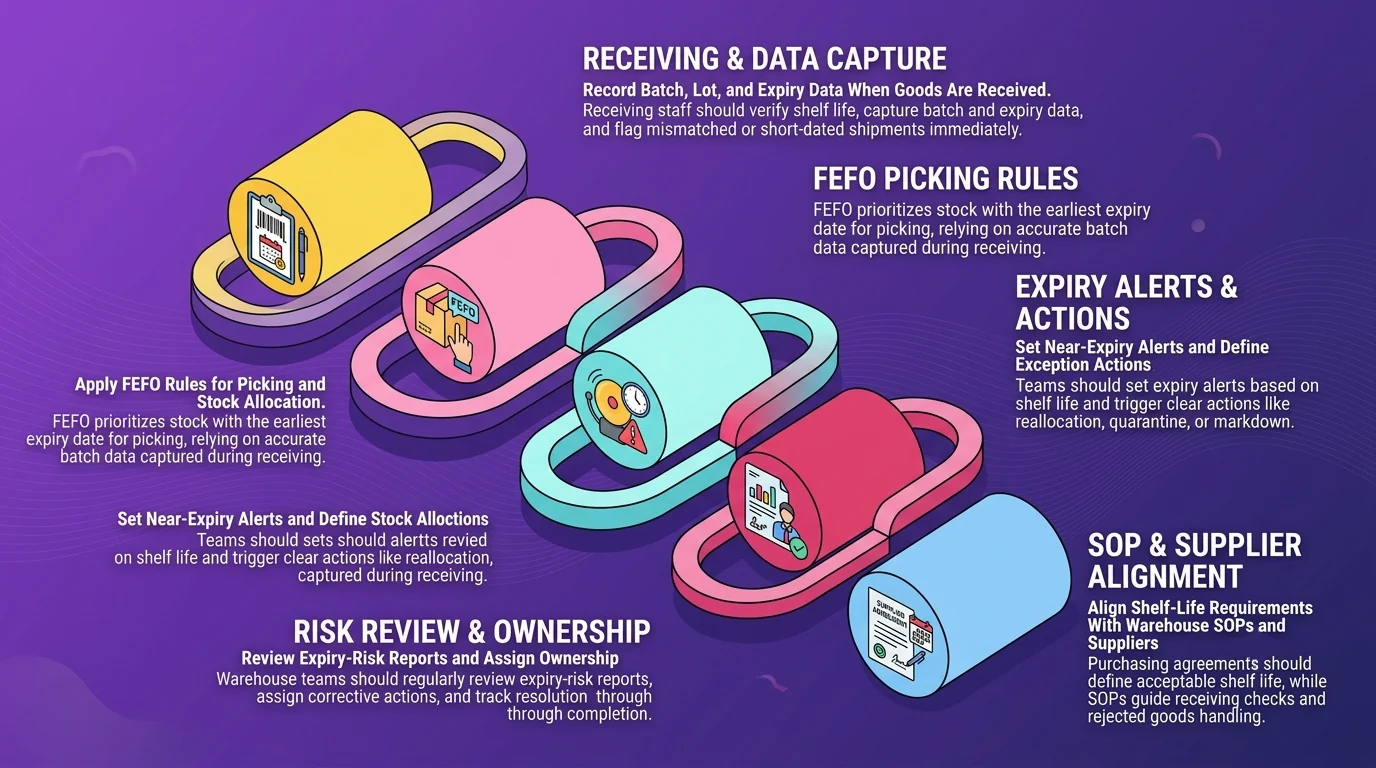
Effective inventory expiration tracking depends on consistent practices at every stage, from receiving and batch tracking to FEFO inventory management, expiry alerts, and near-expiry action. The following best practices explain what teams should do, why each control matters, and the operational outcome it supports across warehouses and product flows.
Record Batch, Lot, and Expiry Data When Goods Are Received
Accurate inventory expiration tracking begins with a receiving SOP. Before acceptance, staff should verify remaining shelf life against purchasing requirements, capture the batch or lot number and expiry date, and assign the correct storage status and location. Short-dated, mismatched, or incomplete receipts should be flagged before release for fulfilment.
Across enterprise operations, these controls should remain consistent at every warehouse and business unit. An integrated warehouse management software can support validation, putaway, and exception handling, while barcode scanning reduces entry errors and prevents unverified stock from becoming available for picking or sale.
Apply FEFO Rules for Picking and Stock Allocation
First-Expire, First-Out (FEFO) prioritises stock with the earliest valid expiry date for allocation and picking, provided the batch meets the order’s remaining shelf-life requirements. Unlike FIFO, which follows receipt order, FEFO uses recorded expiration dates to determine which eligible stock should move first.
FEFO strengthens expiry control, but it depends on accurate batch and expiry data captured during receiving, along with clearly defined shelf-life rules. Research on shelf-life modelling for FEFO warehouse management similarly shows that effective FEFO decisions require known expiry dates, product history, and supply-chain visibility so it is not a replacement for accurate receiving data and shelf-life rules.
Set Near-Expiry Alerts and Define Exception Actions
Expiry alerts should give teams enough time to act before stock becomes unusable or unsellable. Instead of applying a universal number of days, set alert thresholds according to product shelf life, quality requirements, relevant lead times, and the business’s ability to move inventory before expiration.
Each alert should trigger a defined workflow. Teams may review stock for inter-warehouse reallocation, arrange a supplier return where agreed, quarantine items pending inspection, apply a controlled markdown where business policy permits, or request an approved write-off. Clear ownership ensures inventory expiration tracking leads to timely action rather than passive notifications.
Review Expiry-Risk Reports and Assign Ownership
Expiry control should follow a recurring review schedule rather than rely on ad hoc checks. Inventory and warehouse teams should regularly review near-expiry, expired, and quarantined stock, investigate each exception, assign corrective actions, and track them through resolution.
Inventory and warehouse teams should own exception resolution, including reallocation, quarantine, supplier returns, or disposal. Operations and finance teams can then use expiry-risk reports to assess waste, stock exposure, and approved write-offs. This clear division of responsibility strengthens accountability and ensures every identified risk receives appropriate follow-up.
Align Shelf-Life Requirements With Warehouse SOPs and Suppliers
Purchasing agreements should define the acceptable remaining shelf life for relevant products at delivery, along with documentation requirements and clear criteria for rejecting nonconforming shipments. This gives receiving teams consistent standards for deciding whether goods can enter available inventory.
Warehouse SOPs should specify receiving checks, segregation and handling of rejected goods, storage requirements, and escalation to procurement or quality teams. A structured return and inspection process helps teams document approvals and determine whether rejected goods should be returned, quarantined, or disposed of.
What to Look for in an Inventory Expiration Tracking System
An inventory expiration tracking system should support operational control rather than simply store expiry dates. It should help teams capture accurate lot and shelf-life data, prioritise inventory appropriately, and address expiry risks before they cause waste or stock losses.
When evaluating a system, consider its support for lot or batch traceability, expiry alerts, first-expired-first-out picking, quarantine controls, configurable shelf-life rules, audit trails, and reporting. It should also integrate with purchasing, warehouse, sales, and finance workflows so teams can act consistently on near-expiry, rejected, or expired stock.
Batch- and Lot-Level Traceability With Expiry-Date Fields
The system should maintain a usable record of each batch or lot, including its expiry date, location, quantity, and inventory status. Users should be able to trace stock from receipt through storage, transfer, picking, quarantine, and final disposition.
This information must support operational decisions rather than data collection alone. For example, warehouse teams should be able to identify which quantities are available, reserved, near expiry, quarantined, or no longer suitable for sale.
FEFO Automation and Configurable Expiry Alerts
A suitable system should apply First Expired, First Out allocation rules consistently, prioritising eligible stock with the nearest expiry date. Businesses evaluating this capability can first review how the FEFO inventory management method works and whether it matches their product-handling requirements.
Expiry alerts should use configurable thresholds based on product category, shelf life, warehouse, or business policy. Notifications must reach the appropriate inventory, warehouse, quality, or purchasing team with enough information to act. These controls can reduce expiry risk, although they cannot fully prevent expired stock without accurate data and timely follow-up.
Multi-Warehouse Visibility and Audit Trail
The system should consolidate expiry-sensitive inventory across warehouses and locations while preserving lot-level detail. Users need to see where stock is held, its current status, and whether another location can use it before expiry.
Controlled status changes and audit trails should record critical actions such as transfers, quarantines, releases, adjustments, and write-offs. Third-party warehouse partners should follow the same data-capture standards and exception workflows so external stock remains visible and traceable.
Reports for Near-Expiry, Expired, Quarantined, and Written-Off Stock
Expiry reports should support action rather than serve only as historical records. Teams should be able to prioritise at-risk inventory by remaining shelf life, quantity, value, location, and status; assign follow-up actions; and monitor whether each exception has been resolved.
Reporting should also reveal recurring patterns in expired or written-off inventory. These trends can help operations, purchasing, and finance review replenishment decisions, supplier performance, stock exposure, and sources of inventory loss.
Inventory Expiration Tracking System Requirements
| Capability | Why it matters | Operational use |
|---|---|---|
| Batch and lot records | Preserve traceability for expiry-sensitive stock | Trace products from receipt to transfer, sale, quarantine, return, or disposal |
| Expiry-date capture | Establish a reliable basis for stock rotation and alerts | Record and validate expiry dates during receiving |
| Location and quantity visibility | Show exactly where affected inventory is held | Identify available, reserved, transferred, or isolated quantities |
| Inventory status controls | Prevent restricted stock from entering normal operations | Classify stock as available, near expiry, quarantined, expired, or written off |
| FEFO allocation | Apply expiry-based stock rotation consistently | Prioritise eligible stock with the nearest expiry date during picking |
| Configurable alerts | Give teams sufficient time to respond to risk | Notify responsible users according to product-specific warning thresholds |
| Multi-warehouse visibility | Provide consolidated oversight without losing location detail | Compare expiry exposure and coordinate stock transfers across facilities |
| Audit trail | Maintain accountability for critical inventory decisions | Review status changes, approvals, adjustments, transfers, and write-offs |
| Exception workflow | Ensure identified risks receive follow-up action | Assign owners, record decisions, escalate issues, and track resolution |
| Expiry-risk reporting | Turn inventory data into operational priorities | Review near-expiry, expired, quarantined, and written-off stock and analyse loss trends |
How ERP Software Supports Expiry-Date Control at Scale
As operations expand, expiry-date control becomes harder to coordinate through spreadsheets, disconnected warehouse records, and manual follow-ups. ERP software connects inventory events with the transactions and approvals that create, move, sell, return, or remove stock.
This connected process gives purchasing, warehouse, sales, operations, and finance teams a shared view of expiry-related risks. Each department can act from consistent records while retaining responsibility for its own decisions and approvals.
Connect Inventory Data With Purchasing, Sales, Warehouse, and Finance
Connected records allow purchasing teams to assess remaining shelf-life requirements and existing stock exposure before confirming orders. At receiving, warehouse teams can verify expiry information, reject unsuitable goods, and assign the appropriate inventory status before items become available.
During fulfilment, sales and warehouse teams can allocate eligible stock according to customer requirements and approved rotation rules. If goods must be returned, quarantined, or written off, the related inventory movement and financial treatment can follow the same controlled process.
Standardise Controls Across Warehouses and Business Units
An integrated ERP helps enterprises apply common expiry-control rules, roles, reporting definitions, approval requirements, and escalation paths across locations. This reduces the risk of each warehouse interpreting shelf-life policies differently or maintaining separate versions of critical records.
Standardisation should not remove local accountability. Warehouse and business-unit teams must still own data accuracy, exception resolution, and approved inventory actions within their locations. Central teams, on the other hand, can use inventory audit procedures to monitor policy compliance and enterprise-wide stock exposure.
Make Faster Decisions on At-Risk Inventory
Timely, connected visibility helps authorised teams evaluate at-risk stock before its condition or commercial value deteriorates further. Depending on product status, remaining shelf life, demand, and company policy, teams can decide whether to reallocate inventory, return it, quarantine it, or approve a write-off.
Because operational and financial records remain connected, decision-makers can review the available quantity, location, transaction history, approval status, and accounting impact before acting. This supports faster and more accountable resolution without assuming that every expiry risk can be eliminated.
Improve Inventory Expiration Tracking With HashMicro
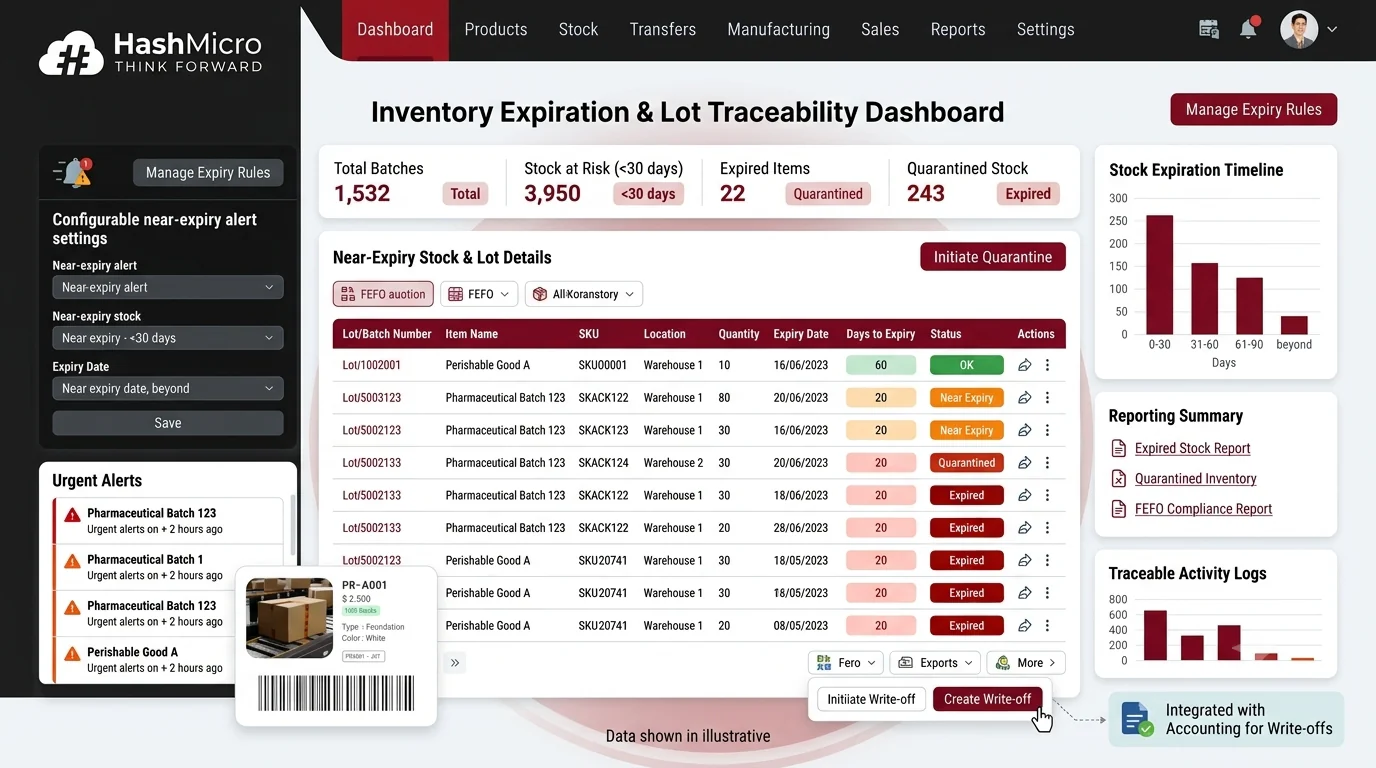
Reliable inventory expiration tracking requires accurate expiry data, consistent FEFO allocation, and timely near-expiry alerts. Clear reporting and lot-level traceability help teams coordinate receiving, transfers, quarantine, returns, and approved write-offs across locations. Businesses can evaluate HashMicro's Inventory Management Software to centralise these controls across warehouses and business units.
Here are the key benefits of HashMicro's inventory management system:
- Centralised batch, lot, and expiry-date records across warehouses.
- FEFO-based allocation supporting consistent stock rotation.
- Configurable near-expiry alerts for earlier exception handling.
- Consolidated reporting for expired, quarantined, and at-risk inventory.
- Traceable receipts, transfers, returns, adjustments, and inventory status changes.
- Connected inventory valuation and financial workflows for approved write-offs.
Together, these controls strengthen consistent expiry management and accountable decisions across locations. Talk to our team to see how HashMicro can support expiry-date control across your inventory operations.

Conclusion
Effective inventory expiration tracking protects product quality, reduces avoidable losses, and maintains traceability across enterprise operations. The approach should remain consistent as warehouses, products, and transaction volumes expand.
Reliable expiry control combines accurate batch data, FEFO allocation, configurable alerts, multi-warehouse visibility, actionable reporting, and complete audit trails. Businesses should also assess integration with purchasing, warehouse, sales, returns, and finance workflows before selecting a system.
Evaluate operational fit, ownership requirements, implementation scope, and total costs before making a final decision. Enterprises needing centralised expiry control can assess HashMicro Inventory Management and ERP through a free consultation tailored to their operations.

FAQ for Expiry-date Tracking
Inventory expiration tracking is the process of recording, monitoring, and managing product expiry dates across warehouses and inventory locations. It helps businesses identify near-expiry stock, prevent expired items from entering fulfilment, and maintain lot-level traceability. Effective expiration date tracking also supports timely reallocation, quarantine, returns, and approved write-offs.
In inventory management, FIFO moves stock according to receipt order, so the oldest received items leave first. FEFO inventory management prioritises products with the earliest valid expiry date, regardless of arrival time. FEFO is better suited to perishable inventory when remaining shelf life determines safe and acceptable fulfilment.
Batch and lot tracking links each product’s expiry date to a specific quantity, location, and inventory status. This traceability helps teams identify affected stock quickly, verify its movement history, and prevent restricted goods from being released. Reliable batch tracking also strengthens quality investigations, inventory audits, and targeted product recalls.
Businesses should identify near-expiry inventory early and follow predefined exception workflows based on product requirements and company policy. Appropriate actions may include inter-warehouse reallocation, supplier returns, quarantine, permitted markdowns, or an approved inventory write-off. Each decision should have a responsible owner, documented approval, and a completion deadline.
An inventory expiration tracking system should include batch and lot traceability, validated expiry-date fields, FEFO allocation, and configurable near-expiry alerts. It should also provide multi-warehouse visibility, inventory status controls, audit trails, exception workflows, and actionable reports covering near-expiry, expired, quarantined, returned, and written-off stock.
ERP software improves inventory expiration tracking by connecting purchasing, receiving, warehouse, sales, returns, and finance workflows through shared records. This integration gives teams consistent expiry data, multi-location visibility, controlled approvals, and traceable inventory movements. It also supports faster decisions on reallocation, quarantine, supplier returns, and approved write-offs.