














Starting in 2026, the Bureau of Internal Revenue (BIR) is rolling out an electronic invoicing system that changes how businesses handle tax documentation in the Philippines. If you’re running a company here, whether it’s a sari-sari store chain, a manufacturing plant in CALABARZON, or a BPO outfit in BGC, this will affect you. The BIR EIS replaces paper-based invoicing with digital transactions, and the government isn’t just suggesting it. They’re mandating it.
So what does this mean for your business? Simply put, you’ll need to issue invoices electronically, transmit them to BIR in real-time, and store everything digitally. It sounds like a lot, but here’s the upside: businesses that’ve already made the switch report faster processing, fewer errors, and smoother audits. No more digging through filing cabinets during tax season.
This guide covers everything you need to know about BIR’s e-invoicing requirements, from what the system actually is, to how it works, to practical steps for getting your business ready before the deadline hits.
Key Takeaways
BIR CAS handles accounting processes; the EIS focuses specifically on tax-related digital invoicing
Electronic billing through BIR improves accuracy, speeds up invoice processing, and reduces fraud risk
To register for BIR EIS, prepare required documents, choose BIR-compliant invoicing software, submit your registration online, await approval, and test your system before going live.
The BIR E-Invoicing system will roll out in phases: Phase 1 compliance for large taxpayers by December 31, 2026, and Phase 2 expansion to B2C transactions and exporters starting in 2027.
What is the BIR Electronic Invoicing System?
The BIR Electronic Invoicing System (EIS) is the government’s digital platform for creating, transmitting, and storing invoices and receipts. Instead of printing paper receipts and manually filing them, businesses generate everything electronically and send data directly to BIR.
The system covers official receipts, sales invoices, credit and debit notes, and other tax-related documents. Think of it as the BIR’s way of getting real-time visibility into business transactions across the country.
This push started with Republic Act No. 10963, also known as the TRAIN Law. The legislation shifted tax collection from paper to digital, and the EIS is the enforcement mechanism. Since July 2022, the 100 largest taxpayers have been required to use it for government invoices (B2G transactions). Now it’s expanding to everyone else.
Who Needs to Comply with BIR EIS in 2026?
Your business is required to comply by December 31, 2026 if you are:
- Under the Large Taxpayers Service (LTS)
- A large taxpayer under the Ease of Paying Taxes Act (RA No. 11976)
- Engaged in e-commerce or online transactions
- Using a Computerized Accounting System (CAS) or invoicing software
Benefits of BIR EIS Compliance

Let’s be honest, compliance mandates rarely feel like a gift. But this one actually delivers real benefits:
- Fewer manual errors. Human mistakes in invoicing are expensive. Automated systems catch discrepancies before they become problems during audits.
- Faster processing. No more waiting for physical documents to move between offices. Everything happens digitally, which means quicker turnaround on payments and reconciliations.
- Better audit readiness. All transactions are timestamped and stored. When BIR comes knocking, your records are already organized.
- Cost savings over time. Yes, there’s upfront investment. But eliminating paper, manual filing, and the staff hours those require adds up quickly, especially for businesses with high transaction volumes.
- Real-time financial visibility. Business owners and finance teams can see what’s happening now, not what happened last month when the reports finally came in.
Technical Requirements for EIS Compliance
The BIR isn’t just asking for digital copies of paper invoices. They’ve set specific technical standards:
- JSON format. All electronic invoices and receipts must use JavaScript Object Notation. It’s a lightweight data format that standardizes how information gets transmitted.
- Direct submission. You can’t just create compliant invoices and sit on them. Data must be transmitted to BIR through their web service or API. This ensures a secure, direct transfer.
- Secure storage. Businesses must protect their electronic records and keep them accessible for the period BIR requires. Data integrity isn’t optional.
BIR CAS vs. BIR EIS: What’s the Difference?
People often confuse these two systems. Here’s the short version: CAS (Computerized Accounting System) handles your overall accounting. EIS (Electronic Invoicing System) specifically manages tax-related invoices. They’re related but serve different purposes.
| Aspect | BIR CAS | BIR EIS |
| Main Function | Manages complete accounting processes digitally | Automates e-invoice issuance and reporting for tax purposes |
| Scope | Covers all financial operations and accounting | Focuses on tax-related electronic invoicing |
| Purpose | Overall accounting management | Tax compliance with government regulations |
| Regulation | Follows general accounting standards | Mandated for businesses meeting specific tax criteria |
| Primary Focus | Financial records, revenue, and expenses | Tax invoices and compliance reporting |
If you’re already using a Philippine CAS, integrating it with BIR EIS gives you complete accounting compliance. Many modern accounting platforms used locally offer both capabilities.
Why the Government Pushed for This System
The BIR didn’t implement EIS just to make businesses buy new software. There are real policy goals behind it:
- Reducing tax evasion. Real-time reporting makes it harder to under-report sales or issue fake invoices.
- Improving trade competitiveness. E-invoicing is standard in many countries. Philippine businesses trading internationally need compatible systems.
- Pushing digital transformation. The government wants more businesses to operate digitally. This mandate accelerates that shift.
- Simplifying cross-border transactions. Standardized e-invoices work better with international partners than paper receipts.
- Cutting administrative burden. Eventually. The transition has costs, but long-term, everyone deals with less paperwork.
Also read: BIR POS Registration and Accreditation Explained
How the BIR EIS Actually Works
The system follows a straightforward flow:
- Step 1: Your business creates an invoice using BIR-accredited software
- Step 2: The software formats the invoice data in JSON and transmits it to BIR
- Step 3: BIR validates and records the transaction
- Step 4: The invoice gets stored securely (both at BIR and in your system)
- Step 5: When tax filing comes around, your data is already there
How to Get Your Business Ready for BIR EIS
Here’s a practical approach to compliance that won’t overwhelm your team:
- Audit your current invoicing process. What’s working? What’s a mess? Understanding your baseline helps you plan the transition.
- Choose BIR-accredited software. This isn’t optional. Non-accredited systems won’t work with the BIR portal. Look for vendors with local support; you’ll need it when questions come up.
- Train your team. The best software fails if people don’t know how to use it. Invest time in proper training, especially for accounting staff.
- Test before the deadline. Don’t wait until enforcement starts to find out something’s broken. Run parallel systems if you need to.
- Update internal policies. Your processes need to match the new system. Document how things work now so everyone’s on the same page.
- Plan for data security. Digital records are convenient but need protection. Make sure your security measures meet BIR requirements.
How to Register for BIR EIS
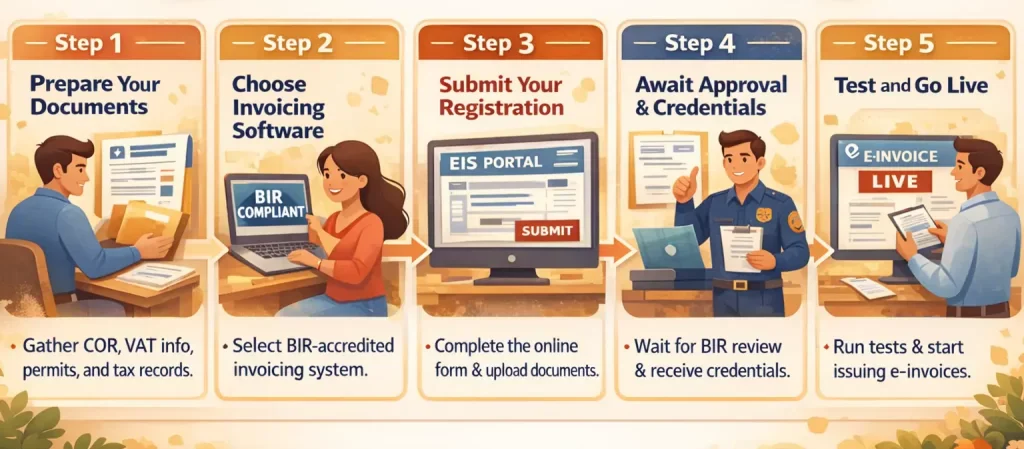
Registration is done through the BIR’s EIS Certification Portal. Here are the steps:
Step 1: Prepare your documents
Gather your BIR Certificate of Registration, VAT registration details, business permits, and tax records. You will also need a valid TIN and, if applicable, a Board Resolution or Secretary’s Certificate (for corporations) or Special Power of Attorney (for individuals).
Step 2: Choose a compliant invoicing software
Review your invoicing software for compatibility with BIR’s requirements. Invoices must be generated in JSON format and digitally signed before transmission. If your current system is not compatible, secure a BIR-accredited invoicing solution before proceeding.
Step 3: Submit your registration
Complete the online registration form on the EIS Certification Portal and attach scanned copies of your required documents in PDF format. Declare your chosen e-invoicing solution as part of the submission.
Step 4: Await approval and receive credentials
BIR will review your documents and may require system inspections or testing. Processing typically takes a few weeks depending on application volume. Once approved, you will receive EIS credentials and digital certificates for your system.
Step 5: Test and go live
Conduct trial runs to verify integration before full compliance. Once confirmed, your system is ready to issue, sign, and transmit e-invoices to the BIR within three calendar days of each transaction.
BIR E-Invoicing Rollout Timeline (as of April 2026)
The government is implementing this in stages to avoid disruption, as reported by KPMG:
2022–2024: The BIR launched the EIS pilot program, starting with the country’s 100 largest taxpayers who were required to report sales data electronically in near real-time.
February 2025: The BIR issued RR No. 11-2025, expanding the mandate to e-commerce businesses, Large Taxpayers Service (LTS), and businesses using Computerized Accounting Systems (CAS).
September 2025: The BIR issued RR No. 26-2025, extending the original March 2026 deadline to December 31, 2026, giving businesses more time for system readiness and transition.
December 31, 2026: Current compliance deadline for Phase 1 — covered taxpayers must issue e-invoices in XML or JSON format via BIR-accredited systems. (as of April 2026)
2027 onward: Phase 2 expansion to include B2C transactions, exporters, and other taxpayer groups, with separate deadlines to be announced once BIR infrastructure is fully operational.
How to Choose BIR-Compliant Invoicing Software
Not all software is created equal. Here’s what matters when you’re choosing:
- BIR accreditation. Non-negotiable. If it’s not accredited, don’t bother.
- VAT compliance features. The system should handle Philippine VAT requirements automatically.
- Integration capabilities. Can it connect with your existing accounting system, POS, or inventory management?
- Local support. When something breaks at 9 PM on a Friday before a filing deadline, you want someone who answers.
- Scalability. Will it still work when your business doubles in size?
- User-friendly interface. Complex systems create mistakes. Look for something your team can actually use.
- Vendor track record. How long have they been in the Philippine market? What do other businesses say about them?
Here are some commonly used software options that are compatible with BIR’s EIS requirements:
- SAP Business One — widely used by large taxpayers, with BIR CAS accreditation support available through local partners
- QuickBooks Online — popular among SMEs, can be registered as a CAS with proper documentation
- Xero — cloud-based, supported by a Philippine partner network for BIR compliance configuration
- QNE AI Cloud Accounting — locally developed, widely preferred for its built-in BIR compliance and local support
What Happens If You Don’t Comply?
Non-compliance can trigger statutory penalties under the Tax Code. For example, invoice-related violations may be penalized under Section 264(a) of the Tax Code, penalties range from PHP 1,000 to PHP 50,000, with possible imprisonment of two to four years for violations related to official receipts, while failures involving electronic sales data transmission may also be subject to separate penalties under BIR rules implementing the electronic sales reporting system.
Beyond penalties, non-compliance creates operational headaches like failed audits, delayed permits, and potential issues with business partners who need proper documentation.
Conclusion
The BIR Electronic Invoicing System is coming whether businesses are ready or not. The transition requires effort, choosing software, training staff, and updating processes, but it also brings real benefits: fewer errors, faster processing, and better audit readiness.
For Philippine businesses, the smart move is starting early. Understand the requirements, pick the right tools, and give your team time to adjust. By 2026, compliant businesses will be operating more efficiently while non-compliant ones scramble to catch up. To stay ahead, explore our integrated billing and invoicing software and ensure your business is fully prepared for the future.
FAQ About BIR EIS
BIR accept e-invoices. All electronic receipts submitted to the BIR must be in JavaScript Object Notation (JSON) format. Businesses can upload their e-invoices through""" the Electronic Sales Reporting System (eSRS) portal. This web-based platform allows for the secure transmission of e-invoice data directly to the BIR.
The invoice must include the necessary details of both the seller and the buyer. It should also provide transaction specifics, such as the quantity, unit cost, description or nature of the service, and the applicable VAT rate/amount or exemption, in accordance with Section 6(B) of RR 7-2024.
The BIR can review essential documents, like articles of incorporation and annual financial statements, which are key to investigating or auditing corporate tax fraud.
BIR EIS (also written as EIS BIR) stands for the BIR Electronic Invoicing System, a framework where businesses issue e-invoices/e-receipts and submit sales data in a more digital, structured way to support tax reporting and compliance. This electronic invoicing system, BIR, is part of the BIR’s broader push for stronger visibility, accuracy, and enforcement through e-invoicing BIR processes.
Businesses that implement the BIR Electronic Invoicing System may qualify for additional allowable deductions on implementation costs (subject to BIR rules and documentation). Commonly""" cited rates are 100% additional deduction for micro/small taxpayers and 50% for medium/large taxpayers, and this may apply whether adoption is mandated or voluntary under the policy direction of the EOPT-related e-invoicing measures.
The BIR’s aim is to collect internal revenue taxes and enforce tax laws, while improving taxpayer service and compliance so government revenue is properly raised and administered.