







A Philippine distributor ordering 600 cases twice a month for demand of 1,200 carries an average cycle stock of 300 cases. Many businesses set that quantity by instinct. A 2025 Guimaras study of 287 micro-business owners scored the use of inventory data for decisions at only 3.16 out of 5.
Cycle stock replaces that instinct with a number. It is the inventory that covers normal demand between replenishment receipts. It differs from safety stock, which absorbs uncertainty, and from pipeline, seasonal, and special-order inventory. When demand and receipts stay stable, you divide the order quantity by two.
This article discusses what cycle stock is, how it differs from safety stock, how to calculate it, what drives it, and when inventory management software becomes necessary.
Key Takeaways
Cycle stock is the average inventory used to cover expected demand between replenishment orders; it excludes safety stock and other protective or exceptional inventory.
Calculating cycle stock uses Q divided by two, plus seven steps to validate the result.
Philippine businesses should review cycle stock by location when branches have different demand, service requirements, lead times, or transfer rules.
Inventory management software is most useful when it connects stock balances, purchasing workflows, supplier data, transfers, approvals, reporting, and finance records.
What Is Cycle Stock in Inventory Management?
Cycle stock is the average inventory a business holds to cover expected demand between regular replenishment orders. It excludes safety stock, seasonal buffers, promotional stock, goods in transit, and one-off customer requirements. Cycle stock rises when a purchase order arrives and falls as you fulfill orders.
Businesses hold cycle stock because suppliers deliver in batches, not continuously. Order size, delivery frequency, and supplier minimum order quantities set the level. Get it wrong, and you either tie up cash in slow-moving stock or run short before the next receipt.
Picture a distributor receiving 600 cases of a fast-moving beverage. Demand draws stock down evenly, so the inventory cycle runs from 600 cases toward zero. The average holding across that cycle is roughly 300 cases. That average, not the peak, drives your working capital and storage needs.
Cycle Stock vs Safety Stock: What's the Difference?
Cycle stock covers the demand you expect during a normal replenishment cycle. Safety stock covers what you cannot predict, such as a sales spike or a late delivery. Adding safety stock raises your total on-hand inventory but leaves the average cycle stock unchanged. Most teams set safety stock levels separately.
| Point of comparison | Cycle stock | Safety stock |
|---|---|---|
| Purpose | Fulfil expected demand between receipts | Reduce exposure to unexpected demand or supply variation |
| Demand assumption | Relatively predictable demand | Demand may exceed the forecast |
| Replenishment trigger | Planned order cycle, review schedule, or order quantity | Reorder-point or exception policy based on risk |
| Risk addressed | Normal consumption | Stockout risk caused by uncertainty |
| Main inputs | Order quantity, demand rate, and replenishment frequency | Demand variation, lead-time variation, service requirements, and management policy |
| Reporting treatment | Average recurring inventory | Protective inventory shown separately |
| Management response | Review quantity and ordering cadence | Validate uncertainty, supplier performance, and required protection |
A predictable weekly purchase is a cycle-stock decision. A supplier delay on an imported component is usually a safety-stock or pipeline-stock issue. A business should not use safety stock to conceal an oversized purchase quantity, nor reduce safety stock simply because cycle stock appears high.
How Do You Calculate Cycle Stock?
You calculate average cycle stock by dividing the replenishment order quantity by two. The formula assumes stable demand, receipts that arrive when expected, and repeat orders of a similar size. It estimates the average stock held across one inventory cycle, not your reorder point or maximum stock level.
The basic cycle stock formula is:
Use this formula to size working capital, storage space, and purchasing frequency for a single SKU:
- Confirm the SKU and location being analysed.
- Clean demand and receipt history, including unit-of-measure conversions and cancelled orders.
- Check whether order quantities are repeatable and demand is stable enough for an average estimate.
- Identify the replenishment quantity Q.
- Divide Q by two.
- Review the result against MOQ, warehouse capacity, supplier reliability, branch demand, and service requirements.
- Keep safety, pipeline, seasonal, promotional, and special-order inventory separate.
Doing these steps can be slow using manual spreadsheets. One wrong unit conversion skews every branch estimate. Inventory management software pulls receipts, transfers, and order quantities into one record. This allows your team to calculate cycle stock from live data, not last month's export.

A Cycle Stock Calculation Example for a Philippine Business
A distributor with a monthly demand of 1,200 cases orders 600 cases per purchase order. If demand and receipts are stable, the average cycle stock is 300 cases. The following worksheet is illustrative only and does not represent a HashMicro customer or published market data.
| Worksheet item | Illustrative value |
|---|---|
| Monthly expected demand | 1,200 cases |
| Normal purchase-order quantity (Q) | 600 cases |
| Purchase frequency | Two orders per month |
| Average cycle-stock formula | 600 ÷ 2 |
| Average cycle stock | 300 cases |
| Illustrative landed cost | PHP 850 per case |
| Illustrative average cycle-stock value | 300 × PHP 850 = PHP 255,000 |
The ₱255,000 figure is illustrative, so finance should confirm your own freight, duty, and handling assumptions. Branch demand varies, so run the inventory cycle per location, then compare central purchasing against local replenishment. A warehouse management system connects receiving, put-away, bin balances, and transfers. The 600-case order still needs owner approval and depends on how you manage stock across branches.
Why Cycle Stock Matters to Your Business
Cycle stock matters because one order quantity drives product availability, cash, warehouse capacity, and replenishment workload. Larger orders cut purchasing frequency but raise average stock and storage needs. Smaller orders free cash but create more purchase orders, receiving events, and approvals.
Judge cycle stock against availability, inventory value, and replenishment performance. A low level is not efficient if it triggers rush orders. A high level is not wasteful when it serves a documented seasonal commitment. Reliable stock data makes that judgment easier, which is a benefit of a warehouse system.
5 Factors That Determine Your Cycle Stock Level
Five factors decide whether your cycle stock level makes sense: demand and forecast quality, order quantity assumptions, supplier conditions, location requirements, and warehouse capacity. Check the signal, risk, and action for each one before you change a replenishment rule or shorten an inventory cycle.
| Factor | Signal to review | Risk if ignored | Recommended action |
|---|---|---|---|
| Demand rate and forecast quality | Recent demand, forecast variance, promotions, and lost sales | Q ÷ 2 understates or overstates normal consumption | Segment stable, seasonal, and volatile SKUs, then name a forecast owner |
| Order quantity and EOQ assumptions | Q, ordering cost, holding cost, and order history | An optimal-looking quantity no longer matches current operations | Recalculate the inputs and compare them against actual receipts and workload |
| Supplier MOQ and lead time | MOQ, delivery variance, shipment size, and approval effort | Forced large orders inflate stock; late delivery raises stockout risk | Negotiate MOQ, separate pipeline stock, and size safety stock to lead-time variance |
| Location demand and service level | Branch sales, transfer history, and fulfillment priority | Company-wide averages hide shortages or excess at specific sites | Set location-level policies or documented transfer rules |
| Warehouse capacity and handling cadence | Bin space, receiving windows, truck capacity, and picking frequency | Stock arrives before space or labor is available | Align order calendars with receiving windows and confirm bin space before ordering |
Lead time rarely changes Q divided by two. It changes when you order, how much pipeline stock you see, and whether you need safety stock. Revisit your economic order quantity inputs when supplier terms shift. Central purchasing wins discounts, while local replenishment answers branch demand faster.
How to Manage Cycle Stock Without Tying Up Cash
Manage cycle stock through SKU segmentation, order-quantity review, supplier validation, and exception governance. The goal is not the smallest possible balance on every item. It is an explainable inventory cycle that meets service commitments without excess cash exposure, urgent buying, or branch imbalance.
A practical checklist:
- Classify SKUs by demand pattern, value, service requirement, and replenishment risk. An ABC analysis helps when value and business significance differ.
- Compare planned Q against actual purchase quantities, receipts, sales, cancellations, and returns. Flag any quantity driven by habit rather than current demand.
- Test supplier MOQs, order multiples, lead times, and delivery reliability against that quantity, then review order history and approval rules with procurement.
- Confirm that receiving windows and bin capacity support the planned cadence. Adjust delivery calendars, storage assignments, or order splits with the warehouse team.
- Calculate average cycle stock by location where branch demand or service commitments differ.
- Separate safety, pipeline, seasonal, promotional, quarantined, and special-order balances in reports.
- Review excess-stock value, stockouts, backorders, days of supply, aging, and urgent transfers together. Let finance prioritize the highest-value and oldest exceptions.
- Verify master data, permissions, and transaction history before trusting any of these numbers. Correct item, supplier, and location errors first.
- Approve policy changes each month with finance, procurement, warehouse, and operations owners, then monitor exceptions after implementation.
Inventory software makes this checklist practical by linking stock balances to purchasing, receiving, transfers, approvals, and finance records. A procurement management system adds requisition, purchase order, and supplier approval history. Automation supports the monthly review, but it cannot replace judgment when demand or supplier reliability shifts.
When Is Inventory Management Software Necessary?
Spreadsheets work for a small, stable operation with one location and few SKUs. They break down when branches follow different reorder rules or teams post receipts and transfers late. They also fail when finance cannot reconcile inventory value with your actual inventory cycle balances.
Assess whether your current system can:
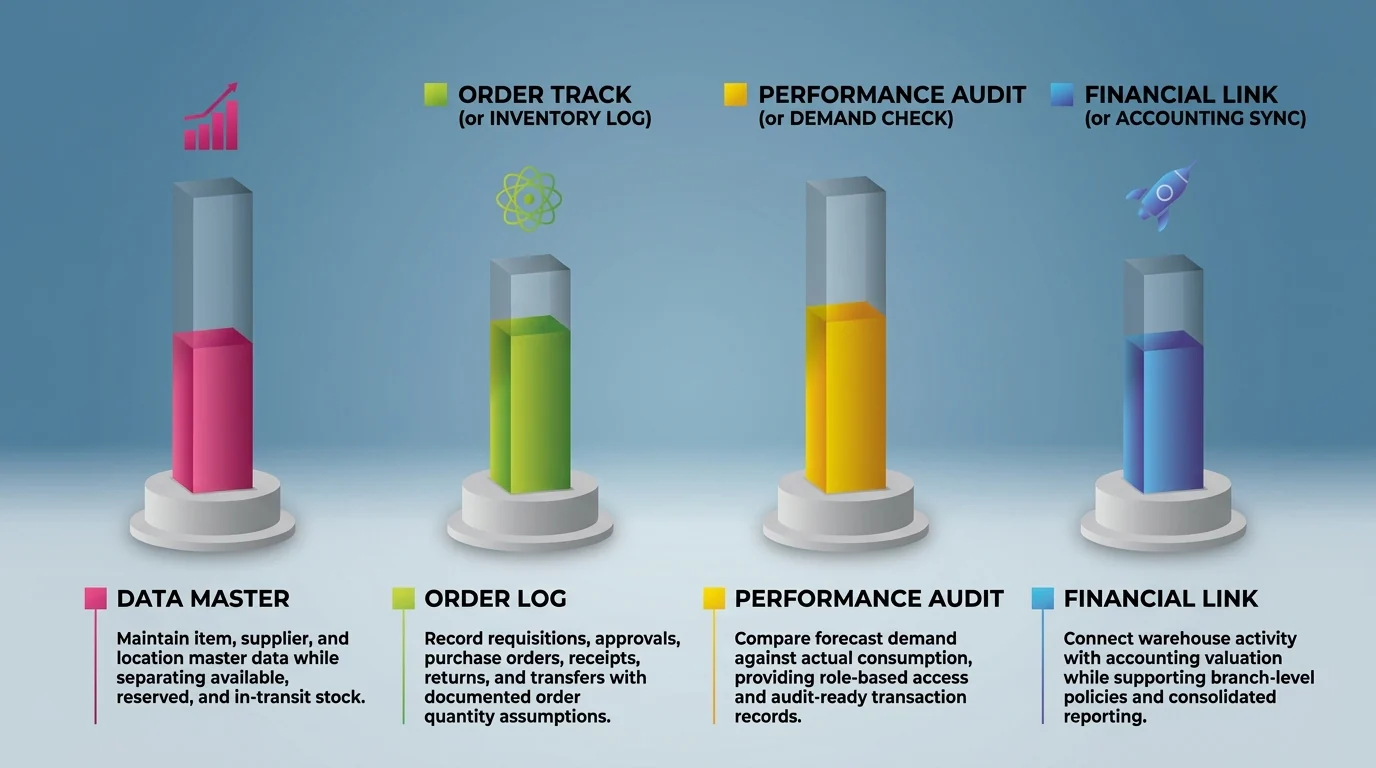
- Maintain item, supplier, unit-of-measure, cost, and location master data.
- Show available, reserved, in-transit, safety, and cycle stock separately.
- Record purchase requisitions, approvals, purchase orders, receipts, returns, and transfers.
- Calculate or report order quantities using documented assumptions.
- Compare forecast demand with actual consumption and identify exceptions.
- Provide role-based access, change history, and audit-ready transaction records.
- Connect warehouse activity with accounting and inventory valuation.
- Support branch-level policies while preserving consolidated management reporting.
Build the case on control requirements, not on a promise that software alone shrinks inventory. Clean master data first, then define who owns each field and how cycle, safety, and pipeline stock appear in reports. Compare several vendors against this checklist, and book a free consultation when you are considering HashMicro.
Conclusion
Cycle stock is the average inventory that covers expected demand between replenishment orders. The Q divided by two formula works when demand and receipts stay stable. It does not replace a review of supplier constraints, branch requirements, warehouse capacity, safety stock, or pipeline inventory.
For Philippine businesses, the most reliable policy stays location-aware and cross-functional. Review order quantities with finance, procurement, warehouse, operations, and IT. Monitor stockouts and excess value together, and document exceptions for seasonal, slow-moving, volatile, and special-order items in every inventory cycle.
Once you define your cycle-stock policy and system requirements, check how those processes hold up across your locations. HashMicro's inventory management control for Philippine businesses should match your branch structure, reporting needs, and approval rules. Talk to our team about what that setup involves.

FAQ About Cycle Stock
Report them as two lines, not one balance. Cycle stock shows the average quantity that covers demand between receipts. Safety stock shows the buffer held against demand or supplier variation. Validate each item's assumptions against demand history and lead-time records before you publish the figures.
Calculate it per location when branches differ in demand, service commitments, lead times, or transfer rules. A Metro Manila outlet rarely matches a provincial branch. Central purchasing wins supplier discounts, while local replenishment reacts faster. Neither model is universally correct, so test both against your service targets.
EOQ assumes stable demand, known ordering cost, known holding cost, and flexible supplier terms. It breaks when those assumptions fail. Skip it for seasonal items, volatile SKUs, slow movers, and special orders. It also fails when a supplier minimum order quantity already dictates how much you buy.
Review stock value, demand variance, stockouts, and excess stock first, because those four expose most cash and service problems. Then check order frequency, supplier delivery performance, transfer volume, and aging balances. Close by scanning location balances and master-data exceptions such as duplicate items or missing lead times.
Cut order quantities only where demand data supports it. Segment SKUs first, then confirm each quantity against actual sales, receipts, and returns. Renegotiate supplier minimum order quantities where they force oversized purchases. Monitor stockouts weekly, and agree every change with finance, procurement, warehouse, and operations.