







Choose manufacturing software by following one production order from material planning through output and cost review. Include shortages, rejected units and approval limits in the test. This guide helps Philippine production managers and finance teams compare workflows, calculate PHP examples and prepare a practical software evaluation.
The sections below explain the workflow, evaluation criteria and practical next steps.
What is Manufacturing Software?
Manufacturing software connects production plans with materials, work orders and recorded output. It helps teams compare what they intended to make with what happened. The useful result is a traceable production record, rather than a dashboard alone. For the related workflow, see A Guide to Manufacturing Resource Planning (MRP) II.
For example, a PHP 150,000 batch may consume several materials across two work centres. A planner needs availability, while finance needs actual consumption and accepted output. Both teams should be able to trace the same order.
Choose Software Around the Production Problems You Need to Solve
Start with a real order from your plant. Ask each vendor to plan materials and show shortages. Then record consumption, calculate order cost and test approvals.
Bring a bill of materials, stock balances and open purchase orders. Include output targets, cost rates, delivery requirements and quality exceptions. The scenario should be familiar to your production and finance teams. A generic presentation can hide the handoffs that cause delays in daily operations.
Define the business problem before naming a feature. If purchasing waits for production to identify shortages, test the path from finished-goods demand to a purchase proposal. If managers cannot explain an order margin, test actual consumption and applied rates against the standard. If sales promises dates without a capacity review, test how the planner sees the load before accepting the commitment.
Separate must-have requirements from optional capabilities. Test every requirement with your sample data. Identify each approver and retain records supporting the result.
Use a PHP 150,000 batch to identify your most expensive production delay. Record which team owns the decision that currently holds up the order.
Turn Your Production Workflow into Evaluation Criteria
Use a decision table during every demonstration. The vendor should show the task, the resulting record, and the evidence your team can retain after the meeting.
| Operational problem | Capability to evaluate | Demonstration task | Evidence required |
|---|---|---|---|
| Material shortages delay production | MPS and MRP linked to the bill of materials, stock, and open orders | Set a finished-goods plan, run material requirements, and identify a component shortfall | Requirement quantities, available stock, open-order quantities, need dates, and the resulting purchase proposal |
| Purchase requests bypass controls | Approval workflow after planning | Convert a shortage into a purchase request and show the approval boundary | Named role, approval status, audit trail, and treatment of rejected or changed requests |
| Order margins are uncertain | Production-order costing against a bill-of-materials standard | Record material use, labour time, and overhead rates for the sample order | Consumption records, rates, adjustments, standard comparison, and reconciliation path |
| Every order is customised | Order-specific bill of materials | Copy or create a bill of materials for a custom order and link it to the order | Version history, approval owner, changed quantities, and resulting cost |
| Delivery dates are difficult to promise | Capacity visibility at the promise stage | Enter a required ship date and review work-centre load | Capacity assumptions, planner review, conflicts, and escalation steps |
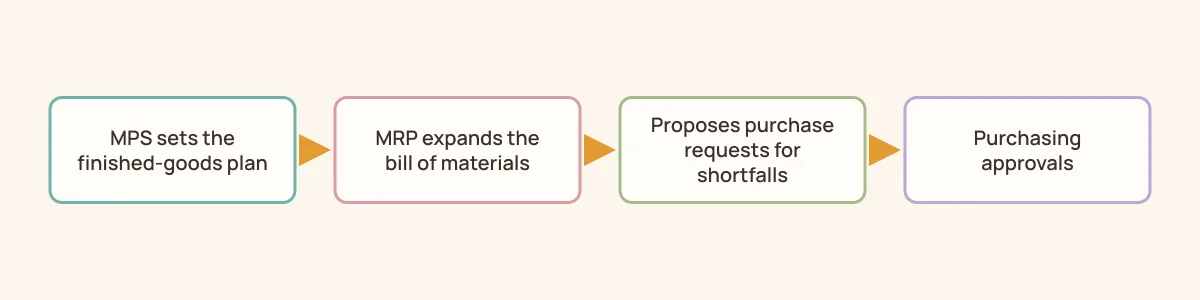
Keep MPS and MRP distinct. The Master Production Schedule sets the finished-goods plan. What to make, how much, and when. Material Requirements Planning expands the plan through the bill of materials. For the related workflow, see How Production Planning System Benefit Manufacturers.
It considers stock and open orders before proposing replenishment. Purchase proposals still need the relevant purchasing approval; MRP does not buy materials autonomously.
For uncertain margins, ask the vendor to compare the production-order cost with the bill-of-materials standard using the same output. For custom work, ask how staff maintain an order-specific bill of materials. Test how your team enters custom bills of materials. Include the time needed for manual preparation in the implementation plan. For the related workflow, see Production Cost Report: BOM, Materials, Work Order Costing, and Example.
For delivery commitments, ask whether capacity is checked when the date is promised. Ask the planner to review work-centre load before promising a date. Test how an overloaded operation affects the proposed schedule. A system can still provide useful visibility while leaving the promise decision with the planner.
Test a PHP 5,000 material shortage during the planning demonstration. Follow the request through approval and inspect the impact on the production date.
Use Your PHP Order Costs to Test Reporting Depth
A costing demonstration should expose the records behind the total. Bring an anonymised Philippine workshop order with costs recorded in PHP. Ask the vendor to show materials, applied labour and applied overhead. Compare accepted output with the standard cost for that output.
Use those records to test the calculations. Add the recorded cost components and divide by accepted finished units. Compare the total with the standard cost for the same output. Require an explanation of each variance and retain the supporting calculation with your demonstration notes.
Identify the allocations used for applied labour and overhead. Distinguish applied labour from actual payroll and explain the difference. Do not accept a report using applied overhead as fully reconciled actual expenditure until finance demonstrates the period-end treatment.
Also ask how late production records affect work in progress, inventory valuation, and the order report. Log exceptions when consumption differs from the approved bill of materials. Include rejects and rework in the same review.
Agree on KPIs Before Comparing Dashboards
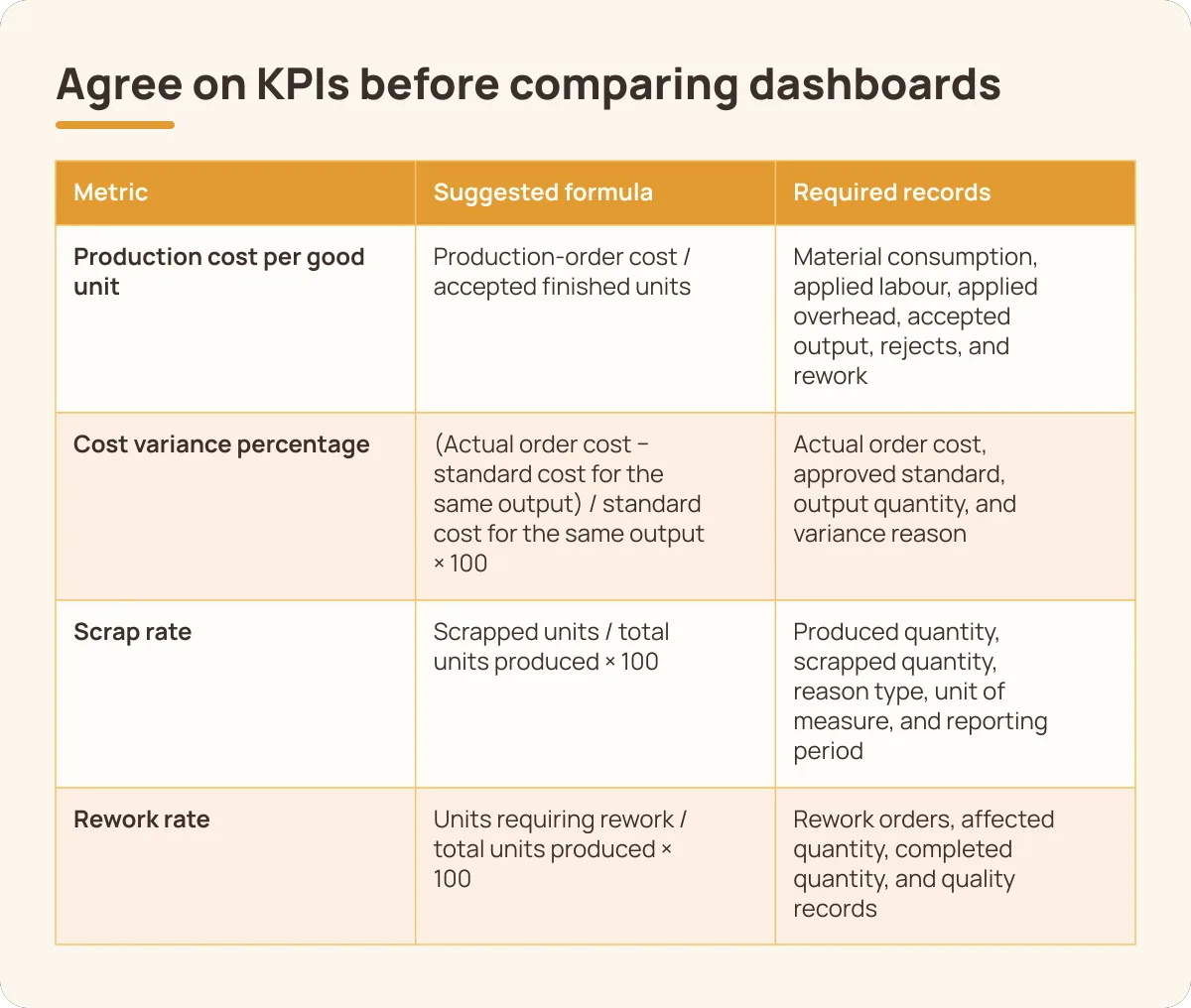
Agree on definitions before you compare dashboard tiles. A useful metric is only as reliable as its source records, units, denominator, reporting period, and treatment of exceptions.
| Metric | Suggested formula | Required records | Buying question |
|---|---|---|---|
| Production cost per good unit | Production-order cost / accepted finished units | Material consumption, applied labour, applied overhead, accepted output, rejects, and rework | How do rejects and rework affect the denominator and allocated costs? |
| Cost variance percentage | (Actual order cost − standard cost for the same output) / standard cost for the same output × 100 | Actual order cost, approved standard, output quantity, and variance reason | Does a positive result show an unfavourable variance, and can the reason be traced? |
| Scrap rate | Scrapped units / total units produced × 100 | Produced quantity, scrapped quantity, reason type, unit of measure, and reporting period | Can the report keep units and periods consistent across lines? |
| Rework rate | Units requiring rework / total units produced × 100 | Rework orders, affected quantity, completed quantity, and quality records | Can a reworked unit also appear in another quality measure without double counting? |
Use these measures as buyer calculations during the evaluation. Ask whether each measure is native, configurable, reportable from source records, or dependent on an export and separate calculation. Do not score a capability that has not been demonstrated.
For a PHP 150,000 batch, measure accepted output and cost variance together. A cheaper batch may still perform poorly if rejected output increases.
Check the Handoffs Between Planning, Purchasing, Production, and Finance
Trace the same sample order across departments. The demonstration should make ownership visible when demand, stock, costs, or dates change.
- Planning to purchasing: Start with finished-goods demand in MPS. Run MRP to expand the bill of materials and net stock and open orders. Ask who reviews each shortage, who converts a proposal into a purchase request, and who approves it.
- Change control: Reduce available stock or change the required date during the demo. Ask which plan, proposal, approval, and work order records update, and which records require manual review.
- Production to costing: Record actual material consumption, applied labour, and applied overhead against the production order. Open the cost report and trace every amount back to its source record.
- Finance reconciliation: Ask how period-end overhead actualization is booked, how it reaches production costs, and how finance reconciles work in progress with open manufacturing orders.
- Existing systems: Ask the vendor to demonstrate links with your sales, inventory, purchasing, and accounting systems. Identify included connections, manual transfers, and development that would be separately scoped.
Follow a PHP 20,000 material purchase from approval through receipt and consumption. Each handoff should preserve the order reference and its responsible owner.
How HashMicro Supports Production Workflows
HashMicro separates the finished-goods plan from material requirements planning. MRP considers the bill of materials, available stock and open orders. Shortages can lead to purchase requests through the purchasing workflow. For the related workflow, see 8 Best MRP Software for Manufacturers in the Philippines (2026).
Production records capture material use, hours, output and rejects. The MO Cost Report supports comparison with the bill-of-materials standard. Quality checks, quarantine, scrap reasons and rework orders handle different production exceptions.
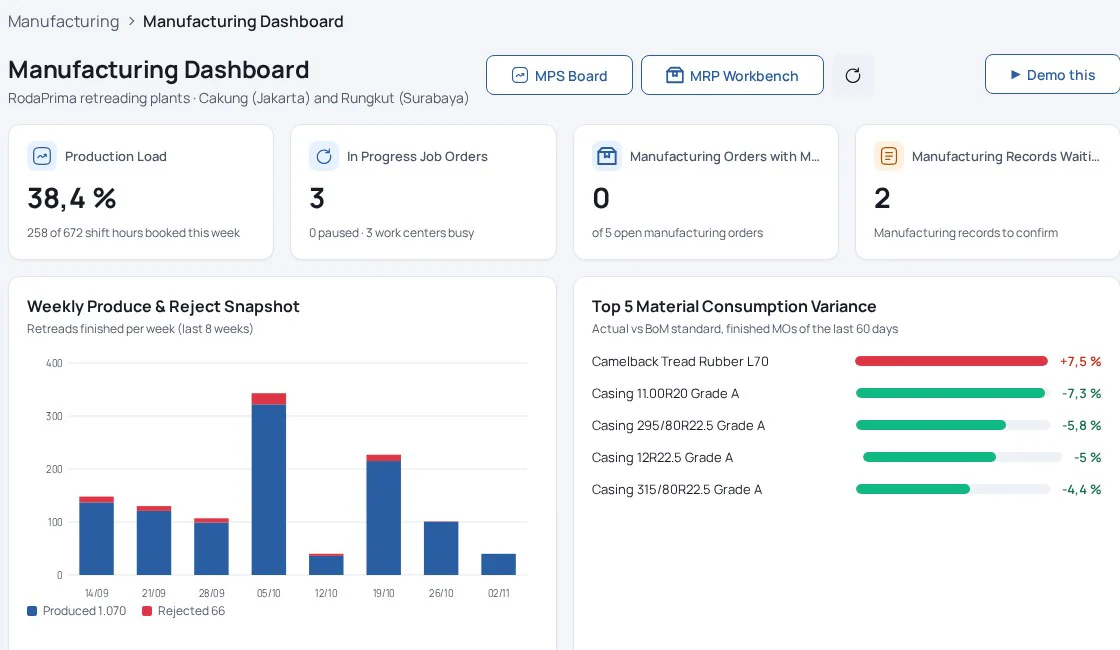
Use a PHP 150,000 batch to examine each handoff during a demonstration. Review material entries and applied labour before assessing the final unit cost. Keep purchase approval and production approval responsibilities clear.
Prepare a Demo Pack and Make the Purchase Decision
Bring one representative production order and enough supporting data to make the demonstration realistic. Include its bill of materials, stock balances and open orders. Add cost rates, delivery requirements, approval roles and a scrap example.
Use anonymised sample data. Define acceptance tests before the meeting. Identify a shortage and show the purchase proposal with its approvals.
Explain a cost variance and demonstrate a quality exception. Record the evidence, owner, and unresolved question for each must-have requirement.
Request a written proposal covering licences, implementation, migration, training, support, integrations, and customisation. Do not assume prices, deployment times, or contract terms until they are written and reviewed. Treat an unproven must-have requirement as unresolved before signing.
When your team is ready, request a manufacturing workflow demo using your sample production order.
Include one PHP 2,000 scrap event in the demo pack. Require the team to explain its quantity, reason and effect on the order cost.
Run a Short Pilot Before Expanding the Rollout
Choose one product family and a representative shift for the pilot. Give planners, warehouse staff, supervisors and finance a shared acceptance checklist. Keep the first scope small enough to investigate every exception.
Record a PHP 150,000 batch using the same assumptions as your spreadsheet. Compare material quantities, accepted units and applied costs line by line. Resolve differences before adding more products or another factory.
Test a shortage discovered after planning but before material release. Ask who changes the plan and who approves an urgent purchase. Record the effect on the promised date and expected cost.
Next, reject ten units and recover six through rework. Keep the original loss visible alongside the extra labour and material. Check that good output does not include units still awaiting inspection.
Train each role using a normal transaction and a correction. Supervisors should explain how an error reaches the exception queue. Finance should trace a correction through the cost report without losing the original reference.
For acceptance, compare results with a documented manual calculation. Record unresolved issues with owners and target dates. Expand only after the team can complete and explain the full cycle.
Philippine Tax, Labour and Privacy Controls
Use the BIR rules applicable to your transactions and registration. Keep invoice numbers, tax classifications and correction references alongside each posting. A software demonstration alone does not establish BIR accreditation.
For a PHP 100,000 purchase, distinguish the base amount from taxes and settlement. Have finance select the applicable treatment before testing the posting. Do not reuse a tax assumption from an unrelated transaction.
Labour records should follow applicable DOLE requirements and company approvals. Separate approved hours from the value allocated to a production order. This distinction helps explain differences between payroll and applied labour.
Protect employee and supplier information under the Data Privacy Act. Restrict exports and use masked records during supplier demonstrations. Give each user the access needed for their assigned responsibilities.
Conclusion
Prepare a PHP 150,000 batch and its cost assumptions. Use those records to review HashMicro Manufacturing Software. Book a Demo.
FAQ
Manufacturing software connects material planning, production orders and recorded factory output. A Philippine workshop producing 100 units needs to know which materials are required, what operations will run and what was actually consumed. These records support costing and stock control. The useful scope depends on the factory’s production method and existing processes.Before selecting a solution, write down the specific record your team needs and who will maintain it. Use a small representative sample to confirm the scope with operational staff. Separate essential requirements from optional features, then ask the supplier to demonstrate the essential workflow using that sample.
Use a sample order for 100 finished units. Define the bill of materials, check material availability, release production work and record consumption and output. Separate good units, rejects and remaining work. Compare the expected material quantity with the actual issue rather than assuming that completing an order proves its original plan was accurate.As a next step, draw the handover between the people involved and identify where an exception needs approval. Walk through the example with the person doing the work and the person reviewing it. Keep the supporting documents together so another team member can reproduce the result.For the connected process, read: Related workflow: How Production Planning System Benefit Manufacturers.
Cost drivers include users, sites, production complexity, data preparation, training and integrations. A factory with 2 work centres and one warehouse needs a different rollout from multiple plants. An illustrative PHP 10,000 training allowance is an internal budget example, not a subscription price. Request a breakdown covering implementation, support and recurring charges.Build a total-cost worksheet for the first year and later years, showing assumptions beside each line. Include internal staff time and ask who owns any extra work. Next, compare written proposals against the same scope and acceptance criteria rather than comparing headline fees with different inclusions.
A Philippine food producer planning 100 packs should define the recipe quantity, expected output and treatment of rejects. If only 95 packs pass inspection, the team needs a documented explanation for the difference. Use a sample batch to identify who records output and who approves adjustments before connecting production results to financial reporting.Treat these figures as an illustrative scenario, not a statutory threshold or promised result. Next, repeat the exercise with a recent transaction and ask its owner to explain every difference. Check the relevant official guidance for the local context, and retain the documents that support your own decision.Official local guidance: Data Privacy Act.
Choose with a representative production case rather than a feature count. Test 1 order with a material shortage, an unexpected reject and a corrected quantity. Check whether the planner, shop-floor supervisor and accountant can trace the same order. Machine data capture and specialised regulatory reporting require an explicit scope discussion instead of an assumption.Next, record the outcome of each test and the evidence used to accept it. Name a responsible reviewer for any gap before agreeing the final scope. Ask for a repeat demonstration when a critical case fails, then use the written results to support the purchasing decision.
- Agree mandatory requirements before scoring.
- Test exceptions with supporting evidence.
- Record gaps and obtain a named owner.
Start with one product family, one bill of materials and a small stock sample. For example, rehearse a 100-unit order before opening all factory orders in the new process. Assign owners for material codes, work-centre times and opening balances. Agree who signs off the trial results and which discrepancies must be resolved first.Next, agree the pilot’s acceptance criteria with the people who will use the process daily. Keep an issue log with an owner and a due date for each problem. Expand only after the team can explain and reproduce the results, including the handling of a correction.
- Prepare a clean sample and assign owners.
- Rehearse the complete workflow and corrections.
- Review the results before expanding the rollout.
Production needs a consistent handover to inventory and accounting. Test whether a 100-unit order leaves the expected material, finished-goods and cost records. Document which system owns each identifier and who handles failed exchanges. If machinery or an external planning tool must connect, request a separate demonstration of that connection and its error handling.Next, create a field map and test both a normal record and a deliberate error before approving the interface. Ask who monitors failures and how corrections are replayed without duplicates. Include support responsibilities in the written scope so a future incident has a clear owner.