







Many Philippine businesses approve a warehouse expansion or software rollout without knowing which costs build assets. A 2025 study by Bongalonta, M. B. found that manufacturing firms in Bulan, Sorsogon, had heavy reliance on the payback period. Those firms stay vulnerable to short-term financial pressure.
Understanding the differences between CapEx and OpEx explains that gap. CapEx covers spending that creates or improves assets beyond the current reporting period. OpEx covers the daily costs that keep operations running. Classifying each cost correctly fixes budgets, approvals, profit reporting, and asset records.
This article gives you the quick difference, clear definitions, and a framework that separates CapEx vs OpEx from COGS. You will also see examples across eight business functions plus calculation and budgeting methods. Later sections cover Philippine tax and reporting review, ERP visibility controls, and a practical decision checklist.
Key Takeaways
CapEx generally creates or improves a long-term asset, while OpEx supports current business operations.
CapEx vs OpEx vs COGS framework separates asset creation, operating support, and direct delivery costs by reporting destination and owner.
CapEx and OpEx budgeting compares the planning basis, approval, cash forecast, commitments, and the variance questions for each category.
The practical decision checklist runs ten steps, from describing the purchase to escalating unusual or material cases for review.
CapEx vs OpEx: The Quick Difference for Philippine Enterprises
CapEx is generally an investment in a long-term asset or material improvement, while OpEx supports current business operations. For example, a manufacturer purchasing a new production machine may record a capital asset after approval, delivery, and commissioning. Monthly electricity, routine servicing, and cleaning support the facility but are normally reviewed as period operating costs or production costs under company policy.
| Decision area | CapEx | OpEx |
|---|---|---|
| Purpose | Acquire, construct, replace, or materially improve a long-term asset | Operate, maintain, sell, administer, and support the business |
| Expected benefit period | Extends beyond the current reporting period | Consumed during the relevant operating period |
| Cash-flow timing | Often linked to project milestones, deposits, delivery, or commissioning | Usually linked to monthly, quarterly, or service-period payments |
| Profit-and-loss treatment | Usually recognised through depreciation or amortisation over the approved useful-life policy | Usually recognised as an expense when the service or benefit is consumed |
| Balance-sheet treatment | May create or increase a property, equipment, software, or other asset balance | Normally does not create a long-term asset, subject to policy review |
| Depreciation or amortisation | Commonly assessed after the asset is available for use | Generally not applicable to ordinary period expenses |
| Approval owner | Project sponsor, finance, procurement, and asset owner | Budget owner, finance, procurement, and operating department |
| Representative examples | Production equipment, permanent fit-outs, warehouse racking, qualifying hardware | Rent, utilities, subscriptions, routine repairs, insurance, outsourced services |
The classification is a workflow, not just a ledger choice. A budget request may become a purchase order, supplier invoice, receiving record, capitalisation assessment, asset registration, expense posting, or variance report. One technology project can contain CapEx, OpEx, COGS, and other categories. Company policy remains authoritative when treatment is uncertain. A guide to IFRS in the Philippines gives broader reporting context.
What Is OpEx and Which Costs Usually Belong in It?
The OpEx definition is straightforward. OpEx is the operating expenditure that covers costs a business consumes to run and support itself during a reporting period. It funds selling, service delivery, department administration, facility upkeep, and customer support, rather than acquiring a long-term asset.
Recurring billing offers a useful clue, but it does not fully classify a cost. The CapEx vs OpEx distinction depends on the benefit period, not billing frequency alone. Common operating expenditure examples include:
- Rent, utilities, internet, and telecommunications for branches, offices, hotels, and warehouses.
- Payroll-related operating costs, recruitment services, and staff welfare expenses.
- Office supplies, routine maintenance, cleaning, security, and repairs.
- Marketing campaigns, professional fees, logistics services, and outsourced back-office work.
- Software subscriptions, cloud consumption, help-desk support, and maintenance contracts.
- Insurance premiums and other services recorded as a prepaid expense first, then consumed over the agreed coverage period.
How to test and track each cost
A monthly expense review is more useful when each line connects to evidence and an owner. Finance teams often maintain a register that tracks each cost systematically, including:
- Vendor and cost centre
- Service period and budget owner
- Recurring status and expected benefit period
- Purchase order and invoice reference
- Review status
Ask three questions for every line to apply the CapEx vs OpEx test correctly:
- What business activity does the cost support?
- When does the business consume the benefit: immediately, over the service period, or through a long-term asset?
- What evidence supports the posting, such as a contract, service receipt, invoice, or approval?
Committed vs Controllable OpEx and Capex vs Opex Borderline Cases
Separate committed OpEx from controllable OpEx to sharpen forecasts and clarify variances. A signed annual maintenance contract counts as committed OpEx, even when a department has little short-term flexibility. Discretionary advertising, travel, or consulting spending typically falls under controllable OpEx instead.
A major repair often creates a capex vs opex borderline case. Routine servicing that maintains an asset's existing condition usually counts as an operating expense. A significant upgrade that increases capacity, extends useful life, or improves performance may require capitalisation review instead. Always check the approved policy rather than forcing a universal answer.
What Is CapEx and When Does Spending Become an Asset?

The CapEx meaning centers on spending that acquires, constructs, replaces, or materially improves an asset. Businesses expect these assets to deliver benefits beyond the current reporting period. This CapEx vs OpEx distinction hinges on the benefit period, not the invoice type.
Common CapEx examples include production machines, warehouse improvements, vehicles, and permanent building fit-outs. Major infrastructure, hardware, and qualifying software or implementation components also qualify but are subject to policy review.
The Asset Lifecycle: From Approval to Depreciation
Consider a new machine purchase to see the full asset lifecycle in action. The process typically starts with a business case, funding approval, and a purchase order. It continues through supplier invoice, delivery evidence, installation, commissioning, and asset registration.
Depreciation begins once the asset becomes available for use, following organisational policy. This lifecycle view supports CapEx vs OpEx decisions, since it shows how value builds over time. Later controls include impairment review, location transfers, custodian updates, and eventual retirement or disposal.
An asset-lifecycle checklist should include the following steps:
- Define the business need, expected benefit, project code, and proposed asset class.
- Obtain approval under the capital expenditure authority matrix.
- Match procurement documents, invoice, delivery, installation, and commissioning evidence.
- Assess whether each cost qualifies for capitalisation under company policy.
- Register the asset with location, custodian, in-service date, useful-life policy, and depreciation method.
- Reconcile the asset register with the general ledger, and review impairment, transfer, or disposal status.
CapEx vs OpEx: Routine Repairs and the Fixed-Asset Register
For planning, a company may use the illustrative formula: gross CapEx = qualifying asset purchases + capital improvements. This formula supports planning only; it does not replace the approved accounting policy.
A fixed-asset register should capture several key details for each item:
- Asset class and location
- Custodian and in-service date
- Useful-life policy and depreciation method such as straight-line method
- Project reference and accumulated depreciation
- Disposal status
Avoid assuming thresholds, useful lives, rates, or tax deductions without current professional validation. Routine repair differs from an asset purchase in a classic CapEx vs OpEx scenario. Replacing a worn part to keep equipment operating may qualify as OpEx. Installing a new system that materially increases capacity may qualify as CapEx instead. The purpose and expected benefit period matter more than the invoice label.
CapEx vs OpEx vs COGS: A Practical Classification Framework
A practical three-way framework is one where CapEx acquires or improves long-term assets, OpEx supports business operations, and COGS represents direct costs associated with goods sold or services delivered. COGS is not simply another name for general OpEx; its treatment depends on the business model and accounting policy.
| Category | Purpose | Typical examples | Reporting location | Budget owner | Transaction source | Review question |
|---|---|---|---|---|---|---|
| CapEx | Create or improve a long-term asset | Machine, fit-out, permanent racking | Balance sheet, then depreciation or amortisation | Project sponsor and finance | Capital request, PO, receiving, commissioning | Will the benefit extend beyond the current period? |
| OpEx | Run and support operations | Rent, subscription, cleaning, routine repair | Period expense or operating overhead | Department budget owner | Supplier bill, contract, service receipt | When is the service consumed? |
| COGS | Capture direct cost of goods or services delivered | Raw materials, resale inventory, direct delivery labour | Income statement through inventory or service costing | Operations, supply chain, and finance | Production issue, inventory movement, sales invoice, payroll allocation | Is the cost directly attributable to delivered output? |
For a Philippine manufacturer, a machine may be CapEx, raw materials may move through inventory to COGS, and factory utilities may require a policy-based allocation between production cost and operating overhead. A retailer's purchased merchandise normally follows inventory and COGS processes, while store rent is generally an operating expense. An ambiguous shared service should be escalated with its source document, cost object, and business purpose.
CapEx vs OpEx Examples Across 8 Business Functions
The same CapEx vs OpEx label cannot apply to every cost in a project. Manufacturing, retail, warehousing, technology, hospitality, cloud, and facility costs each raise different CapEx vs OpEx questions. The following scenarios illustrate CapEx vs OpEx treatments across business functions; final classification depends on company policy and professional review.
| Expenditure | Likely category | Rationale and implication | Control question |
|---|---|---|---|
| Manufacturing production machine | CapEx | Acquires a long-term operating asset; requires project approval, commissioning evidence, asset registration, and depreciation assessment | Has the machine been received and made available for use? |
| Retail store fit-out or permanent equipment | CapEx, subject to lease and policy review | Permanent improvements may provide benefits across several periods; track location, project code, and component details | Is the work removable maintenance or a material improvement? |
| Distribution warehouse racking or material-handling equipment | CapEx | Durable racking, conveyors, or forklifts support warehouse capacity over time | Which assets were delivered, installed, and assigned to a custodian? |
| BPO laptops and technology hardware | Often CapEx when above policy threshold; otherwise policy-dependent | Owned hardware can be registered and depreciated; accessories and support may be separate costs | Are hardware, accessories, warranties, and support separately identified? |
| Hospitality property renovation | Mixed CapEx and OpEx | Structural or material improvements may be capitalised; repainting and routine repairs are commonly period costs | Does the renovation extend useful life, capacity, or quality beyond maintenance? |
| Cloud software subscription or usage fees | Usually OpEx | Recurring access and consumption are generally period operating costs; implementation components need separate assessment | What portion is subscription, usage, support, or implementation? |
| Major repair or upgrade | Requires policy review | A major replacement may improve capacity or extend useful life, while routine repair restores condition | What changed in capability, useful life, or residual value? |
| Outsourced security, cleaning, or facility services | OpEx | Services are consumed as delivered and normally charged to the relevant cost centre | Is there a valid contract, service period, approval, and receipt? |
A single project can mix CapEx and OpEx costs instead of following one label. Teams should separate hardware, implementation work, subscriptions, support, training, and data migration whenever possible. Each component may need a different accounting treatment. The project name or vendor contract should never decide the CapEx vs OpEx posting alone. Only each cost's nature and benefit period should guide that decision.

How Are CapEx and OpEx Calculated and Budgeted?
CapEx budgets follow project and asset plans, while OpEx budgets follow period and operating activity. This CapEx vs OpEx distinction shapes how finance builds each budget. Teams that compare spending across years often report net capital expenditure, which deducts periodic depreciation from gross CapEx before the comparison.
A useful budget connects approved spending, commitments, actual costs, expected service periods, cash timing, and reporting treatment together.
Teams that compare spending across years often report net capital expenditure, which deducts periodic depreciation from gross CapEx before the comparison.
Teams that compare spending across years often report net capital expenditure, which deducts periodic depreciation from gross CapEx before the comparison.
Teams that compare spending across years often report net capital expenditure, which deducts periodic depreciation from gross CapEx before the comparison.
Teams that compare spending across years often report net capital expenditure, which deducts periodic depreciation from gross CapEx before the comparison.
Teams that compare spending across years often report net capital expenditure, which deducts periodic depreciation from gross CapEx before the comparison.
Teams that compare spending across years often report net capital expenditure, which deducts periodic depreciation from gross CapEx before the comparison.
Teams that compare spending across years often report net capital expenditure, which deducts periodic depreciation from gross CapEx before the comparison.
Teams that compare spending across years often report net capital expenditure, which deducts periodic depreciation from gross CapEx before the comparison.
Teams that compare spending across years often report net capital expenditure, which deducts periodic depreciation from gross CapEx before the comparison.
Teams that compare spending across years often report net capital expenditure, which deducts periodic depreciation from gross CapEx before the comparison.
| Budget field | CapEx planning | OpEx planning |
|---|---|---|
| Basis | Asset plan, project scope, and milestone | Department activity, contract, headcount, and service period |
| Approval | Capital authority and business case | Operating budget authority and purchase approval |
| Cash forecast | Deposits, progress payments, delivery, and commissioning | Monthly or contracted payment schedule |
| Commitment view | Open POs, construction commitments, and unbilled receipts | Renewals, purchase orders, and contracted services |
| Actual comparison | Approved project cost versus asset additions | Period expense versus budget and forecast |
| Future impact | Depreciation, amortisation, maintenance, and replacement planning | Recurring run-rate, inflation, renewals, and service changes |
Finance organises each request into approved, committed, actual, and forecast values, distinguishing CapEx commitments from OpEx run-rate. A HashMicro accounting system can track purchase orders, subscription renewals, and cancellation terms, keeping cash-flow planning accurate from approval through payment.
A simple monthly variance review can test capex vs opex classification with these questions:
- Was the cost approved against the correct category and cost centre?
- Did the timing differ from the budget because of delivery, commissioning, or service-period changes?
- Is the variance caused by price, volume, scope, foreign exchange, or classification?
- Does the forecast include future depreciation, renewals, maintenance, or disposal costs?
Accounting software can connect requisitions, purchase orders, invoices, projects, assets, inventory, and the general ledger. This reduces reliance on separate spreadsheets and gives finance and operations a shared capex vs opex record for review.
CapEx, OpEx, Tax, and Philippine Reporting Review
Book accounting and tax treatment are related but not always identical. Philippine businesses should assess transactions against their approved accounting policy, applicable Philippine Financial Reporting Standards, current tax rules, materiality guidance, and documentation requirements. Treatment may also vary between entities, industries, leases, and bundled technology contracts.
Escalate a decision for professional review when it involves a major repair, internally developed software, implementation services, bundled contracts, or differences between book and tax treatment. Retain the business case, approval evidence, purchase order, invoice, delivery or commissioning evidence, and capitalisation assessment.
A connected audit trail demonstrates who approved a request, what changed, and when the transaction moved through procurement and finance controls. It does not replace accounting judgement, but it strengthens the evidence available for review and supports faster, more confident decisions.
Improving CapEx and OpEx Visibility with ERP Controls
Disconnected finance, procurement, IT, and operations tools make cost classification harder to manage. Fragmented systems obscure the capex vs opex distinction and slow down monthly reviews. An integrated ERP process brings these functions together and helps teams apply company policy consistently. It can support the following controls:
- Budget controls that check available funds before requisition approval.
- Separate workflows for capital projects, recurring services, inventory, and direct production costs.
- Purchase-order matching for invoices, receipts, and commissioning evidence.
- Fixed-asset registers linked to projects, locations, custodians, and depreciation schedules.
- Contract and subscription records with renewal dates and committed OpEx.
- Dashboards showing approved, committed, actual, and forecast amounts.
- Role-based approvals and an audit history for changes and exceptions.
ERP controls avoid forcing one chart of accounts on every organisation. They simplify policy and give management timely visibility. Finance can then explain whether a variance reflects a new project, delay, or incorrect posting. Businesses evaluating an integrated platform can read HashMicro's guide on ERP ROI for Philippine businesses.
A Practical Decision Checklist
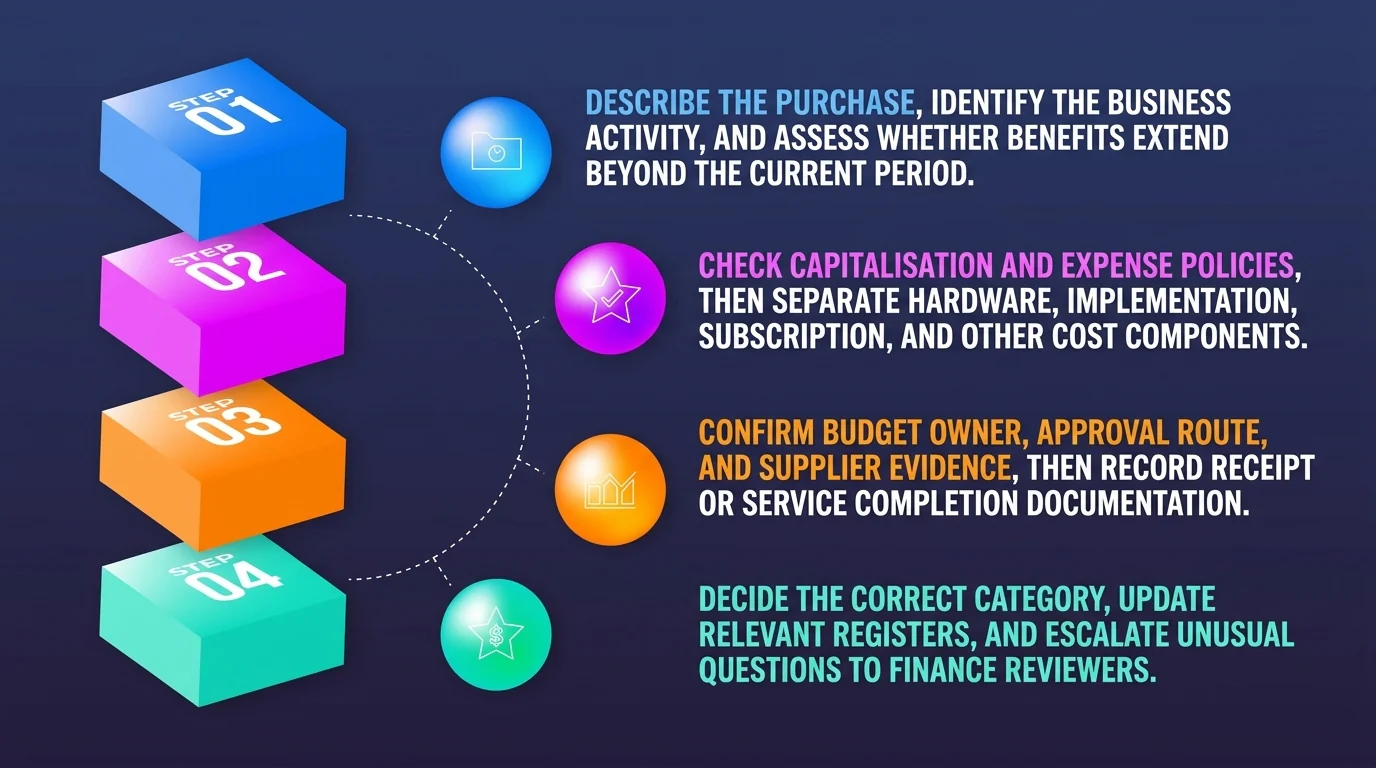
Classifying a cost as CapEx or OpEx requires more than a quick judgment call. This CapEx vs OpEx decision checklist walks finance teams and budget owners through ten practical steps, from describing the purchase to escalating unusual cases for professional review before finalising the posting.
- Describe what was purchased or delivered in plain language.
- Identify the business activity, project, asset, inventory item, or service period involved.
- Assess whether the benefit is consumed now or extends beyond the current reporting period.
- Check the approved capitalisation, expense, inventory, lease, and materiality policies.
- Separate hardware, implementation, subscription, support, training, and other identifiable components.
- Confirm the budget owner, approval route, cost centre, project code, and supplier evidence.
- Record receipt, commissioning, service completion, or production-use evidence.
- Decide whether the amount belongs in CapEx, OpEx, COGS, inventory, or another policy-defined category.
- Update the asset register, contract register, inventory records, or expense schedule as applicable.
- Escalate unusual, material, or book-versus-tax questions to the finance reviewer or external professional adviser. Assign an accountable owner, validate the inputs, and review the outcome before applying the recommendation across the full process.
Conclusion
CapEx generally creates or materially improves a long-term asset. OpEx supports current operations. COGS captures direct costs associated with goods sold or services delivered. The distinction affects budgets, cash flow, profit reporting, depreciation or amortisation, approvals, asset records, and management decisions.
For Philippine enterprises, the most reliable approach is to review each identifiable cost by purpose, benefit period, evidence, owner, and reporting destination. A software project, branch expansion, warehouse upgrade, or hotel renovation may contain several treatments. Clear policies and connected workflows help finance teams apply those policies consistently.
If CapEx and OpEx decisions are creating uncertainty in your budgets, approvals, or financial reports, schedule a free consultation with HashMicro's team to discuss your requirements for accounting software to align with your workflows and business needs.

FAQ About CapEx vs OpEx
Separate the project into identifiable components instead of applying one blanket treatment. Address hardware, qualifying implementation work, recurring subscriptions, support, and training independently. Apply the approved accounting policy to each component, then obtain professional review whenever the correct treatment stays unclear or disputed.
Yes. An owned hardware component may be CapEx, while recurring cloud usage, implementation services, maintenance, and user training may require separate OpEx or policy review. Classification follows the nature and benefit period of each cost, not the project name or vendor contract alone.
Retain the business case, approval evidence, purchase request, purchase order, supplier invoice, delivery or commissioning evidence, asset location, project code, expected benefit period, and capitalisation assessment. The exact documentation set should follow company policy and applicable Philippine requirements, so confirm the list with your finance head.
Both categories affect cash flow, but finance monitors them differently. CapEx runs through project funding, asset additions, and future depreciation or amortisation. OpEx moves through recurring commitments, period expenses, cost centres, and operating variances, which keeps monthly management reporting easier to explain.
Escalate when a cost involves a major repair, internally developed software, implementation services, bundled contracts, asset improvements, unusual useful-life assumptions, material amounts, or possible differences between book and tax treatment. This article provides general education, not tax or accounting advice.