







The Bureau of Working Conditions (BWC) processes thousands of wage-related complaints each year, and incorrect overtime computation consistently ranks among the most cited violations in DOLE enforcement data. A single misapplied multiplier is all it takes to trigger a back-pay order and a payslip audit covering the previous three years.
Get it wrong once and you are staring at a DOLE wage complaint, a back-pay order, and an audit of every payslip you issued in the last three years. Get it right and you protect your company, your employees, and your next payroll run.
This guide gives you the complete DOLE rate table for 2026, the exact three-step formula, and peso-denominated examples for every scenario from a simple ordinary day to a regular holiday with night-shift differential. All figures follow the DOLE BWC Handbook and Labor Code Articles 82–89.
Key Takeaways
Overtime begins the moment an employee works beyond 8 hours in a single workday (Labor Code Art. 87).
The base overtime rate is 125% of the hourly rate on an ordinary day; multipliers escalate to 338% on a rest day that falls on a regular holiday.
Night-shift differential (10%) stacks on top of whatever day-type multiplier applies.
One consistent peso example runs throughout: daily wage PHP 600, hourly rate PHP 75.
What Counts as Overtime Work Under Philippine Labor Law?
Under Philippine employment law, the standard workday is eight hours (Labor Code Art. 83). Work performed beyond those eight hours on any given day is overtime regardless of what time those extra hours begin or end.
Three mechanics apply consistently across all day types:
- Rest breaks under 20 minutes are compensable. Deducting a 15-minute break from an employee's hours violates compensable time rules; only meal breaks of at least one hour may be excluded.
- Undertime cannot offset overtime (Art. 88). An employee who arrives one hour late and stays one hour late still earns overtime premium because the undertime is an absence, not a credit.
- Overtime may be compulsory under Art. 89 in situations involving national emergencies, urgent equipment repairs, or unusual work volume beyond the employer's control. Outside those situations, overtime must be voluntary or governed by a CBA.
All three rules apply before you reach the rate calculation, getting them wrong changes both the hours count and the exposure amount.
Overtime Pay Rate Table in the Philippines: 2026 DOLE Multipliers
The multiplier you use depends on the type of day the overtime falls on. The table below reflects the rates in the current DOLE BWC Handbook (2024 edition) and remains in effect for 2026.
| Day Type | OT Multiplier | Computation Basis |
|---|---|---|
| Ordinary working day | ×1.25 | Hourly rate × 1.25 × OT hours |
| Rest day / Special non-working day | ×1.69 | 1.30 × 1.30 |
| Rest day falling on special non-working day | ×1.95 | 1.50 × 1.30 |
| Regular holiday | ×2.60 | 2.00 × 1.30 |
| Regular holiday + rest day | ×3.38 | 2.60 × 1.30 |
| Night shift (22:00–06:00) | +10% on top | Stack onto applicable multiplier |
For full details on which days are declared regular holidays and special non-working days, see our guide to holiday pay rules.
How to Compute Overtime Pay: A Step-by-Step Guide With Peso Examples
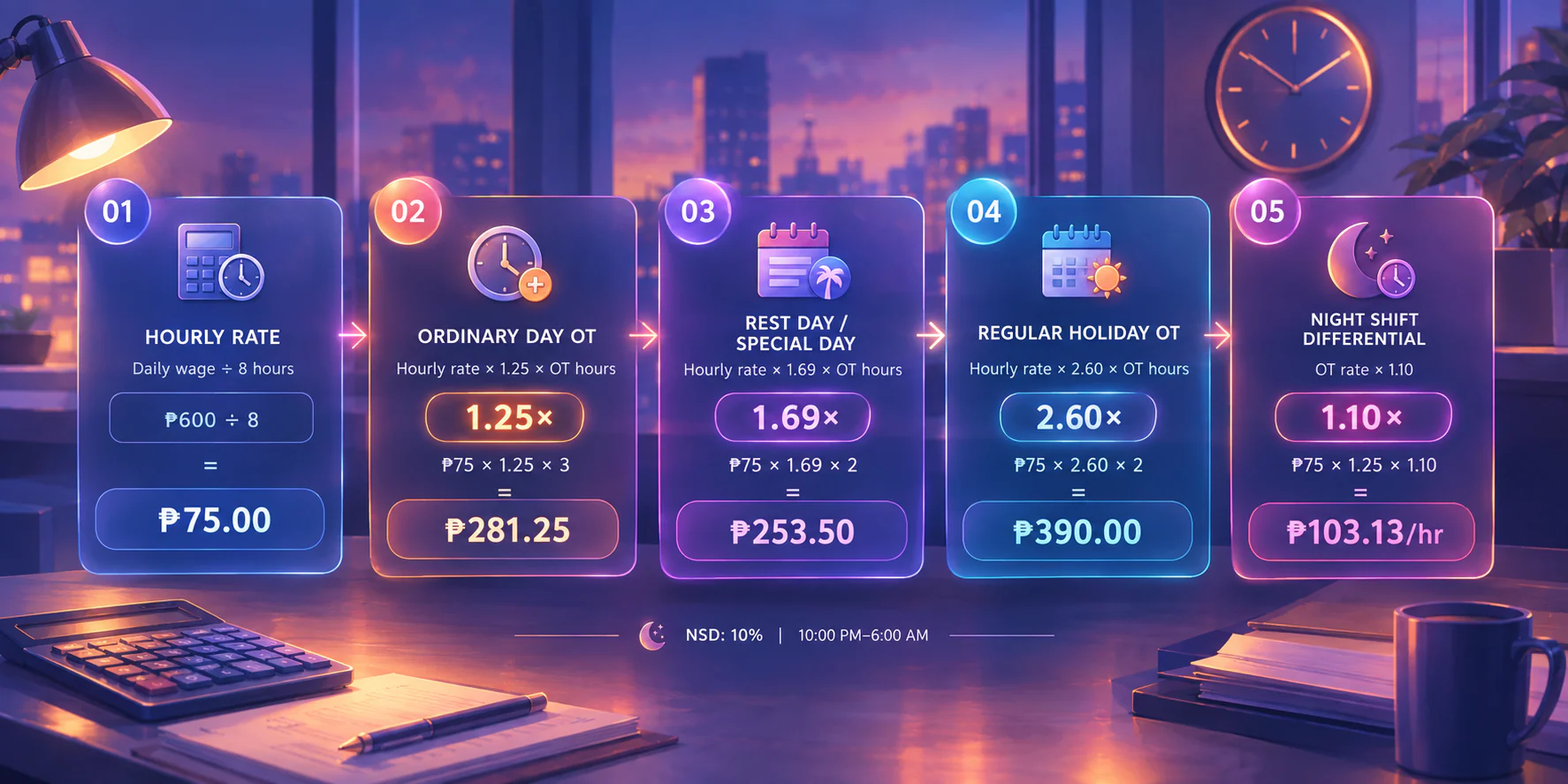
Three steps cover every scenario. The numbers below use a consistent baseline: daily wage PHP 600, semi-monthly payroll.
1. Get the Hourly Rate From the Daily Wage
Hourly rate = Daily wage / 8 hours
Hourly rate = PHP 600 / 8 = PHP 75.00
If your company uses a monthly salary, convert it first. For a monthly-paid employee:
Daily rate = Monthly rate x 12 / 261 (regular working days per year)
For project-based or part-time staff, see our guide on pro-rated salary computation.
2. Ordinary Day Overtime at 125%
The most common case: an employee stays late on a regular Tuesday.
OT pay = Hourly rate x 1.25 x OT hours
OT pay = PHP 75 X 1.25 X 3 hours
OT pay = PHP 281.25
Total for that day: PHP 600 (regular 8-hour pay) + PHP 281.25 (3 hours OT) = PHP 881.25.
3. Rest Day / Special Non-Working Day Overtime at 169%
When overtime falls on a rest day or a special non-working day, the rate is 1.69×. The multiplier is derived by stacking: the rest-day/special rate already pays 130% for the first 8 hours, then overtime adds another 30% on top of that rate (1.30 × 1.30 = 1.69).
OT pay = PHP 75 x 1.69 x 2 hours = PHP 253.50
4. Regular Holiday Overtime at 260%
On a regular holiday, DOLE requires you to pay 200% for the first 8 hours worked. Overtime then adds 30% on top of that:
OT pay = PHP 75 x 2.60 x 2 hours = PHP 390.00
Important distinction: "working on a holiday" (200% for any hour worked) is different from "overtime on a holiday" (2.60× applies only to hours beyond 8). An employee who works exactly 8 hours on a regular holiday earns 200% for each of those hours and no OT premium applies until hour 9.
5. Night Shift Differential, Stacked on Overtime
Night shift differential (NSD) of 10% applies to hours worked between 10:00 PM and 6:00 AM. It is not an either-or with overtime, it stacks on top of whatever day-type multiplier you are already using.
Ordinary-day OT with NSD = PHP 75 x 1.25 x 1.10 = PHP 103.13 per hour
Regular holiday OT with NSD = PHP 75 x 2.60 x 1.10 = PHP 214.50 per hour
For a detailed discussion of how night-shift hours interact with each pay period schedule, check our dedicated pay-period guide.
A Full Payroll Scenario: One Employee, One Pay Period
Meet Juan. His daily wage is PHP 600 (hourly rate: PHP 75). In the first half of September he logs three types of overtime:
3 hours OT on an ordinary Thursday
2 hours OT on September 15 (regular holiday: Independence Day)
4 hours OT from 11 PM to 3 AM on an ordinary Tuesday (night shift applies)
Here is the breakdown:
| OT Type | Hours | Rate | OT Pay |
|---|---|---|---|
| Ordinary day OT (Thu) | 3 hrs | ×1.25 | PHP 281.25 |
| Regular holiday OT (Sep 15) | 2 hrs | ×2.60 | PHP 390.00 |
| Ordinary night OT (Tue, 11 PM–3 AM) | 4 hrs | ×1.25 × 1.10 | PHP 412.50 |
| Total OT premium | PHP 1,083.75 |
Juan's gross pay for the semi-month is his regular earnings plus this total OT premium. His gross pay forms the basis for SSS, PhilHealth, and Pag-IBIG contribution computations before arriving at net pay.
Note: statutory deductions (SSS, PhilHealth, Pag-IBIG) apply to total gross earnings including the OT premium. Your payslip should show OT pay as a separate line item for transparency, it also makes any DOLE audit substantially easier.
Calculating multiple overtime scenarios manually can quickly become time-consuming. HashMicro's payroll system can help automate these calculations and keep each pay component organized.

Who Is Entitled to Overtime Pay, and Who Is Not?
Labor Code Article 82 explicitly excludes the following groups from the overtime pay provisions:
Government employees (covered by Civil Service rules, not the Labor Code)
Managerial employees, those with primary duties involving management of the enterprise or a recognized department, who customarily direct the work of two or more employees, and who have authority to hire, fire, or effectively recommend personnel actions
Officers or members of a managerial staff, those whose primary duty is to assist an executive in a managerial capacity
Domestic helpers and persons in the personal service of another
Workers paid by results (piece-rate, boundary, task-based) where they are paid based on output rather than time
Everyone else including supervisors who do not exercise genuine managerial authority is entitled to overtime pay by default.
A common mistake: classifying a team leader or senior associate as "managerial" to avoid paying OT. If the employee's actual duties are primarily operational or technical, with only nominal authority, DOLE will treat them as rank-and-file and the back-pay exposure compounds for every pay period of misclassification. This connects directly to the full list of statutory employee benefits your workforce is entitled to.
Is Overtime Pay Taxable, and Does It Affect 13th Month Pay?
On tax: Overtime pay is part of taxable compensation income. It is included in the gross taxable income used to compute monthly withholding tax under the Bureau of Internal Revenue (BIR) graduated rates. When processing payroll, compute the employee's monthly gross (regular pay + all OT premium) and apply the appropriate rate from the BIR tax table.
On 13th month pay: Under PD 851, the basis for 13th month pay computation is the employee's basic salary and not total compensation. Overtime pay, night-shift differential, and holiday pay premiums are excluded from the 13th-month computation unless your company's policy or a CBA provision explicitly includes them. The safest practice: keep your payslip categories clean (basic, OT, NSD, allowances) so the 13th-month base is unambiguous.
6 Common Overtime Pay Mistakes Philippine Employers Still Make
1. Offsetting undertime against overtime: As Article 88 makes clear, you cannot legally net an employee's late arrival against extra hours worked later the same day. Both transactions must be recorded and processed separately.
2. Using the wrong pay base: Overtime must be computed on the employee's basic daily wage, not gross pay. If an employee receives a transportation allowance or meal subsidy, those amounts are excluded from the OT base.
3. Missing the stacking rule on rest days and holidays: Many employers apply a flat 1.30× for all rest-day OT. The correct rate depends on the combination: rest day alone is 1.69×, rest day on a regular holiday climbs to 3.38×.
4. No written authorization or time records: Article 89 requires employers to keep accurate time and attendance records. Absence of records in a DOLE inspection is treated as a violation, regardless of whether overtime was actually worked.
5. Misclassifying employees under Article 82: See the previous section where rank-and-file employees given the title "supervisor" without real supervisory authority remain fully entitled to overtime pay.
6. Confusing compressed work week with overtime-free scheduling: A compressed work week arrangement, when properly documented and filed with DOLE, allows employees to work longer daily hours without triggering overtime on those additional hours. Without that filing, the extra hours are ordinary overtime.
How Payroll Software Computes Overtime Automatically
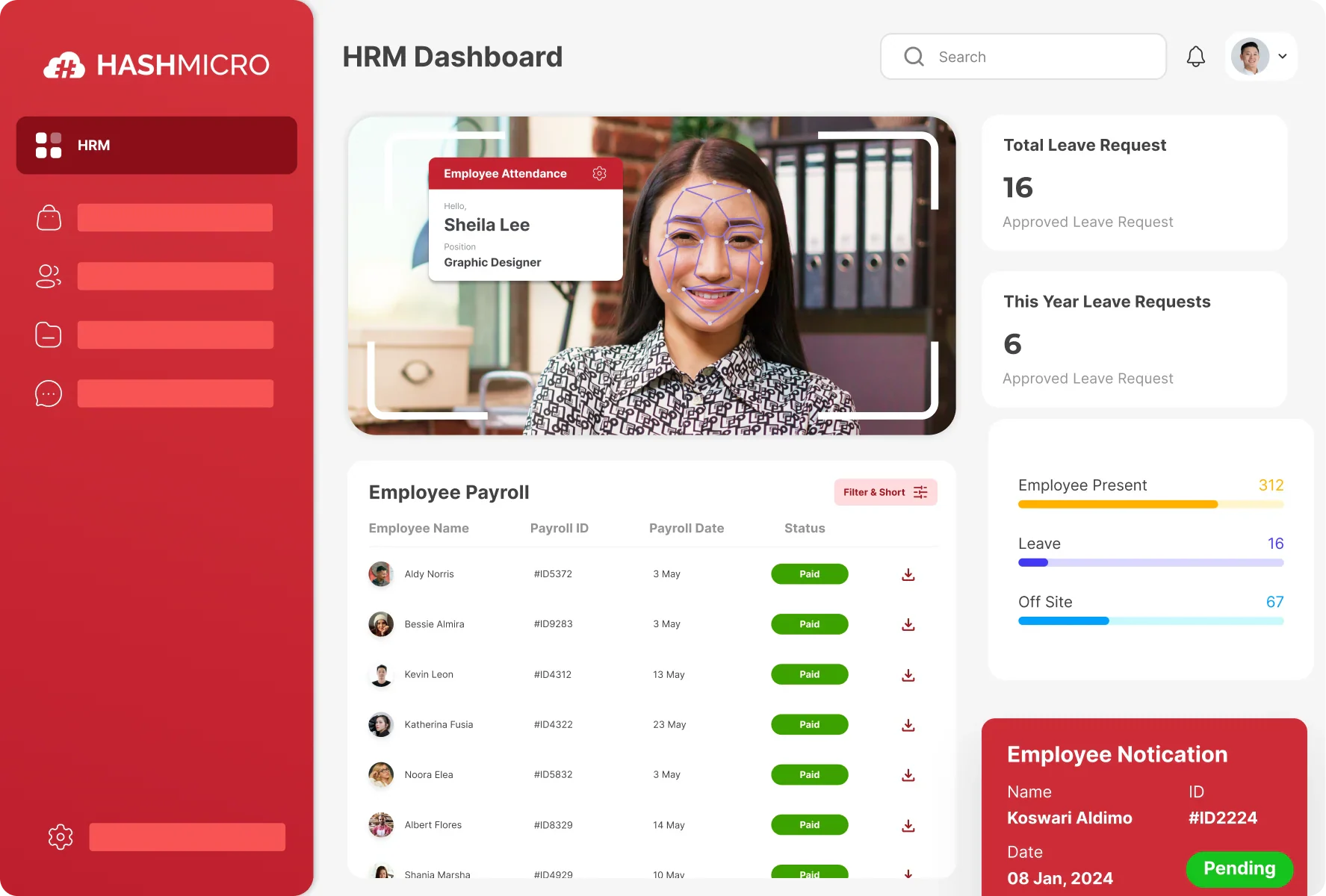
Every scenario above can be configured once in a payroll system and computed accurately on every payroll run thereafter. HashMicro's Payroll Software automatically:
Detects the day type (ordinary, rest day, special non-working, regular holiday) from the integrated holiday calendar
Applies the correct DOLE multiplier based on the detected day type and whether night-shift hours were logged
Separates basic pay, OT premium, and NSD on each payslip line item
Generates an audit-ready overtime report for DOLE inspection
Rather than maintaining a spreadsheet that must be updated every time DOLE issues a new proclamation or a public holiday is rescheduled, a payroll system keeps the computation consistent and the records defensible. When paired with an HRIS, the best HRIS software in the Philippines also handles the upstream time-and-attendance data that feeds those overtime calculations.
For a broader look at how the full payroll process works from time capture through disbursement and statutory filings, see our dedicated guide.
Conclusion
Overtime pay in the Philippines follows a clear structure: a 125% multiplier for ordinary days, escalating rates for rest days and holidays, and a 10% night-shift differential that stacks on top. The three-step formula works for every scenario once you know which multiplier applies.
Two non-negotiables are keep accurate time records (your first line of defense in any DOLE inspection) and never offset undertime against overtime. Beyond that, the rate table in this guide gives you every figure you need for the next payroll run.
Ready to automate overtime computation for your entire workforce? Schedule a free demo with HashMicro's payroll specialists today.

FAQ Around Overtime Pay in Philippines
The basic overtime rate is 125% of the hourly rate on an ordinary working day. The rate escalates based on the type of day: 169% on a rest day or special non-working day, 260% on a regular holiday, and up to 338% when a rest day falls on a regular holiday. Night-shift hours (10 PM–6 AM) add a 10% differential on top of the applicable rate.
Convert the monthly salary to a daily rate first: Monthly rate × 12 ÷ 261 (the standard number of regular working days per year). Then divide the daily rate by 8 to get the hourly rate. Apply the appropriate DOLE multiplier and multiply by the number of overtime hours worked.
The Labor Code does not set a fixed cap on daily overtime hours for ordinary circumstances. However, DOLE and occupational health standards recommend limits, and certain industries (healthcare, manufacturing) have sector-specific rules. In practice, compulsory overtime under Article 89 must still be reasonable and cannot be used to circumvent rest-period requirements.
No. Under Presidential Decree 851, the basis for 13th month pay is the employee's basic salary only. Overtime premium, night-shift differential, and holiday pay premiums are excluded unless a company policy or CBA expressly includes them.
Yes. Night shift differential (10%) and overtime pay are computed independently and then combined. An employee working overtime between 10 PM and 6 AM on an ordinary day earns: hourly rate × 1.25 (OT) × 1.10 (NSD). On a regular holiday the formula becomes hourly rate × 2.60 × 1.10.
What is the overtime rate in the Philippines?
The basic overtime rate is 125% of the hourly rate on an ordinary working day. The rate escalates based on the type of day: 169% on a rest day or special non-working day, 260% on a regular holiday, and up to 338% when a rest day falls on a regular holiday. Night-shift hours (10 PM–6 AM) add a 10% differential on top of the applicable rate.
How do you compute overtime pay from a monthly salary?
Convert the monthly salary to a daily rate first: Monthly rate × 12 ÷ 261 (the standard number of regular working days per year). Then divide the daily rate by 8 to get the hourly rate. Apply the appropriate DOLE multiplier and multiply by the number of overtime hours worked.
What is the maximum number of overtime hours allowed in the Philippines?
The Labor Code does not set a fixed cap on daily overtime hours for ordinary circumstances. However, DOLE and occupational health standards recommend limits, and certain industries (healthcare, manufacturing) have sector-specific rules. In practice, compulsory overtime under Article 89 must still be reasonable and cannot be used to circumvent rest-period requirements.
Is overtime pay included in 13th month pay?
No. Under Presidential Decree 851, the basis for 13th month pay is the employee's basic salary only. Overtime premium, night-shift differential, and holiday pay premiums are excluded unless a company policy or CBA expressly includes them.
Does night shift differential stack on top of overtime pay?
Yes. Night shift differential (10%) and overtime pay are computed independently and then combined. An employee working overtime between 10 PM and 6 AM on an ordinary day earns: hourly rate × 1.25 (OT) × 1.10 (NSD). On a regular holiday the formula becomes hourly rate × 2.60 × 1.10.