










 Limited to 100 registrants

When a buyer or distribution partner asks for your haccp principles documentation and you have nothing ready, the contract conversation ends immediately. That is the reality for many Philippine food manufacturers who discover the gap only when an audit is already scheduled. Food safety is not a documentation exercise; it is a structured system that protects consumers and your business license simultaneously.
According to the World Health Organization, an estimated 600 million people fall ill from contaminated food every year, and 420,000 die as a result. In the Philippines, the Food and Drug Administration requires an HACCP-based food safety management system for registered food establishments under FDA Circular No. 2013-012.
This guide covers every principle of haccp, walks through the Codex Alimentarius 12-step process, and outlines the documentation practices your team needs to pass an FDA inspection with confidence.
Key Takeaways
HACCP is a system you build, not a certificate you buy. Consultants can guide you, but the plan has to describe your process.
GMP is the floor, HACCP is the layer above it. A sanitary permit covers your premises, an FDA LTO covers your licence to operate, and HACCP covers your process.
The haccp 7 principles are seven questions about control. What can go wrong, where can you stop it, at what limit, who checks, what happens when it fails, how do you know the system works, and what proves it.
Most plans fail on records, not on science. Logs filled in at the end of the week are the single most common audit finding.
HACCP and It's Role In Philippine Food Safety Regulations
Hazard Analysis and Critical Control Points (HACCP) is a science-based preventive system for identifying, evaluating, and controlling food safety hazards before they cause harm. Unlike reactive quality checks performed after production, it addresses biological, chemical, and physical risks at each stage of the food handling process.
In the Philippines, any business that manufactures, processes, repacks, or distributes food must register with the FDA and show compliance with the good manufacturing practices framework that HACCP builds upon. A completed HACCP plan is a mandatory attachment to FDA License to Operate applications for higher-risk categories, including dairy, meat, seafood, canned goods, and ready-to-eat foods.
The Codex Alimentarius Commission defines HACCP as a tool that identifies specific hazards and the measures needed to control them, and Philippine regulations follow that Codex framework closely. For businesses exporting to the United States, European Union, or Japan, HACCP certification is a buyer requirement, not merely a domestic compliance box to check.
What Are the 7 Principles of HACCP?
The haccp principles were codified by the Codex Alimentarius Commission and are internationally recognized as the foundation of any credible food safety management program. Every FDA-compliant food safety plan in the Philippines must address all seven principles in sequence.
| Principle | What It Requires |
|---|---|
| 1. Conduct a Hazard Analysis | Identify all biological, chemical, and physical hazards at each process step and assess their significance. |
| 2. Identify Critical Control Points (CCPs) | Determine the specific steps where a control measure can prevent, eliminate, or reduce a hazard to an acceptable level. |
| 3. Establish Critical Limits | Set the measurable maximum or minimum value (temperature, pH, time) at each CCP that separates safe from unsafe product. |
| 4. Establish Monitoring Procedures | Define how, when, and by whom each CCP will be measured to confirm it remains within its critical limit. |
| 5. Establish Corrective Actions | Specify what must be done when monitoring shows a CCP is out of control, including disposition of affected product. |
| 6. Establish Verification Procedures | Confirm through testing, audits, or review that the HACCP system is working as intended. |
| 7. Establish Record-Keeping Systems | Maintain documentation that proves monitoring, corrective actions, and verification occurred as planned. |
Each principle builds on the previous one. A business that completes a hazard analysis but never identifies which steps are CCPs has fulfilled only the first of the seven principles of haccp and cannot claim a compliant system.
Prerequisite Programs Philippine Food Businesses Must Have in Place First
HACCP is designed to sit on top of a solid operational foundation. Without that foundation, the seven principles cannot function reliably. The Codex Alimentarius calls these foundational requirements Prerequisite Programs (PRPs), and Philippine FDA guidelines align with this expectation.
The following PRPs must be documented and operational before your HACCP team begins hazard analysis work:
- Good Manufacturing Practices (GMP). Personal hygiene standards, facility design, equipment maintenance, and pest control programs that prevent contamination at the source.
- Sanitation Standard Operating Procedures (SSOPs). Documented cleaning and disinfection schedules for all food-contact surfaces, equipment, and storage areas.
- Supplier Quality Assurance. Specifications and approval criteria for all raw material and packaging suppliers, including incoming inspection procedures.
- Allergen Control. Procedures for segregating allergenic ingredients, preventing cross-contact, and labeling finished products accurately.
- Traceability and Recall. Batch coding, lot tracking, and documented recall procedures that allow any product to be retrieved from trade within a defined timeframe.
Philippine food businesses applying for or renewing a sanitary permit from their local government unit will find that most LGU inspection checklists already reference these PRP elements, so having them documented serves a dual compliance purpose.
A useful practice is to audit your PRPs annually using a documented checklist, separate from the HACCP plan review cycle, so gaps in the operational foundation are caught before they affect the HACCP system itself.
Six Reasons an HACCP Plan Fails a Philippine FDA Audit
An haccp plan that exists on paper but does not reflect actual operations is the most common reason Philippine food businesses receive a non-conformance during an FDA inspection. Reviewers compare the documented plan against observed practice, and any gap becomes a finding.
Each failure type represents a gap in your quality control system that FDA auditors are trained to flag. The six most frequently cited reasons for HACCP audit failure in the Philippines are:
- Incomplete hazard analysis: Hazards identified at only a few process steps, with no scientific justification for the ones excluded.
- CCP misidentification: Steps labeled as CCPs when they do not control a significant hazard, or significant hazards with no CCP assigned.
- Critical limits without scientific basis: Temperature or time limits copied from a template without citing the regulatory standard or scientific study that validates them.
- Monitoring records not completed in real time: Forms filled in bulk at the end of a shift rather than at the time of the actual measurement.
- Corrective actions not documented: Out-of-control events occurred but no corrective action record shows what was done with the affected product or how the process was restored.
- Verification activities not performed: Internal audits, calibration records, or end-product testing scheduled in the plan but with no evidence they were carried out.
12 Steps to Build and Implement an HACCP Plan
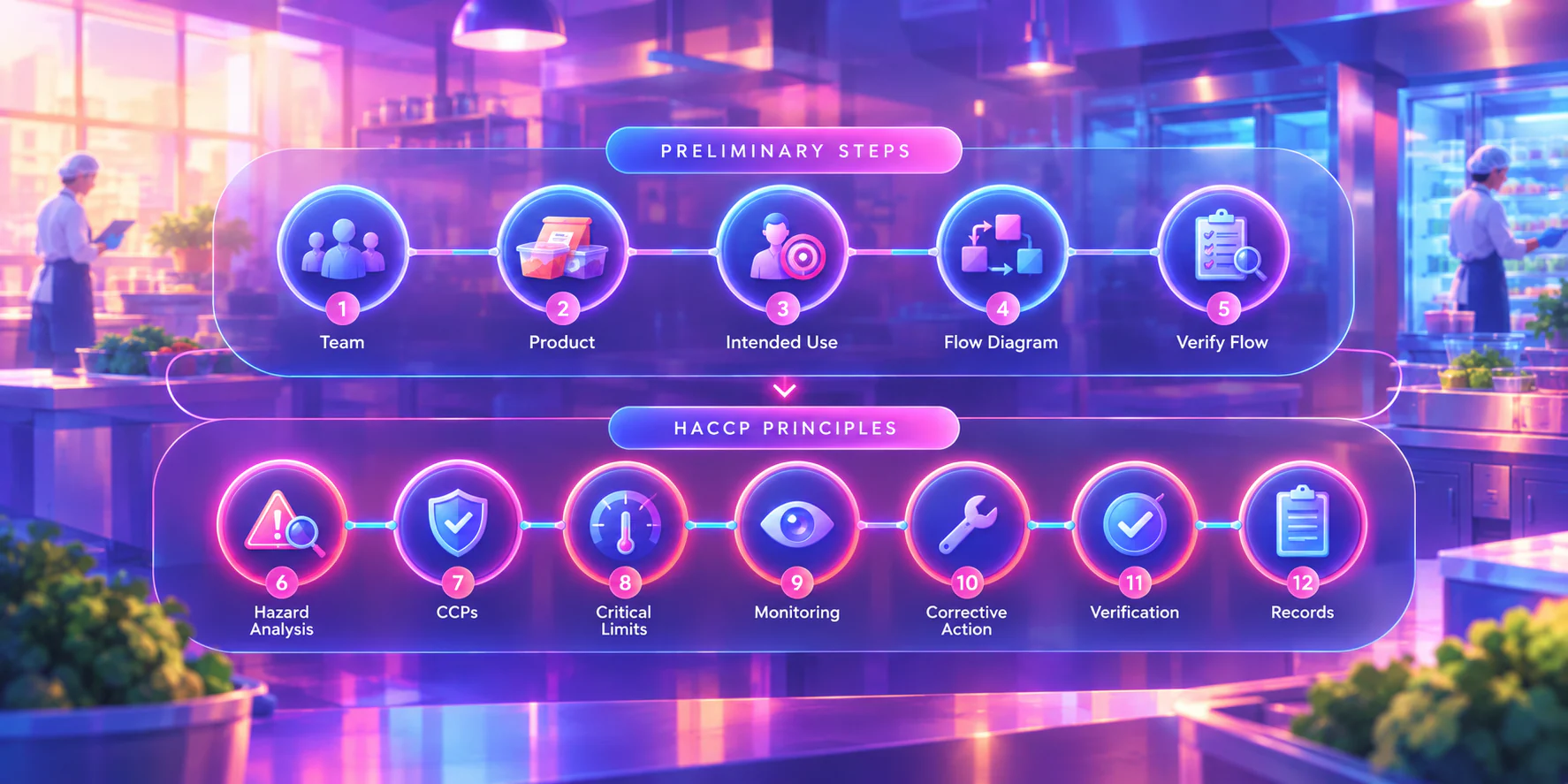
The Codex Alimentarius Commission recommends a 12-step process that combines five preliminary steps with the application of all seven haccp principles. Philippine FDA auditors expect to see documentation that traces each step from team formation through to ongoing verification.
- Assemble the HACCP Team. Form a multidisciplinary team that includes production, quality, engineering, and management representatives. Document team members, their roles, and relevant food safety training.
- Describe the Product. Prepare a full product description covering composition, physicochemical properties, packaging, shelf life, and storage conditions.
- Identify the Intended Use. State who will consume the product and whether any vulnerable groups (infants, elderly, immunocompromised) are likely end users.
- Construct a Process Flow Diagram. Map every step from raw material receipt through finished product dispatch, including rework loops and outsourced steps.
- On-Site Verification of the Flow Diagram. Walk the actual production line and confirm that the diagram matches real-world operations before proceeding.
- Conduct a Hazard Analysis (Principle 1). List all potential hazards at each step, assess their likelihood and severity, and determine which are significant enough to require a control measure. This is the first of the seven principles of haccp and the most analytically demanding step.
- Identify CCPs (Principle 2). Apply the CCP decision tree to each step with a significant hazard and document the reasoning for each CCP determination.
- Establish Critical Limits (Principle 3). Set the maximum or minimum value for each CCP parameter, referencing the FDA, BFAD, or Codex standard that validates each limit.
- Establish Monitoring Procedures (Principle 4). Define the measurement method, frequency, responsible person, and the monitoring record for each CCP.
- Establish Corrective Actions (Principle 5). Document the immediate action for each deviation scenario, including product disposition and root-cause correction.
- Establish Verification Procedures (Principle 6). Schedule internal audits, equipment calibrations, and any end-product microbiological testing that confirms the system is effective.
- Establish Record-Keeping (Principle 7). Design the forms, logs, and filing system that will hold all monitoring, corrective action, and verification records in a format accessible to FDA inspectors.
Critical Control Points: How to Identify and Document Them
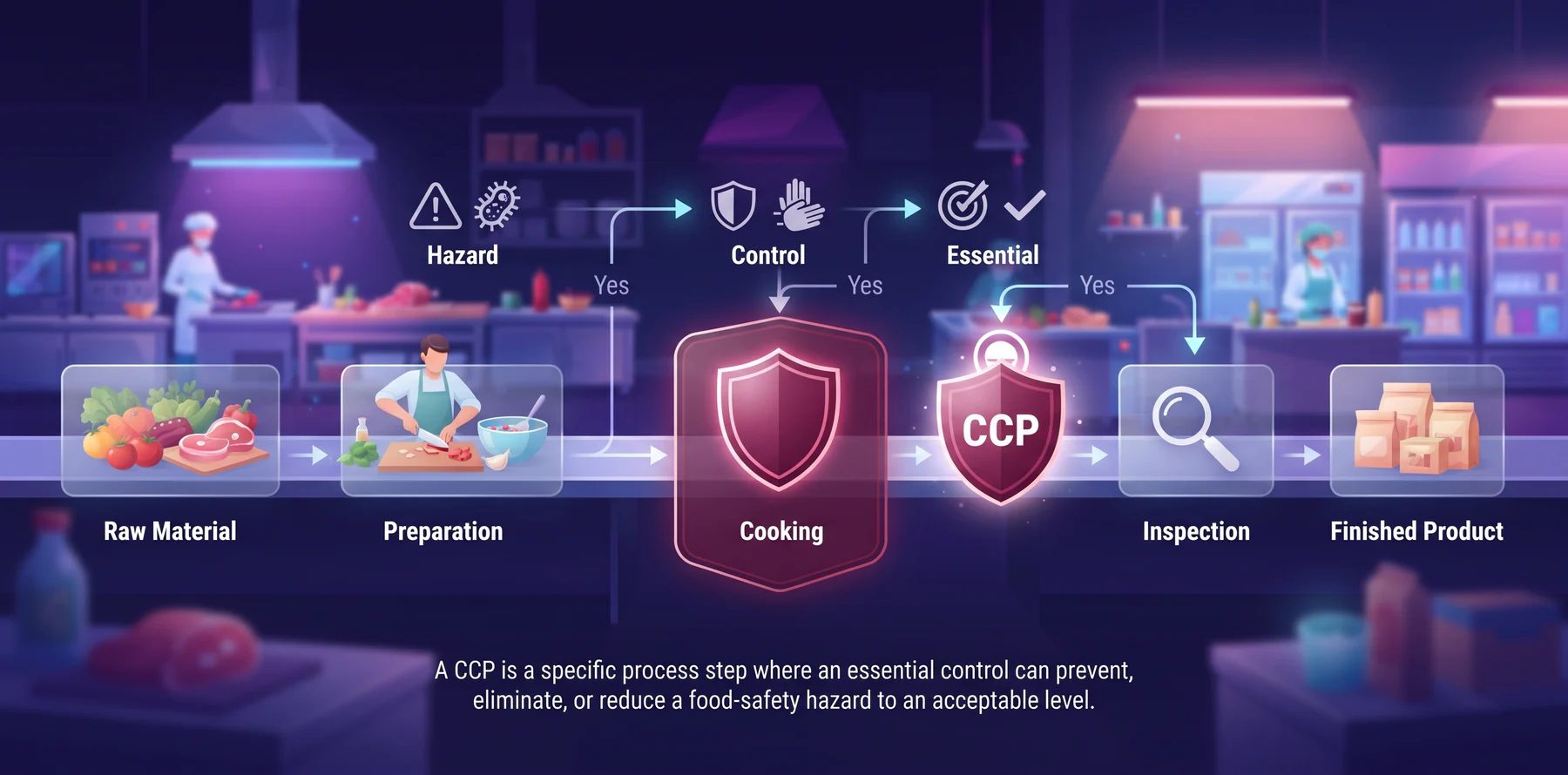
A Critical Control Point is a step in the process where a control measure can be applied and is essential to prevent, eliminate, or reduce a food safety hazard to an acceptable level. Not every step with a control measure qualifies as a CCP. The Codex decision tree helps teams apply this distinction consistently. Connecting each CCP to a batch tracking record ensures every lot is individually traceable if a deviation occurs.
Example CCPs for Common Philippine Food Products
| Product Type | Process Step | Hazard | Critical Limit | Monitoring Method |
|---|---|---|---|---|
| Pasteurized milk | Pasteurization | Pathogenic bacteria (Listeria, Salmonella) | 72°C for 15 seconds (HTST) | Continuous temperature recorder + flow diversion valve check |
| Canned goods | Retort sterilization | Clostridium botulinum spores | Per scheduled process (F0 value) | Continuous retort data logger, reviewed per batch |
| Ready-to-eat meat | Metal detection | Metal fragments | Fe 2.0mm / Non-Fe 2.5mm / SS 3.0mm | Test piece run at start, middle, and end of each shift |
| Frozen seafood | Receiving (raw material) | Histamine in tuna/mackerel | Supplier COA + temperature ≤4°C on arrival | Temperature check on arrival; COA review per lot |
| Bakery products | Baking | Undercooking (Salmonella in eggs) | Internal product temperature ≥75°C | Probe thermometer per batch, recorded on batch card |
Raw material management is a key phase in hazard prevention. Maintaining inventory accuracy at the ingredient receipt point, covering lot numbers, supplier verification, and specification checks ensures out-of-specification materials are caught before they introduce hazards downstream.
What HACCP Records Must Philippine Food Businesses Keep?
Principle 7 of the haccp principles requires that every monitoring measurement, corrective action event, verification activity, and HACCP plan modification be documented and retained. During an FDA inspection, the absence of records is treated as evidence that the activity did not occur, regardless of what the operator reports verbally.
The minimum record set for a compliant HACCP system includes:
- CCP monitoring logs: dated, time-stamped entries for every critical limit measurement.
- Corrective action records: description of the deviation, product disposition, and corrective measure taken.
- Verification records: calibration certificates, internal audit reports, and any microbiological test results.
- HACCP plan document itself: including all revisions with effective dates and the signatures of the review team.
- Supplier records: Certificates of Analysis, supplier audit reports, and receiving inspection logs.
Philippine FDA regulations specify retention periods for food safety records; consult the current FDA Circular on HACCP implementation or your registered food safety consultant for the applicable requirement for your product category.
For businesses managing large inventories of perishable ingredients and finished goods, the FIFO inventory method directly supports HACCP Principle 7 compliance. By rotating stock in first-in, first-out order, food businesses ensure that best-before and use-by dates are consistently honored, lot-level records stay accurate, and product traceability is maintained for any recall event.
Reviewing and Updating Your HACCP Plan After Process Changes
An haccp plan is a living document. A plan written for a specific product, process, and facility becomes inaccurate the moment any of those elements change. Changes that trigger a mandatory plan review include new ingredients or suppliers, new equipment or process steps, changes in product formulation, new distribution channels (such as adding ambient to frozen), and changes in intended consumer groups. Any significant shift in your supply chain management arrangements should trigger a formal HACCP review.
Philippine FDA expects that any significant change to operations is accompanied by a documented reassessment of the hazard analysis and, if needed, an update to the CCP list, critical limits, and monitoring procedures. The review should be conducted by the HACCP team and signed off by the food safety coordinator or plant manager.
In practice, a scheduled annual review is the minimum frequency. Any reported customer complaint involving a potential food safety issue, any product recall or withdrawal, or any new scientific information about a hazard relevant to your product should also trigger an unscheduled review. The date of each review, the changes made, and the team members involved must be recorded in the HACCP plan revision log.
Businesses that skip this review cycle typically discover the gap when an FDA auditor points out that the process flow diagram shows equipment that was replaced two years ago or a CCP for a step that no longer exists.
Food Manufacturing Software and HACCP Compliance
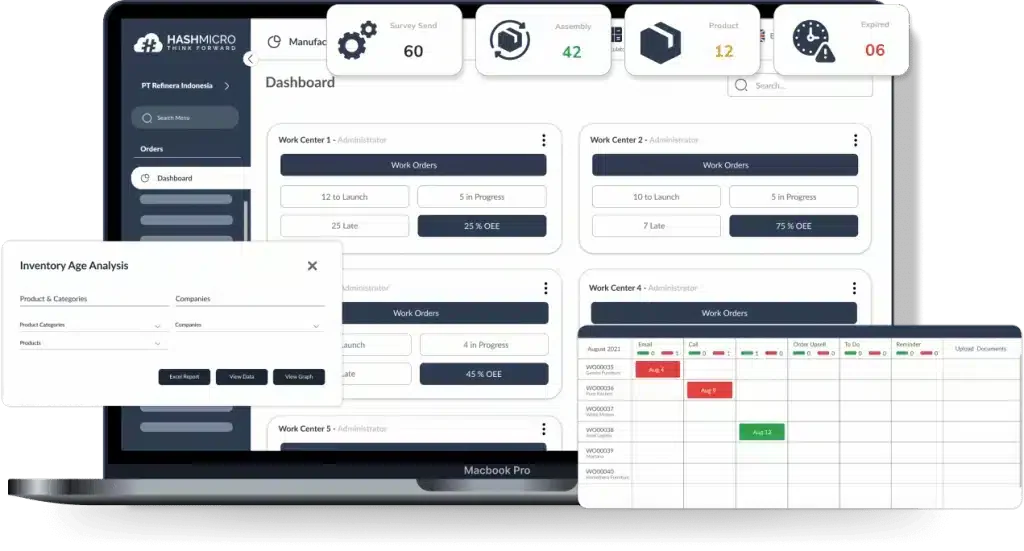
Manual HACCP record-keeping using paper logs and spreadsheets is adequate for small operations, but it creates two recurring problems at scale: records get lost or altered, and monitoring gaps are discovered only during an audit rather than in real time. Philippine food manufacturers with multiple production lines, multiple shifts, or multiple facilities face these challenges most acutely.
A food manufacturing software system can address these gaps by digitizing CCP monitoring logs, triggering alerts when a measurement approaches a critical limit, and generating audit-ready reports with full time stamps and operator attribution. When a corrective action is needed, the system creates a linked record that ties the deviation, the product lot, and the corrective measure in one traceable chain.
HashMicro's food manufacturing software includes traceability and quality control modules that allow Philippine food businesses to log CCP data, track raw material lots from receiving through production, and produce FDA-format reports on demand. The system integrates inventory, production, and quality records in a single platform.
Conclusion
The seven haccp principles provide a systematic framework that turns food safety from a reactive fire-fighting exercise into a documented, verifiable process. For Philippine food businesses, a compliant haccp plan is simultaneously a legal obligation, a commercial requirement for B2B buyers, and a meaningful protection for consumers.
If your team is still managing CCP monitoring logs on paper, the step from manual records to a digitized system is one of the highest-return improvements a Philippine food manufacturer can make before the next inspection cycle.
HashMicro's food manufacturing software centralizes CCP monitoring logs, corrective action records, and verification schedules in one auditable platform, you can request a free consultation to see how it supports your HACCP compliance.

FAQ Around HACCP Principles
Not for all categories. Philippine FDA requires HACCP-based food safety management for food establishments manufacturing higher-risk products such as dairy, meat, seafood, canned goods, and ready-to-eat foods. Lower-risk cottage food businesses may be subject to GMP requirements only. Check the specific FDA Circular applicable to your product category to confirm your obligation.
GMP (Good Manufacturing Practices) sets baseline standards for facility conditions, personal hygiene, and equipment sanitation. HACCP is a hazard-specific system built on top of GMP that identifies and controls the particular biological, chemical, and physical risks in your specific product and process. GMP is a prerequisite for HACCP, not a substitute for it.
A first-time HACCP plan for a single product category typically takes four to eight weeks from team formation to completed documentation, assuming prerequisite programs are already in place. Businesses with multiple product lines, complex processes, or no prior food safety documentation can expect the timeline to extend to three to six months.
Yes, if at least one team member completes a recognized HACCP training course and the business has sufficient resources to document its processes thoroughly. The FDA offers guidance materials, and the Bureau of Agriculture and Fisheries Standards has published sector-specific HACCP guidance for small producers. A consultant accelerates the process but is not a regulatory requirement.
The FDA issues a notice of non-conformance specifying the deficiencies. The business is given a defined period to submit a corrective action plan and supporting evidence. Failure to address findings within the prescribed period can result in License to Operate suspension or revocation and, for exporters, removal from approved establishment lists for the relevant market.
Is HACCP mandatory for small food businesses in the Philippines?
Not for every business. Good hygiene and manufacturing practices apply to all food operators, while a documented HACCP plan is expected where risk justifies it, typically processors of high-risk products, exporters, and suppliers to institutional buyers. Many small operators adopt one because a buyer or mall requires it.
What is the difference between HACCP and a sanitary permit?
A sanitary permit is issued by your City or Municipal Health Office and evaluates your premises. A HACCP plan is a document you write that controls hazards in your process. One covers the place, the other covers what happens inside it, and holding a permit does not satisfy a HACCP requirement.
How many critical control points should a HACCP plan have?
As few as genuinely control the hazards. A single-product kitchen often has two to four, usually cooking, hot holding, chilling, and sometimes receiving. A long list is a warning sign, because points that are not monitored consistently provide no control at all.
How long does it take to create a HACCP plan?
For one product and one flow, three to four weeks of part-time work is realistic, with most of the time spent verifying the flow diagram and training staff on the logs. Multi-product commissaries take longer because each product family needs its own hazard analysis.
Do I need a consultant to get HACCP certified?
No. A consultant can speed up the drafting and spot gaps, but the plan must describe your own process, and certification by a third party is voluntary unless a buyer or export market requires it. Many operators write the first version internally and bring in help only for review.