






Your Manila head office, Cebu and Davao branches, and subsidiary may each assign invoice numbers differently. This causes mismatched references that can stall matching and payment. This is a rather common problem, as proven by Ardent Partners' 2025 global benchmark, which reported a 22% average invoice exception rate.
An invoice number is the unique reference that identifies and tracks each sales invoice. It differs from purchase order, sales order, customer account, delivery receipt, and payment references. No single invoice numbering format fits every business, so building the right system takes some know-how.
To avoid invoice exceptions, start with one prefix catalogue so all branches use agreed codes, then review the sequence regularly and log every gap. This guide explains what an invoice number means, why it matters, the key differences between numbers, what common mistakes exist and how to solve them, and how invoice software can help.
Key Takeaways
An invoice number permanently identifies one issued invoice. Never reuse it or confuse it with PO, delivery, or payment references.
The invoice number links to creation, approval, collection, and audit. Treat numbering as a control, not a formatting choice.
Decide ownership, format, permissions, exceptions, reporting, and migration first. Finance approves the policy before IT configures anything.
Invoicing software enforces uniqueness, prefixes, and audit history automatically. Test the full workflow in a demo before choosing.
What Is an Invoice Number and How Is It Different from Other References?
An invoice number is the unique reference a seller assigns to each invoice it issues. It stays permanently linked to that document, so staff, customers, auditors, and systems can trace one charge without ambiguity. A business never reuses or reassigns an issued invoice number, even after cancellation.
| Reference | Main purpose | Usually created by | Typical timing | Usual location |
|---|---|---|---|---|
| Invoice number | Identifies the issued invoice | Seller's finance or billing system | When invoice is issued | Invoice header and accounting record |
| Purchase order number | Identifies the buyer's authorised order | Customer's procurement team | Before supply or billing | Customer PO and invoice cross-reference |
| Sales order number | Tracks the seller's accepted order | Sales or order-management team | After order acceptance | Sales order, fulfilment record, invoice |
| Delivery receipt number | Proves or tracks delivery | Warehouse or logistics team | At dispatch or delivery | Delivery receipt and fulfilment record |
| Customer account number | Identifies the customer account | CRM or finance team | When account is opened | Customer master data and statements |
| Payment reference | Identifies a remittance or bank transaction | Customer or bank | When payment is sent | Remittance advice and bank record |
| Official receipt number | Confirms collection of payment, not the sale | Seller's finance or billing team | When payment is received | Official receipt and collection record |
| Credit note number | Identifies an adjustment document | Finance or billing system | When credit is approved | Credit note and linked invoice |
A customer sends PO-7842 to Manila. Sales raises SO-2026-1198, Cebu records DR-CEB-4407, and finance issues INV-MNL-2026-004581. The bank remittance then quotes that invoice number. The map above stops teams from treating these numbers as interchangeable, so finance posts receivables, and treasury matches payments. A credit note carries its own number and references the invoice it adjusts.
The Importance of an Invoice Number for Business Operations
Most guides explain what an invoice number is and stop there, despite the operational meaning being more important. The number connects creation, approval, collection, reconciliation, and audit evidence. Without a controlled reference, payments sit unmatched, queries drag on, and branch reports blur together. Numbering is therefore a control mechanism, not merely a visual formatting choice.
The order-to-cash flow typically involves these hand-offs:
- Sales creates or confirms the customer order.
- Operations fulfils the order and records delivery or service completion.
- Finance generates and approves the invoice.
- The customer receives the invoice and schedules payment.
- Treasury receives the remittance and matches it to the invoice.
- Finance investigates exceptions and closes the receivable.
- Management uses the records for branch, entity, and period reporting.
A missing invoice number forces staff to search by name, amount, or date. A duplicate sends payment to the wrong record, even when the invoice number on the receipt looks correct. An inconsistent branch prefix routes queries to the wrong team. A reused cancelled number hides the original document's history.
A stable reference supports accounts receivable management, customer statements, collection follow-ups, approval tracking, and audit preparation. It also gives IT and finance one key when connecting an ERP, CRM, or bank feed. Enforcing that discipline by hand across branches is slow; this is where an invoice system can come in and help apply the rules automatically.
What Should an Invoice Number Include?
An invoice number should carry a controlled sequence that stays unique. Add an entity code, branch code, issue year, or document-type prefix only when each segment earns its meaning. Leave out details that change often, such as salesperson, product, customer address, or payment terms.
| Format approach | Illustrative example | Strength | Limitation | Best fit |
|---|---|---|---|---|
| Simple continuous sequence | 004581 | Short and system-friendly | Carries no branch or period context, and duplicates easily once a second location starts issuing | Single-location business |
| Year-based sequence | 2026-004581 | Makes the issue year visible | Restart rules must be documented and controlled | One location with annual reporting cycles |
| Branch-prefixed sequence | INV-CEB-004581 | Helps route queries and reports | Requires prefix governance across branches | Multi-branch single entity |
| Entity-branch-year sequence | INV-HO-MNL-2026-004581 | Supports ownership and consolidated reporting | Longer references and more configuration effort | Group with subsidiaries |
| Document-type sequence | CN-HO-2026-000114 | Distinguishes credit notes from invoices | Must be explained to customers and users | Any business issuing adjustments |
Test hyphens and letters against portals, spreadsheets, APIs, and payment-matching rules. Lenders offering financing against unpaid invoices use the same reference. A customer reading the invoice number on the receipt should retype it. Treat INV-MNL-2026-004581 as illustrative. Confirm Philippine invoicing and tax requirements with the BIR or an authorised adviser.
How to Create an Invoice Numbering System
You create an invoice numbering system by settling six decisions before configuration: ownership, format, permissions, exceptions, reporting, and migration. Finance approves the policy, then IT or the implementation team configures and tests it. Document every rule before the first invoice leaves the system.
- Assign sequence ownership: Decide whether group finance, each legal entity, or an authorised billing team owns the sequence. Document who can create, void, and investigate numbers.
- Choose the format: Select a simple, year-based, branch-prefixed, entity-specific, or hybrid pattern based on reporting and operational needs.
- Define entity and branch identifiers: Create a controlled list of codes. Prevent two entities or branches from using the same prefix.
- Separate document types: Decide how sales invoices, debit notes, credit notes, replacement invoices, and other documents are identified and linked.
- Set sequence behaviour: Specify whether numbers are continuous, reset by period, or generated separately by entity. Record the effective date and approval.
- Protect permissions: Restrict manual edits, deletion, backdating, and sequence changes. Use role-based access for finance, supervisors, and administrators.
- Define approval and exception rules: Explain what happens when an invoice is cancelled, rejected, duplicated, or generated with incorrect information. Require a reason and approver.
- Plan continuity: Decide how numbering continues during staff absence, system downtime, branch opening, and year-end. Avoid informal offline lists unless they are controlled and reconciled.
- Design reports and integrations: Test searches, customer statements, tax reports, payment matching, APIs, electronic invoicing channels, and consolidated reporting using the invoice number as a reference.
- Migrate and monitor: Map legacy references, preserve original numbers in a separate field when needed, test duplicate prevention, train users, and review exception logs after launch.
Changing a live sequence without documenting the reason can create gaps that users later interpret as missing invoices. Before migration, freeze the cutover point, reconcile open receivables, communicate the new format, and obtain finance approval for any exceptions. A documented ERP implementation planning checklist helps separate policy decisions from system configuration.
Should You Use a Central or Entity-Specific Invoice Sequence?
Use a central invoice sequence when one legal entity shares finance control. Choose entity-specific numbers when subsidiaries own their books and report separately. Your answer depends on legal ownership, branch autonomy, transaction volume, and reporting design. No single model suits every group.
| Operating condition | Central sequence | Entity-specific sequence | Hybrid model |
|---|---|---|---|
| One legal entity with shared finance | Usually simple to govern | May add unnecessary complexity | Useful if branches need visible prefixes |
| Independent subsidiaries | Can blur document ownership | Makes ownership explicit | Central standards with local sequences |
| Separate BIR registration per entity | Harder to tie an invoice to its issuing registration | Each registered entity issues under its own sequence | Entity prefix shows the registration; policy stays central |
| High branch autonomy | Requires strong central access controls | Lets branches operate locally | Shared rules with branch-level ranges |
| Very high transaction volume | One sequence can bottleneck at peak periods | Parallel sequences spread the load | Branch ranges reduce contention without losing standards |
| Centralized reporting | Easy to consolidate if controls are strong | Requires mapping prefixes | Shared reporting schema plus local codes |
| Frequent system downtime or offline work | One recovery process | Each entity needs continuity procedures | Central backup with local contingency rules |
| Need for local accountability | Less visible in the reference | Clear entity or branch responsibility | Prefix identifies owner while governance stays central |
A central sequence gives one numbering authority but depends on central availability. Entity-specific numbers clarify ownership, yet finance must prevent collisions when consolidating invoices across entities. A hybrid keeps one policy while assigning controlled prefixes to each entity. Confirm your billing system process handles a Cebu user creating a Manila number.
Invoice Number Examples for Different Business Scenarios
Invoice number examples should prove uniqueness, ownership, and traceability, not just look professional. Each sample below shows what an invoice number means once you break it into segments. The references are illustrative and carry no legal, tax, customer, or payment data.
| Scenario | Sample invoice number | Benefit | Limitation | Watch out for |
|---|---|---|---|---|
| Single-entity business | INV-0004581 | Short and easy to communicate | Does not show location or year | Collisions the moment a second site starts issuing |
| Multi-branch retailer | INV-CEB-2026-001284 | Routes queries and supports branch reports | Prefix list needs governance | Two branches claiming the same prefix |
| Recurring billing | INV-MNL-2026-03-000772 | Shows issue period and sequence | Billing-period changes need clear rules | Duplicate runs in the same period |
| Project-based contractor | INV-PROJ7-2026-00031 | Links billing to a project code | Project codes can become lengthy | Portal and export field-length limits |
| Multi-subsidiary group | INV-SUB2-2026-00418 | Identifies legal-entity ownership | Consolidated reports must map entities | Entity prefix not matching its BIR registration |
| Service retainer | INV-MNL-2026-RET-00219 | Separates retainers from one-off billing | Adds a document-type segment to govern | Staff typing RET on non-retainer invoices |
| Cancelled or voided invoice | INV-CEB-2026-001284 (voided, never reissued) | Keeps the original history intact | Sequence shows a permanent gap | Someone recycling the number for a new sale |
| Credit note | CN-CEB-2026-000114 | Separates adjustment documents | Must link to the original invoice | Credit notes issued without the source reference |
| Replacement invoice | INV-REPL-2026-000052 | Signals controlled replacement | Original and reason must remain in history | Replacement issued while the original stays open |
| Migrated legacy record | LEG-2019-88421 | Preserves the historical reference | New system key should also be stored | Legacy and new sequences colliding after cut-over |
A practical map links SO-2026-1198 to INV-CEB-2026-001284, then remittance REM-77821. The billing reference stays primary; order and payment numbers support it. Small businesses can run a short sequence and follow invoicing best practices. Groups gain routing and reporting from structured prefixes, provided the invoice number on the receipt stays readable.
What Are Common Invoice Numbering Mistakes and How Can You Prevent Them?
Most invoice numbering mistakes fall into four failures including uniqueness, continuity, ownership, and auditability. Each one needs a preventive control and a documented response. Finance often spots the problem late, when a customer queries the invoice number on the receipt against your records.
| Mistake | How it appears in daily work | Preventive control | Consequence |
|---|---|---|---|
| Duplicate invoice number | Two invoices share one reference | System uniqueness validation | Payment and receivable matching becomes uncertain |
| Skipped sequence | Users ask whether a document is missing | Exception log and review | Audit investigation takes longer |
| Manual overwriting | A user changes an issued reference | Role permissions and audit history | Original evidence may be obscured |
| Inconsistent branch prefix | Similar transactions use different codes | Controlled prefix catalog | Reports and queries route incorrectly |
| Reused cancelled number | A new invoice receives a voided reference | Never recycle issued numbers | Document history becomes ambiguous |
| Unclear credit-note reference | Adjustment cannot be tied to an invoice | Mandatory original-invoice field | Reconciliation and review require extra work |
| Unapproved sequence change | Someone edits the numbering setup itself | Segregation of duties on configuration | Control owners cannot explain changes |
| Missing exception log | Gaps have no documented reason | Periodic sequence review | Finance cannot distinguish error from valid exception |
| Year-end reset without policy | 2026 numbering restarts while 2025 invoices stay open | Documented reset rule plus a year segment | Two open invoices can share one short reference |
| Draft number changing at posting | The customer holds one reference, the ledger stores another | Assign the number only when the invoice posts | The reference on the customer copy stops matching your records |
| Numbers created during downtime | Staff issue offline or handwritten references | Controlled contingency range, reconciled after recovery | Offline numbers collide with system-generated ones |
| Duplicate after migration | Legacy and new records collide | Cross-system mapping and validation | Opening balances or customer statements may be misstated |
| Poor user training | Staff bypass the system or mistype codes | Role-based training and quick guides | Repeated exceptions consume finance time |
| Number outside the registered series | An invoice carries a reference beyond the approved range | Configure system ranges to the registered series | The invoice may be questioned during a BIR examination |
Uppercase or lowercase differences in an invoice reference stay harmless when systems read them consistently. A duplicate, unexplained gap, or unauthorized change demands investigation and an approved correction or cancellation workflow. Connect each control to audit trail management, so your team sees who acted, what changed, and when.
Managing Invoice Numbers with Invoicing Software
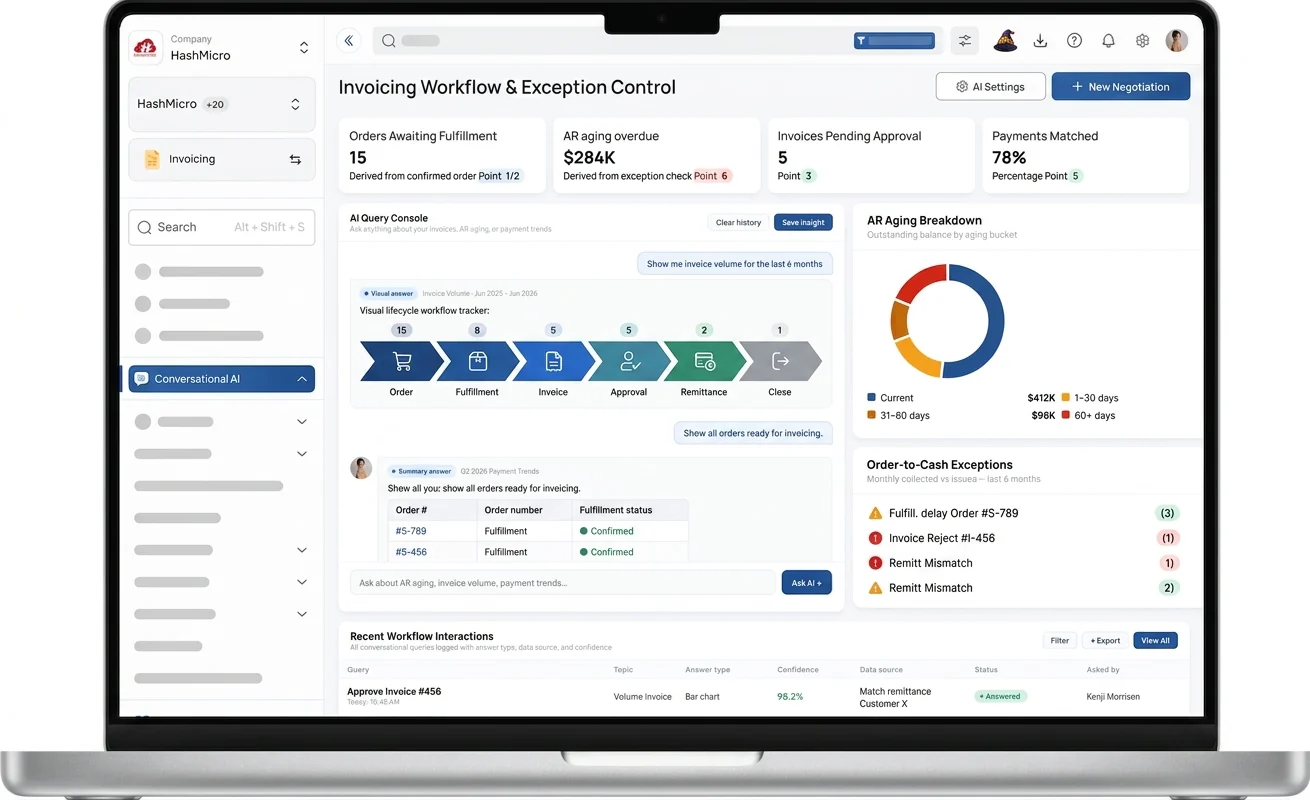
Invoicing software generates each invoice number automatically, applies branch prefixes, and blocks duplicates before posting. It locks issued references against casual edits and keeps every change in audit history. HashMicro's system adds Hashy, an AI layer that schedules recurring billing and flags unpaid invoices in real time.
During a demo, ask the vendor to run the full workflow, not a feature tour. Compare what you see against your shortlist of best invoicing systems before deciding. Ask the vendor to issue and trace these seven documents:
- A standard sales invoice with a personalized template
- A credit note linked to its original invoice
- A cancelled document, showing that the reference never returns
- A branch transaction under a different prefix
- A duplicate attempt the system must reject
- An approval exception on a discounted or special price
- A payment received through the online gateway and matched automatically
Confirm the system shows your sequence to authorized users, retains original values after corrections, and searches by any linked reference. Check how it handles year-end, downtime, migration, and subsidiary reporting. HashMicro covers these controls with tax, credit-limit, and receivable-aging features. To compare the system, request a free consultation.
Conclusion
An invoice number is the unique reference your business assigns to each issued invoice. Most invoice numbering formats combine a controlled sequence with optional entity, branch, year, or document-type segments. Those segments give the invoice number its meaning for staff, customers, auditors, and systems.
Mismatched references still stall matching and reporting across branches. A customer checking the invoice number on the receipt gets no clear answer. A checklist should test uniqueness, ownership, continuity, and auditability. Confirm the owner, protect prefixes, never recycle numbers, and log every gap, then close with a BIR or adviser review.
HashMicro's invoicing software applies your numbering rules automatically. It generates sequential references, blocks duplicates before posting, restricts edits by role, and keeps audit history intact. Its dashboards track invoice age and unpaid balances. Consult the HashMicro invoicing solution team to curate your budget and needs.
FAQ About Invoice Number
Look at the top section of the invoice, usually near the invoice date and your customer details. Sellers label it Invoice No. or INV. If you cannot find it, search your email, customer portal, or bank remittance advice. Your supplier's finance team can also reissue the reference.
Usually yes. A bill number is the same reference seen from the buyer's side. One party's invoice is the other party's bill. In the Philippines, do not confuse it with the official receipt number, which records collection rather than the sale.
Ask the seller to reissue the invoice with its reference. Without a number, your finance team must match the payment by customer name, amount, or date, which slows reconciliation. Philippine buyers need the invoice itself, not only a receipt, to support their accounting and tax records.
Start with a simple sequence like INV-0001 and increase it by one for every invoice. Add a branch or year segment if you operate multiple locations. Never reuse a number, even after cancelling an invoice, and record who may issue new references.
An invoice ID number is another name for the invoice number: the unique reference identifying one issued invoice. Some systems call it invoice ID, document number, or reference number. Whatever the label, one invoice keeps one permanent reference that nobody reuses.