








 Limited to 100 registrants
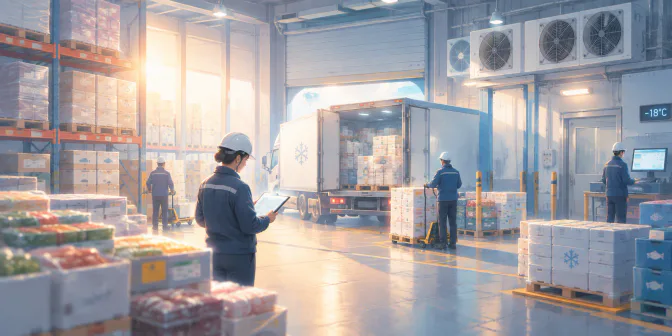
Cold chain management is the process of keeping temperature-sensitive goods inside a required temperature range from production to final delivery. It covers more than refrigeration, it also covers monitoring, handover records, and the decision a team makes when a reading fails.
Philippine distributors of frozen seafood, meat, dairy, ice cream, and fresh produce lose margin whenever a shipment waits too long on a dock. According to the Food and Agriculture Organization, roughly 13 percent of the world's food is lost between harvest and retail, and inadequate cooling ranks among the main causes.
A product can arrive looking acceptable and still lose shelf life. This guide covers the four stages of the cold chain, temperature requirements by product type, the causes of cold chain breaks, and the records Philippine teams need to prove control.
Key Takeaways
Cold chain management keeps temperature-sensitive goods inside a required range from production to delivery, and it treats records as part of the control.
A cold chain break happens either when a product leaves its range or when the business can no longer prove it stayed inside it.
The four stages are pre-cooling and first mile, controlled holding, refrigerated transport, and last-mile delivery and handover.
Daily control means four habits: monitor consistently, record at the point of action, escalate exceptions at once, and tie every reading to specific stock.
What Is Cold Chain Management?
Cold chain management means holding a product inside its required temperature range at every step of the journey. It covers the equipment that does the cooling and the records that prove the cooling worked.
Ordinary supply chain management asks whether goods moved on time. A cold chain asks that too and adds one hard condition. The temperature must never leave the specified range. Timing and handovers carry far more weight as a result.
A frozen seafood shipment is not judged only by whether it reaches the store. The business also needs proof that the product stayed frozen from the loading bay to the receiving dock. Without that proof, a clean-looking delivery still counts as a risk. The difference becomes concrete once you compare what each chain has to prove.
Cold Chain vs Standard Supply Chain: The Key Difference
| Dimension | Standard supply chain | Cold chain |
|---|---|---|
| What it tracks | Movement, cost, availability, delivery performance, stock | All of that, plus temperature at every step |
| Effect of a two-hour delay | Service level slips | Shelf life, safety, and compliance can all slip |
| Proof required at handover | Quantity and condition | Quantity, condition, temperature reading, and batch identity |
| What counts as failure | A late or incomplete delivery | Out-of-range stock, or stock you cannot prove stayed in range |
The last row is where most losses hide. A shipment can stay cold the whole way and still be written off because nobody tied the reading to the right batch.
What Counts as a Cold Chain Break?
A cold chain break comes in two forms. The first is physical: the product leaves its required temperature range. The second is evidentiary: the product may have stayed cold, but nobody can prove it.
Both cost money. A pallet of tuna that sat at −8°C for six hours is a physical break. A pallet that held −20°C all trip with a dead data logger is an evidentiary break. The receiving team still has to put it on hold.
Four Stages of the Cold Chain
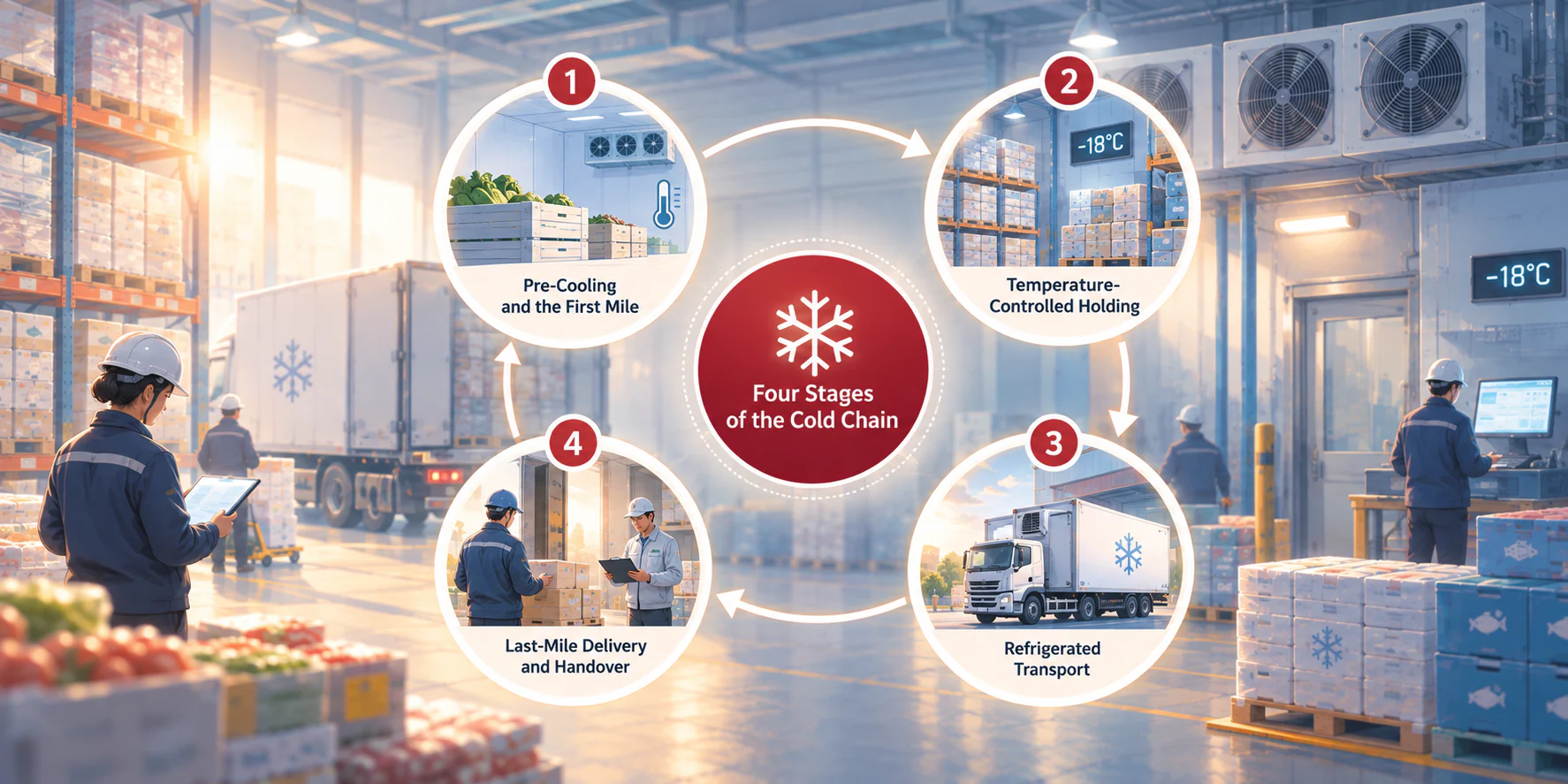
A cold chain runs through four stages: pre-cooling and the first mile, temperature-controlled holding, refrigerated transport, and last-mile delivery and handover. Receiving checks close that final stage, and one weak handover can compromise the whole chain.
1. Pre-Cooling and the First Mile
The cold chain starts before goods reach a vehicle. Preparation depends on the product and usually means chilling or freezing first, then staging the load for collection.
The first mile is the weak point because goods often wait at a farm or a dock before conditions are controlled. Good inbound and outbound logistics planning tightens pickup windows and fixes who accepts the goods and at what temperature.
2. Temperature-Controlled Holding
Between movements the goods sit in a chilled room or a freezer or a reefer container. All of these count as cold storage, and the goal is not uniform coldness but each product inside its own range.
3. Refrigerated Transport
Refrigerated transport runs on reefer trucks and containers, with insulated packaging handling smaller loads. Risk climbs with every traffic delay and every transfer between companies.
A reefer unit controls the environment but not accountability. Confirm the unit condition and the target temperature before dispatch so the trip starts from a known baseline.
4. Last-Mile Delivery and Handover
The last mile moves product from a vehicle into a store or a clinic or a receiving dock. Even a ten-minute wait on an open dock can cost shelf life.
Receiving is where the paperwork has to match the pallet. The team checks condition against the temperature record and the batch number, then names who accepted the shipment and when.
Cold Chain Types: Active, Passive, Chilled, and Frozen
An active cold chain uses powered equipment such as refrigerated trucks, freezers, and controlled rooms. A passive cold chain uses insulated packaging, gel packs, dry ice, or phase-change materials to maintain temperature for a limited period.
| Type | Classified by | How it holds temperature | Typical Philippine use | Main limitation |
|---|---|---|---|---|
| Active | Cooling method | Powered reefer trucks, freezers, controlled rooms | Frozen seafood trunkline hauls, supermarket DCs | Fails during power loss or unit breakdown |
| Passive | Cooling method | Insulated boxes, gel packs, dry ice, phase-change material | Last-mile vaccine and specialty food drops | Holds for a limited window only |
| Chilled | Temperature requirement | Kept above freezing inside a set low range | Dairy, fresh meat, vegetables, tropical fruit | Narrow band, spoils quickly once breached |
| Frozen | Temperature requirement | Kept at −18°C or colder | Frozen seafood, processed meat, ice cream | Refreezing after a thaw still degrades quality |
Whichever type you run, the target number comes from the product, not the equipment.
What Temperature Requirements Apply to Each Product Type?
Every product carries its own target range. No single freezer setting covers a mixed load.
Every product carries its own target range. No single freezer setting covers a mixed load.
| Product category | Temperature requirement | Philippine examples |
|---|---|---|
| Products specified for chilled or vaccine storage | +2°C to +8°C | Vaccines and products whose specifications require this range |
| Quick-frozen food | −18°C or colder | Frozen seafood, processed meat, ice cream |
| Controlled room temperature pharmaceuticals | 20°C to 25°C | Shelf-stable pharmaceutical products |
| Fresh produce and chilled food | Product- and commodity-specific | Vegetables, tropical fruit, dairy, fresh meat |
You can define quick-frozen food as maintained at −18°C or colder throughout the relevant chain. This is a ceiling rather than a narrow temperature band, so it should not be written as “−18°C to −20°C.”
Fresh produce requires particular care because different commodities have different sensitivities. Businesses should use product specifications, applicable food-safety requirements, and validated operating procedures instead of applying one temperature to every item.
Temperature Excursions and Stock Decisions
An excursion does not automatically mean the product is lost. The decision depends on the temperature reached and how long the exposure lasted.
A short exposure may be recoverable for frozen seafood and disqualifying for a vaccine. Document the assessment against the specific batch so the record shows what happened and who approved it.
- The monitoring layer detects the excursion and raises an alert.
- Operations identifies the affected batch and its current location.
- The inventory record moves that stock to hold or quarantine.
- A named reviewer logs the assessment and the decision.
- The stock is released or rejected under the applicable policy.
Shelf-life tracking and rotation for perishable inventory follow the same batch logic.
Food vs Pharmaceutical Cold Chain Requirements
Both chains control temperature, but they answer to different consequences. Food failure costs stock while pharmaceutical failure can cost efficacy.
| Dimension | Food and beverage | Pharmaceuticals |
|---|---|---|
| Main concern | Safety and shelf life | Efficacy and regulatory compliance |
| Typical products | Seafood and meat and dairy and frozen food | Temperature-sensitive medicines |
| Common references | Codex and product handling rules | USP and WHO and FDA Philippines |
| Failure impact | Waste and returns and recall exposure | Quarantine and efficacy risk |
A business handling both categories should not run one generic procedure. The documentation burden alone separates them.
What Causes a Cold Chain Break, and How Do You Prevent It?
Cold chain breaks come from three places: equipment, handovers, and process. A freezer breakdown is the obvious one. The quieter failures come from incomplete records, unclear ownership, and delays during transfer.
1. Equipment and Power Failures
Cold rooms, freezers, reefer units, sensors, and data loggers all fail. Brownouts and generator gaps hit controlled holding areas even when the equipment itself still works.
The real test is detection speed. An alarm that fires without a batch-level response proves only that something happened. It does not show which pallets need review.
Prevent it by setting alarm thresholds per product range, logging each event against the affected location and batch, isolating that stock, and running the release or quarantine procedure the same day.
2. Handover Delays and Dock Dwell Time
Loading, unloading, cross-docking, port handling, and receiving each open an exposure window. Goods often leave a controlled environment before the next party is ready to accept them.
Faster movement alone does not fix this. Each party must know who releases the goods, who records the temperature, and who can place a shipment on hold.
Prevent it with a fixed handover record: transfer time, product condition, temperature reading, shipment identity, and receiving decision. Companies using third-party logistics providers should write those duties into the contract.
3. Human Error and Documentation Gaps
Typical failures are missed temperature checks, incomplete receiving records, wrong lot numbers, unclear labels, late exception reports, and logs filled in hours after the event.
A shipment can be physically fine and still fail an audit. If the reading cannot be tied to the batch, location, expiry date, and receiving note, the business cannot defend the product.
Prevent it by making the correct action the easy one. Standard checklists, fixed handover fields, defined escalation rules, and recording at the point of action cut the reliance on memory.
Daily Cold Chain Control and Records
Most cold chain failures trace back to four habits that lapsed. Monitoring ran but nobody tied the reading to a batch. A log got filled in hours after the event. An exception was noticed but not escalated. Stock sat on hold with no named reviewer.
Daily control means the opposite of all four.
- Monitor consistently. Set thresholds per product range. An alert that fires without a batch-level response shows only that something happened.
- Record at the point of action. A reading logged after the fact is a reconstruction. It cannot tie a temperature to the batch that was actually in the location at that moment.
- Escalate exceptions the same day. Hold decisions deferred to the next shift compound exposure and make the audit trail harder to defend.
- Tie every reading to specific stock. Product identity, batch or lot number, expiry date, location, and movement record must link to the same event.
A paper-based system can cover all four, but the error rate rises with volume and staff turnover. An inventory management system that records at the point of movement reduces the reliance on memory and keeps the audit trail current.
How Cold Chain Management Matters in the Philippines
According to the Department of Agriculture Philippines, 151 cold-storage warehouses are accredited nationwide, with 45 in Metro Manila and 30 in Central Luzon and 24 in Calabarzon. Cold-storage capacity is concentrated where consumption and logistics infrastructure already is.
That distribution shapes the risk. A shipment from Metro Manila to Mindanao or the Visayas absorbs more legs and more handovers than the same shipment within NCR. Each additional leg is an additional exposure window and a new gap in the temperature record.
How Do Multiple Transport Legs Increase Risk?
Every handover between a cold room and a reefer truck opens a window where temperature is uncontrolled and responsibility is unclear. The risk is not only physical exposure. It is the gap in records. If a shipment passes through four parties and only two of them log a reading, the business cannot locate where the excursion happened.
Reduce it by writing handover duties into every third-party contract. Each party logs the temperature at the point of transfer and names who accepted the shipment. That record does not prevent a break but it tells the team exactly which leg to investigate.
Who Regulates Cold Chain Activities in the Philippines?
Regulation depends on the product category. A business handling both food and pharmaceutical products should not run one compliance procedure for both.
| Regulatory Aspect | Food and agricultural goods | Pharmaceutical products |
|---|---|---|
| Regulator | Department of Agriculture | Food and Drug Administration Philippines |
| Key regulation | Administrative Order No. 23, series of 2013 | FDA Circular No. 2021-003 |
| Who it covers | Cold-storage warehouses handling agricultural and fishery goods | Drug manufacturers, distributors, and retailers |
| What it requires | Temperature control, recordkeeping, and facility standards for DA accreditation | Cold chain management requirements including excursion documentation and corrective action |
Conclusion
Cold chain management runs from preparation through holding, transport, and final handover. It is only as reliable as its weakest transfer, and a weak transfer is often a documentation gap rather than a physical failure.
The difference between a defensible cold chain and a vulnerable one is the record. A business that can tie every temperature reading to a specific batch and location and receiving decision can respond to a complaint and pass an audit on the same day. A business that cannot has the same equipment but a different exposure.
If your current setup can detect an excursion but cannot immediately show which batch, location, or stock status it affected, that is a traceability gap. The HashMicro Supply Chain Management Solutions connects batch details, expiry dates, locations, movement history, and stock status so teams can respond to cold-chain exceptions with specific information.
FAQ Around Cold Chain Management
Cold storage is a facility or controlled environment used to hold temperature-sensitive goods. Cold chain is the complete process of keeping those goods within the required temperature range from source to delivery. Cold storage is one stage within a cold chain, not the entire process.
It depends on the product. Cold-storage warehouses handling agricultural and fishery goods need Department of Agriculture accreditation under Administrative Order No. 23, series of 2013. Establishments handling temperature sensitive medicines fall under FDA Circular No. 2021-003 and must meet its cold chain management requirements instead.
Frozen seafood exporters, meat and poultry processors, dairy and ice cream distributors, fresh produce consolidators, quick-service restaurant suppliers, and pharmaceutical distributors depend on it most. Each moves products that lose value or efficacy within hours of leaving their required temperature range, so handover records matter as much as refrigeration.
Responsibility depends on the contract, handover terms, documented roles, and evidence of what occurred. Clear temperature and acceptance records at every transfer make it easier to identify when responsibility changed and which party must investigate the event.
Manual logs may be suitable for simple operations when they are completed on time, consistently, and in an auditable format. As product risk, volume, and handover complexity increase, automated monitoring connected to inventory records helps reduce blind spots.