






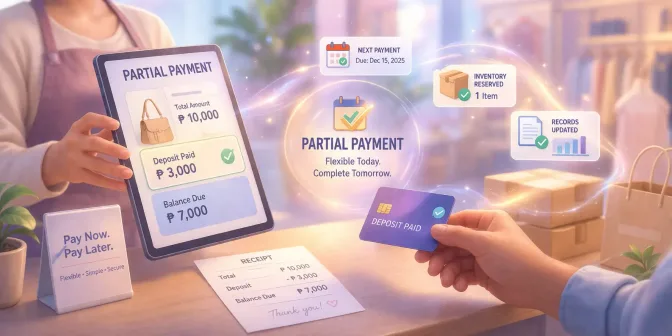
As businesses enter 2026, payment activity in the Philippines is becoming more digital, more real-time, and more infrastructure-driven. The Bangko Sentral ng Pilipinas has already moved to align retail payment systems with the ISO 20022 standard, and it is also studying near-24/7 PhilPaSSplus operations to support faster and more continuous payment flows. For retailers and B2B merchants handling custom or high-value orders, this makes partial payments more relevant as customers look for more flexible ways to complete purchases.
At the same time, businesses are adjusting to tighter operating conditions linked to flexible work arrangements in the Philippines and shorter on-site schedules in some settings. In this environment, accepting a deposit is only part of the process. Companies also need to track remaining balances, reserve inventory accurately, and keep payment and accounting records aligned. This article explains how partial payments work and what businesses need to manage them more efficiently.
Key Takeaways
Partial payments help businesses offer more flexible transactions, but they require accurate tracking of deposits, balances, and order status to avoid operational issues.
For retailers and B2B businesses, partial payments work best when the POS is connected to accounting, inventory, and customer records in one system.
Without clear payment terms and real-time system integration, partial payments can lead to billing errors, stock mismatches, and delayed collections.
Businesses that manage partial payments with the right workflow can improve customer trust, support higher-value sales, and maintain better financial control.
What Is Partial Payment?
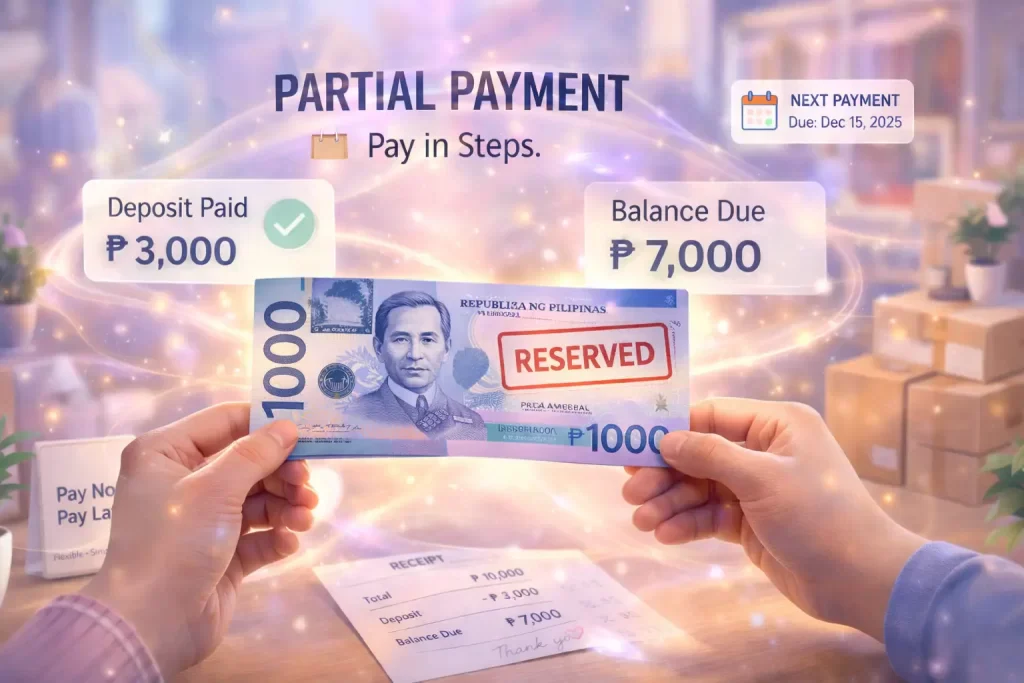
A partial payment is a payment arrangement where a customer pays only part of the total order value upfront, while the remaining balance is settled later based on agreed terms. This setup is common in custom orders, bulk purchases, pre-orders, and other transactions where businesses need a deposit before fulfilment.
In practice, a partial payment does not close the invoice or order. For example, if a supplier issues a ₱100,000 invoice and the buyer remits ₱40,000, the invoice stays open with a ₱60,000 outstanding balance. That remaining balance is still due under the original terms unless the seller agrees to a new payment schedule. It also differs from a minimum credit card payment, which is a fixed card requirement, while a partial payment can be any agreed amount below the full invoice value.
Because the balance stays open, partial payments should not be treated as a simple checkout feature. Businesses need to track outstanding balances accurately, keep reserved stock aligned with the order, and make sure payment records match accounting reports, otherwise they risk collection delays, stock discrepancies, and reporting errors.
Differences from Layaway and BNPL
| Aspect | Partial Payment | Layaway | BNPL |
| Payment Timing | Pay a part upfront and the rest later based on agreed terms. | Full payment is made before the item is released. | Payment is divided into installments, often with no interest. |
| Release of Goods | Goods are released once the balance is paid. | Goods are not released until full payment is made. | Goods are released immediately, and the customer pays in installments. |
| Financing | Managed directly by the merchant. | Typically, no external financing; handled by the retailer. | Third-party provider typically handles the financing. |
| Interest or Fees | No interest or fees if paid as per the terms. | Typically no interest or fees, as it’s paid before release. | Often has no interest, but late fees may apply. |
| Merchant Responsibility | Merchants track unpaid balances and manage the process. | Merchants retain the product until full payment is made. | The third-party provider handles payment collection. |
How Partial Payments Work in Philippine Retail and B2B Sales
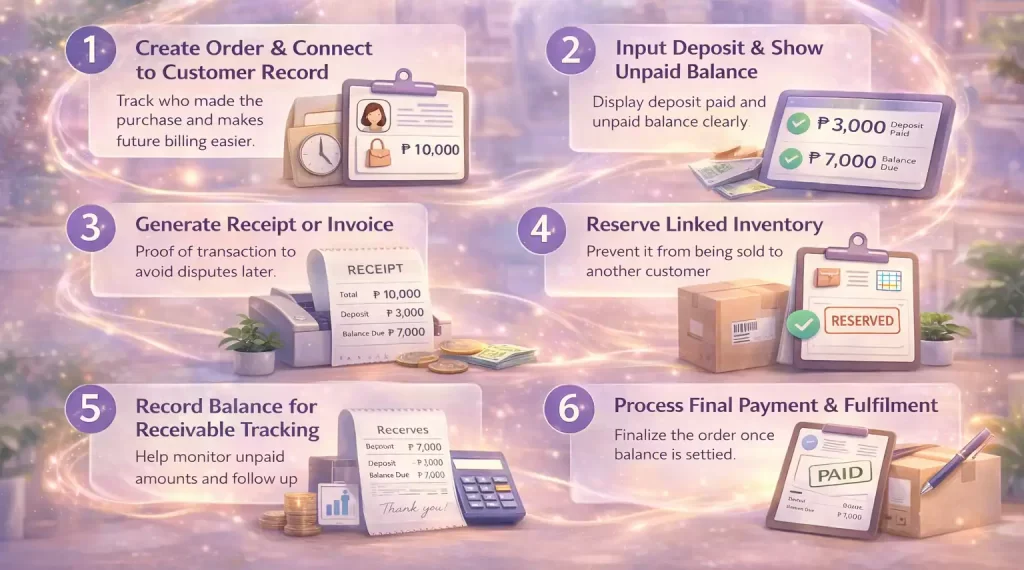
Handling partial payments requires more than simply accepting a deposit. Businesses also need to track the remaining balance, reserve inventory, and keep financial records accurate. For small business owners and accounting teams, a structured workflow can help reduce billing errors, prevent stock mismatches, and make final settlement easier to manage. In this context, a POS for small retail stores helps businesses track partial payments and manage the payment process seamlessly within their system.
Common Types of Partial Payment
Partial payment appears in several forms depending on the transaction:
- Deposits: Customers pay part of the total amount upfront to reserve an item, confirm a custom order, or book a service.
- Milestone payments: Customers pay in stages after specific project, delivery, or construction milestones are completed.
- Installments: Customers spread a larger cost into smaller scheduled payments over an agreed period.
Step-by-step partial payment flow:
1. Create the order and connect it to the customer record.
This helps the business track who made the purchase and makes future billing easier.
2. Input the deposit amount and show the unpaid balance clearly.
Both the business and the customer need to see how much has been paid and how much is still due.
3. Generate a receipt or invoice with payment details.
This serves as proof of transaction and helps avoid disputes later.
4. Reserve the inventory linked to the order.
This prevents the same item from being sold to another customer before payment is completed.
5. Record the balance for receivables tracking.
The accounting team can then monitor unpaid amounts and follow up on time.
6. Process the final payment and complete the fulfilment.
Once the balance is settled, the order can be finalized and recorded properly in the system.
Most partial payments today are settled through cashless transaction channels such as QR Ph, e-wallets, or card payments, which means each instalment needs to post to the correct open balance in the same system the POS uses for sales recording.
How to Manage Partial Payments

Managing deferred payments at scale requires three things working in tandem: clear written policies, a POS system integrated with your accounting stack, and compliance with the legal and data security frameworks that govern how deposits and customer data are handled. Each layer builds on the next.
1. Set Clear Deposit and Payment Terms
Merchants should calculate the minimum deposit needed to cover costs and mitigate default risks. For custom orders, this includes raw material and labor costs, while for retail items, it covers restocking and holding fees. Deposits typically range from 20% to 50%, depending on margins.
Every invoice that includes an outstanding balance must be accompanied by explicit terms and conditions. These terms must clearly articulate:
- The exact amount of the initial deposit and the remaining balance.
- The specific due date(s) for the final settlement.
- The acceptable methods for completing the transaction.
- The consequences of a missed deadline (e.g., late fees, forfeiture of the deposit, or cancellation of the order).
- The policy regarding refunds and cancellations. Are deposits non-refundable? If an item is restocked, is there a penalty fee?
2. Train Staff and Integrate POS with Accounting and CRM Systems
POS systems should be integrated with accounting, CRM, and inventory to track payments, revenue, and stock levels. Real-time synchronization enables accurate financial tracking, while CRM automation sends reminders to customers, improving cash flow and reducing manual effort.
3. Protect Customer Data and Stay Compliant
Businesses must ensure secure handling of customer and payment data. Compliance with security protocols and clear terms reduces the risk of fraud and disputes. Proper systems protect sensitive information, ensuring data security and legal adherence.
The same systems that protect payment data can also keep the money side visible from the deposit, milestone, to installment recorded, with outstanding balances and due dates in one place. See how it works in your business by scheduling a consultation with HashMicro's team.

Struggles with Managing Partial Payments
Managing partial payments effectively comes with its own set of challenges. Businesses must address the following struggles:
- Tracking Outstanding Balances
When a customer makes only a partial payment, businesses need to accurately track the remaining balance. Without proper systems in place, keeping track of these outstanding amounts can lead to confusion, errors in financial reporting, and delayed collections. This issue is especially significant when dealing with large or multiple transactions. - Managing Inventory for Reserved Items
For businesses accepting partial payments, inventory must be accurately reserved for each customer. This means businesses need to ensure that the items or services are not mistakenly sold to another customer before the balance is paid. This can be challenging for businesses that deal with high-demand products, potentially resulting in stockouts or customer frustration. - Delayed Payments and Cash Flow Issues
Partial payments often result in delayed full payments, which can affect cash flow. Businesses may struggle with liquidity issues, especially when relying on the remaining balances for operational expenses. Delays in collecting the final payment can lead to cash flow shortages and create additional financial stress on the business. - Customer Disputes and Refunds
If a customer defaults or requests a refund, businesses face the difficulty of managing disputes and adhering to their refund policies. Unclear or poorly communicated terms can lead to disagreements, which harm customer relationships and lead to potential legal challenges. Businesses must ensure that their partial payment terms, including refund and cancellation policies, are clear and enforceable. - Compliance with Legal and Data Protection Standards
When accepting partial payments, businesses must comply with data protection laws and financial regulations, ensuring the secure handling of customer information. Any lapses in security or legal compliance can lead to data breaches, legal penalties, and loss of customer trust. Stay compliant with HashMicro’s POS Software for partial payments. - Missed Final Payments and Order Controls
When a customer misses the final payment, the business should sending documented follow-ups, deciding whether the order will remain open or be cancelled, releasing reserved stock once cancellation is confirmed, and updating invoices, payment receipts, and internal records so inventory and accounting stay aligned.
Why More Philippine Businesses Are Using Partial Payments in 2026
The mechanics of partial payments are well established of what is changing is how intelligently businesses can manage them. AI, predictive analytics, and blockchain are moving from pilot projects into live POS environments, giving merchants tools to personalize payment terms, forecast cash flow with precision, and automate collections in ways that were not practical even a few years ago.
1. AI-Driven Risk Assessment and Dynamic Terms
Most businesses still apply the same deposit rule to every customer, even though payment risk can vary from one transaction to another. With AI integrated into the POS, businesses can assess customer history, purchase behavior, and risk factors more quickly to set more suitable payment terms. As a result, trusted customers may qualify for lower deposits, while higher-risk transactions can require stronger upfront payment to reduce default risk.
2. Predictive Analytics for Cash Flow Forecasting
Many businesses still monitor outstanding balances only after payments become overdue. With predictive analytics, POS and retail ERP systems can read past payment patterns to estimate when customers are likely to settle their balances. This helps finance teams plan cash flow more accurately and respond earlier to possible collection delays.
3. Smart Contracts and Blockchain Integration
Some B2B and high-ticket transactions still depend on manual invoicing and payment verification, which slows down collections. With smart contracts and blockchain, the payment terms can be recorded automatically when a deposit is made, and the final payment can be released once a set condition, such as delivery confirmation, is completed. This helps reduce manual follow-up and makes the payment process more secure and efficient.
How Different Industry-Businesses Use Partial Payments
The mechanics are consistent, but the specifics vary by sector. Here is how partial payments play out across three of the most common use cases.
| Industry | How Partial Payments Work | System Requirement |
| Furniture and High-Ticket Retail | Customers often pay an initial deposit for custom or high-value items, while the remaining balance is settled before delivery. | The POS must track the order status, connect the balance to the delivery timeline, and trigger final billing before dispatch. |
| B2B Wholesale and Distribution | Businesses may pay a partial upfront amount to secure inventory, with the remaining balance settled under agreed credit terms such as Net 30. | Businesses with this workflow often need a grocery store POS system that can track deposits and follow-up balances. The system must manage deposits alongside standard purchase orders, track outstanding invoices, and support follow-up payments without separate reconciliation workflows. |
| Event Management and Hospitality | Customers usually pay a reservation fee first, followed by scheduled payments before the event date to confirm the booking fully. | The POS must schedule multi-stage payment milestones, automate collection reminders, and ensure the full balance is completed before the event takes place. |
Conclusion
Partial payments are no longer just a temporary solution. They have become a practical way for retail and B2B businesses to support more flexible transactions. When managed with clear policies, connected systems, and accurate recordkeeping, they can reduce purchase friction, improve order value, and strengthen customer trust. Businesses usually run into problems when deposits, balances, and accounting records are still handled manually.
Partial payments need strong operational control, not just a flexible sales approach. Businesses must be able to manage deposit rules, track outstanding balances, and keep payment records aligned with inventory and accounting data. For companies reviewing this capability, exploring a POS system that supports partial payments and accounting integration POS system that supports partial payments and accounting integration can be a practical next step.
FAQ About Partial Payments
Yes, WooCommerce can support partial payments through specific payment plugins or custom checkout configurations. This setup allows merchants to accept deposits or split payments, depending on how the store’s payment workflow is designed.
Yes, businesses can accept partial payments with PayPal, but the setup usually depends on the platform, plugin, or payment integration being used. Merchants should also make sure the system can track the remaining balance properly after the initial payment is received.
Amazon may support partial payment in certain cases, but the availability depends on the product, payment method, or promotional offer. For merchants, this is different from a direct partial payment setup in their own POS or e-commerce system, where they manage deposits and outstanding balances themselves.
In online stores, partial payments usually allow customers to pay a deposit first and settle the remaining balance later. To manage this smoothly, the business needs a system that can record the initial payment, track the unpaid amount, and connect it to the correct order and customer record.