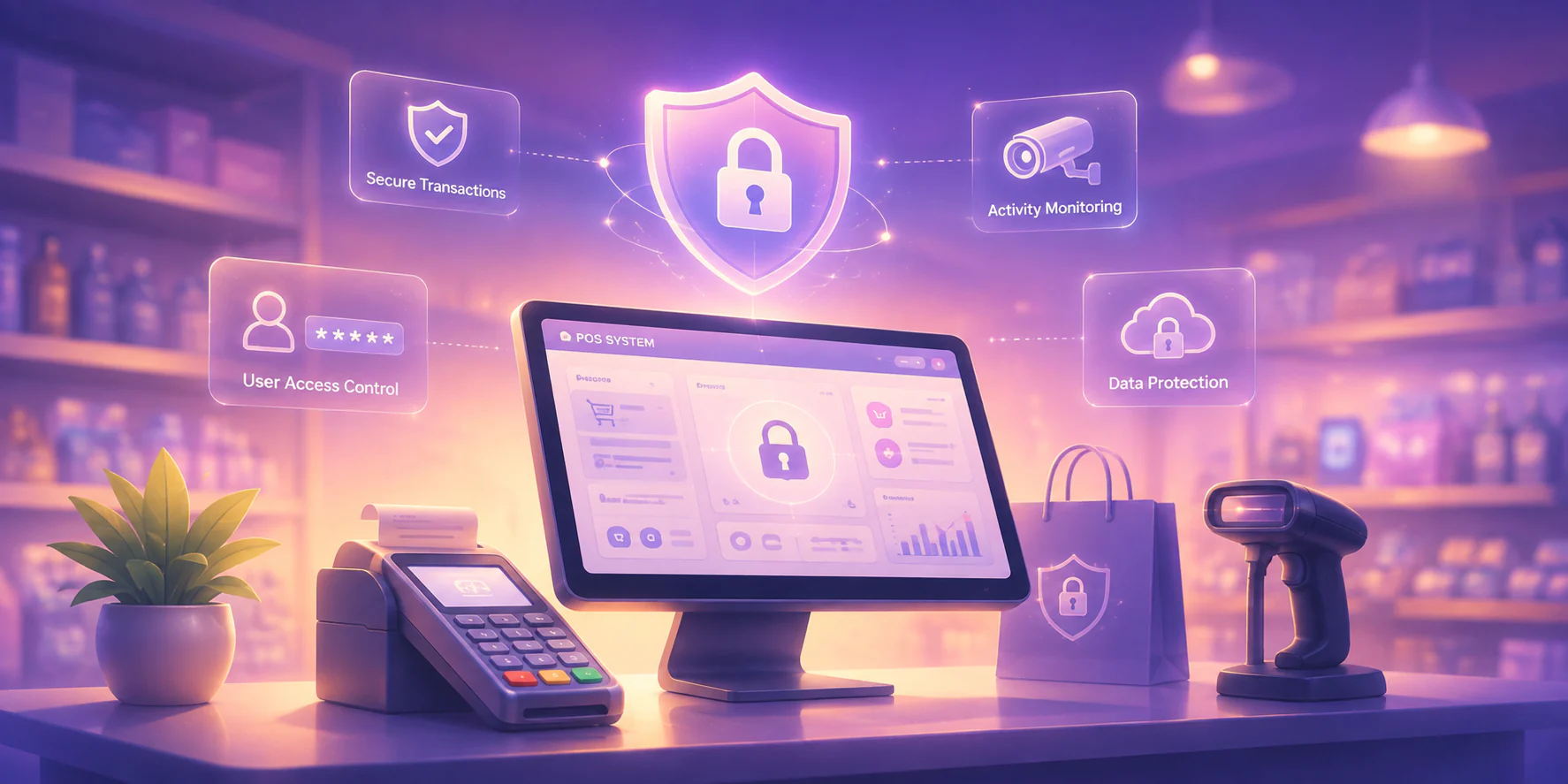






For many Philippine retailers, the checkout counter is treated as the last step of a transaction rather than a selling area, so high-intent moments pass without any planned prompt, display, or offer. The result is a predictable gap: shoppers who were still open to adding one more item leave with exactly what they came for.
Treating the checkout counter as a planned touchpoint closes that gap, since placement, displays, loyalty prompts, and transaction data can all be set up deliberately instead of left to chance. The POPAI Shopper Engagement Study reported that a large share of purchase decisions happen in store, and while that figure comes from a historical sample outside the Philippines, it is a useful reminder of why the counter area deserves the same planning as any other marketing channel.
Key Takeaways
POS marketing uses the checkout and nearby purchase area to influence buying decisions.
Retailers should test each tactic against a defined baseline and measurement period.
A POS system can support consistency through product suggestions, loyalty records, branch management, and sales reporting.
What Is POS Marketing?
POS marketing, or point-of-sale marketing, is the use of displays, promotions, product recommendations, loyalty mechanics, and customer communication at or near the checkout to shape a purchase decision. Unlike advertising that works to bring shoppers into the store, it speaks to customers who are already there and close to paying.
That timing is what makes the checkout useful, because it is the one moment where you can present a relevant add-on, explain an offer, invite loyalty enrolment, or remind a customer about a product they skipped. The goals are practical: higher basket value, more loyalty sign-ups, and clearer communication at the payment stage.
POS marketing is often confused with POP marketing, but the two work in different places and at different moments. Point of purchase marketing covers the broader in-store environment through shelf talkers, end-cap displays, and aisle signage while shoppers are still browsing, whereas POS activity happens at the counter during payment itself, and the two work best when they run together.
Why Does POS Marketing Matter?
POS marketing matters because it sits where the marketing message and the actual transaction meet, so the results show up directly in your sales records rather than in estimates. For Philippine retailers, that makes it one of the easier tactics to justify, test, and adjust.
- It is measurable: You can see which products were bought, which offers were accepted, and whether the customer came back, instead of guessing at the impact of an awareness campaign.
- It is easy to test: Set a baseline, run the promotion for a fixed period, then compare the result and decide whether to keep the tactic.
- Loyalty has a business case: Bain research has reported that a 5% increase in customer retention can lift profits by 25% to 95% depending on the business, which is a reason to track repeat purchasing rather than treat each sale as a one-off.
- It adapts to any store format: A supermarket can use end-cap displays and bundle prompts, a convenience store can focus on queue-area products, and a smaller shop can start with clearer placement and a simple repeat customer record.
- It scales with your data: As transaction records build up, you can tell which counter offers actually work for your store instead of copying what works elsewhere.
The most reliable approach is systematic: pick one tactic, define the metric, run it for a fixed period, and compare it against a baseline you set in advanc
7 POS Marketing Strategies for Philippine Retailers
Test these one at a time, or in small groups, so you can tell which change actually moved the number. Before you start, write down the baseline period, the outlet, the offer, the products involved, and the measurement window.
1. Optimize Product Placement at the Checkout Area
Use the checkout for products that are easy to understand, easy to carry, and related to what the customer is already buying. Snacks, small drinks, accessories, travel-size items, and complementary grocery items usually fit.
Start by mapping three zones: what customers can reach, what they can see while queueing, and what the cashier can recommend. Then check that each product has a clear price, enough stock, and a sensible link to the main basket.
Keep the test simple by comparing items per transaction before and after the layout change. Record the dates, the outlet, the products you moved, and any promotion running at the same time.
Documenting the reason for the change makes the result easier to read later. Moving complementary products together tests a different idea from placing cheap items beside the payment terminal.
Measure: items per transaction, units sold per promoted product, and stock availability during the test.
2. Use Digital Signage and Customer-Facing Displays
Customer-facing displays can show the running total, current promotions, payment instructions, loyalty balances, or product reminders. What makes them work is relevance and timing, not the screen itself.
A single-store retailer may only need a printed design for one offer. A multi-outlet business benefits more from centrally managed content, since it cuts inconsistent updates and repeated manual work.
Before buying anything, confirm the supported hardware, payment integrations, display workflow, and who owns content updates. These vary by POS setup, so check with your provider rather than assuming.
A good display answers one customer question quickly, such as the current total, how a bundle works, or which payment methods you accept. Too many unrelated messages slow the line down.
Measure: promoted-item conversion, average queue time, and customer response across comparable periods.
3. Build a Loyalty Program
A loyalty program rewards customers and gives you a structured way to recognise repeat buyers. It can run on points, membership tiers, vouchers, or targeted offers.
Keep the first version simple by defining how customers join, how points are earned, when rewards expire, and how redemptions are recorded. Explain the terms at the counter so the value is clear right away.
QR or digital payment enrolment is worth considering if your payment and POS systems support it. Confirm with your implementation team before promising a specific wallet integration to customers.
Also review the operational cost before rollout. If enrolling a customer or redeeming a reward takes several manual steps, cashiers will quietly stop offering it.
Measure: new members, active members, redemptions, repeat visits, and average transaction value by member status.
4. Increase Basket Size with Cross-Selling and Upselling
Cross-selling suggests a complementary product, while upselling suggests a larger or higher-value version. Both need to be relevant to the current basket and easy for a cashier to explain in one sentence.
Begin with a handful of pairings and review acceptance by product, cashier, outlet, and time of day. A POS system helps by recording cart activity and, where supported, surfacing suggested items during checkout, but treat that as a workflow aid rather than proof of added revenue.
Measure: average transaction value, attachment rate, units per transaction, and acceptance rate per pairing.
5. Trigger Impulse Buys with POSM and Seasonal Promotions
POSM, or point-of-sale materials, covers the physical and digital assets that communicate a product, promotion, price, or call to action near the counter, and their job is to make one offer obvious at a glance. Seasonal campaigns work well around Philippine shopping moments such as Valentine's, back-to-school, town fiestas, Christmas, and New Year, so use product combinations and wording your own customers recognise rather than a translated international promo.
| Campaign element | Planning question |
|---|---|
| Product | Is the item relevant to the occasion and available at the participating outlet? |
| Message | Can the customer understand the offer without staff explanation? |
| Placement | Will the display be visible during queueing or payment? |
| Measurement | Which baseline and comparison period will be used? |
Measurement suggestion: track promoted-product units, bundle conversion, stock-outs, and revenue per transaction during the campaign, then compare them against the baseline period you set before the display went up.
track promoted-product units, bundle conversion, stock-outs, and revenue per transaction during the campaign, then compare them against the baseline period you set before the display went up.
6. Use POS Data to Personalize Marketing
RFM analysis groups customers by Recency, Frequency, and Monetary value. In plain terms: who bought recently, who buys often, and who spends more.
Use the groups to plan concrete actions, such as inviting inactive customers back, rewarding frequent buyers, or showing higher-value segments the products that match their spending. Just remember that RFM does not explain everything, since store location, seasonality, stock availability, and past promos all shape behaviour too.
Pull the data from a POS report or export, and define the period, the customer population, the revenue field, and any excluded transactions. Keep that calculation consistent so month-to-month comparisons stay meaningful.
Measure: customer count and revenue per RFM segment, campaign response, and repeat purchase after each targeted promotion.
7. Train Staff to Support the Checkout Experience
Cashiers do not need a long script. They need clear rules on which offer to mention, when to mention it, and how to accept a no without pushing.
A practical format is one offer, one prompt, one timing cue, for example offering a single complementary product right after the main item is scanned. Training should also cover when not to suggest anything, because an unrelated prompt slows the queue and chips away at trust.
Measure: offer acceptance, average transaction value, customer complaints, and how consistently cashiers follow the approved prompt.
Illustrative Philippine Scenarios
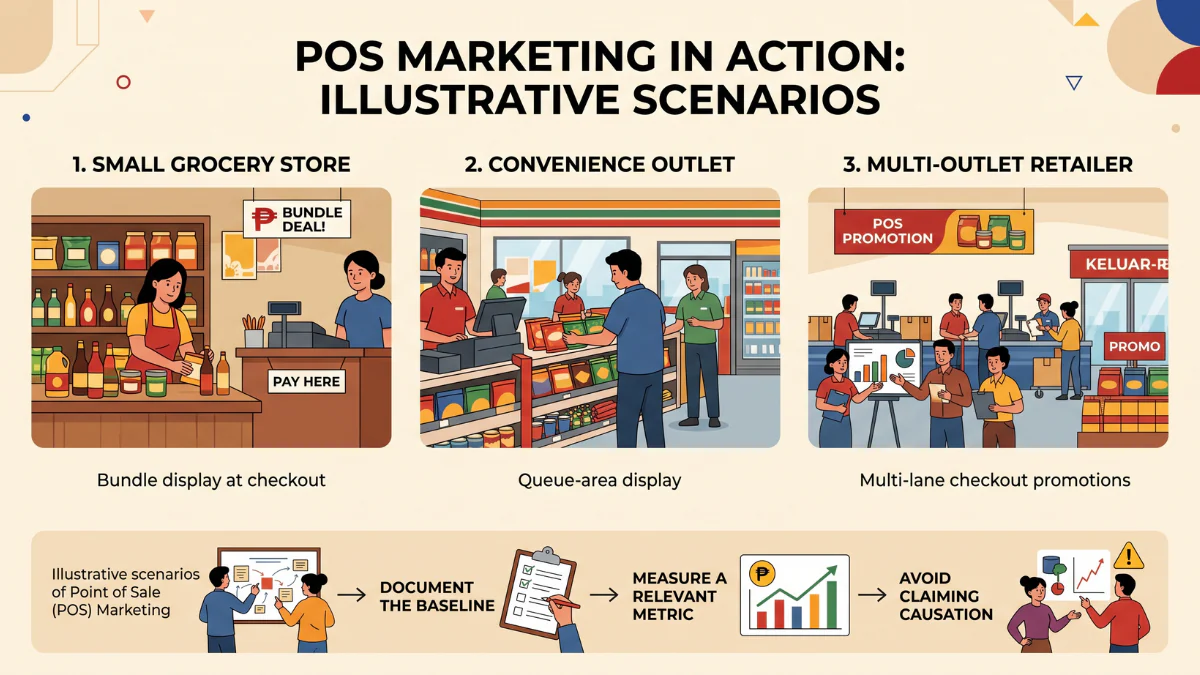
The examples below are illustrative scenarios, not HashMicro client results. They are meant to show how a test is set up, not what returns to expect.
- Small grocery store: The owner moves complementary cooking ingredients near the payment area and adds a clearly priced bundle message. After four weeks, items per transaction are compared against the previous four-week period.
- Convenience outlet: The manager tries a queue-area display for quick-consumption items and tracks units sold per transaction. The results are then broken down by day part to see whether morning and evening behave differently.
- Multi-outlet retailer: The operations team runs one promotion in selected branches, compares the results per outlet, and checks stock movement before deciding whether to roll it out further.
- The pattern in all three is the same: pick one tactic, write down the baseline, measure a metric that fits the goal, and hold back on claiming cause when more than one thing changed at the same time.
How Can a POS System Support These Strategies?
Every POS marketing strategy requires data and consistency. A POS system can help retailers centralize transactions, apply product recommendations, manage loyalty records, coordinate multiple outlets, and review sales reports.
HashMicro point-of-sale system page describes capabilities including auto-suggested upselling and cross-selling, central multi-branch POS, real-time POS sales reports, customer display hardware, receipt promotion and branding, loyalty points management, membership management, and gift and voucher management.
| Marketing need | Capability to evaluate | Validation Question |
|---|---|---|
| Relevant add-ons | Upsell and cross-sell suggestions | Can recommendations be configured from cart or product data? |
| Outlet consistency | Central multi-branch POS | Can prices, promotions, and reports be managed across outlets? |
| Customer communication | Customer display and receipt branding | What display and receipt content can be configured? |
| Repeat purchase | Loyalty points and membership management | How are enrolment, points, vouchers, and redemption recorded? |
| Measurement | Real-time POS sales reporting | Can the required baseline and comparison metrics be exported? |
Retailers should evaluate the system against their actual workflow. A feature is useful only when staff can use it consistently, and managers can measure the result.
Conclusion
POS marketing works best as a measurable operating process, not a collection of attractive displays. Start with one checkout tactic, define the baseline, record the result, and expand only when the numbers support it.
A suitable POS system makes that process easier to repeat, since it keeps transaction records, loyalty data, and promotion results in one place. Even so, every retailer should validate the workflow, configuration, and commercial result in their own stores before scaling a tactic across outlets.
If you want help setting up a checkout process that is easier to measure and manage, schedule a free consultation with our expert team to review your POS, loyalty, and reporting setup.

FAQ about POS Marketing
A POS system may support product suggestions, loyalty records, customer displays, promotion workflows, multi-outlet management, and sales reporting. Exact capabilities depend on the selected configuration and should be confirmed before implementation.
POS marketing focuses on the checkout and payment moment.POP marketing covers the broader in-store purchase environment, including shelves, aisles, end-caps, and product displays.
Start with one checkout layout improvement, one complementary product pairing, and one promotion that can be measured clearly. Track items per transaction, promotion conversion, and stock availability before expanding the program.
POSM means point-of-sale materials. It includes physical or digital promotional assets placed near the point of purchase to communicate products, prices, or offers.
Average transaction value equals total revenue divided by the number of transactions in the selected period. Compare the same formula across consistent periods to evaluate change.
Useful metrics include average transaction value, items per transaction, promotion conversion, loyalty enrolment, redemption rate, repeat purchase rate, and stock availability.