






Import duties in the Philippines can increase a shipment’s landed cost when a product is classified incorrectly, declared at the wrong value, or cleared without the required documents. These errors may lead to unexpected charges, delayed release, reassessment, or disputes with customs authorities.
Accurate import costing matters because customs charges affect cash flow,inventory valuation inventory valuation, pricing decisions, and profit margins. A business must separate customs duty, import VAT, excise tax, processing charges, brokerage, and logistics costs before recording the shipment’s total landed cost.
This guide explains how import duties Philippines rules work, how to compute duties and taxes on import Philippines shipments, and how the Bureau of Customs assesses imported goods. It also covers AHTN classification, customs value, the PHP 10,000 de minimis threshold, the PHP 50,000 entry threshold, clearance procedures, and import cost recording.
Key Takeaways
Customs duty rates depend on the product's AHTN or HS code, customs value, country of origin, and applicable tariff schedule.
Import VAT is generally 12%, computed on the value the Bureau of Customs uses for duty, plus customs duties, excise taxes where applicable, and other charges included in the base.
Goods with an FOB or FCA value of PHP 10,000 or less are generally not charged duties and taxes under the CMTA.
The goods declaration must generally be lodged within 15 days from discharge of the last package, or the shipment risks implied abandonment.
What Are Import Duties in the Philippines?
Import duties are charges imposed on goods brought into the Philippines from another country. The Bureau of Customs assesses these charges when imported goods enter Philippine customs territory.
Under Section 104 of the Customs Modernization and Tariff Act, imported goods are generally subject to duties and taxes unless the CMTA or another law provides an exemption. Importation is considered complete when the applicable duties, taxes, and other charges have been paid or secured and the goods have received legal clearance for release.
For businesses, customs duty represents only one part of total import cost. The final landed cost may also include freight, insurance, import VAT, excise tax, processing charges, port fees, brokerage, inspection, and inland transportation.
Which Charges Can Apply to Imported Goods?
The total cost of an imported shipment depends on the product, customs value, tariff classification, country of origin, entry type, and applicable customs rules.
| Cost component | What it covers |
|---|---|
| Customs duty | Tariff charged on the basis of the applicable AHTN or HS classification and the customs value |
| Import VAT | Generally 12%, applied to the BOC valuation base plus applicable duties, excise taxes, and other charges |
| Excise tax | Additional tax on selected products such as automobiles, tobacco, alcohol, petroleum, and certain beverages |
| Import Processing Charge (IPC) | A customs charge that varies by shipment value and processing method |
| Customs Documentary Stamp | Documentary charge that may apply to goods declarations |
| Container Security Fee | May apply to shipments handled through covered container facilities |
| Fuel Marking Fee | May apply to certain fuel-related importations |
| Port, terminal, and brokerage charges | Commercial costs billed by port operators, brokers, carriers, or logistics providers |
The Bureau of Customs identifies import tariffs, VAT, excise taxes, trade remedies, and other lawful charges as part of the import assessment process. The BOC Guidelines on Importation also list the Import Processing Charge, Customs Documentary Stamp, Container Security Fee, and Fuel Marking Fee as charges that may apply under relevant rules.
Factors That Determine Import Duty Rates
The applicable import duty rate depends on several connected factors. A correct supplier invoice alone does not determine the final amount.
1. Identify the AHTN or HS code
The Harmonized System provides the international framework for classifying traded products. The Philippines uses the ASEAN Harmonized Tariff Nomenclature for its tariff classification.
A product’s classification may depend on:
Composition and materials
Function and intended use
Technical specifications
Packaging and presentation
Degree of processing
Whether the item is a raw material, component, or finished good
Two products with similar everyday names may belong to different tariff lines and carry different duty rates.
Importers should avoid assigning a tariff code based only on the product name. Use the Philippine Tariff Finder to search by product description or AHTN code.
2. Check the country of origin
Where goods were shipped from is not always where they originated. Origin generally depends on where the goods were wholly obtained or substantially transformed, and it determines whether a preferential rate is even available. A valid Certificate of Origin is normally required to claim preferential treatment under a free trade agreement.
3. Check the applicable tariff treatment
Two treatments come up most often:
Most-Favored-Nation (MFN): generally applies to imports from WTO member countries when no preferential agreement is claimed.
Preferential: may apply where the goods qualify under a free trade agreement or other preferential arrangement.
How Is Customs Value Established?
Customs value is the value used by the Bureau of Customs (BOC) to assess tariffs and customs duties. For many transactions, the transaction value serves as the starting point, but adjustments may be required for freight, insurance, commissions, packing, containers, assists, royalties, and other relevant elements.
For this reason, CIF should not automatically be treated as the final customs value. CIF can help businesses prepare an internal estimate, but the official assessment depends on customs valuation rules and supporting documents.
Import Duty Formula and VAT Computation
For goods subject to an ad valorem tariff, businesses can use the following formulas for an internal estimate.
| Calculation | Formula | Example |
|---|---|---|
| Customs duty | Customs value × applicable duty rate | PHP 110,000 × 5% = PHP 5,500 |
| VAT base | Customs value + customs duty + applicable excise tax and other dutiable charges | PHP 110,000 + PHP 5,500 = PHP 115,500 |
| Import VAT | VAT base × 12% | PHP 115,500 × 12% = PHP 13,860 |
| Duty and VAT | Customs duty + import VAT | PHP 5,500 + PHP 13,860 = PHP 19,360 |
| Landed cost | Purchase price + freight + insurance + applicable customs and logistics costs | Depends on shipment documents and accounting treatment |
.The import VAT base generally includes customs value, customs duty, applicable excise tax, and other charges required under applicable rules. Not all landed costs automatically form part of the VAT base.
The import VAT base generally includes customs value, customs duty, applicable excise tax, and other charges required under applicable rules. Not all landed costs automatically form part of the VAT base.
Step by Step Import Duty Calculation
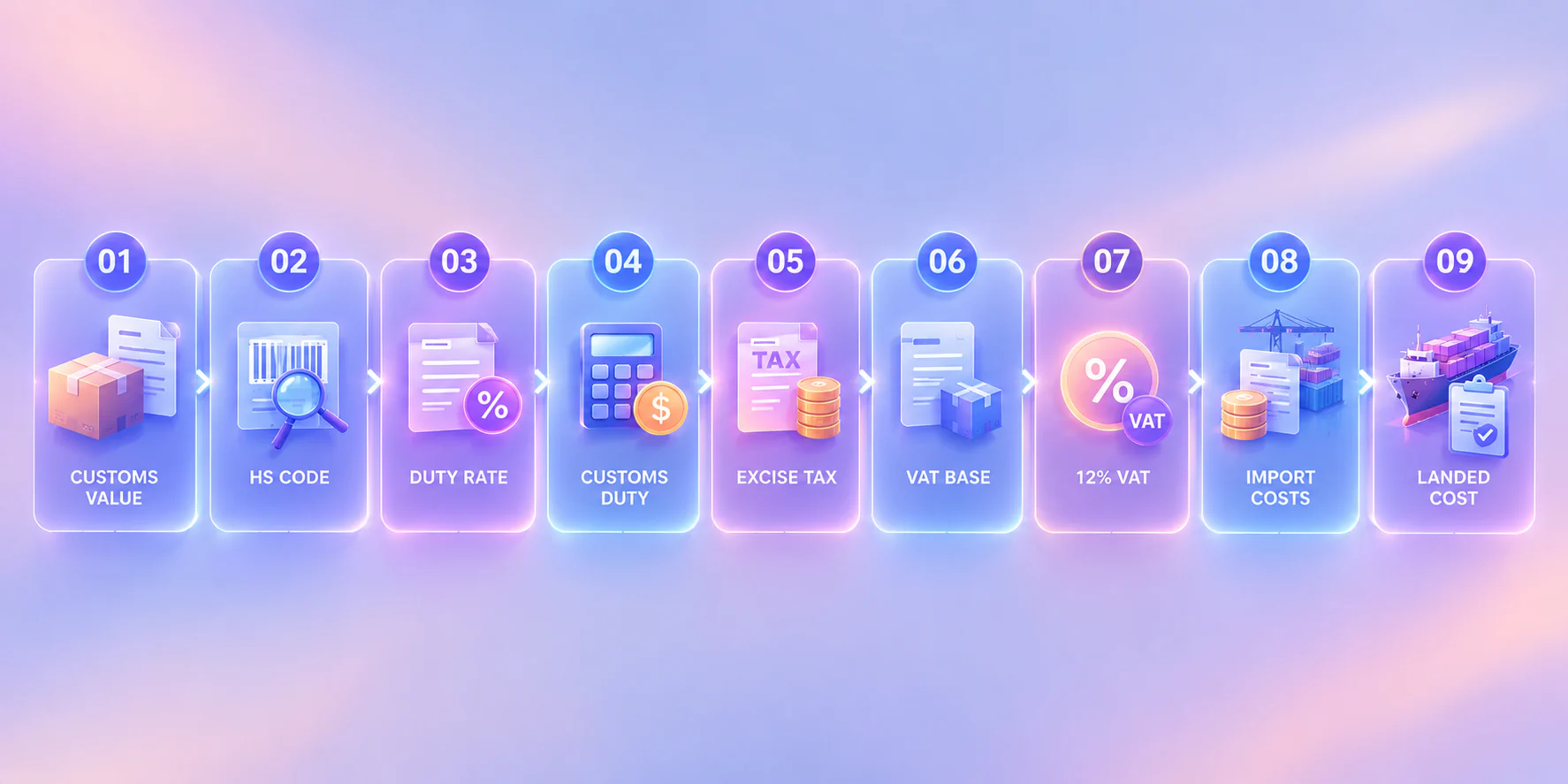
Determine the product's customs value.
Confirm the AHTN or HS code.
Check the applicable MFN or preferential duty rate.
Calculate the customs duty.
Determine whether excise tax applies.
Build the import VAT base.
Apply the 12% VAT rate where applicable.
Add processing charges, documentary charges, port costs, brokerage, and other expenses.
Record the full amount in the shipment's landed-cost analysis.
Worked Example: PHP 110,000 Shipment
Assume a business imports goods under the following conditions:
- Customs value: PHP 110,000
- Illustrative duty rate: 5%
- Import VAT rate: 12%
- Excise tax: Not applicable
- Other charges: Excluded for illustration
Step 1: Calculate Customs Duty
The estimated customs duty is PHP 5,500.
PHP 110,000 X 5% = PHP 5,500
Step 2: Calculate the VAT base
The estimated VAT base is PHP 115,500.
PHP 110,000 + PHP 5,500 = PHP 115,500
Step 3: Calculate Import VAT
The estimated import VAT is PHP 13,860.
PHP 115,500 X 12% = PHP 13,860
Step 4: Add Custom Duty and Import VAT
The estimated customs duty and import VAT total is PHP 19,360.
PHP 5,500 + PHP 13,860 = PHP 19,360
This calculation is only an internal illustration. It does not represent an official BOC assessment. The final amount may change because of the actual AHTN classification, customs valuation, country of origin, preferential tariff eligibility, excise tax, trade remedies, and other applicable charges.
How Does the PHP 10,000 De Minimis Rule Work?
Under Section 423 of the CMTA, goods with an FOB or FCA value of PHP 10,000 or less are generally exempt from customs duties and taxes. These values may differ from the total amount paid by the buyer, depending on shipping costs and other charges.
However, the exemption does not necessarily eliminate customs processing, brokerage, carrier, or logistics fees. CAO No. 02-2025 provides relevant rules on customs charges and processing procedures.
| FOB or FCA value | General treatment |
|---|---|
| PHP 10,000 or less | Generally exempt from duties and taxes |
| Above PHP 10,000 | Duties and taxes may apply based on classification and valuation |
| Any value | Processing, brokerage, carrier, or logistics fees may still apply |
PHP 50,000 Entry Threshold: Formal vs. Informal Entry
The Bureau of Customs distinguishes formal and informal entry based on the FOB or FCA value of commercial goods.
The Bureau of Customs distinguishes formal and informal entry based on the FOB or FCA value of commercial goods.
| Shipment value and type | General entry treatment |
|---|---|
| Commercial goods below PHP 50,000 FOB/FCA | Informal entry |
| Commercial goods at PHP 50,000 FOB/FCA or above | Formal entry |
| Personal or household goods | May be treated differently depending on quantity, context, and applicable rules |
The PHP 50,000 threshold determines the general customs entry procedure, not whether duties and taxes apply. Imported goods remain subject to the required goods declaration unless an exemption or different treatment applies.
BOC Import Clearance Process
1. Register and Obtain Accreditation
Businesses that intend to import should secure the appropriate registration and accreditation through the Bureau of Customs Accounts Management Office.
2. Prepare Import Documents
Commonly required: commercial invoice, sales contract or purchase order, packing list, bill of lading or air waybill, Certificate of Origin where applicable, import permit or clearance where required, proof of payment, insurance and freight documents, and any product-specific supporting documents.
3. Lodge the Goods Declaration
After arrival, the importer or customs broker lodges the goods declaration electronically through the E2M system. BOC states that the declaration must generally be lodged within 15 days from the discharge of the last package from the vessel or aircraft. Missing that window can result in implied abandonment of the shipment.
4. Use a Provisional Goods Declaration When Necessary
A Provisional Goods Declaration may be used when complete information or supporting documents are not yet available.
Under the BOC guidelines, the importer generally must complete the missing information or documents within 45 calendar days from lodgment. The period may be extended for another 45 calendar days for valid reasons.
5. Undergo Customs Inspection
Based on the cargo selectivity system and assessed risk, a shipment may undergo:
- Documentary inspection
- Non-intrusive inspection through scanning
- Physical examination
Inspection may verify the goods’ nature, origin, condition, quantity, value, and tariff classification.
6. Pay the Assessment and Obtain Release
Once the assessment is complete, the importer pays or secures the assessed duties, taxes, and other lawful charges. After customs and regulatory requirements are satisfied, the Bureau issues the release instructions.
What Causes Import Duty Reassessment or Delays?
Most disputes trace back to a handful of avoidable problems.
1. Undervaluation
he declared value should match the actual transaction value and supporting proof of payment. Freight, insurance, commissions, packing, containers, royalties, assists, and other required valuation elements may also affect the customs value.
2. Incorrect Tariff Classification
A generic product description may lead to the wrong AHTN code and duty rate. Businesses should use the product’s technical specifications, composition, function, and intended use when confirming classification.
3. Incorrect Country of Origin
A preferential tariff claim must be supported by the correct Certificate of Origin and applicable rules of origin. If the origin is incorrect or the documents are incomplete, the preferential rate may be withdrawn.
4. Missing permits
Regulated and restricted goods may require permits or clearances before importation. Businesses should check the applicable requirements before the supplier ships the goods.
5. Inconsistent Records
Mismatches between the commercial invoice, purchase order, packing list, transport document, proof of payment, and customs declaration can trigger additional questions.
A consistent document trail helps businesses explain the relationship between the shipment, the customs assessment, and the recorded inventory cost.
How Should Businesses Record Import Costs?
Businesses should record directly attributable acquisition and import expenses, including supplier purchase price, freight, insurance, customs duty, applicable excise tax, import processing charges, customs documentary stamps, port and terminal charges, brokerage, inland transportation, and inspection and handling fees, as part of the landed-cost assessment.
Import VAT should be assessed based on its recoverability and the company’s accounting policy. Recoverable input VAT is generally recorded separately rather than automatically included in inventory cost.
Conclusion
Import duties in the Philippines depend on more than the supplier invoice. The final amount may change based on tariff classification, customs value, country of origin, preferential treatment, VAT, excise tax, processing charges, and the required entry procedure.
Businesses should confirm these details before shipment and connect the invoice, packing list, transport documents, proof of payment, customs assessment, and inventory receipt.
Accurate import costing also requires a clear record from purchase order to inventory receipt. By applying effective supply chain management practices, businesses can connect procurement, shipment, inventory, and accounting data in one workflow, improve landed-cost visibility, reduce reassessment risks, and make better purchasing decisions.