










 Limited to 100 registrants

One invoice paid through two methods can create several records for your finance team to authorise, allocate, settle, refund, and reconcile. That is why split payment is not only a checkout feature. For Philippine companies, it can affect POS records, ecommerce orders, receivables ageing, bank matching, branch reporting, and customer service follow-ups.
Digital transactions now make up 57.4% of the volume and 59% of the value of monthly retail payments in the Philippines, up from 52.8% a year earlier, according to the Bangko Sentral ng Pilipinas' 2024 Status of Digital Payments report. As more customers pay through a mix of cards, wallets, and bank transfers, split payment, one total amount divided across multiple payment methods, payers, or settlement destinations, has stopped being a niche checkout feature.
In simple terms, split payment means a total payment is divided into more than one part. The split may happen through split tender at checkout, through divided customer payments, through several payers, or through marketplace-style payout allocation after settlement. If you are a CFO, finance manager, IT manager, ecommerce leader, or operations director, the key question is not whether the customer can pay flexibly. The real question is whether every payment portion remains traceable to the original order or invoice.
Without a controlled split payment process, one invoice paid through two methods can already create several records for your finance team to settle. For Philippine companies, this can affect their order operational and the gaps usually only show up once something needs to be traced back, a refund, a mismatched settlement, an audit trial question.
This guide shows you how to diagnose the right payment model, weigh six decision factors, and prepare your accounting and ERP workflows before changing any payment rule. Read on to map your payment flow and see where split payment adds control instead of reconciliation risk.
Key Takeaways
Split payment can describe a division across payment methods, payers, collection dates, or settlement recipients, so you must define where the split occurs.
Customer-facing payment flexibility is useful only when each payment portion remains traceable to the original order or invoice.
Finance and IT teams should assess reconciliation, refunds, gateway compatibility, ERP integration, approvals, and reporting before rollout.
Payment gateways handle authorisation and routing, while accounting and ERP workflows handle allocation, posting, exceptions, and reconciliation.
What Is Split Payment in a Business Transaction?
Split payment is a business payment transaction where one total amount is divided across multiple payment methods, payers, recipients, invoices, collection dates, or settlement destinations. The exact split payment meaning depends on where the division occurs: at checkout, across receivable dates, between payers, or during payout allocation.
Split payment divides one total amount across multiple payment methods, payers, recipients, invoices, or settlement dates. The split payment meaning depends on where that division happens either at checkout, across collection dates, between payers, or during payout allocation.
For example, a customer may buy equipment worth PHP 120,000. They pay PHP 80,000 by bank transfer and PHP 40,000 by corporate card. This is an illustrative example, not customer data. To the buyer, it may feel like one purchase. For your finance team, however, there are two payment records that must still connect to one invoice.
For example, a customer buys equipment worth PHP 120,000 and pays PHP 80,000 by bank transfer and PHP 40,000 by corporate card. To the buyer it feels like one purchase, but for finance team now, they holds two payment records that must still link back to a single invoice.
A different case may involve a PHP 50,000 hospitality booking where the customer pays a PHP 15,000 deposit today and the PHP 35,000 balance later. That looks closer to a partial payment or staggered collection arrangement than a single checkout split. Another case may involve one marketplace order where funds are later allocated to several sellers, service providers, or branches.
Defining where the split occurs before choosing the type of POS system that can support your business or changing payment rules is important:
- If the problem is customer acceptance, review your checkout, POS, and payment gateway.
- If the problem is collection timing, review receivable terms and partial payment tracking.
- If the problem is payout allocation, review settlement reporting and audit references.
When and Why Should Philippine Companies Use Split Payment?
Split payment makes operational sense when a single transaction must be divided and every portion stays traceable to its original invoice. Without that traceability, the flexibility becomes a reconciliation liability and not a feature.
Split payment makes operational sense when a single transaction must be divided and every portion stays traceable to its original invoice. Without that traceability, the flexibility becomes a reconciliation liability and not a feature.
| Where the split occurs | Common scenario | Finance team concern | Business result |
|---|---|---|---|
| At checkout | Customer pays PHP 120,000 equipment via bank transfer + corporate card | Two payment records must link to one invoice | Reduces friction at point of sale |
| Across collection dates | PHP 15,000 deposit today, PHP 35,000 balance on delivery | Partial payments must stay tied to one receivable | Shortens collection cycles for staged arrangements |
| Across payers or recipients | One marketplace order funds multiple sellers or branches | Each portion needs a clean settlement reference | Cleaner payout audit trail per entity |
Split payment is useful when the business requirement is real: mixed cash and card acceptance, customer deposits and final balances, multiple corporate payers, partner payout allocation, or high-value transactions that permit more than one payment source. It is less useful when teams only want flexibility but cannot define the reconciliation owner.
- At checkout: A single sales transaction is paid using two or more methods at the point of sale. One part may be settled via bank transfer while the remainder is charged to a credit card or corporate account. The finance team's job is to match both payment records to a single invoice so reconciliation does not require manual intervention.
- Across collection dates: A single obligation is paid in stages over time. The seller collects a deposit upfront and the balance upon delivery or booking completion. Each partial collection must remain tied to the same receivable record so the outstanding balance is always visible and overdue follow-ups go to the right invoice.
- Across payers or recipients: One transaction involves multiple parties on either side of the payment. A marketplace platform may distribute a single customer payment to several sellers, or a company may split a vendor obligation across two internal cost centers. Each portion needs its own settlement reference to pass an audit and support VAT reconciliation under BIR rules.
Split payment improves the buying experience for large transactions and reduces collection friction when deposits or phased billing are involved. For finance teams, the practical value is visibility, because if the original invoice, each payment portion, settlement timing, and open balance are visible in one workflow, fewer decisions rely on spreadsheets or email trails.
How Split Payment Works
How Does Split Payment Work From Checkout to Settlement?
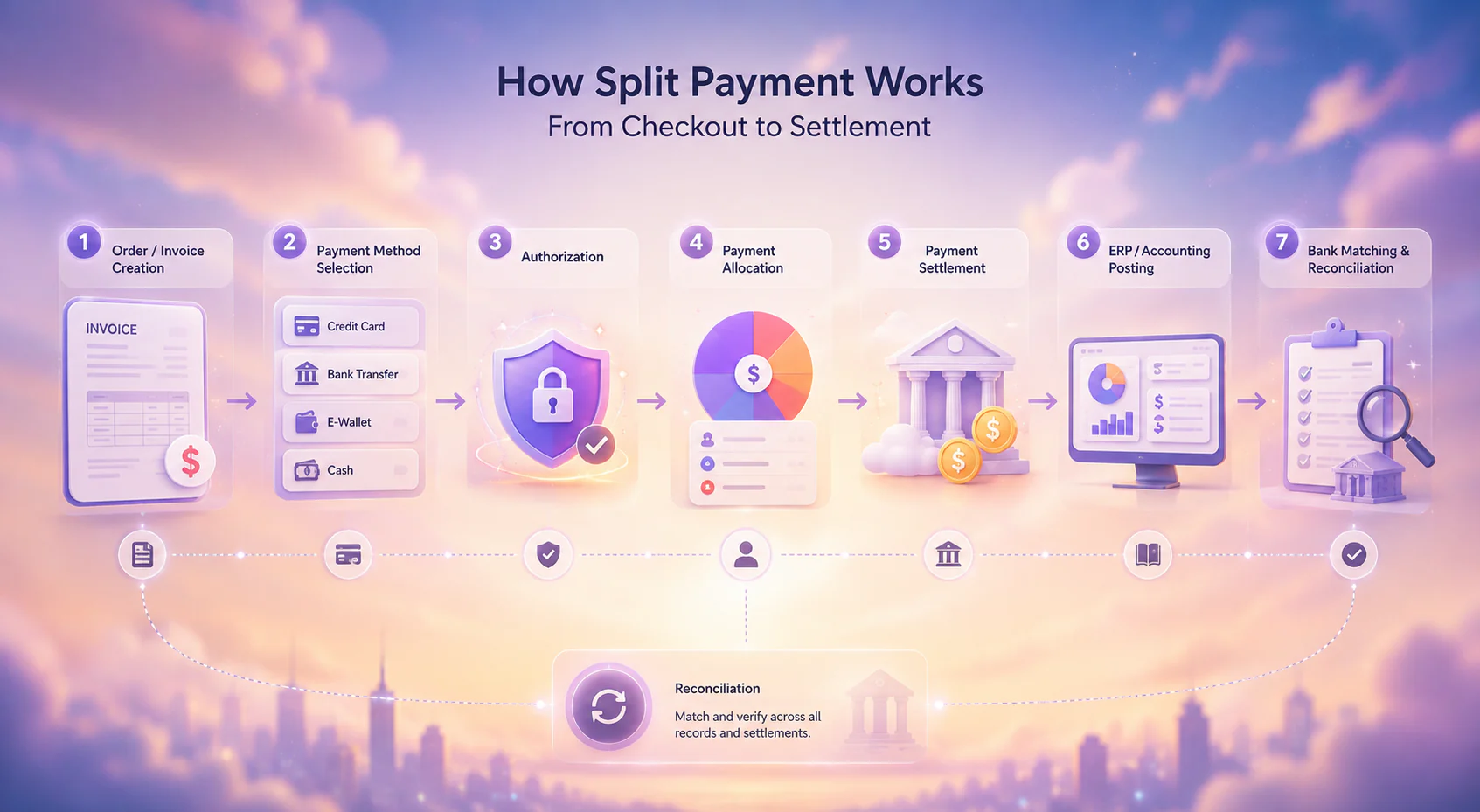
The split payment process starts when an invoice or order is created. The practical workflow usually looks like this:
Order or invoice creation. The business creates the commercial record first. This record should become the parent reference for every later payment portion.
Payment-method selection. The customer, cashier, billing team, or portal chooses whether payment will come from cash, card, bank transfer, wallet, cheque, deposit, or another allowed source.
Gateway or acquirer authorization. A payment gateway, acquiring bank, POS device, or online payment service checks whether each portion can be authorized. A split may succeed fully, fail fully, or succeed only in part.
Payment allocation. Each authorized amount is mapped back to the same invoice, order, customer account, branch, project, or cost center. This is where clean references matter.
Payment settlement. Funds settle according to the timing of each provider or bank. One portion may appear earlier than another, so settlement records may not match the invoice total on the same day.
ERP or accounting posting. The accounting platform records the receipt, fees, clearing account movements, receivable status, and any open balance. A gateway can route a payment, but the ERP or accounting workflow must preserve the invoice reference.
Bank matching and reconciliation. Finance matches bank statements, gateway settlement reports, POS data summaries, and ledger entries. Exceptions should show which payment portion is missing, delayed, reversed, or over-applied.
Partial authorization needs special handling. If the card portion succeeds but the bank-transfer portion is not yet received, the system should not silently mark the full invoice as paid.
- If a payment fails, the open amount must remain visible.
- If settlement is delayed, the finance team should be able to distinguish timing differences from genuine unreconciled items.
This boundary is important where payment infrastructure handles authorization and routing, while accounting and ERP workflows handle allocation, posting, exceptions, and transaction reconciliation.
Split Payment vs Instalment, BNPL, Staggered Payment, and Split Tender
Split Payment vs Instalment, BNPL, Staggered Payment, and Split Tender
Businesses often use these terms interchangeably, but each one describes a different part of a transaction, from how a customer pays, to when they pay, to who ultimately receives the funds. That distinction matters because it changes what your checkout, receivables, refund, and reporting processes need to track. The table below breaks down how each term differs in practice.
| Term | Core meaning | Philippine example | Finance team concern |
|---|---|---|---|
| Split payment | Total amount divided across sources, payers, recipients, or settlement destinations | PHP 120,000 invoice paid through bank transfer and corporate card | Each portion must map to the same invoice; references must survive from checkout to ledger |
| Split tender | One checkout uses more than one payment method | PHP 3,000 cash + PHP 7,000 card at a branch POS | POS, cashier shift, and card settlement records must match |
| Staggered payment | A single obligation paid in stages at different dates or milestones | 30% deposit before delivery, 70% upon project completion | Receivable ageing and due dates become central; outstanding balance must stay visible |
| Instalment | Total obligation divided into scheduled periodic payments | Customer pays monthly under agreed billing terms | Each due date needs collection tracking; late or missed payments affect reports |
| Buy now, pay later (BNPL) | A financing provider settles with the merchant; the buyer repays the provider | Customer selects GCash PayLater or BillEase at checkout | Merchant settlement and buyer repayment are separate; refunds require provider-specific handling |
| Marketplace payout splitting | Settled funds distributed to multiple recipients after collection | One Lazada order distributed among seller, platform fee, and logistics | Allocation rules must be documented; reports must show each recipient's share and fees |
We recommend naming the requirement before comparing systems. If the customer uses multiple methods in one checkout, you are likely discussing split tender. If money is due on different dates, you are closer to staggered or instalment terms. If one collected amount must be distributed among sellers, branches, or partners, payout splitting is the more accurate label.
This distinction matters because the staggered payment meaning is about timing, not necessarily about multiple payment methods. A transaction can involve both staggered payment and split payment, but your accounting setup should not treat them as identical.
What Should Finance and IT Teams Verify Before Enabling Split Payment?
The main risk in split payment is losing the link between each payment portion and the original commercial transaction. Once that link breaks, finance teams may struggle to validate refunds, close receivables, explain settlement differences, enforce approvals, or produce reliable management reports.
Before enabling split payment, finance and IT teams should confirm one thing above all that every payment portion must stays linked to its original invoice. Once that link breaks, teams struggle to validate refunds, close receivables, explain settlement gaps, enforce approvals, and produce reliable reports.
After defining the payment model. Decide whether you mean split tender, partial collection, staggered payment, instalment terms, multiple payers, or payout allocation. Then run the six control factors below with finance, IT, operations, and customer-facing teams before rollout.
| Control factor | What can go wrong | Verification question | Control owner | Minimum evidence before launch |
|---|---|---|---|---|
| Reconciliation rules | Payment portions settle on different dates and cannot be matched to the invoice | Can finance match each portion to invoice, gateway, POS, bank, and ledger references? | Finance controller | Sample reconciliation showing paid, pending, failed, and reversed portions |
| Refund handling | Partial refunds return to the wrong source or record differently across systems | Can the team define how full and partial refunds are allocated? | Finance with customer service | Written refund rules and test cases for original-source and exception refunds |
| Gateway compatibility | Gateway supports authorisation but not the required allocation data | Does the provider pass references, fees, status, and settlement identifiers consistently? | IT with finance | Integration test or provider documentation for required fields |
| ERP integration | Accounting entries depend on manual uploads or spreadsheet mapping | IT and accounting | Can the ERP post receipts, fees, clearing entries, and open balances without losing references? | End-to-end test from checkout to ledger and bank reconciliation |
| Approval controls | Staff override allocations, refunds, or write-offs without proper review | Who can approve exceptions, and are role limits enforced? | Finance leadership | Approval matrix, user-role list, and exception log design |
| Reporting visibility | Management cannot distinguish collections, unsettled funds, failed portions, and fees | Can reports show invoice status, settlement status, channel, branch, and open balance? | CFO or finance director | Report mock-up validated by finance and operations users |
If your team cannot answer a verification question, classify the requirement as conditional. If the system cannot capture the minimum evidence, classify it as not ready. If owners, rules, data fields, and reports are all confirmed, the requirement is closer to ready.
Two final steps turn the checks into a controlled launch. First, train users with real scenarios, so staff understand the operational consequences of each split. Second, review and monitor unmatched payments, delayed postings, refund exceptions, and manual journal adjustments during the first reporting cycles.
If split payment is already creating reconciliation or reporting questions for your team, you can discuss your ERP requirements with HashMicro's consultants. A practical conversation should start with your current workflow, not with a feature list.
How Can ERP and Accounting Workflows Handle Split Payment?
How Can ERP and Accounting Workflows Handle Split Payment?
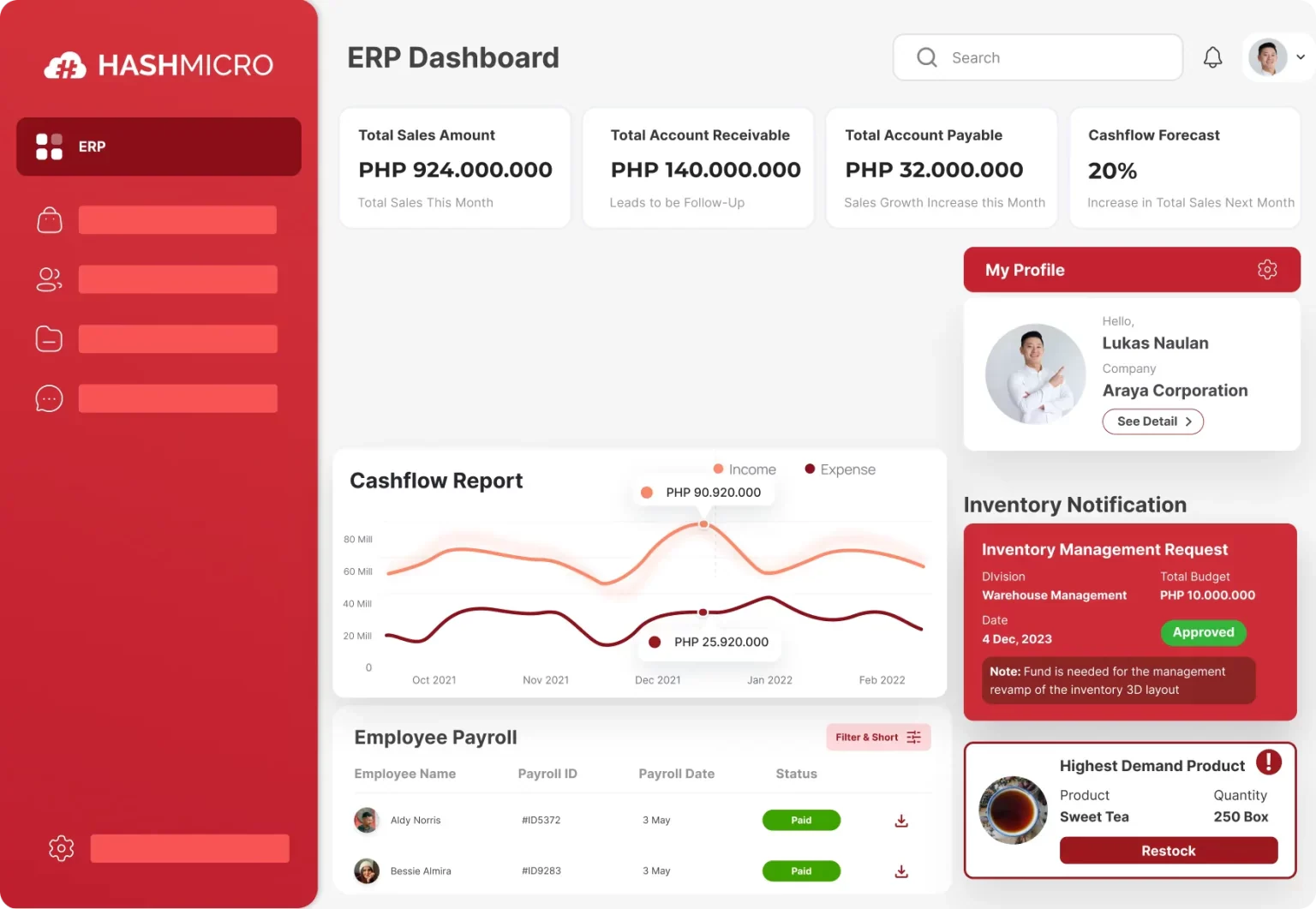
ERP and accounting workflows handle split payment by preserving the parent invoice reference, recording each payment portion, posting the correct accounting entries, managing exceptions, and reconciling settlement data. The goal is not only to accept money, but to keep every movement explainable after the transaction.
At minimum, your workflow should cover these records:
- Original order, invoice, contract, reservation, or sales document
- Customer account and payer details when the payer differs from the buyer
- Payment method, amount, date, gateway reference, bank reference, and cashier or user ID
- Fees, taxes, discounts, clearing accounts, and settlement status where applicable
- Open balance, overpayment, failed payment, reversal, chargeback, or refund status
- Branch, project, department, salesperson, or partner allocation when needed
Once the records above are in place, the split payment workflow comes down to three handling points. The table shows what happens at each and what the accounting or ERP system must do to keep every portion traceable.
| Handling point | What happens | What the system must do |
|---|---|---|
| Checkout capture | POS or gateway records one sale paid by several methods (e.g. cash + card) | Post cash receipts, card settlement receivables, gateway fees, and bank deposits separately where each tied to one invoice |
| Receivables status | Only part of the amount settles; the rest is pending or failed | Keep the invoice open and report by portion: paid, unsettled, failed, or pending |
| Refund handling | A customer who paid from two sources requests a partial or full refund | Link the refund to its original portions and keep the gateway, ledger, customer, and settlement records consistent |
For refunds, the workflow should connect the refund request to the original payment portions. If the customer paid through two sources, your policy should state whether refunds return proportionally, follow the original source, or require approval for exceptions. The gateway record, accounting entry, customer communication, and settlement report should tell the same story.
Conclusion
Split payment can help Philippine companies support mixed payment methods, deposits, shared obligations, high-value transactions, and payout allocation. It becomes risky, however, when each portion cannot be traced back to the original invoice or order.
For finance teams, the safest approach is to define where the split occurs, confirm the payment process from checkout to settlement, and test accounting workflows before launch. Payment gateways can handle authorization and routing, but your ERP or accounting system must handle allocation, posting, refunds, exceptions, and reconciliation.
You can consider schedule consultation to HashMicro's ERP team to assess how your accounting, POS, CRM, and reporting workflows should support split payment before it becomes a recurring month-end problem.

Frequently Asked Questions Around Split Payment
Split payment can raise transaction costs because each payment portion may trigger its own gateway or acquirer fee. A single PHP 120,000 order paid through two methods can generate two separate charges. Finance teams should confirm whether fees apply per transaction or per order before enabling multiple payment sources at checkout.
Each split payment should still map to one sales document, so the BIR official receipt or e-invoice reflects the full invoice amount, not separate fragments. For businesses covered by the BIR EIS e-invoicing mandate, the accounting system must link every payment portion back to the same registered document reference.
VAT is calculated on the total invoice value, not on how the payment is divided. Splitting a PHP 112,000 VAT-inclusive sale across two methods does not change the 12% VAT due or the tax reporting. Each portion should still reconcile to one VATable sales document for accurate BIR filing.
If one portion of a split payment fails, the order is only partially settled, so the balance stays open until it is paid or cancelled. Finance teams should define whether the paid portion is held, refunded, or retried, preventing an invoice from being marked settled while part of the amount is still outstanding.
The refund policy should define whether funds return to the original payment sources, how partial refunds are allocated, and who approves exceptions. The gateway, accounting records, customer communication, and settlement report should reflect the same refund outcome.
Split payment suits businesses of any size when a transaction genuinely needs to be divided and each portion stays traceable to one invoice. A small retailer accepting cash plus GCash benefits as much as a multi-branch enterprise. The deciding factor is reconciliation control, not company size.