




An ERP system price can look affordable until implementation starts and hidden requirements appear. Data migration, integrations, custom workflows, training, support, and internal adoption work can quickly turn a low licence quote into a much larger investment, especially for Philippine businesses managing multiple branches or disconnected systems.
The safest approach is to compare the full cost of ownership, not the subscription alone. This guide explains ERP pricing models, common cost drivers, and the questions to ask before choosing ERP system software.
Key Takeaways
ERP system price is shaped by users, modules, deployment, implementation scope, integrations, support, and future expansion.
Compare one-time costs and recurring costs separately, then calculate a three-year total cost of ownership.
Ask vendors to state what is included, excluded, configurable, customized, and charged separately.
Control cost through clear priorities, prepared data, standard configuration, phased rollout, and accountable project ownership.
Is ERP Worth the Investment?
When teams repeatedly enter the same data, wait for reports, or struggle to reconcile inventory figures, those delays can cost more than they appear. ERP can be worth the investment if it solves these problems at a total cost the business can justify.
The case becomes stronger when finance, sales, and operations rely on separate records but need the same accurate information. A connected system can reduce duplicate work and improve visibility across departments, provided its implementation reflects how the business operates.
For a small team with straightforward processes, a focused accounting, inventory, or POS solution may be enough. If growing branches, approval needs, and integrations call for broader control, use an ERP implementation guide to define the scope before comparing proposals.
What Does ERP System Price Include?
ERP system price usually combines one-time project costs with recurring operating expenses. Because vendors and deployment models package these costs differently, each quotation should explain every component instead of presenting one unexplained total.
Separate the full scope before comparing proposals, including the total cost of ownership, migration, integrations, training, and internal resources. This makes included work, exclusions, responsibilities, and future change costs easier to evaluate.
| Cost component | What to review |
|---|---|
| Software access | Subscription, license, user types, included modules, contract term, and expansion rules. |
| Implementation | Discovery, process mapping, configuration, testing, go-live support, and stabilization. |
| Data migration | Data cleansing, mapping, import templates, validation, and responsibility for legacy records. |
| Integration | Connected systems, API scope, middleware, monitoring, maintenance, and change requests. |
| Customization | What is configurable versus specially developed, including ownership and upgrade impact. |
| Training | Role-based training, training materials, administrator enablement, and refresher sessions. |
| Support and upgrades | Support hours, response targets, release policy, updates, backups, and escalation. |
| Internal resources | Project management, subject-matter experts, testing time, and temporary parallel work. |
ERP Pricing Models in the Philippines
ERP vendors commonly use subscription, perpetual licensing, hosted, or hybrid pricing models. The most suitable option depends on your cash flow, technical resources, desired control, expected growth, and the services included in the quotation.
Subscription or SaaS ERP
A subscription or SaaS ERP spreads software costs through recurring payments based on users, modules, transaction volume, entities, or a combination of these factors. Before signing, review renewal terms, price adjustments, data access, support coverage, and the cost of adding users or modules as your business grows.
Perpetual Licensing
A perpetual licence usually requires a larger upfront software payment, followed by separate maintenance, support, or upgrade costs. It may suit organisations that want greater control over their environment, but the budget should also include infrastructure, security, technical staff, upgrades, and future customisation.
Hosted or Hybrid ERP
Hosted and hybrid ERP models divide responsibilities between the vendor and the customer. Review the ERP deployment options carefully to confirm data hosting, availability monitoring, backups, security, integrations, and upgrade ownership.
A cloud ERP software model can reduce the infrastructure work handled internally, while a hybrid setup may preserve control over selected systems or applications. HashMicro ERP gives Philippine businesses a structured way to connect finance, inventory, purchasing, sales, and operations, helping teams evaluate pricing against the visibility and control they need as the business grows.
What Determines ERP System Cost?
ERP system cost changes when the project must support more users, more business processes, more locations, or more exceptions. The following factors should appear in a vendor discovery discussion and in the final proposal.
Number of users and access levels
User count is only one part of access pricing. Some employees may need full transaction access, while others need approval, reporting, warehouse, POS, or inquiry permissions. Ask how inactive users, temporary users, branches, and external collaborators are treated. Also clarify whether user changes can be made during the contract term.
Modules and process complexity
A business using accounting, purchasing, inventory, sales, CRM, manufacturing, POS, and fixed assets may need a broader scope than a business adopting one module first. Complexity also increases when processes involve multiple branches, approval layers, currencies, warehouses, tax treatments, or special reporting requirements.
Deployment and infrastructure
Cloud deployment may move more infrastructure responsibility to the vendor, while on-premises or hybrid deployment may require customer-managed servers, security, backups, and technical support. Compare the full operating responsibility, not only the initial installation amount.
Data migration
Migration cost depends on the number of records, data quality, source formats, history requirements, and validation effort. Old spreadsheets often contain duplicate customers, inconsistent item names, incomplete balances, or outdated codes. Cleaning those records before migration can reduce project risk and prevent unreliable reports after go-live.
Integrations and customization
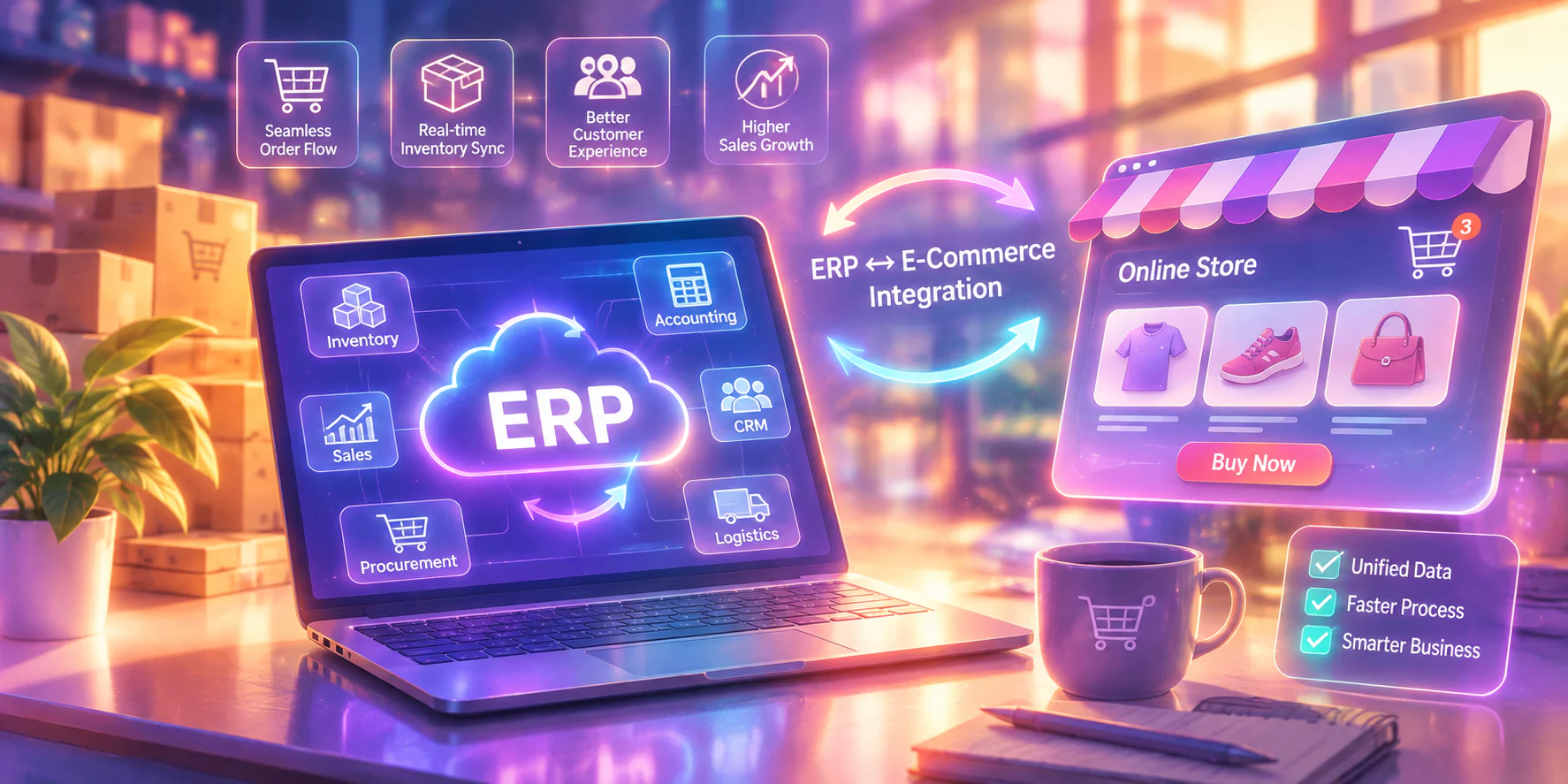
Integrations can connect payment services, e-commerce platforms, payroll, banking, logistics, POS, or other business applications. Customization may address a genuine process requirement, but it can also increase testing, support, and upgrade dependencies. Ask whether the proposed solution can be handled through standard configuration first.
Training, support, and upgrades
Training and post-launch support influence adoption as much as the software itself. Review the number of sessions, role coverage, administrator training, response targets, support hours, upgrade policy, and fees for additional assistance. Employee turnover may also create a need for repeat training.
What Is the Cost of Implementing an ERP System?
A clear ERP implementation guide helps businesses understand what each phase involves before comparing quotations. The final cost depends on your processes, data quality, number of users, integrations, customization needs, and internal readiness.
- Discovery and process mapping: Document current workflows, pain points, approval rules, user roles, and reporting requirements.
- Configuration: Set up standard features, master data, permissions, taxes, warehouses, branches, and agreed workflows.
- Data preparation and migration: Clean, map, import, reconcile, and validate the records transferred to the new system.
- Integration and customization: Connect approved external systems and develop only the changes that standard configuration cannot support.
- Testing and user acceptance: Test regular transactions, exceptions, reports, permissions, integrations, and end-to-end processes.
- Training and go-live: Prepare users, complete cutover activities, support the launch, and resolve early operational issues.
- Stabilization: Monitor adoption, correct defects, refine procedures, and transfer ownership to the internal administrator or support team.
A lower implementation quote may be suitable when processes are standard, data is clean, integrations are limited, and the internal team is ready. Ask the vendor to document all inclusions, exclusions, assumptions, and customer responsibilities before approving the implementation fee.
Cloud ERP Versus On-Premise ERP Cost
Cloud and on-premise ERP systems distribute costs differently. Cloud ERP software may reduce customer-managed infrastructure work, while on-premise ERP can provide greater control over the environment but usually requires more investment in hardware, maintenance, security, and technical staff.
| Comparison area | Cloud ERP | On-premise ERP |
|---|---|---|
| Initial investment | Often distributed across subscription and implementation | May require larger software, hardware, and installation spending |
| Infrastructure | Usually managed by the vendor or hosting provider | Usually managed by the customer or a contracted technical team |
| Maintenance | More responsibility may sit with the provider | Customer manages more of the environment and maintenance plan |
| Scalability | Capacity and users can often be expanded through the agreement | Expansion may require additional infrastructure or technical work |
| Upgrades | Often included or governed by the service policy | Customer may plan and fund upgrade projects separately |
| Internal resources | Focus shifts toward administration, process ownership, and vendor management | Requires stronger infrastructure, security, and application support capability |
Hidden ERP Costs Buyers Should Evaluate
Hidden ERP costs are often not hidden intentionally. They arise when a proposal does not describe future scenarios in enough detail. Add the following questions to the evaluation before approving a budget.
What happens when the business adds users, branches, warehouses, or modules?
Are migration delays or data-cleaning work charged separately?
Who maintains integrations after an external system changes its API or process?
Which requests are configuration, and which become paid customization?
Are refresher training, new-employee training, and administrator support included?
Will the business run old and new systems in parallel during the transition?
Can renewal pricing change, and how much notice is required?
How can the customer export its data if the agreement ends?
How much internal time will managers and subject-matter experts need to contribute?
How to Compare ERP Quotes
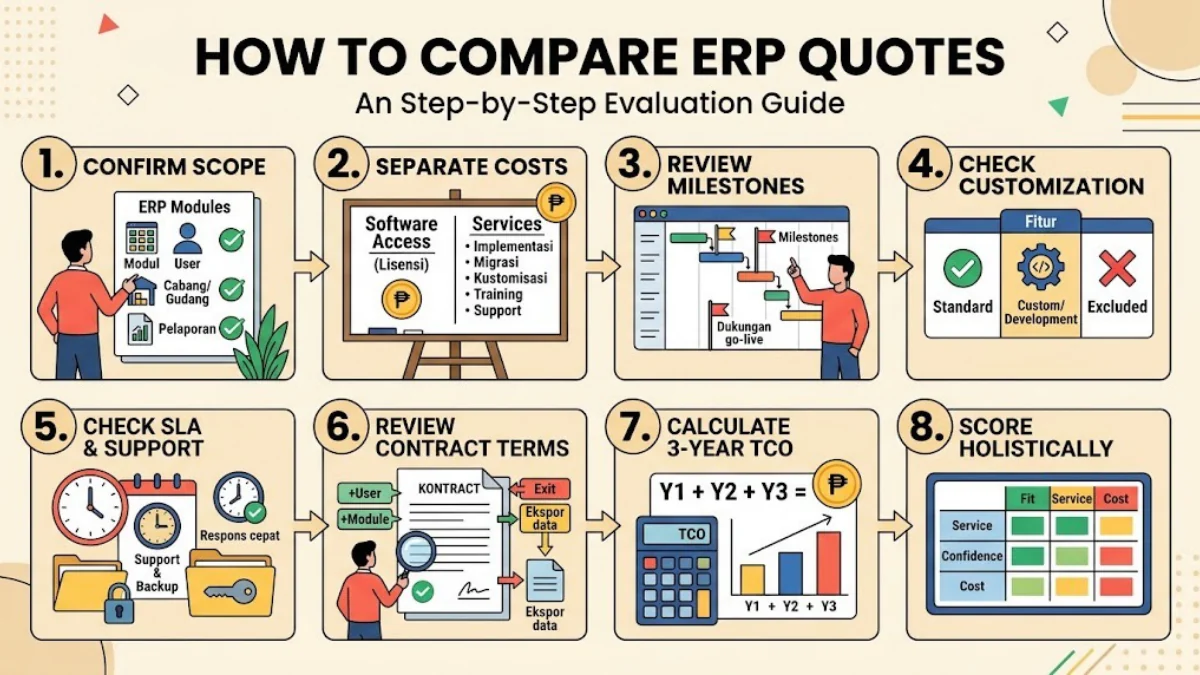
Compare ERP proposals line by line rather than ranking the headline total. A quote comparison should make differences in scope visible. Use the same checklist for every vendor so the decision is based on comparable assumptions.
Confirm the included modules, user types, branches, warehouses, entities, and reporting requirements.
Separate software access from implementation, migration, integration, customization, training, support, and infrastructure.
Ask for implementation deliverables, milestones, customer responsibilities, acceptance criteria, and go-live support coverage.
Identify which features are standard configuration, which require development, and which are excluded.
Review support hours, response targets, escalation paths, upgrade policy, backup policy, and security responsibilities.
Check renewal, additional-user, additional-module, data-export, and termination terms.
Calculate a three-year total cost of ownership using the same assumptions for each proposal.
Score business fit, implementation confidence, service quality, and cost together instead of selecting ERP on price alone.
The most useful question is often, “What would make this estimate increase?” A transparent answer gives the buying team a better view of risk than a low starting figure without assumptions.
How to Manage ERP Costs Without Underscoping the Project
Control ERP costs by removing avoidable work and defining the scope clearly, while retaining the activities needed for adoption. Calculate total cost of ownership (TCO) using both vendor charges and internal business costs. For Year 1, record the quoted software or subscription, implementation, migration, integration and customization, and training costs in PHP.
For Years 2–3, record recurring fees, support and upgrades, additional users or modules, and internal administration costs. Apply the same assumptions and time period to every vendor proposal. Use the figures in each quotation rather than generic market averages, and document what each amount includes.
Ways to Control Cost
Control ERP costs by prioritizing the modules and processes that deliver the most immediate business value. A phased implementation can reduce change pressure, while clean master data and standard configuration help limit avoidable migration and customization work.
Customization should be reserved for requirements with a clear operational or compliance need. Assign decision owners to prevent unresolved change requests, and define success measures for user adoption, data quality, reporting accuracy, processing time, and internal control.
Use the ERP pricing calculator to prepare a more realistic budget based on your actual business requirements.
Conclusion
ERP system price in the Philippines is best evaluated as a complete investment rather than a single license or subscription figure. Users, modules, deployment, implementation, migration, integrations, training, support, expansion, and internal resources all influence the real cost.
The lowest initial quote is not automatically the lowest-cost option. Compare what each proposal includes, what it excludes, who owns each implementation task, how recurring fees can change, and what the three-year TCO looks like. A clear comparison helps the business choose a system that fits its processes without underscoping the work needed for adoption.
The lowest initial quote is not automatically the lowest-cost option. Compare what each proposal includes, what it excludes, who owns each implementation task, how recurring fees can change, and what the three-year TCO looks like. A clear comparison helps the business choose a system that fits its processes without underscoping the work needed for adoption.
FAQ about ERP System Price
There is no single ERP price that applies to every Philippine business. Cost depends on the number of users, selected modules, branches, deployment model, data migration, integrations, customization, training, support, and contract terms. Request an itemized proposal and compare the three-year total cost of ownership instead of relying on one headline figure.
ERP pricing may include software access, modules, implementation, migration, integrations, customization, training, support, upgrades, hosting, backups, or security services. The inclusion varies by vendor and plan. Ask for a written scope that states what is included, excluded, configurable, customized, and charged separately.
ERP system cost is the broader investment in operating the solution, including software access, support, upgrades, infrastructure, and internal administration. Implementation cost covers the project work needed to prepare and launch the system, such as discovery, configuration, migration, testing, training, and go-live support.
Cloud ERP may reduce customer-managed infrastructure and upgrade work, while on-premise ERP may require more upfront hardware, maintenance, security, and technical resources. The better comparison is total cost of ownership over the expected operating period. Review infrastructure, support, upgrades, security, scalability, and internal responsibilities together.
Add licensing or subscription, implementation, migration, integrations and customization, training and change management, infrastructure and security, support and upgrades, and internal resources or productivity costs. Apply the same assumptions to every proposal, then compare Year 1 and Years 2-3 separately to make recurring costs visible.