







HR software pricing in the Philippines rarely stops at the monthly subscription. Setup fees, employee-data migration, payroll configuration for SSS, PhilHealth, Pag-IBIG and BIR withholding, integrations, training, VAT, and headcount changes can all land in the first-year budget, which is why two systems with the same advertised plan can cost very differently once they go live.
That gap is the real problem for HR managers, finance teams, and business owners comparing quotations. The cheapest plan is not automatically the most affordable one if payroll still needs manual adjustments every cutoff or if the system cannot handle your statutory contribution and withholding requirements as your headcount grows.
This guide breaks down the common HRIS pricing models, compares public Philippine pricing examples, shows sample first-year costs for 20, 50, and 100 employees, and gives you a checklist for reviewing vendor quotations before you sign.
Key Takeaways
HR software pricing depends on employee count, billing model, modules, and implementation fees.
Philippine payroll compliance, including SSS, PhilHealth, Pag-IBIG, and BIR reporting, can affect setup costs and required features.
Compare first-year costs, ongoing fees, and scalability before choosing an HR software plan
Is HR Software Worth the Cost?

HR software is worth the cost when manual payroll, attendance, leave, and employee records create recurring admin work or errors. It centralizes employee data, automates payroll calculations, generates payslips, and streamlines approvals and reporting.
Spreadsheets may still work for small businesses with simple payroll needs. However, as headcount, branches, and payroll complexity grow, HR software can reduce administrative work and improve accuracy. Choose a plan that supports your actual workflows to avoid paying for unnecessary features or missing essential ones.
How Much Does HR Software Cost in the Philippines?
How Much Does HR Software Cost in the Philippines?
HR software pricing in the Philippines varies by billing method, employee count, modules, and implementation scope. Public vendor pages show four different approaches: per employee, per user, by employee band, or through a custom quotation.
1. TimeboxHR
TimeboxHR lists plans from ₱3,900 to ₱15,000 per month, depending on the employee band. Prices are VAT-exclusive, and selected bands also carry setup fees.
2. Corebuso Payora
Corebuso Payora advertises ₱149 or ₱249 per employee per month. The plans require a minimum of 10 employees, and the Enterprise plan is marked as coming soon.
3. Better HR General Pricing
Better HR's general Philippines pricing page lists ₱99 per user per month. This is a per-user rate, so it may cover a different scope from the company's payroll-specific plans.
4. Better HR Payroll Pricing
Better HR's payroll page lists ₱120 per employee annually or ₱150 per employee monthly. Because this pricing sits on a separate page, confirm which payroll features, support services, and employee limits are included.
First-Year Cost for 20, 50, and 100 Employees
The scenarios below use public subscription figures and published setup fees. They are comparison examples, not guaranteed quotations.
TimeboxHR (employee bands)
| Employees | Plan used | Annual subscription | Published setup | Illustrative first-year subtotal |
|---|---|---|---|---|
| 20 | Growth | ₱70,800 | ₱0 | ₱70,800 |
| 50 | Business | ₱109,200 | ₱5,000 | ₱114,200 |
| 100 | Enterprise | ₱180,000 | ₱15,000 | ₱195,000 |
TimeboxHR also publishes optional professional services: data migration from ₱5,000, custom configuration at ₱1,500 per hour, custom reports from ₱3,000 each, and additional training at ₱2,500 per session. These are excluded from the subtotals above.
Corebuso Payora (per employee)
| Employees | Plan used | Monthly calculation | Annual subscription |
|---|---|---|---|
| 20 | Starter | 20 × ₱149 | ₱35,760 |
| 50 | Growth | 50 × ₱249 | ₱149,400 |
| 100 | Growth | 100 × ₱249 | ₱298,800 |
Corebuso's public pricing states a 10-employee minimum, and its Growth plan is shown for up to 100 employees. The figures exclude optional services, VAT where applicable, and any mid-term plan changes.
Better HR (published rates)
| Employees | General page at ₱99/user | Payroll page annual at ₱120 | Payroll page monthly at ₱150 |
|---|---|---|---|
| 20 | ₱23,760 | ₱28,800 | ₱36,000 |
| 50 | ₱59,400 | ₱72,000 | ₱90,000 |
| 100 | ₱118,800 | ₱144,000 | ₱180,000 |
Keep these three columns separate. The general pricing page quotes a per-user rate, while the payroll page quotes annual and monthly per-active-employee rates, so blending them into one average would misstate the cost.
None of these calculations include statutory payroll remittances. SSS, PhilHealth, Pag-IBIG, and withholding tax are employer obligations, not software costs. An HRIS can compute and report them, but the remittances themselves sit outside your HRIS total cost of ownership.
What Determines HRIS Pricing?
The cost of an HRIS is shaped by more than the number of employees. The main pricing drivers include:
Employee count and billing unit
Some providers bill every active employee. Others use employee bands, seats, users, or a minimum subscription level. Ask whether the vendor charges for employees who are on leave, inactive, newly hired, or included only for historical records.
Payroll complexity
Payroll for salaried employees with fixed monthly pay is simpler than payroll involving commissions, allowances, overtime, holiday premiums, night differential, multiple cutoff schedules, loans, salary advances, or different payroll groups.
Modules and workflows
Attendance, leave, recruitment, performance management, expense tracking, employee self-service, and payroll may be included in one plan or sold as separate modules. Approval workflows and custom pay components may also be restricted to higher tiers.
Implementation and migration
Implementation may include account setup, employee-data import, historical payroll migration, policy configuration, testing, training, and go-live support. The implementation scope should appear as a separate line in the quotation.
Integrations and reporting
Biometric devices, attendance tools, accounting systems, banking files, ERP platforms, APIs, custom reports, and statutory forms can increase the total cost. A vendor should identify whether each integration is included, optional, or priced after technical assessment.
For a broader view of implementation and ownership costs, link this article to HashMicro's ERP cost guide using natural body copy rather than placing the link in a heading.
What Are the Common HR Software Pricing Models?
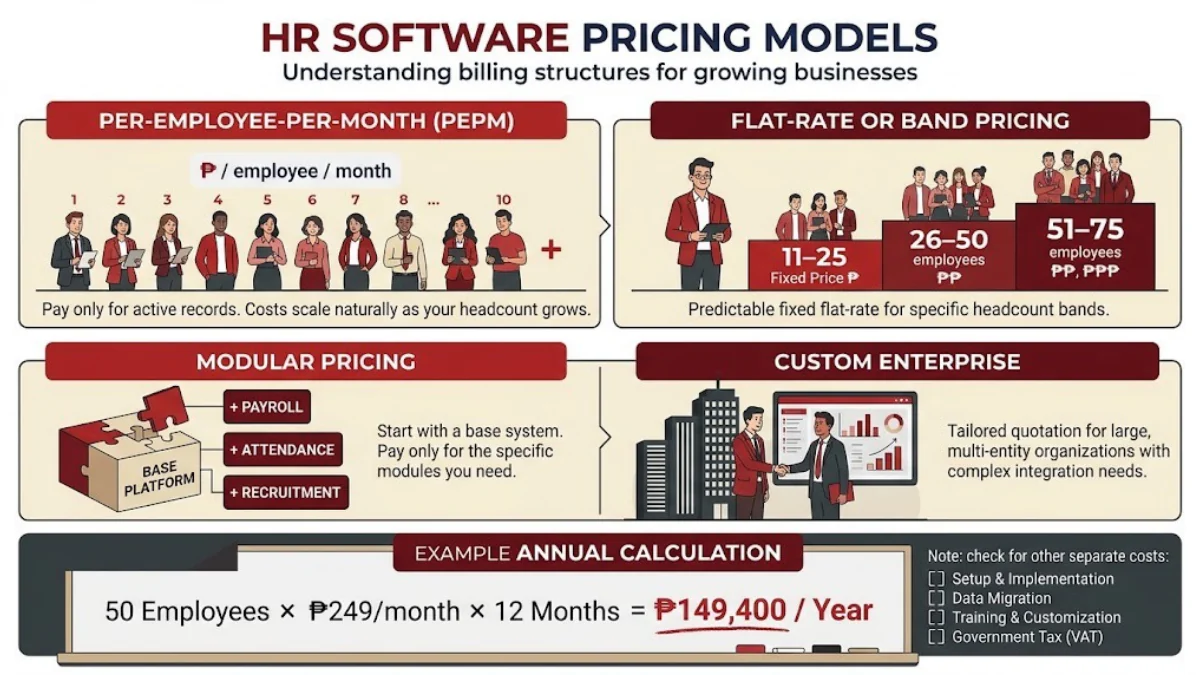
HR software providers use different pricing structures, so the same employee count can produce very different monthly and first-year costs. Understanding the billing model helps Philippine businesses compare plans fairly and identify whether the price will remain practical as the workforce grows.
1. Per-Employee-Per-Month Pricing
This model charges based on the number of employees or active records in the system. It is easy to estimate and suits growing businesses whose costs should increase with headcount, although the monthly bill rises as more employees are added.
2. Flat-Rate or Employee-Band Pricing
The business pays a fixed amount for an employee range, such as 11 to 25 or 51 to 75 employees. This makes budgeting more predictable, but companies near the lower end of a band may pay for unused capacity.
3. Modular Pricing
The business pays a base fee and adds modules such as payroll, attendance, recruitment, performance management, or employee self-service. This can reduce the initial subscription, but the total cost may increase as more HR workflows become necessary.
4. Custom Enterprise Pricing
Large or multi-entity organisations often receive a tailored quotation based on employee volume, implementation scope, integrations, security requirements, support, and reporting needs. Custom pricing is appropriate when standard plans cannot reflect the company’s operating model.
For example, a plan priced at ₱249 per employee per month for 50 employees would cost:
This calculation covers the subscription only. Setup, data migration, integrations, training, custom reports, support upgrades, and VAT may be charged separately, so confirm the complete scope before comparing quotations.
Does Philippine Payroll Compliance Affect HR Software Cost?
Yes. Philippine payroll compliance affects the HR software configuration, testing, reporting, and support your business may need. Before comparing plans, check whether the system supports these requirements:
Government contributions and tax reporting: SSS, PhilHealth, Pag-IBIG, BIR withholding tax, and Form 1601-C reporting. Confirm whether the system produces the required data or reports for your filing process, based on the latest BIR Form 1601-C guidance.
Statutory employee benefits: 13th-month pay, overtime, holiday pay, rest-day pay, and night differential. DOLE 13th-month pay guidance states that the statutory amount is generally one-twelfth of the employee’s basic salary earned during the calendar year.
Payroll structures: Monthly or semi-monthly schedules, multiple payroll groups, branches, legal entities, new hires, resignations, salary changes, and partial-year employment.
Contribution updates and remittance workflows: Verify whether the system can apply current SSS and PhilHealth contribution tables, calculate employee and employer shares, and support the required remittance procedures. Review the relevant SSS employer guidance and PhilHealth employer procedures before implementation.
For a broader comparison, review payroll software options for Philippine businesses alongside your employee count, payroll structure, compliance requirements, and reporting needs. The software subscription is only one part of the budget, so include configuration, migration, training, support, and future payroll changes when estimating total cost.
How Should You Compare HR Software Quotes?

Compare every HR software quotation against the same requirements so differences in pricing, features, implementation, and support are easy to identify.
Define your workforce size: State your current employee count, expected growth, branches, legal entities, contractors, inactive records, archived employees, approvers, administrators, and temporary users. Confirm which records are billable.
List required modules: Separate essential and optional features, such as payroll, attendance, leave, employee self-service, recruitment, performance management, and reporting.
Describe your payroll structure: Include payroll groups, monthly or semi-monthly cutoffs, salary components, overtime, holiday pay, night differential, deductions, and approval workflows.
Separate subscription and implementation fees: Request recurring software costs separately from setup, onboarding, configuration, training, and support fees.
Price data migration clearly: Confirm the cost and responsibility for migrating employee records, historical payroll, opening balances, and related documents.
Confirm integrations and statutory outputs: Ask whether accounting, attendance, payment, and reporting integrations are included, along with SSS, PhilHealth, Pag-IBIG, and BIR outputs.
Review support and training: Check training coverage, support hours, response commitments, escalation procedures, and administrator enablement.
Check commercial terms: Confirm VAT, renewal increases, payment schedules, contract duration, minimum terms, and additional user or module charges.
Protect your data rights: Clarify data ownership, export formats, retention periods, access after termination, and each party’s implementation responsibilities.
Request comparable totals: Ask the provider to show the complete first-year cost and recurring annual cost separately. When reviewing payroll software options for Philippine businesses, use the same specification sheet for every vendor.
Which HR Software Plan Fits Your Business?
There is no single plan that suits every company, because the right choice depends on headcount, payroll complexity, approval layers, and expansion plans. Use the profiles below to identify which features and support level your business actually needs before comparing quotations.
Small Businesses
Prioritise predictable pricing, employee records, attendance, leave, payslips, and basic statutory calculations. A simple per-employee plan or a low employee-band plan is usually enough when payroll rules are straightforward and headcount is stable.
Growing Businesses
Evaluate employee self-service, approval workflows, payroll automation, attendance integrations, reporting, data migration, and support coverage. Check what happens when you cross a plan limit, add a new branch, or introduce additional pay components.
Larger or Multi-Entity Businesses
Assess multi-branch payroll, role-based approvals, audit trails, custom pay components, API access, consolidated reporting, implementation governance, and dedicated support. Custom pricing is often justified at this level because standard plans rarely reflect multiple entities or complex integrations.
For organisations at this stage, HashMicro provides an integrated HR and payroll solution that connects employee data, attendance, payroll, approvals, and reporting across branches and legal entities. Because the scope is defined during consultation, you receive a quotation based on your actual headcount, payroll structure, compliance requirements, and reporting needs rather than a fixed package.
Conclusion
The right HRIS is rarely the cheapest monthly plan. Philippine businesses should compare first-year total cost of ownership, payroll compliance coverage, implementation scope, support, integrations, billing rules, and room to scale as headcount grows.
Start with a clear employee count and payroll scenario, then request itemised quotations using the same specification for every vendor. The strongest option is the platform that handles your actual payroll and HR workflows at a cost you can predict.
If you want help translating your headcount, payroll structure, and compliance requirements into a realistic budget, book a free consultation with HashMicro. Our team can walk through your current HR processes and show you what an integrated HR and payroll system would cover for your business.

Frequently Asked Questions
HRIS pricing is the amount a business pays for human resources information system access and related services. It may be calculated per employee, per user, by employee band, by module, or through a custom enterprise quotation.
Public examples checked on 6 October 2026 ranged from ₱99 per user per month on Better HR's general pricing page, ₱149 per employee per month on Corebuso's Starter plan, and ₱3,900 per month for TimeboxHR's 1-10 employee Starter plan. These figures are not directly comparable and may exclude implementation, VAT, or optional services.
Public Philippine examples include Corebuso at ₱149 or ₱249 per employee per month and Better HR at separately published per-user or per-active-employee rates. The final cost depends on the billing unit, included modules, minimum seats, and additional services.
They may be separate. Some plans include initial setup, while others charge for setup, migration, configuration, custom reports, integrations, or additional training. Request each implementation item as a separate line in the quotation.
Annual billing may reduce the effective monthly rate, while monthly billing provides more flexibility. Compare the total annual commitment, cancellation terms, renewal increases, included support, and whether the business expects to keep the system for at least one year.