







A cash discrepancy in one register may be only ₱500, but recurring cash shortages and cash overages across cashiers, shifts, and branches can weaken financial controls. Differences between POS reports and physical cash also make reconciliation time-consuming and make it difficult for the finance team to identify the cause.
Cash variance in retail is the difference between the amount of cash that should be available in the register and the amount of cash counted physically. This difference may be caused by errors in giving change, unrecorded paid-outs, refunds on the wrong tender, handover gaps, or system configuration, so it does not automatically indicate fraud.
This guide explains the cash variance rate formula, calculation examples in Philippine pesos, the retail cash reconciliation process, a control framework, and the data required for POS and ERP monitoring. Tolerance limits must follow company policy, risk profile, transaction mix, and verified official guidance.
Key Takeaways
Cash variance is the difference between counted cash and expected cash at register, shift, store, or enterprise level.
Standard procedures, approved adjustments, shift reconciliation, exception logs, segregation of duties, and centralized reporting ensure traceable cash control.
Integrated POS and ERP records connect transactions, users, approvals, tenders, reconciliations, deposits, and finance reports while preserving human review.
What Is Cash Variance in Retail and What Does It Measure?
Cash variance in retail is the difference between the cash physically counted and the cash a register should contain at the end of a shift or reporting period.
Expected cash is calculated by adding cash sales to the opening float, then subtracting refunds, approved paid-outs, and deposits. For example, a ₱10,000 float plus ₱45,000 in sales, minus ₱2,000 in refunds and ₱3,000 in deposits, gives an expected balance of ₱50,000. A lower count indicates a shortage, while a higher count indicates an overage. Neither automatically indicates fraud.
Expected cash is calculated by adding cash sales to the opening float, then subtracting refunds, approved paid-outs, and deposits. For example, a ₱10,000 float plus ₱45,000 in sales, minus ₱2,000 in refunds and ₱3,000 in deposits, gives an expected balance of ₱50,000. A lower count indicates a shortage, while a higher count indicates an overage. Neither automatically indicates fraud.
What Causes Cash Variance in Retail Stores? A Seven-Point Diagnostic

Variance alone does not prove misconduct. Investigate the sequence of events and compare transaction, tender, user, approval, and deposit evidence before assigning accountability.
Cashier counting mistakes: The signal may be a one-off difference at shift close with no unusual transaction pattern. Review the cash-count sheet, recount record, and cashier handover first. Provide coaching or a documented recount procedure when the evidence points to counting technique.
Incorrect change: A customer may receive too much or too little change, especially during busy periods. Review the transaction receipt, item total, tender amount, timestamp, and any available till note. Escalate repeated patterns to the supervisor for training and observation.
Unrecorded cash movements: A paid-out, cash transfer, float adjustment, or deposit removal may not have been entered. Compare the movement log, approval record, deposit slip, and count sheet. If documentation is missing, the store manager should record the exception and require a controlled correction.
Voids and refunds: A refund may be posted under the wrong tender, or a void may be completed without the required approval. Review the original transaction, refund or void reason, approving user, timestamp, and customer-support record. Escalate only according to documented policy and fair investigation procedures.
Payment-tender or POS configuration issues: A tender mapping error can make a card or QR payment appear as cash, producing a system-wide pattern rather than a single-cashier issue. Compare tender totals, terminal settlement, POS configuration, and bank or payment-provider records. IT and finance should test the configuration before concluding that a cashier caused the difference.
Weak handover procedures: When two people share a register without a witnessed count, responsibility becomes difficult to establish. Review handover forms, timestamps, user IDs, and opening and closing counts. The store manager should introduce dual counts or controlled user handovers where policy requires them.
Deliberate or unauthorized activity: A repeated, concentrated pattern may justify a control investigation, but the pattern is not proof by itself. Review transaction logs, refunds, voids, access rights, camera or incident records where lawfully available, and approval evidence. Finance, HR, compliance, or internal audit should determine the escalation path under approved procedures.
How Do You Calculate the Cash Variance Rate?
The cash variance rate measures the size of the difference relative to expected cash:
The cash variance rate shows the size of a cash difference relative to the expected balance. Use the absolute variance to compare the size of shortages and overages; keep the signed variance to show which direction the difference went.
The cash variance rate shows the size of a cash difference relative to the expected balance. Use the absolute variance to compare the size of shortages and overages; keep the signed variance to show which direction the difference went.
The cash variance rate shows the size of a cash difference relative to the expected balance. Use the absolute variance to compare the size of shortages and overages; keep the signed variance to show which direction the difference went.
In an illustrative example, expected cash is ₱50,000 and the cashier counts ₱49,500. The signed variance is −₱500, and the cash variance rate is ₱500 ÷ ₱50,000 × 100 = 1%. This result is an example, not an acceptable variance threshold.
Managers should review the peso amount, frequency, trend, and whether differences cluster by cashier, shift, register, store, or payment method. They should also track whether each difference remains open, has been explained, or has been approved, using the same expected-cash calculation across stores and periods.
What Is the Retail Cash Reconciliation Process?
How Does the Retail Cash Reconciliation Process Work?

A reliable retail cash reconciliation process connects POS closing, physical cash counting, supervisor review, and finance reporting. Each step must have a clear owner and supporting evidence.
Close the shift: End the POS session and save the close report, user ID, and timestamp.
Count physical cash: Count all notes, coins, and approved cash equivalents, then record the total.
Retrieve the expected balance: Review the opening float, cash sales, refunds, paid-outs, deposits, transfers, and approved adjustments. Retailers that accept digital payments should also reconcile POS records with payment gateway reports to identify differences between recorded sales and actual settlements.
Record cash movements: Link every deposit, refund, void, paid-out, and transfer to its reason, supporting document, and approval.
Calculate the variance: Compare actual cash counted with expected cash and record both signed and absolute variance.
Document the exception: State the reason for the difference or mark it unresolved when evidence is incomplete.
Complete supervisor review: Verify POS totals, payment methods, approvals, handover records, calculations, and supporting documents.
Post or escalate the result: Post explained differences to the correct finance account and escalate unresolved, repeated, or unsupported variances to the store manager and finance controller.
Retain POS reports, cash-count records, deposit slips, refund and void approvals, exception notes, timestamps, reviewer sign-offs, and final dispositions. Escalate variances that exceed company thresholds, lack approval evidence, repeat across users or transaction types, or conflict with bank and deposit records.
How Should Retail Managers Interpret a Cash Shortage or Overage?
A cash shortage or overage should trigger a review of what happened during the shift, whether the records support an explanation, and whether the issue has occurred before. Use the patterns below to identify the evidence to check and the next action to take.
Single shortage: Recount the cash and check the count sheet, change transactions, and paid-outs. Correct an explained error or coach on the procedure; document the variance if it remains unresolved.
Repeated shortage by one cashier or shift: Compare user IDs, handovers, refunds, and voids across affected shifts. Refer the pattern to the supervisor and store manager for a fair, documented review.
Isolated overage: Check receipts, tender totals, and terminal settlements for an omitted sale or incorrect tender entry. Correct the record and address the process gap.
Offsetting shortages and overages across registers: Compare register IDs, timestamps, shared users, and transfers. Review handovers and strengthen register ownership and dual-count controls.
The cashier should record the count and any explanation; the supervisor should verify the reconciliation; the store manager should review patterns; and the finance controller should ensure consistent reporting. Escalation should follow documented rules for amount, frequency, concentration, transaction type, and approval evidence. A variance pattern alone is not proof of misconduct.
Which Seven Controls Reduce Cash Variance in Retail?
The most useful retail cash controls combine prevention at the register, detection during reconciliation, and corrective action after an exception.
| Control | Risk addressed | Owner | Evidence | Implementation consideration |
|---|---|---|---|---|
| Standardized cash procedures | Inconsistent counting and handover | Store manager | Approved SOP and training record | Keep steps short enough for busy shifts |
| Automatic change calculation | Incorrect change | POS administrator and cashier | Transaction record and configuration test | Confirm rounding and currency settings |
| Approval controls for voids and refunds | Unauthorized or unsupported adjustments | Supervisor | Approval user, reason, timestamp | Define authorized roles and exceptions |
| Shift reconciliation | Differences discovered too late | Cashier and supervisor | Shift report and signed count | Reconcile at every controlled handover |
| Exception logging | Missing context and repeated issues | Supervisor | Case number, reason, status | Use standard reason codes and due dates |
| Segregation of duties | One person controlling entry and review | Store manager and finance | Role matrix and reviewer sign-off | Avoid access combinations that bypass review |
| Centralized reporting | Limited branch and trend visibility | Finance controller | Dashboard extract and review record | Standardize formulas, filters, and access rights |
Preventive controls reduce the chance of an error. Detective controls identify a difference promptly. Corrective actions explain, correct, coach, or escalate the result.
Prioritize a consistent count procedure, controlled approvals, and timely reconciliation before adding complex automation. Software can support these controls, but it cannot replace clear ownership, training, and fair investigation.
What Data Should Retailers Track to Diagnose Cash Variance?
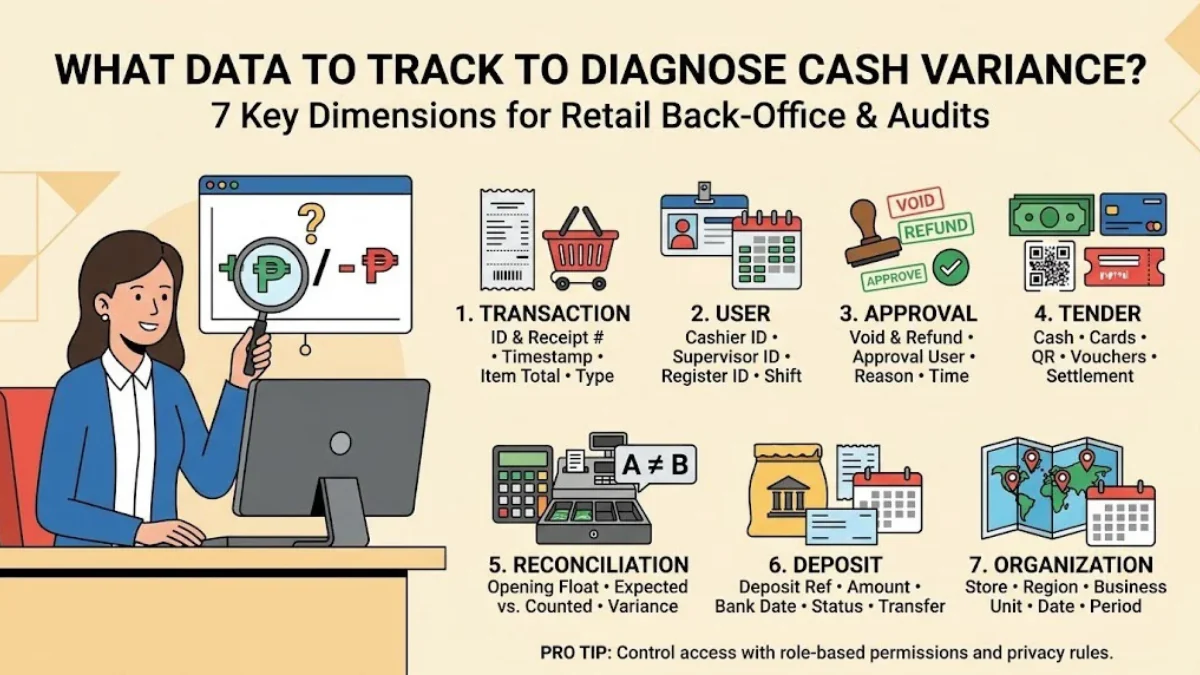
A practical cash variance data dictionary should cover seven dimensions:
- Transaction: transaction ID, receipt number, timestamp, item total, and transaction type.
- User: cashier ID, supervisor ID, register ID, and shift identifier.
- Approval: void or refund status, approval user, reason code, and approval timestamp.
- Tender: cash, card, QR, voucher, mixed tender, terminal reference, and settlement status.
- Reconciliation: opening float, expected cash, counted cash, signed variance, absolute variance, and review status.
- Deposit: deposit reference, deposit amount, bank date, deposit status, and transfer record.
- Organization: store, region, business unit, date, and reporting period.
These fields help managers track variances across cashiers, shifts, and branches while protecting personal data. Collect only essential information and apply appropriate access controls. For connected retail operations, see HashMicro’s retail inventory management guide to align cash exceptions with branch operations and stock movements.
How Can Retail ERP and POS Integration Improve Variance Monitoring?
Retail ERP and POS integration helps managers spot cash variances sooner by bringing shift, payment, and reconciliation records into one view. It can reduce delays caused by manual reporting and inconsistent calculations across branches.
The integration should preserve transaction IDs, timestamps, tender details, adjustment reasons, approvals, reviewer identities, and correction history. Finance teams must be able to trace each posting back to the register and shift that produced it.
Before implementation, check how the system handles offline sales, late settlements, reversed refunds, and failed transfers. Confirm that it applies the approved variance formula, controls access by role, and routes exceptions to the right reviewer.
Automation through a POS system can calculate and flag a variance, but an authorized person must assess the evidence and decide whether to correct, close, or escalate it. If repeated differences are difficult to explain across your Philippine branches, consult HashMicro’s team to review your cash-count, approval, deposit, and reporting workflow.
Conclusion
Cash variance in retail is a signal to investigate, not a verdict based on the amount alone. Compare expected and counted cash, review the shift’s transactions and approvals, and document the cause or escalate an unresolved difference under your store’s policy. Consistent calculations and records help managers identify recurring problems across cashiers, registers, and branches.
When manual reconciliation makes those patterns hard to see, connected POS and ERP records can improve traceability while keeping final decisions with authorized staff. Consult HashMicro’s team to review your cash-count, approval, deposit, and reporting workflow.

Frequently Asked Questions
There is no universal threshold that should be invented for all retailers. Use your approved risk policy, transaction profile, cash-handling procedures, and verified industry or regulatory guidance. Distinguish an escalation threshold from a conclusion that misconduct occurred.
Compare cashier, register, shift, tender, transaction, refund, void, approval, and system-error records. Repeated concentration around one user or shift may require a different review from a system-wide pattern. Variance alone should not assign blame.
Use consistent fields such as expected cash, counted cash, variance amount, variance rate, cashier, shift, register, store, region, tender type, transaction category, exception reason, and review status. Apply consistent formulas and role-based access controls.
Integration becomes more valuable when manual reconciliation creates delayed reporting, inconsistent formulas, missing approval evidence, or limited branch visibility. Evaluate data completeness, auditability, workflow, security, reporting ownership, and implementation fit.