










 Limited to 100 registrants

Artificial intelligence now helps finance teams turn transaction data into reports that are faster to prepare and easier to review. From recording to analysis, AI for financial reporting supports companies in preparing reports for both operational needs and decision-making.
Its adoption is also expanding across various business functions. The Philippine AI Report 2025 by Swarm Technologies found that over 92% of Philippine organizations used AI in some capacity in the past year, with 54% having relied on generative AI tools for more than 12 months for tasks such as data processing and analysis.
Through this article, you will learn how to create financial reports with the help of the best automated financial reporting software, its benefits for companies, and the key considerations to keep analysis results accurate, controlled, and aligned with business needs.
Key Takeaways
AI helps finance teams accelerate data processing, transaction reconciliation, and financial reporting insights.
AI financial reporting runs as one connected workflow from collecting, classifying, checking, and delivering continuously refreshed statements.
The right AI solution needs to integrate with financial systems and support the company’s needs as transactions and operations grow.
What is AI Financial Reporting?
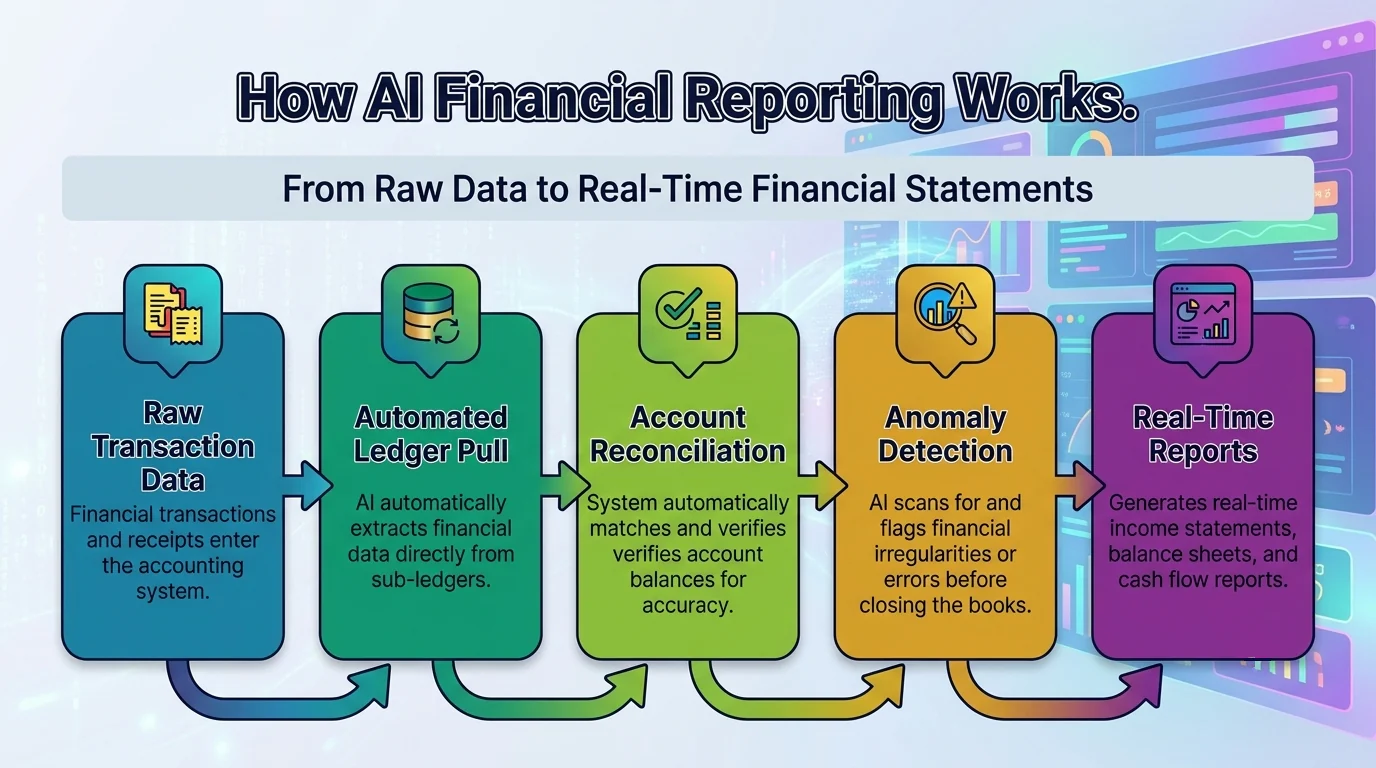
Financial reporting is the process of preparing statements, including the income statement, balance sheet, and cash flow statement, that summarize a company's financial performance over a period. AI financial reporting applies artificial intelligence to that process. It uses financial reporting automation to turn raw transaction data into accurate, real-time reports instead of manually built spreadsheets.
A finance team uses AI financial reporting to pull ledger data automatically, reconcile accounts, and flag anomalies before closing the books. By combining automated financial reporting with tools for automating their accounting processes, teams reduce manual work, speed up month-end close, and make AI in financial reporting a dependable part of daily operations.
The Benefits of Automated Financial Reporting
AI financial reporting gives finance teams practical advantages across preparing, reviewing, and using company financial reports. Through financial reporting automation, it speeds up data processing, reduces recording errors, and sharpens forecasting. The benefits below show how automated financial reporting and AI in financial reporting support faster, more confident decisions.
1. Accelerates financial data processing
AI helps process transaction data from sales, purchases, payments, and operating expenses more efficiently. It can also speed up reconciling transactions across accounts, so finance teams prepare periodic reports faster without spending excessive time on manual recap and consolidation.
2. Reduces the risk of recording errors
AI-powered systems can help flag duplicate transactions, unusual amounts, or account categories that may not be appropriate. Finance teams still need to perform reviews, but potential errors can be detected earlier before reports are used as a basis for decisions.
3. Makes analysis and forecasting easier
Beyond summarizing historical data, AI in financial reporting helps with identifying trends in revenue, expenses, cash flow, and profitability across periods. These insights support companies in preparing budgets, controlling costs, and building more focused financial forecasts.
4. Supports faster business decisions
Faster access to structured financial information makes it easier for management to evaluate business conditions. Companies can respond to performance changes, funding needs, and investment opportunities with a clearer data-driven basis.
5. Strengthens compliance and audit readiness
AI can standardize how transactions are recorded and maintain a clear, traceable audit trail across reporting periods. This helps finance teams keep reports consistent with accounting standards and tax requirements, making internal reviews and external audits smoother and less time-consuming.
AI Financial Reporting Workflow
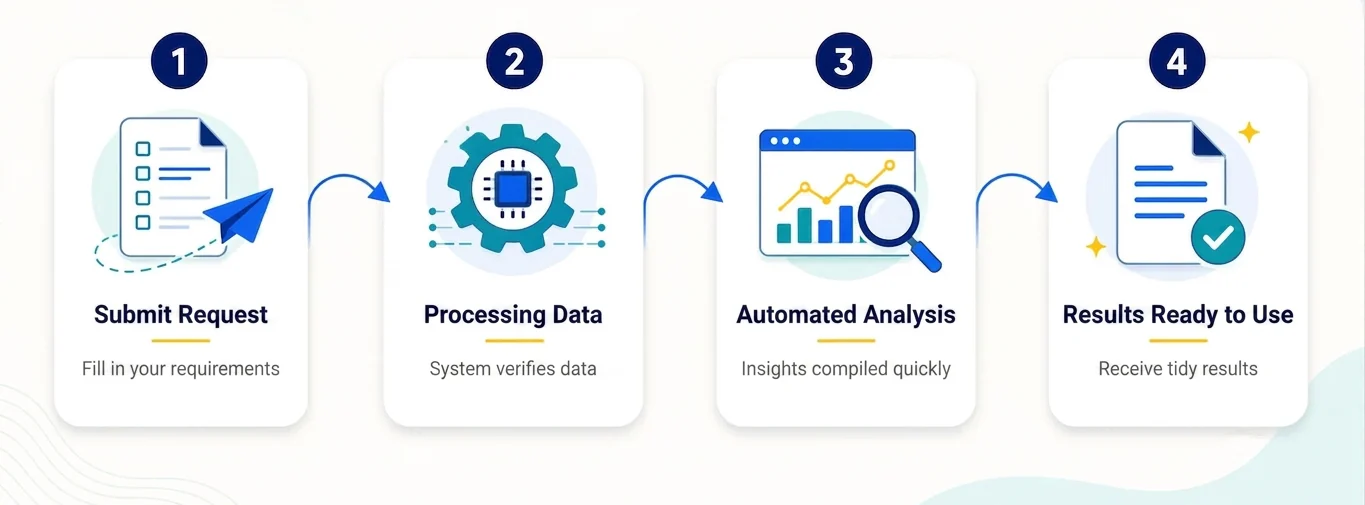
AI financial reporting works as one connected workflow rather than a set of isolated tasks. Through financial reporting automation, it moves data from collection to classification, checks, and finished statements. Automated financial reporting turns raw transactions into accurate, review-ready reports for finance teams.
1. Collecting and integrating transaction data
AI retrieves data from the company's systems, such as the accounting and financial system, to consolidate it into one reporting workflow. With more integrated data, finance teams no longer need to manually gather information from multiple spreadsheets or departments.
2. Automatically classifying data
Based on predefined patterns and rules, AI can help group transactions into the appropriate account categories, such as revenue, operating expenses, receivables, or payables. This process speeds up recording while keeping the data structure consistent.
3. Detecting inconsistencies in data
AI can flag unusual transactions, such as amounts that differ significantly from previous patterns, duplicate data, or incomplete information. Finance teams still need to validate the results, but potential errors can be identified earlier.
4. Presenting financial reports and insights
Once the data is processed, AI helps prepare reports such as profit and loss statements, balance sheets, and cash flow statements based on the required period. AI can also help identify financial trends so management can more easily understand changes in revenue, costs, acid-test ratio, and the company’s cash position.
5. Reviewing and continuously updating reports
Finance teams review the AI-prepared reports before finalizing them, then AI keeps the figures updated as new transactions come in. Instead of rebuilding statements only at period close, teams work from continuously refreshed data. Spotting changes and acting before the books are closed becomes easier.
With HashMicro Accounting Software, your finance team can run the entire AI reporting workflow inside one system. This reduces manual consolidation and recording errors, enabling faster, more confident month-end decisions.

Examples of AI Financial Reporting Applications in Business
Philippine companies across banking and enterprise are already putting AI financial reporting into practice. From financial reporting automation in banking to automated financial reporting across global operations, the examples below show how AI in financial reporting helps finance teams move faster and work with more confidence.
1. UnionBank of the Philippines: AI-Driven Financial Analytics Across Banking Segments
UnionBank is one of the Philippines' most digitally advanced banks. It uses AI to improve how financial data is processed and reviewed. Through automated financial reporting tools, finance teams consolidate performance data across retail, corporate, and digital banking units. Manual data gathering from separate sources is no longer needed at each period close.
This also supports BSP-required regulatory reporting and internal management accounting reviews. Finance teams validate AI-generated outputs before finalizing any reports. Structured, continuously updated data makes regulatory compliance and management briefings easier to prepare.
2. Jollibee Foods Corporation: Consolidating Financial Data Across Global Brands
Jollibee is one of the Philippines' largest food conglomerates. It operates restaurant brands across multiple countries and markets. Applying AI financial reporting practices, the group's finance teams process revenue, cost, and cash flow data more efficiently. Manual spreadsheet compilation across diverse business units is significantly reduced.
This gives management a faster, more consistent view of group performance. Finance teams can also prepare consolidated statements more efficiently for SEC filings and public disclosures. Structured financial data replaces reports rebuilt from scratch each period.
Differences Between Manual Financial Reports and Automated Financial Reporting
Without AI, finance teams generally collect, reconcile, and consolidate transaction data manually from various sources. Meanwhile, with AI in financial reporting, these processes, such as data processing, unusual transaction detection, and faster insight delivery, are automated while still requiring validation by the finance team.
| Aspek | Tanpa AI | Dengan AI |
|---|---|---|
| Pengumpulan data | Data dikumpulkan manual dari spreadsheet, sistem, atau divisi terkait. | Data dari berbagai sumber dapat diintegrasikan dan diolah lebih cepat. |
| Rekonsiliasi transaksi | Pencocokan invoice, pembayaran, dan mutasi bank dilakukan satu per satu. | AI dapat membantu menandai transaksi yang belum sesuai untuk ditinjau. |
| Deteksi kesalahan | Ketidaksesuaian biasanya ditemukan saat review atau penutupan buku. | Transaksi ganda atau nominal tidak wajar dapat terdeteksi lebih awal. |
| Penyusunan insight | Tim finance mengolah angka menjadi ringkasan secara manual. | AI membantu merangkum tren pendapatan, biaya, dan arus kas. |
Risks, Data Security, and Financial AI Governance
AI financial reporting introduces new risks that Philippine finance teams must govern deliberately. Because financial reports hold sensitive data and guide major decisions, companies must keep AI use secure, accurate, and compliant with the Data Privacy Act of 2012 and BIR recordkeeping rules, supported by clear controls and human validation.
AI can speed up financial data processing, but its use must be paired with data safeguards and defined validation steps. In a Philippine setting, that also means aligning with local regulators before AI outputs enter official books:
- Financial data protection: Restrict access to financial data and verify that AI providers comply with the Data Privacy Act of 2012 (RA 10173), with vendor data-residency and processing terms reviewed against NPC requirements.
- AI output validation: Insights or summaries generated by AI must still be reviewed by the finance team before they enter reports or business decisions. This human check keeps AI financial reporting a support tool, not an unverified source of truth.
- Data quality and risk of errors: AI depends entirely on the data it receives. Incomplete, duplicated, or misclassified entries produce less accurate financial reporting, so clean, well-structured source data is a prerequisite, not an afterthought.
- Clear governance: Define who may access data, who validates AI outputs, and who approves decisions. This preserves segregation of duties and ensures AI reinforces finance controls rather than replacing them.
- Regulatory compliance and audit trail: AI-generated records must meet BIR Computerized Accounting System (CAS) standards and retain a complete audit trail. For regulated entities such as banks, BSP oversight also applies; keep every entry traceable and audit-ready.
Criteria for Choosing an AI Solution for Financial Reporting

Choosing the right AI financial reporting solution determines how well a Philippine company can automate financial reporting without losing control. The best fit aligns with your workflows, transaction volume, BIR compliance needs, and validation requirements. So, evaluate integration, security, human oversight, scale, and local regulatory support before committing.
1. Integrates With Financial Systems
Choose a solution that connects with accounting, sales, purchasing, banking, and operational data. Integration reduces repetitive data entry and keeps financial reporting consistent across branches; this is particularly useful for Philippine companies consolidating multiple outlets or regional offices.
2. Provides Adequate Data Security
An AI solution should offer user access controls, data protection, and clear audit trails. This matters because financial reports hold sensitive information, and under the Data Privacy Act of 2012 (RA 10173), that data must be handled and stored responsibly.
3. Supports Validation by the Finance Team
AI should provide recommendations, classifications, or anomaly flags without removing human review. The finance team must still review, correct, and approve every output before reports are finalized. Keep AI financial reporting as a support tool, not an unchecked authority.
4. Fits the Company’s Needs and Scale
Companies with multiple branches, divisions, or high transaction volumes need a solution that processes data at scale. Make sure the system can grow as operations expand across the Philippines.
5. Supports Philippine regulatory and BIR compliance
Confirm the solution can produce BIR-compliant records. Choosing accounting software built for Philippine compliance simplifies this step, especially when the vendor offers local implementation support. A local-based system ensures that the automated financial reporting is audit-ready in a Philippine setting.
Conclusion
AI financial reporting helps companies accelerate data processing, transaction reconciliation, and insight generation. With more integrated processes, finance teams can reduce administrative work and focus more on business analysis.
However, using AI still requires accurate data, protection of financial information, and validation by responsible stakeholders. AI supports decision-making; it does not replace the controls and approvals of the finance team.
To manage financial reports in a more structured way, companies can consider a system that integrates finance data and processes on a single platform. Book a free consultation with the HashMicro team to find the right solution for your business.

FAQ for AI Financial Reporting
Yes. Before implementing an AI financial reporting solution, companies must organise transaction data, standardise account codes, and ensure supporting documents are consistent. Clean, structured data lets the AI classify entries accurately, detect anomalies faster, and generate reliable financial statements without requiring manual corrections at each step.
Implementation timelines for AI financial reporting vary by company size, data volume, and system integrations. Most organisations complete an initial phase in four to twelve weeks, starting with high-repetition tasks like data classification and reconciliation before expanding to full statement generation and real-time reporting.
Not necessarily. Finance teams using an AI financial reporting system need to understand the review workflow, validate AI-generated entries, and apply judgement to flagged anomalies. Technical setup is handled by the vendor, but accounting knowledge remains essential for approving outputs and maintaining report accuracy.
Yes. Most AI financial reporting solutions connect with existing accounting software, ERPs, and banking platforms through APIs. This allows the system to pull transaction data automatically, eliminating manual imports and ensuring the AI always works with real-time, up-to-date financial records across all data sources.
AI financial reporting tools identify errors by cross-referencing transactions against historical patterns, accounting rules, and predefined thresholds. When a figure falls outside expected ranges or contradicts an earlier entry, the system flags it for human review rather than posting it directly to the final report.