






The BIR requires all entities, individuals, and organizations alike to obtain a Certificate of Tax Exemption or a BIR ruling before legally claiming tax-exempt status under the National Internal Revenue Code (NIRC). The government grants these exemptions to bodies that deliver measurable public benefits.
However, a business cannot just easily claim they are non-profit to gain tax exemptions. Securing and maintaining tax-exempt status demands active effort. Organizations must keep detailed records, follow BIR regulations, and meet reporting deadlines throughout the year. Missing these requirements can trigger financial penalties, BIR audits, or the full revocation of exempt status.
This article will explain which entity types the BIR recognizes as tax-exempt, the conditions and documentation each category requires, and the compliance steps organizations must follow to secure and protect their exemption under Philippine tax law, which can be assisted with specialized accounting software.
Key Takeaways
Organizations secure and maintain BIR tax-exempt status by completing legal structuring, BIR registration, local government compliance, and proper accounting architecture.
In the Philippines, tax-exempt status applies to specific entity types recognized under BIR rules.
Properly categorizing funds ensures that donations earmarked for specific purposes are managed separately from general operating funds.
While BIR requirement covers income tax, organizations must individually find applicable local government taxes or permits in each jurisdiction they operate in.
What is Tax Exempt Status?

Tax-exempt status relieves specific entities and transactions from paying certain taxes such as income tax and VAT under Philippine law. Governments grant this designation to qualifying organizations such as non-profits, religious groups, and government bodies. While it provides significant financial relief, it also carries regulatory requirements organizations must meet to maintain their standing.
Tax-exempt organizations in the Philippines redirect funds toward their core activities instead of paying taxes on eligible income and transactions. The BIR grants and administers this status, requiring applicants to document their eligibility and limit operations to approved purposes, including charitable, religious, or educational activities, while meeting their annual BIR tax obligations to remain compliant.
How to Secure and Maintain Tax-Exempt Status
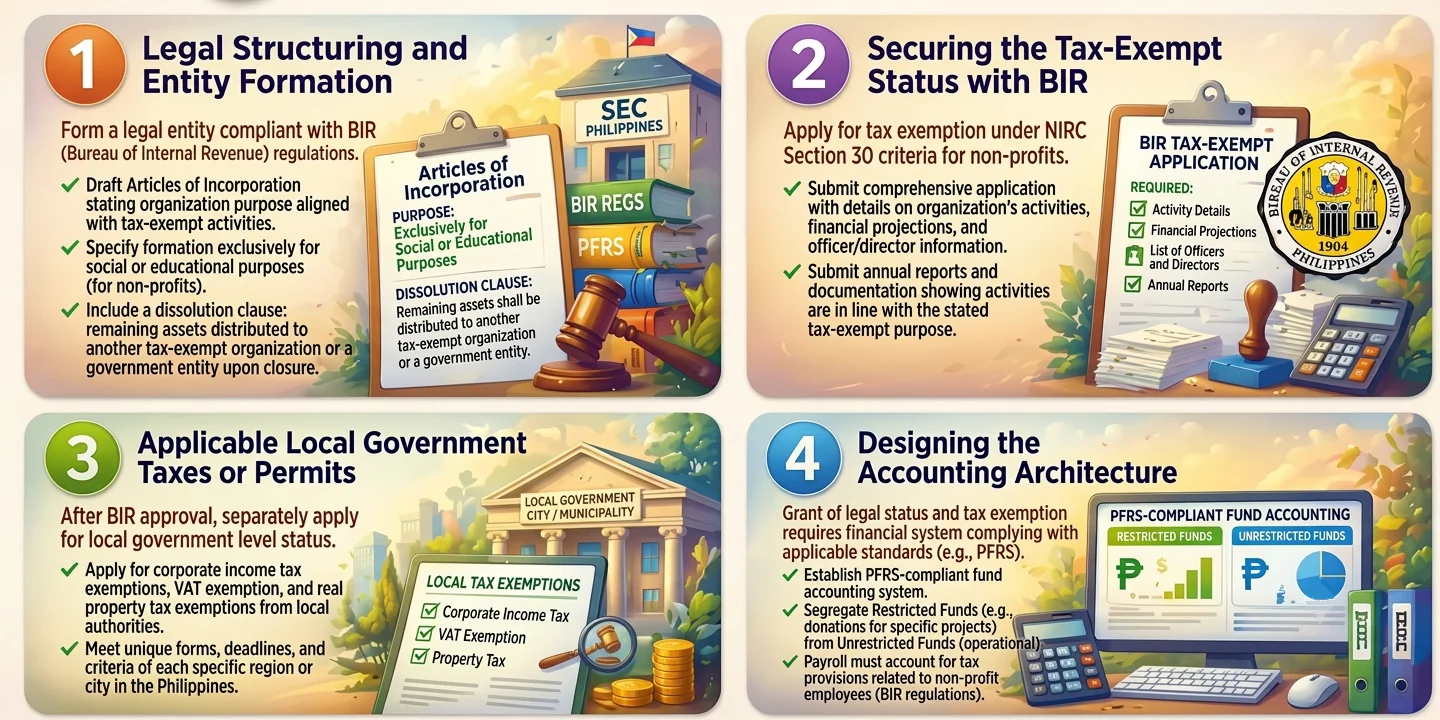
Securing BIR tax-exempt status in the Philippines requires a structured, multi-step approach. Tax accountant and legal professionals must guide organizations through entity formation, BIR registration, and local-level compliance on an ongoing basis. A clear implementation strategy prevents missed filings and protects the organization's long-term financial health.
1. Legal Structuring and Entity Formation
Form a legal entity in compliance with BIR (Bureau of Internal Revenue) regulations to begin the process of securing tax exemption in the Philippines. This starts with drafting the Articles of Incorporation, which must clearly state the organization's purpose aligned with tax-exempt activities.
For example, to qualify as a non-profit organization in the Philippines, the document should specify that the entity is formed exclusively for social or educational purposes. A dissolution clause must also be included, specifying that remaining assets will be distributed to another tax-exempt organization or a government entity upon closure.
2. Securing the Tax-Exempt Status with BIR
The next step is to apply for BIR tax-exempt status. This involves submitting a comprehensive application that includes details about the organization's activities, financial projections, as well as information about officers and directors. The organization is also required to submit annual reports and documentation that show its activities are in line with the stated tax-exempt purpose.
This step is crucial to ensure the entity meets the criteria under the National Internal Revenue Code (NIRC), particularly Section 30, which outlines tax exemptions for non-profit organizations.
3. Applicable local government taxes or permits
After receiving approval from BIR, the organization must separately apply for tax-exempt status at the local government level, if applicable. This includes applying for corporate income tax exemptions, VAT exemption, and real property tax exemptions from local authorities. Each region or city in the Philippines may have its own forms, deadlines, and eligibility criteria that the organization must meet.
4. Designing the Accounting Architecture
Once legal status and tax exemption are granted, the organization must establish a financial system that complies with applicable standards for -profits. In the Philippines, this follows Philippine Financial Reporting Standards (PFRS), which require organizatinonons to segregate restricted funds (e.g., donations for specific projects) from unrestricted operational funds.
The accounting software solution in the Philippines must be capable of segregating restricted funds (donations for specific projects) from unrestricted operational funds. Additionally, the payroll system must account for tax provisions related to non-profit employees, governed by BIR regulations on payroll and income tax.
Types of Tax-Exempt Entities and Organizations
Various organizations in the Philippines may qualify for tax-exempt status, depending on BIR rules and the entity’s legal purpose. Common examples include non-stock, non-profit organizations, religious institutions, educational institutions, and other entities recognized under Philippine tax laws.
| Tax-Exempt Entity | Description | Key Requirements |
|---|---|---|
| Charitable and Philanthropic Organizations | Non-stock, non-profit organizations formed for charitable, scientific, cultural, or public-interest purposes, exempt under Section 30(e) of the NIRC. PCNC-accredited organizations may qualify donors for additional BIR deduction benefits. | Must secure a BIR Certificate of Tax Exemption and file Form 1702-EX annually. Net income must not benefit private individuals. Partisan political activity or substantial lobbying can forfeit the exemption. |
| Educational Institutions | Non-profit schools recognized by DepEd, CHED, or TESDA are fully exempt under the 1987 Constitution and Section 30(h) of the NIRC. Proprietary schools pay a preferential 10% income tax rate under Section 27(B). | Full exemption applies to non-profit institutions only. Unrelated income such as commercial leasing remains taxable. Both non-profit and proprietary schools must maintain BIR registration and file annual compliance returns. |
| Religious Organizations | Philippine religious institutions, including the Catholic Church, Protestant churches, Iglesia ni Cristo, and Islamic organizations, are exempt from income tax under Section 30(e) of the NIRC. | Exemption covers income derived for religious purposes only. Revenue from unrelated commercial activities may be taxable. Organizations must comply with BIR registration and annual reporting requirements. |
| Trade Associations and Chambers of Commerce | Business leagues, industry federations, and chambers of commerce, including PCCI-affiliated bodies, are exempt under Section 30(f) of the NIRC on income from member dues, levies, and assessments. | Exemption covers membership-related income only. Revenue from investments, rentals, or non-member services may be taxable. Member dues are deductible as business expenses but do not qualify as charitable contributions. |
| Government Entities | National government agencies, LGUs, and GOCCs performing governmental functions are generally exempt from income tax under the NIRC. | GOCCs engaged in proprietary or commercial activities may be subject to income tax. Exemption scope varies and must be confirmed against BIR rulings or the entity's enabling charter. |
How Tax-Exempt Status Affects on Financial Planning
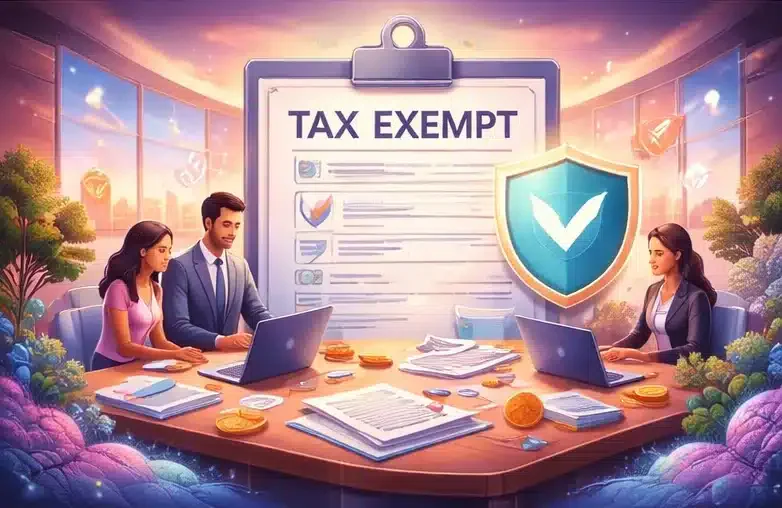
They can reinvest savings from tax exemptions back into their operations, increasing their capacity to serve their mission. However, failing to maintain tax-exempt status due to non-compliance can result in penalties, back taxes, and a loss of credibility. Therefore, continuous compliance with BIR requirements and review from entities preparing formal reports is essential to maintain this status.
1) Structuring the Chart of Accounts
For tax-exempt organizations in the Philippines, the Chart of Accounts (CoA) must be structured to track funds based on donor restrictions rather than just standard revenue and expense categories. Accountants must segregate funds into categories such as:
- Unrestricted Net Assets: Funds that the organization’s board of directors can use at its discretion for any legitimate purpose.
- Temporarily Restricted Net Assets: Funds subject to donor-imposed stipulations that will be met either by actions of the organization or the passage of time.
- Permanently Restricted Net Assets: Funds subject to donor-imposed stipulations that they be maintained permanently by the organization (e.g., endowments).
2) Managing Unrelated Business Income Tax
Even if an organization holds a BIR tax-exempt ruling, it must pay taxes on income generated from a trade or business that is regularly carried on and is not substantially related to the organization's exempt purpose. For example, if a university operates a commercial hotel on its campus that is open to the general public, the revenue from that hotel may be subject to BIR.
Accountants must meticulously allocate expenses between exempt activities and unrelated business activities to accurately calculate the other liability. Clear reporting becomes easier when teams understand the difference between square-footage allocations for facility costs or time-tracking allocations for personnel costs.
3) Financial Statement Presentation
Tax-exempt organizations replace standard corporate reports with three statements. These statements include the Statement of Activities (net asset changes), a Statement of Financial Position (replacing the Balance Sheet), and a Statement of Functional Expenses, which breaks down costs by their functional classification, including program services, management, and fundraising.
Why BIR Can Reject or Question a Tax-Exempt Application
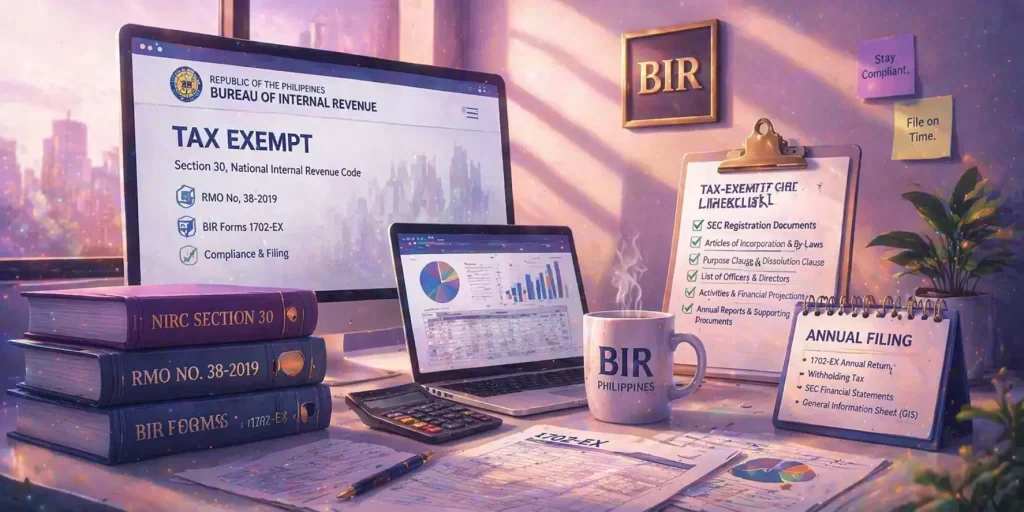
BIR does not look at the label non-profit alone. It checks whether the organization passes both the organizational test and the operational test. Under RMO No. 38-2019, the SEC registration papers, Articles of Incorporation, and by-laws must show that the entity’s primary purposes fall under Section 30 of the NIRC. The entity’s regular activities must also be devoted to those purposes, not to profit-driven operations.
-
Missing or incomplete documents slow the case
BIR uses checklist-based requirements for rulings, including a dedicated checklist for Non-Stock and Non-Profit (Sec. 30) applications. It also validates the accuracy and completeness of documentary requirements during processing. When the file lacks core papers such as SEC registration documents, by-laws, activity details, or financial support, the application can stall before substantive review even starts.
-
Weak purpose clauses can fail the organizational test
A vague purpose clause creates risk immediately. BIR requires the constitutive documents to show that the corporation was organized for a Section 30 purpose, and the dissolution clause must direct remaining assets to one or more entities with similar exempt purposes or to the Philippine government for public purpose. If the papers do not say that clearly, the application becomes vulnerable to rejection or reworking.
-
Mixed-profit activity can break the operational test
BIR can question an application when a substantial part of the organization’s operations involves profit-driven activities. Section 30 entities remain exempt only on income earned in furtherance of their exempt purpose. Income from investments, rentals, or other commercial activities may still be taxable. For applicable taxable receipts, organizations should retain BIR Form 2307 certificates as proof of creditable tax withheld.
-
Documentation gaps raise private-benefit questions
BIR also checks whether earnings or assets benefit insiders. RMO No. 38-2019 lists red flags such as compensation or honoraria to trustees or organizers, unreasonable employee compensation, welfare or financial assistance to members, donations to unrelated parties, and purchases above fair market value from related parties.
When an organization cannot support salaries, grants, purchases, and fund use with clear records, board approvals, and source documents, BIR has reason to question whether the entity is truly operating on a non-profit basis.
Compliance and Reporting Requirements For Philippines Business

Tax-exempt organizations in the Philippines must do more than obtain BIR recognition. They must preserve their eligibility through accurate filings, transparent records, and compliance with the NIRC and applicable LGU rules. These BIR tax-exempt requirements help regulators confirm that each organization continues operating within its approved purpose and exemption scope.
-
The Initial Application Process
Organizations seeking tax exemption in the Philippines must submit the prescribed application and supporting documents to the BIR. These documents establish their legal structure, governance, activities, revenue sources, and financial position. Their Articles of Incorporation must restrict operations to qualified purposes, prevent private benefit, and permanently dedicate assets to tax-exempt purposes.
-
Annual Informational Returns
Tax-exempt status does not eliminate annual BIR filing duties. Eligible entities with no other taxable income generally file BIR Form 1702-EX by the fifteenth day of the fourth month following the taxable year. They should retain financial statements, receipts, books, and governance records supporting exempt activities and any taxable income.
-
Local Compliance
A BIR tax-exempt certificate does not automatically settle every local obligation. Organizations must review LGU requirements for permits, local business taxes, and real property tax treatment. Under the Local Government Code, real property exemptions depend on statutory conditions such as actual, direct, and exclusive use, making centralized compliance tracking essential. Philippine Supreme Court discussion of Local Government Code exemptions
What Tax-Exempt Entities Still Need to File in the Philippines
Tax-exempt entities in the Philippines must continue filing required BIR and SEC reports, monitoring certificate validity, and preserving records after approval. These obligations help regulators confirm that each organization still satisfies its exempt purpose. Proper compliance protects BIR tax-exempt status and prevents penalties, assessments, or revocation.
1. Annual BIR return and withholding reports
Section 30 entities with no other taxable income generally file BIR Form 1702-EX and the required financial statements. Their tax exemption does not remove withholding duties. When they make covered payments, they must withhold and remit the tax and submit the applicable BIR returns or information reports.
2. SEC filings continue after BIR approval
BIR approval does not end a non-stock corporation’s SEC obligations. The SEC generally requires AFS within 120 calendar days after fiscal year-end and GIS within 30 calendar days of the annual members’ meeting. Depending on its classification and annual contributions, the corporation may also need applicable NSPO schedules or supporting attachments.
3. CTE validity must still be monitored
For Section 30 entities covered by RMO No. 38-2019, a Certificate of Tax Exemption generally remains valid for three years and may be revalidated. Material changes in character, purpose, or operations can revoke it. Because the order does not cover every exempt category, organizations should identify their governing BIR issuance before scheduling renewal.
4. Books and proof must stay audit-ready
RR No. 7-2024 requires taxpayers to preserve books and supporting records for five years from the prescribed starting date. Tax-exempt organizations should keep financial statements, ledgers, invoices, payroll files, donor restrictions, grant agreements, and board resolutions accessible. They must retain relevant records longer when a protest, refund claim, or related case remains unresolved.
Conclusion
Tax-exempt status provides organizations with significant financial advantages, but it also comes with a complex array of responsibilities. Organizations must navigate legal structuring, secure national and provincial exemptions, and adhere to rigorous compliance and reporting standards. This continuous process of maintaining tax-exempt status requires diligence, proper governance, and consistent communication with regulatory authorities.
To explore more about managing financial operations and compliance, check out the free consultation for HashMicro’s Accounting Software Solutions to streamline your business’s tax and financial management processes.
FAQ for Tax Exempt Status
Under Section 30 of the NIRC, entities that qualify for BIR tax-exempt status in the Philippines include non-stock non-profit corporations, educational institutions recognized by DepEd or CHED, religious organizations, trade associations, and government bodies. Each category carries specific eligibility conditions and must secure a Certificate of Tax Exemption from the BIR.
Not all purchases qualify. In the Philippines, VAT exemption applies only to specific transactions covered by BIR rulings or the NIRC, not to every purchase a tax-exempt organization makes. Items or services unrelated to the organization's exempt purpose may still incur VAT. Each transaction should be assessed against applicable BIR guidelines.
Under RMO No. 38-2019, applicants must submit a formal application to the BIR together with SEC registration documents, Articles of Incorporation, by-laws, a description of activities, and audited financial statements. The BIR then evaluates whether the organization satisfies both the organizational and operational tests under Section 30 of the NIRC before issuing a ruling.
A business should consider BIR tax-exempt status when it restructures as a non-stock, non-profit entity with a qualifying public purpose under Section 30 of the NIRC, such as charitable, educational, or religious activities. The transition requires updated constitutional documents, BIR registration, and ongoing compliance with annual filing and strict operational restrictions.
Tax-exempt organizations in the Philippines must file BIR Form 1702-EX annually with audited financial statements, even when no income tax is owed. They must also meet SEC reportorial deadlines, comply with LGU obligations, and monitor their Certificate of Tax Exemption, which must be revalidated every three years under RMO No. 38-2019.