







Finance automation software should reduce repeated work while preserving approvals, transaction history and clear ownership of exceptions. Evaluate it using invoice corrections, reconciliations and reporting handoffs that your team completes today. This guide gives Philippine finance managers practical comparison criteria, PHP examples and questions for a realistic buying decision.
The sections below explain the workflow, evaluation criteria and practical next steps.
What is Finance Automation Software?
Finance automation software reduces repeated handling across invoices, payments, journals and financial reporting. Useful controls preserve the connection between each transaction and its supporting records. People still own approvals, exceptions and accounting policy decisions. For the related workflow, see Transaction Reconciliation: The Definitive Guide for Modern Finance (2026).
For example, a PHP 60,000 bill may move through receiving, finance review and payment. Automation should make that handoff easier to trace. It should also make duplicate references and unresolved differences visible.
Start with the Finance Workflow That Needs Fixing
Start with the bottleneck that is costing your team time or control. Repeated data entry and slow invoice corrections create measurable problems. Disconnected reports and unclear exception ownership provide further evaluation priorities.
List the finance work you want to automate. Transaction capture, accounts receivable, accounts payable, general ledger work, reporting, or related operational handoffs. For each activity, identify records, rules, approvals and integrations. Specify the review responsibilities your team must retain.
Evaluate the complete workflow rather than an isolated feature. Ask whether a fast invoice entry screen is backed by a correction process that preserves the original transaction. Check how a report generator handles employee or supplier data, and who reconciles a failed transfer after an approval.
Write the current process from source record to approved report. Map sales orders through to invoices and supplier bills against receipts. Include payroll posting and the assignment of exceptions.
Build your shortlist around five questions:
- Does the system support the workflow that is actually failing?
- Can it enforce approvals, permissions, and period controls?
- Can it exchange data with the systems already used by your teams?
- Can it produce the Philippine reports and exports you need, with clear ownership?
- Can your organisation implement, reconcile, and maintain it at an acceptable cost?
Use a PHP 60,000 supplier bill to map repeated entry and review delays. Record the current processing time before estimating any automation benefit. For the related workflow, see AI Invoice Processing: Transforming Financial Operations with Automation.
Turn Your Requirements into a Practical Evaluation Scorecard
A scorecard makes vendor answers comparable. Ask each provider to identify whether a requirement is native functionality, configuration, a workaround, customization, or a separately priced integration.
| Requirement | Business risk | Evidence to request | Acceptance test |
|---|---|---|---|
| Transaction processing | Manual entry creates delays and inconsistent records. | Recorded workflow, sample posting, audit history. | Process anonymised sales and purchase records and reconcile the resulting entries. |
| Approval controls | Unauthorised changes or payments can pass without review. | Role matrix, approval rules, escalation behaviour. | Submit a transaction above an approval threshold and confirm the required reviewer path. |
| Exception handling | Errors remain unresolved or are corrected without traceability. | Correction, reversal, credit-note, and reopen controls. | Run a wrong-amount scenario and inspect the complete history. |
| Reporting | Teams maintain conflicting spreadsheets or miss reporting deadlines. | Sample reports, filters, period controls, export files. | Produce the buyer’s required management and Philippine outputs from test data. |
| Access permissions | Users see or change records beyond their responsibility. | Permission model, segregation examples, change log. | Test a preparer, approver, and reviewer account separately. |
| Data exports | Migration, audit, or downstream reporting becomes difficult. | Export schema, file examples, documentation. | Export transactions and confirm that key fields, identifiers, and status values are usable. |
| Implementation support | Configuration gaps delay adoption and weaken controls. | Implementation plan, training scope, support response process. | Ask the implementation team to explain ownership for data preparation, testing, and sign-off. |
| Philippine reporting | Reports may be incomplete, assigned to the wrong team, or unusable for filing preparation. | Exact forms, output formats, module ownership, and filing handoffs. | Run the required reports and inspect every output with your tax and payroll owners. |
Evaluate regulatory coverage separately from routine automation. Require specific evidence for any accreditation or direct-submission claim. List what the system generates and exports. Identify user reviews and steps completed outside the system.
Ask for a scope document that separates standard functions, configuration, workarounds, custom development, one-time fees, and recurring fees. Use that document to compare the quoted price with the work needed to make your workflow usable.
Include a PHP 2,000 invoice difference in the scorecard. Define the expected reviewer, correction record and final payable before testing the system.
Test Corrections and Currency Exceptions Before Routine Transactions
Use difficult scenarios before approving routine demonstrations. Require preserved transaction history and an approved correction path. Make period controls and approval rules visible during the test.
| Scenario | Expected control | Evidence to inspect | Pass or fail criteria |
|---|---|---|---|
| Invoice amount error before reporting, outside a closed period | Demonstrate cancellation, reset to draft, correction, and confirmation. | Original status, correction history, approval record. | Pass if the corrected invoice retains a traceable history and follows the configured approval route. |
| Invoice amount error after reporting | Demonstrate a credit note and replacement invoice. | Link between original invoice, credit note, and replacement. | Pass if the receivable and reporting trail reconcile without editing away the original. |
| Difference-only correction | Demonstrate an adjusting entry as a documented workaround. | Journal entry, explanation, account impact. | Pass if the entry is authorised and the resulting balances reconcile. |
| Closed period | Require an authorised user to reopen the period before changing the transaction. | Period status, authorisation, audit log. | Pass if unauthorised users cannot bypass the restriction. |
| Partially settled foreign-currency invoice | Revalue only the remaining open balance at period end. | Invoice balance, revaluation date, journal, unrealised accounts. | Pass if the settled portion is excluded and the open portion is visible. |
| Final settlement at a different rate | Demonstrate the realised exchange difference on settlement. | Payment rate and exchange-difference journal. | Pass if the settlement result reconciles with the payment and prior revaluation entries. |
Choose an anonymised invoice with an amount error from your own records. Test the correction route appropriate for the invoice status. Compare cancellation, credit notes, replacement invoices and adjusting entries. Have your finance team approve the treatment before accepting the scenario.
For foreign-currency receivables, use the accounting note’s example. A USD 1,000 invoice with USD 700 settled leaves USD 300 open. Ask the vendor to display the original invoice, applied payment, and remaining balance before running revaluation. Check that the demonstration excludes the settled portion from the revaluation calculation.
Use exchange rates approved by your finance team for the test date. Recalculate the remaining receivable independently and compare the proposed journal. Inspect the selected unrealised gain or loss accounts. Retain the calculation and journal together as acceptance evidence, with any tax treatment reviewed separately.
Keep period-end unrealised differences and settlement differences separately identifiable in your evaluation. Finance should approve the account configuration and treatment of earlier revaluations. Align report presentation with company accounting policies.
Convert the outstanding foreign balance into PHP using your selected test rate. Compare that amount with the ledger before assessing the proposed revaluation journal.
Check Integrations at Each Financial Handoff
Map only the connections your business needs. A distributor may need purchasing, inventory, sales and accounting handoffs. A services firm may prioritise billing, payroll and the general ledger.
Document each handoff and its field mapping, frequency and owner. Add duplicate prevention, failed-transfer handling and reconciliation. Ask the vendor to demonstrate what happens when a required field is missing or a transfer is interrupted.
- Source records: identify which system creates the customer, supplier, employee, invoice, bill, payment, or journal.
- Field mapping: list identifiers, dates, amounts, tax fields, cost centres, and status values.
- Synchronisation: define whether the transfer is real-time, scheduled, or manual.
- Ownership: assign responsibility for master data, failed transfers, and reconciliation.
- Duplicate prevention: test repeated imports and retried messages.
- Failure handling: inspect error queues, alerts, retry controls, and escalation.
- Reconciliation: compare source totals, destination totals, and unresolved items.
Ask how HR and Accounting reporting responsibilities connect without requiring duplicate maintenance of employee, supplier, or tax data. Assign owners for payroll outputs and accounting reports before selecting the test files. Require the vendor to trace their source records and show who maintains each shared field.
Require evidence for every proposed bank connection, API, import format, and export. Request the interface name, supported version, sample transfer, access requirements, maintenance owner, and price. Include a failed transfer and reconciliation exercise in the acceptance test for each connection your business needs. For the related workflow, see What Is Account Reconciliation? A Guide for Filipino Business Owners.
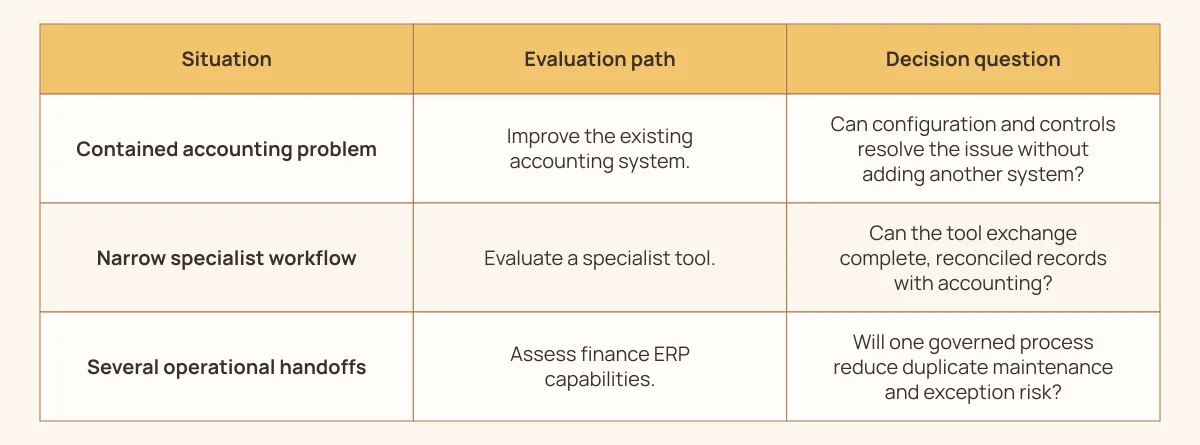
| Situation | Evaluation path | Decision question |
|---|---|---|
| Contained accounting problem | Improve the existing accounting system. | Can configuration and controls resolve the issue without adding another system? |
| Narrow specialist workflow | Evaluate a specialist tool. | Can the tool exchange complete, reconciled records with accounting? |
| Several operational handoffs | Assess finance ERP capabilities. | Will one governed process reduce duplicate maintenance and exception risk? |
When comparing options, review accounting software for Philippine businesses alongside the broader workflow requirements. If several operational handoffs need coordination, also review integrated finance ERP capabilities.
Trace a PHP 60,000 bill through receipt, accounting and payment. Require each team to identify the source reference and explain any remaining difference.
Measure Value with a Baseline and Realistic Costs
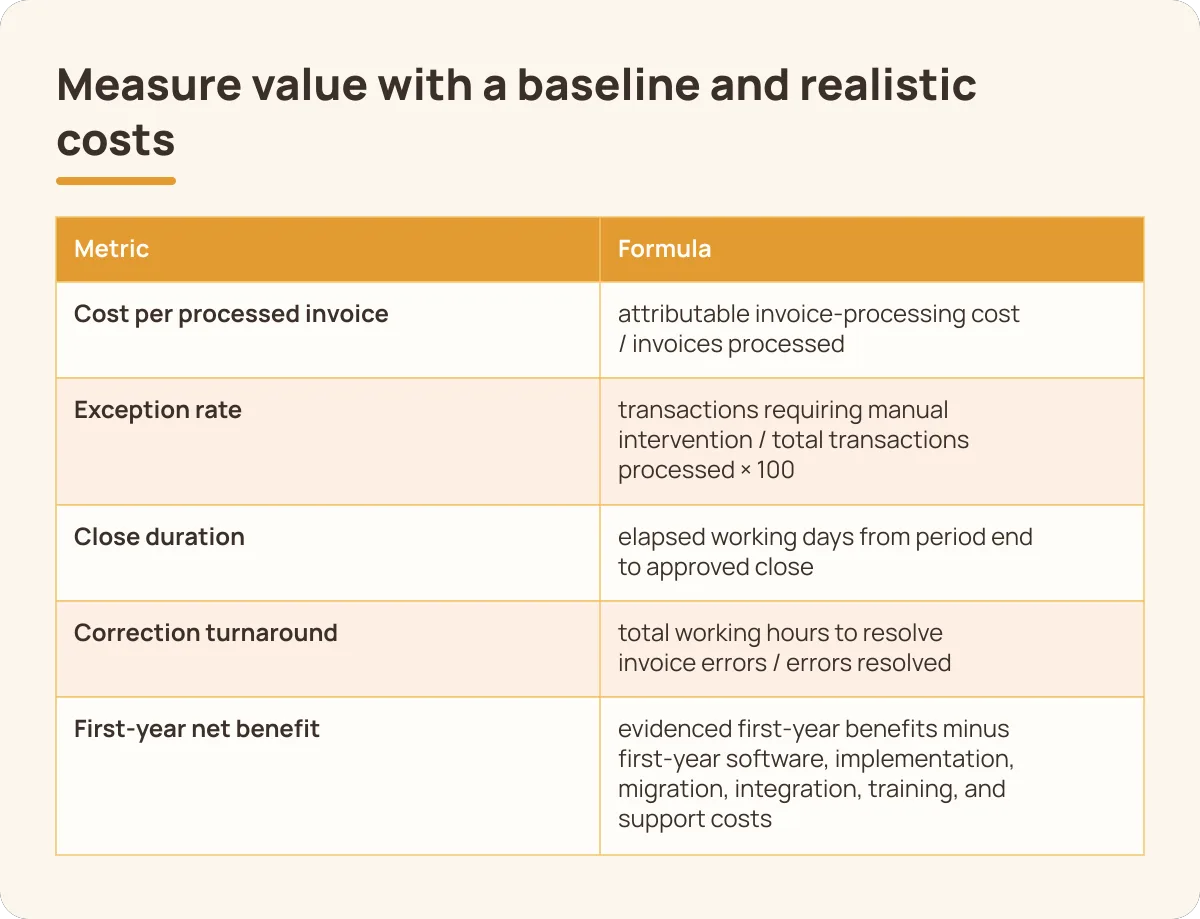
Set a baseline before asking for a business case. Record the current effort, error volume, close duration, and correction workload from operational data. Then agree how often each metric will be measured after implementation.
| Metric | Formula | Baseline source | Measurement frequency |
|---|---|---|---|
| Cost per processed invoice | attributable invoice-processing cost / invoices processed | Time records, payroll cost, process volume, and allocated overhead. | Monthly or quarterly. |
| Exception rate | transactions requiring manual intervention / total transactions processed × 100 | Exception log and transaction register. | Weekly during rollout, then monthly. |
| Close duration | elapsed working days from period end to approved close | Close calendar and approval timestamps. | Each close. |
| Correction turnaround | total working hours to resolve invoice errors / errors resolved | Case log and user time records. | Monthly. |
| First-year net benefit | evidenced first-year benefits minus first-year software, implementation, migration, integration, training, and support costs | Approved business case and actual invoices. | At business-case review and year end. |
Build the staff-capacity calculation from your own time records and an approved hourly cost. Ask the process owner to identify which tasks would take fewer hours and how those hours would be used. Record released capacity separately from cash savings. Support any claimed cash saving with evidence of lower expenditure.
Include implementation, migration, integration, training, support, data cleanup, and internal project time in the first-year cost. Ask vendors to state assumptions behind every estimate and identify recurring charges separately from one-time work.
Do not use promised return-on-investment percentages, guaranteed close-time reductions, or unsupported industry benchmarks. Tie each proposed benefit to a baseline, a measurement owner, and evidence that can be reviewed after go-live.
Assume PHP 20,000 of monthly staff capacity could be released. Compare that estimate with recurring costs and document whether spending actually falls.
Evaluate HashMicro Accounting with Your Own Transactions
HashMicro Accounting covers receivables, payables, journals and bank reconciliation. Its financial workflows include foreign-currency revaluation and period controls. Related operational modules post transactions into the accounting ledger. For the related workflow, see 10 Best AI Accounting Software and Tools in 2026.
Take a PHP 60,000 supplier bill and follow it through review and payment. Inspect the accounting entries and reconcile the remaining payable after partial settlement. Then test a correction using the permissions assigned to each role.
Agree the required Philippine outputs separately in the implementation scope. Distinguish generated reports from exports and statutory filing. Assign a finance reviewer to reconcile each output before submission.
Prepare a Shortlist and a Demo Acceptance Checklist
Prepare the evidence before inviting vendors. Give each vendor the same anonymised sample and require the same pass-or-fail record so that selection remains comparable.
- Anonymised sales and purchase invoices, including one amount-correction scenario.
- An open foreign-currency receivable and a partial-settlement example, if relevant.
- The Philippine reports and exports your finance, payroll, and tax teams require.
- Transaction volumes, approval roles, period controls, and exception categories.
- An integration inventory covering sales, purchasing, inventory, payroll, accounting, banks, and reporting.
- Data ownership, migration constraints, training needs, and support expectations.
Assign owners for data preparation, accounting sign-off, access-control testing, reporting verification, integration reconciliation, and user training. Require unresolved gaps to have an owner, a due date, and a stated workaround or commercial impact.
Ask the vendor to provide a written scope that distinguishes standard functions, configuration, workarounds, customization, implementation tasks, and recurring fees. Record every acceptance result against the same scenario and keep the evidence with the purchase decision.
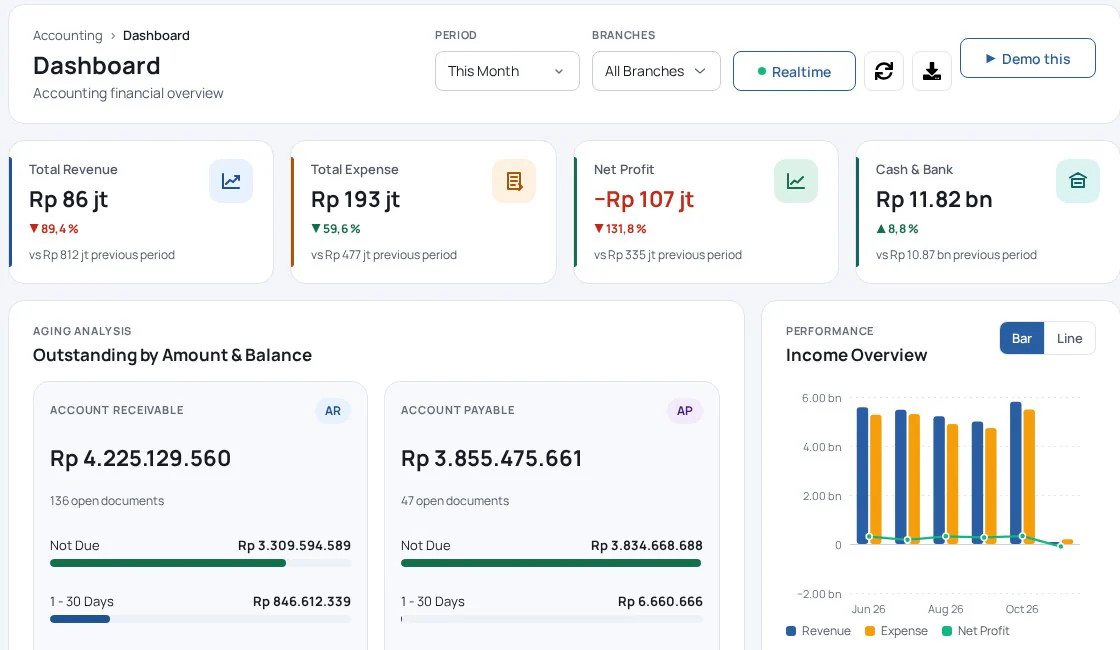
Request a HashMicro demo using your own workflow scenarios and Philippine reporting checklist. Test invoice corrections, foreign-currency revaluation and report ownership. Inspect the exact exports your team must review before submission.
By emmanuel-ramirez.
Add a PHP 2,000 correction to the final acceptance checklist. Require a complete transaction trail and an explanation of the resulting account balances.
Philippine Tax, Labour and Privacy Controls
Use the BIR rules applicable to your transactions and registration. Keep invoice numbers, tax classifications and correction references alongside each posting. A software demonstration alone does not establish BIR accreditation.
For a PHP 100,000 purchase, distinguish the base amount from taxes and settlement. Have finance select the applicable treatment before testing the posting. Do not reuse a tax assumption from an unrelated transaction.
Labour records should follow applicable DOLE requirements and company approvals. Separate approved hours from the value allocated to a production order. This distinction helps explain differences between payroll and applied labour.
Protect employee and supplier information under the Data Privacy Act. Restrict exports and use masked records during supplier demonstrations. Give each user the access needed for their assigned responsibilities.
Conclusion
Bring a PHP 60,000 bill, a correction and a reconciliation example. Compare the workflow using HashMicro Accounting Software. Book a Demo.
FAQ
Finance automation software handles repeatable accounting tasks while retaining records and approvals for review. A Philippine distributor processing 200 supplier bills needs consistent invoice references, account coding and payment status. Automation can reduce re-entry, but it does not remove the need to reconcile balances or resolve exceptions before a financial period is closed.Before selecting a solution, write down the specific record your team needs and who will maintain it. Use a small representative sample to confirm the scope with operational staff. Separate essential requirements from optional features, then ask the supplier to demonstrate the essential workflow using that sample.
Take 1 supplier bill through the complete process: capture its reference, check the relevant order and receipt, assign accounts, approve it and record payment. Reconcile the result with the bank statement. Keep exceptions visible, such as a duplicate invoice or unmatched receipt, so staff can investigate rather than moving an incorrect transaction faster.As a next step, draw the handover between the people involved and identify where an exception needs approval. Walk through the example with the person doing the work and the person reviewing it. Keep the supporting documents together so another team member can reproduce the result.For the connected process, read: Related workflow: Transaction Reconciliation: The Definitive Guide for Modern Finance (2026).
Costs depend on transaction volume, users, entities, migration quality, approval rules and interfaces. Handling 200 monthly bills in one entity differs from several entities with separate bank accounts. An illustrative PHP 5,000 internal data-cleanup allowance is not a licence price. Request written charges for implementation, training, support, integrations and recurring service.Build a total-cost worksheet for the first year and later years, showing assumptions beside each line. Include internal staff time and ask who owns any extra work. Next, compare written proposals against the same scope and acceptance criteria rather than comparing headline fees with different inclusions.
A Philippine distributor could receive 2 copies of the same PHP 25,000 invoice through different channels. Staff should compare supplier identity, invoice reference and supporting records before creating another liability. Test that exception with fictional data. Agree who may override a suspected duplicate and which evidence is required for the reviewer to approve it.Treat these figures as an illustrative scenario, not a statutory threshold or promised result. Next, repeat the exercise with a recent transaction and ask its owner to explain every difference. Check the relevant official guidance for the local context, and retain the documents that support your own decision.Official local guidance: Data Privacy Act.
Compare solutions with 3 examples: a normal bill, a duplicate and a bank line without a clear match. Ask staff to trace each result to its evidence. Check roles, correction history and reporting cutoffs. A high automation percentage is less useful than knowing which transactions still require a person’s judgement and why they were held.Next, record the outcome of each test and the evidence used to accept it. Name a responsible reviewer for any gap before agreeing the final scope. Ask for a repeat demonstration when a critical case fails, then use the written results to support the purchasing decision.
- Agree mandatory requirements before scoring.
- Test exceptions with supporting evidence.
- Record gaps and obtain a named owner.
Start with one finance process, such as vendor bills, and a sample of 20 transactions. Clean supplier records and agree opening balances before importing them. Assign an owner for exception review and a separate approver for sensitive changes. Compare the trial results with your existing ledger before moving more processes into the new workflow.Next, agree the pilot’s acceptance criteria with the people who will use the process daily. Keep an issue log with an owner and a due date for each problem. Expand only after the team can explain and reproduce the results, including the handling of a correction.
- Prepare a clean sample and assign owners.
- Rehearse the complete workflow and corrections.
- Review the results before expanding the rollout.
Finance often receives records from purchasing, inventory and payroll. Test 1 complete handover from a source transaction to the ledger and a matching report. Define shared identifiers, posting dates and the owner of failed transfers. A bank file export is different from a direct bank connection; confirm the exact method before including it in the rollout.Next, create a field map and test both a normal record and a deliberate error before approving the interface. Ask who monitors failures and how corrections are replayed without duplicates. Include support responsibilities in the written scope so a future incident has a clear owner.