







 Limited to 100 registrants

The need to implement a BIR accredited Computerized Accounting System (CAS) is becoming more urgent as the Bureau of Internal Revenue continues to tighten its enforcement.
At the same time, computerized accounting systems offer practical benefits for daily operations. Automation helps reduce human error, shortens reporting cycles, and makes financial management more efficient.
With many solutions available, the key is choosing a cloud-based accounting system that is reliable, scalable, and officially recognized by the BIR, so compliance and accurate financial reporting can be maintained as the business grows.
Key Takeaways
A Computerized Accounting System (CAS) automates financial tasks, integrates with business systems, reduces errors, and simplifies compliance with BIR regulations.
The core features of a computerized accounting systems include automated bookkeeping, bank integration, real-time reporting, and BIR-ready e-invoicing to keep financial records accurate and audit-ready.
Under the BIR CAS policy, businesses must register their system and secure a Permit to Use before it can serve as the basis for official books, invoices, and tax filings.
What Is CAS and BIR?
The Computerized Accounting System (CAS) is closely tied to BIR regulations, requiring businesses in the Philippines to use digital accounting tools that meet government standards to ensure accurate records and compliance.
A Computerized Accounting System (CAS) is accounting software that records, processes, stores, and generates financial transactions electronically. In business use, CAS helps companies manage sales, purchases, expenses, tax records, ledgers, and financial reports without relying on manual books or disconnected spreadsheets. Additionally, it simplifies the accounting process steps across the different types of accounting your business relies on.
The Bureau of Internal Revenue (BIR) is the Philippine tax authority that regulates how businesses record, report, and submit tax-related transactions. CAS becomes relevant to BIR compliance because companies using computerized records must ensure their system can produce accurate, traceable, and compliant accounting data for tax filing, audit, and documentation requirements.
Types of Computerized Accounting Systems
Computerized accounting systems generally fall into three categories based on business size, operational complexity, and customization needs. Retailers often start from the tailored option, where industry-specific tools such as retail accounting software handle sales, inventory, and VAT records in one system.
Companies can select from various CAS options depending on their scale and needs.
Computerized accounting systems generally fall into three categories based on business size, operational complexity, and customization needs. The table below compares their typical users, core capabilities, and key implementation considerations.
| Type of CAS | Ideal For | Key Capabilities | Notes |
|---|---|---|---|
| Preconfigured Accounting Software | Small firms and new ventures | Standard bookkeeping, billing, tax functions | Affordable, easy to set up, but limited in advanced features |
| Tailored Accounting Software | Mid-sized businesses with specialized needs | Industry-specific tools (e.g., retail accounting, restaurant POS) | Higher cost, offers better integration with other operations |
| Large-Scale ERP Systems | Corporations and global enterprises | Unified finance, sales, HR, supply chain management | Comprehensive system for complex, multi-department operations |
For a broader comparison, see our roundup of BIR-ready accounting software options available for businesses in the Philippines.
Features of a Computerized Accounting System
Before looking at the core features, it’s important to understand that a Computerized Accounting System does more than record transaction. It improves compliance readiness and keeps data consistent as the business grows.
- Data Security: A computerized accounting system centralizes and protects financial data. Many firms rely on a BIR computerized accounting system to ensure records remain secure and aligned with compliance expectations.
- Enhanced Reporting: Accounting software improves reporting accuracy by automating tasks and reducing manual entry. These reports can also support compliance needs under BIR CAS requirements.
- Accuracy and Efficiency: Automated processes in accounting software ensure that tasks are performed quickly and with precision, reducing errors and saving time.
- Scalability: Computerized accounting systems are designed to adapt to changing business needs, accommodating growth and increasing transaction volumes seamlessly.
- Advanced Capabilities: Accounting software ranges from simple tools for small businesses to advanced systems for larger enterprises, with features like inventory tracking and multi-user access.
"From my experience reviewing finance workflows across growing teams, HashMicro’s BIR-ready computerized accounting system stands out for secure centralized records, faster reporting, and scalable controls that keep CAS BIR compliance practical as operations expand."
Computerized Accounting System BIR Requirements
1. Core CAS Components
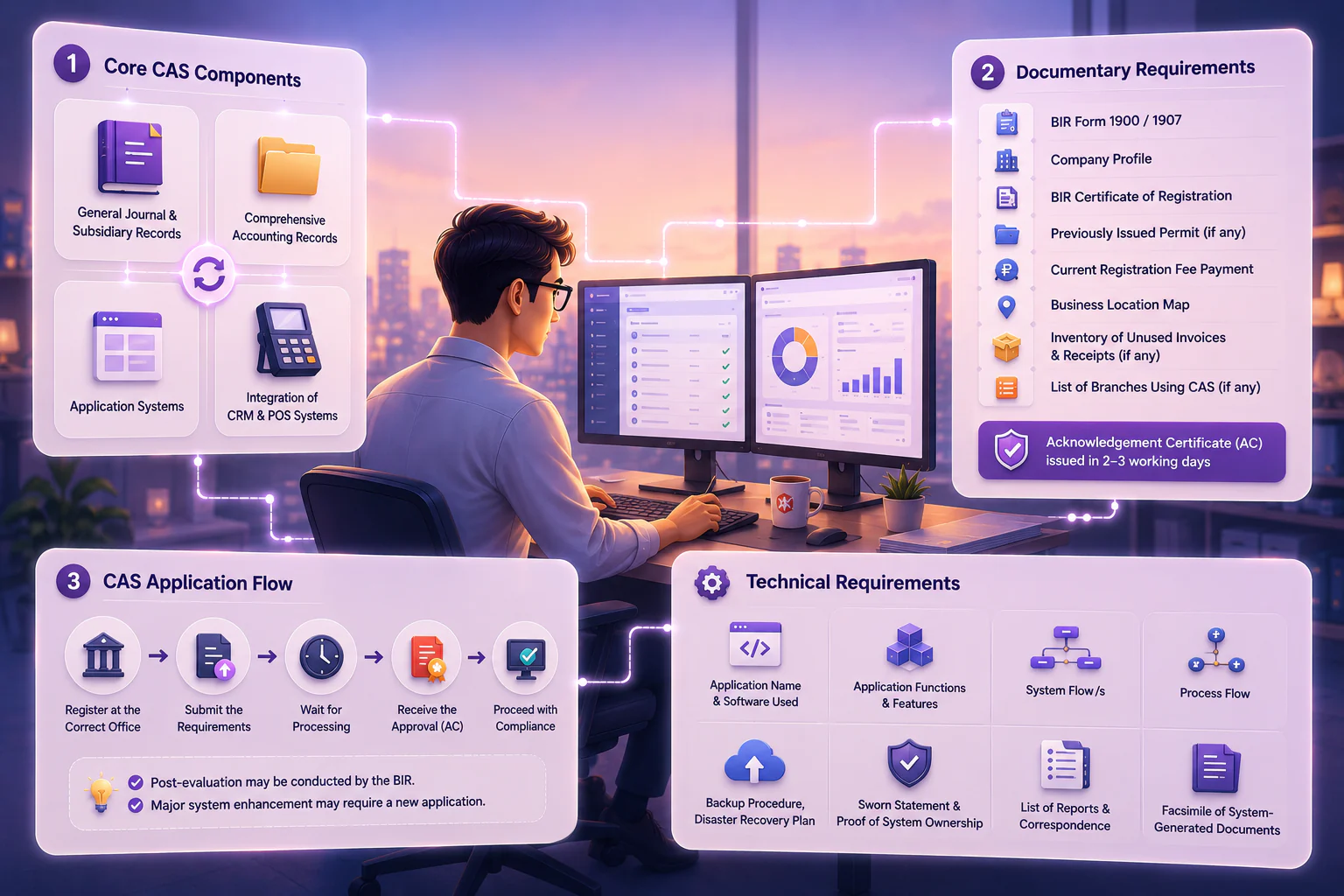
To comply with BIR CAS requirements, Revenue Memorandum Order (RMO) No. 9-2021 outlines four essential components that must be synchronized for proper record-keeping and reporting.
- General Journal and Subsidiary Records: Accountants must maintain both the general journal and subsidiary records.
- Comprehensive Accounting Records: This includes books for sales, inventory, purchases, accounts receivable, accounts payable, payroll ledgers, and subsidiary ledgers.
- Application Systems: Identify systems responsible for generating billing statements, cash vouchers, invoices, official receipts, and other entries for the subsidiary ledger.
- Integration of CRM and POS Systems: Ensure that Cash Register Machines (CRM) and Point of Sale (POS) systems are connected to the CAS.
2. Documentary Requirements
For the initial application to use a Computerized Accounting System BIR or its components, you need to submit the following:
- Filled out BIR Form 1900 and/or BIR Form 1907
- Company profile
- Photocopy of BIR Certificate of Registration
- Photocopy of previously issued permit, if applicable
- Photocopy of current registration fee payment
- Business location map
- Inventory of unused approved invoices and receipts, if applicable
- List of branches using CAS, if any
After submitting complete documentary requirements, the BIR usually issues an Acknowledgement Certificate (AC) within three working days. In the 2024 BIR Citizen’s Charter, the estimated processing time is 2 days and 45 minutes for walk-in applications and 3 days for ORUS applications, although actual processing may still vary depending on document completeness and system availability.
3. Simple CAS Application Flow
After preparing the required documents, businesses can follow a simple CAS registration flow to make the process easier to understand.
- Register at the correct office: Submit the application to the Revenue District Office (RDO) or Large Taxpayer Office where the business is registered. Businesses may also file through the BIR's ORUS platform, the same channel used for online BIR registration.
- Submit the requirements: Provide the documentary and technical requirements listed in this section. The BIR will review the submission and may return incomplete applications for correction.
- Wait for processing: Walk-in applications usually take around 2 days and 45 minutes based on the 2024 BIR Citizen’s Charter, while ORUS applications usually take up to 3 days.
- Receive the approval document: Once approved, the BIR issues an Acknowledgement Certificate (AC), which now serves as the approval document for CAS registration.
- Proceed with the next compliance step: After receiving the AC, the business may use the registered system and keep it aligned with BIR rules. The BIR may still conduct post-evaluation, and any major system enhancement may require a new application.
Technical Requirements
- Application name and software used (development and database)
- Application functions and features
- System flow/s
- Process flow
- Backup procedure, disaster recovery plan
- Sworn statement and proof of system ownership
- List of reports and correspondence (generated by the system, including descriptions, purposes, and sample layouts)
- Facsimile of system-generated loose-leaf books of accounts, receipts, invoices, and a list of them.
Meeting the documentary and technical requirements is only one part of CAS compliance. Businesses also need an accounting system that keeps transactions, ledgers, invoices, audit trails, and reports consistent, traceable, and accessible for review.

Policy of Computerized Accounting System (CAS) by BIR

The Bureau of Internal Revenue (BIR) ensures the government has the funds needed for public services by collecting various taxes, such as income tax, value-added tax (VAT), and business taxes.
One key policy to achieve this goal is implementing a BIR computerized accounting system and an Electronic Invoice System BIR (EIS), both required to ensure accurate and transparent tax reporting. Additionally, every company is now required to implement BIR-accredited POS (Point of Sale) to print their invoices.
Similarly, the EIS policy requires businesses to issue invoices electronically, enhancing transparency and efficiency in tax reporting. Both CAS and BIR electronic filing must be registered and approved by the BIR before use, ensuring they meet all regulatory.
The CAS Permit to Use covers your accounting system, not your sales machines. Terminals used for customer transactions go through a separate process, so confirm the requirements for a BIR-accredited POS system before deploying them in your branches.
Objectives and Benefits of the BIR CAS Policy
| CAS Policy Objective | What It Means for BIR Compliance | Business Benefit |
|---|---|---|
| Enhance accuracy | Financial transactions must be recorded correctly and consistently across the accounting system. | Businesses reduce manual errors and maintain more reliable books of accounts. |
| Improve compliance | Accounting records must support tax reporting, BIR review, and required documentation. | Businesses can lower the risk of penalties caused by incomplete, inconsistent, or unsupported records. |
| Increase efficiency | Accounting processes should move from manual encoding to structured digital workflows. | Finance teams save time on data entry, report preparation, and transaction checking. |
| Promote transparency | Records should be clear enough for audit, verification, and traceability. | Businesses can respond to BIR audits faster because transactions are easier to review and explain. |
In short, the BIR CAS policy is not only about using accounting software. It is about keeping business transactions accurate, traceable, and ready for tax review.
Who Needs to Comply with the CAS Policy?
- Large corporations: Big companies with significant financial transactions must use a Computerized Accounting System to ensure accurate and transparent records.
- Medium-sized enterprises: Growing businesses must adopt CAS to streamline accounting. Using a BIR computerized accounting system helps them manage increasing transactions while staying aligned with regulatory standards.
- Small businesses: While not always required, small businesses can benefit from using CAS. It simplifies accounting and ensures they are prepared for future growth and compliance needs.
- Businesses in regulated industries: Companies in finance, insurance, and real estate, where precise financial records are crucial, should comply with the CAS policy. This ensures they meet industry-specific regulations and standards.
- Newly registered businesses: Start-ups and new businesses should consider implementing CAS from the beginning to avoid future complications down the road.
- Taxpayers must file eSales reports: Businesses that fall under the BIR online sales tracking for businesses system must also comply with certain digital reporting requirements.
Conclusion
A computerized accounting system automates transactions and reporting, ensuring accuracy and control. With growing digital adoption, accounting software for Philippine businesses is crucial for minimizing compliance risks.
It helps meet regulatory requirements, with features like bank integration, analytics, and e-invoicing formats, streamlining accounting processes. To see how a BIR-ready CAS works in practice, you can schedule a free product tour.
FAQ about BIR Computerized Accounting System
Yes, small businesses in the Philippines can use a Computerized Accounting System instead of manual books, as long as the software is registered with the BIR. Smaller taxpayers may also choose the simpler Computerized Books of Accounts (CBA) registration rather than a full CAS, depending on their transaction volume and reporting needs.
Failure to comply with BIR CAS requirements can lead to penalties such as fines and the imposition of additional taxes. These penalties underscore the importance of using accredited software that adheres to BIR standards, ensuring businesses can avoid these risks by maintaining proper and compliant accounting records.
If a company needs to update or enhance its CAS, it must notify the BIR and possibly reapply for a permit, depending on the extent of the changes. Utilizing BIR-accredited software simplifies these updates as vendors typically ensure their solutions meet the latest regulatory requirements.
Yes, cloud-based accounting software can qualify as a BIR-accredited CAS once it passes the BIR’s system evaluation and receives an Acknowledgement Certificate. The software must generate BIR-compliant books, sales, and journal reports, and store records securely for the required retention period. Vendors like HashMicro provide CAS-ready cloud systems built for these requirements.
Once approved, the permit to use a Computerized Accounting System is valid indefinitely unless the system undergoes significant changes or enhancements not in compliance with BIR stipulations. Regular updates through accredited accounting software help ensure continuous compliance without the need for frequent renewals.