







Many Philippine businesses record inventory at purchase cost and never revisit that figure. The balance sheet then overstates inventory, and auditors flag the gap at year-end close. A 2025 study of Southern Manila District manufacturers found that accounting staff apply net realizable value inconsistently.
PAS 2 requires companies to measure inventory at the lower of cost and net realizable value. A write-down follows whenever NRV drops below cost. The same study found that accounting teams understand the rule but apply it unevenly.
This guide defines net realizable value, breaks down the formula, and walks through a Philippine peso calculation. You will also learn when a write-down applies, the required journal entry, and how PAS 2 governs it.
Key Takeaways
Net realizable value is the amount you expect from selling an item, minus the costs to finish and sell it.
The net realizable value formula subtracts estimated completion costs and selling costs from the realistic selling price.
PAS 2 requires an inventory write-down whenever NRV falls below cost, recognized in the period it occurs.
An integrated inventory system flags items whose NRV has dropped below cost before the reporting close.
What Is Net Realizable Value (NRV)?
Net realizable value is the amount a business expects from selling an item under normal conditions. Subtracting the costs to finish and sell the goods gives the inventory value you report. The word realizable matters here. NRV reflects a realistic transaction, not a theoretical ceiling or replacement cost.
The net realizable value formula states that NRV equals the estimated selling price minus completion and selling costs. That calculation stays entity-specific. Two companies holding identical stock can report different NRVs when their selling costs differ.
NRV differs from market value and from fair value under PFRS 13 because only NRV deducts your own selling costs. PAS 2 accepts NRV alone for the lower-of-cost test. The same measure also values accounts receivable net of doubtful accounts.
The Net Realizable Value Formula
The formula turns the NRV concept into a number you can post. You need three estimates for inventory and two for receivables. Each estimate must reflect your own operations, because PAS 2 ties the measurement to the ordinary course of business.
The NRV formula is:
NRV = Estimated Selling Price − Estimated Cost of Completion − Estimated Selling Costs
Each component requires a deliberate estimate:
- Estimated selling price: the price you can realistically achieve in the ordinary course of business. PAS 2 uses that wording, so exclude distress-sale figures and prices that depend on future marketing.
- Estimated cost of completion: the cost to bring work in progress, raw materials, or part-assembled goods to a saleable state. Finished goods that need no further work carry zero here.
- Estimated selling costs: the incremental costs of selling that specific item, such as commissions, packaging, freight-out, and handling. Exclude general overhead and fixed selling costs that arise whether the item sells or not.
NRV Formula for Accounts Receivable
For receivables, the formula simplifies to:
NRV = Gross Receivables − Allowance for Doubtful Accounts
The allowance estimates the invoices you do not expect to collect. Teams set it from aging analysis, historical collection rates, or a customer-by-customer credit review. The net figure is what your balance sheet reports.
How to Calculate NRV: Step-by-Step with Philippine Peso Example
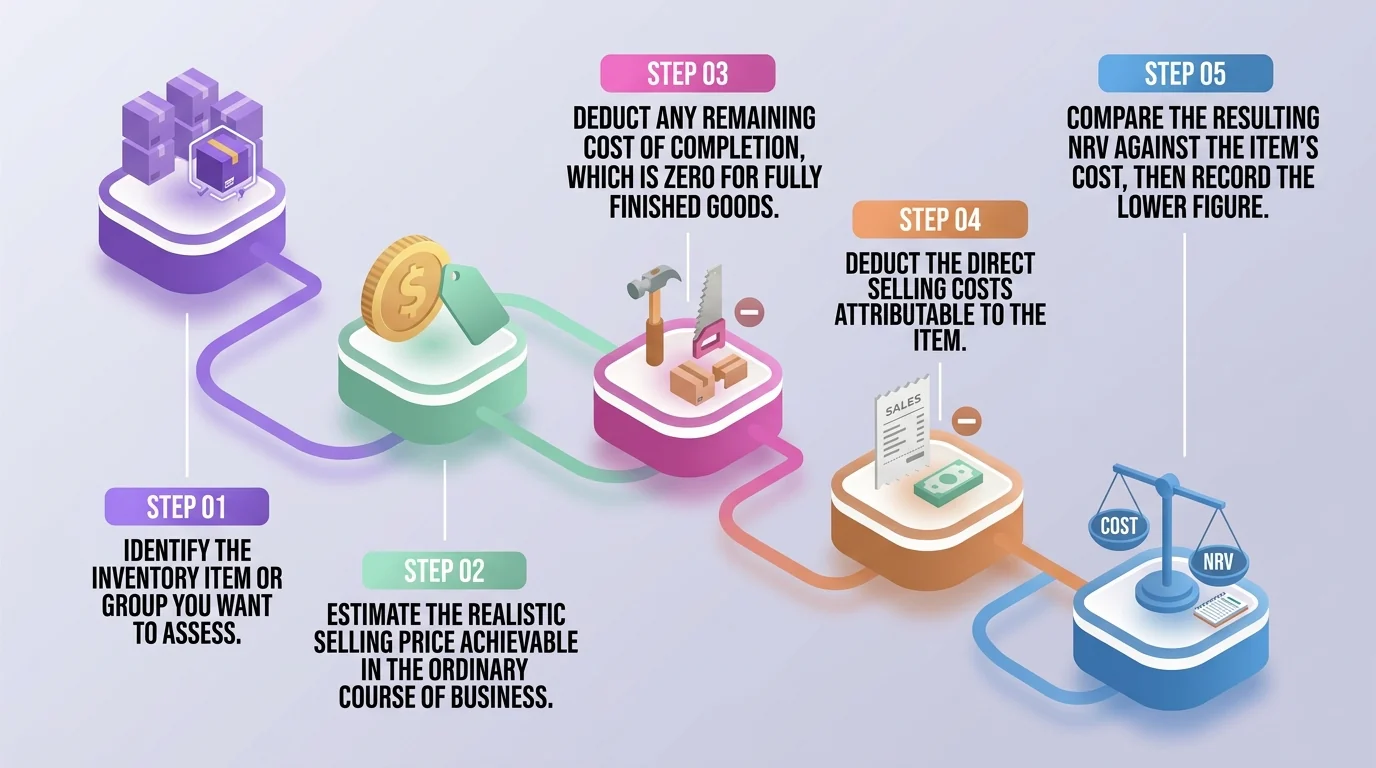
The calculation runs the same way for every item, so you can repeat it across your stock list. You compare one NRV figure against one cost figure, then record the lower number. The peso examples below show how that plays out for finished goods and work in progress.
Calculating NRV for a specific inventory item follows five steps:
- Identify the inventory item or group you want to assess.
- Estimate the realistic selling price achievable in the ordinary course of business.
- Deduct any remaining cost of completion, which is zero for fully finished goods.
- Deduct the direct selling costs attributable to the item.
- Compare the resulting NRV against the item's cost, then record the lower figure.
Worked Example: Finished Goods (Illustrative PHP Figures)
A retail business in Manila holds two categories of finished goods as of its reporting date:
| Item | Cost/Unit (PHP) | Est. Selling Price (PHP) | Selling Costs (PHP) | NRV (PHP) | Balance Sheet Value (PHP) |
|---|---|---|---|---|---|
| Seasonal apparel (slow-moving) | 850 | 700 | 50 | 650 | 650, write-down required |
| Standard merchandise | 500 | 620 | 30 | 590 | 500, no write-down |
For the seasonal apparel, NRV of PHP 650 falls below the PHP 850 cost. You recognize the PHP 200 gap per unit as a loss and write the inventory down to PHP 650. At 500 units, the total write-down reaches PHP 100,000 in the current period.
For the standard merchandise, the NRV of PHP 590 exceeds the PHP 500 cost. No adjustment applies here. The inventory stays on the books at PHP 500 per unit because PAS 2 never permits a write-up above cost.
Worked Example: Work in Progress
A food manufacturer carries partially processed goods at PHP 1,500 per unit. Completing and packaging each unit costs another PHP 150. The finished product sells at PHP 1,700, and direct selling costs run PHP 80 per unit.
NRV = PHP 1,700 − PHP 150 − PHP 80 = PHP 1,470
NRV of PHP 1,470 sits below the PHP 1,500 carrying amount, so you write down PHP 30 per unit. The shortfall means finishing the production run will not recover the current carrying amount. PAS 2 requires you to recognize that loss now.
Inventory Write-Down: When and How to Apply It Under PAS 2
A write-down is where the NRV rule stops being theory. PAS 2 forces the adjustment once cost exceeds what you can recover, and the entry hits your income statement immediately. This section covers the triggers, both journal entry methods, and the write-off distinction.
The Lower of Cost and NRV Rule Under PAS 2
PAS 2, the Philippine Accounting Standard that governs inventory, has been applied since 1 January 2005. It sets one measurement rule. Inventories shall be measured at the lower of cost and net realizable value. The obligation bites the moment recoverable proceeds fall below what you originally paid.
The write-down obligation arises whenever any of the following conditions apply:
- Inventory has suffered physical damage or deterioration
- Inventory has become wholly or partially obsolete
- Market selling prices have declined since you purchased the goods
- Costs to complete or sell the goods have increased, compressing the achievable margin
You recognize the write-down as an expense in the period it occurs. PAS 2 does not let you defer it. If the conditions reverse or selling prices recover, PAS 2 requires a reversal, capped at the original write-down.
How to Record an Inventory Write-Down (Journal Entry)
Two methods record the same loss. Both reduce reported inventory to its NRV, but they differ in where the reduction sits. Choose the direct method for one-off adjustments and the allowance method when you need to track gross and net values.
Direct method:
| Account | Debit (PHP) | Credit (PHP) |
|---|---|---|
| Loss on Inventory Write-Down | [NUMBER] | |
| Inventory | [NUMBER] |
Allowance method:
| Account | Debit (PHP) | Credit (PHP) |
|---|---|---|
| Loss on Inventory Write-Down | [NUMBER] | |
| Allowance for Inventory Write-Down | [NUMBER] |
The direct method reduces the inventory account at once, so the ledger shows only the written-down figure. The allowance method keeps the original cost and parks the gap to net realizable value in a contra-asset account. That split helps when reversals happen often.
Write-Down vs. Write-Off: What Is the Difference?
| Differences | Write-Down | Write-Off |
|---|---|---|
| Inventory still exists? | Yes | No |
| Value adjustment | Partial, reduced to NRV | Full, removed from books |
| Reversible? | Yes, up to the original write-down amount | No |
| Journal entry | Dr Loss, Cr Inventory or Allowance | Dr Loss, Cr Inventory at full cost |
A write-down applies when inventory retains part of its value, so you restate it at net realizable value. A write-off applies when nothing remains to recover. Destroyed, expired, or unexplained losses from inventory shrinkage leave the books entirely.
Common Mistakes When Calculating NRV
While some might assume NRV errors come from the arithmetic, most NRV errors actually come from the inputs. Teams apply the net realizable value formula correctly but feed it an optimistic price or an incomplete cost list. The five mistakes below show where those inputs go wrong and how to correct them.
1. Using an Aspirational Selling Price
NRV must reflect the price you can realistically achieve under current market conditions. A projected price after a future promotion does not qualify. Overstating the selling price inflates NRV and understates the write-down you actually owe.
2. Omitting Selling Costs from the Formula
A common shortcut compares selling price straight against cost. The net realizable value formula also requires you to deduct commissions, freight, and handling. PAS 2 deducts only costs to complete and sell, so inventory holding cost stays out of NRV. Skipping that step overstates NRV on every item.
3. Treating the Review as a Year-End Exercise
PAS 2 requires an NRV assessment at each reporting period. A business that reviews only annually can carry overvalued stock for months. The delayed write-down then lands as one large hit instead of a measured adjustment.
4. Applying One NRV Estimate Across All Inventory
Different SKUs carry different NRV profiles, shaped by category, age, and condition. A blanket estimate hides the slow-moving inventory that needs a write-down on its own merits. Assess by item or by tightly defined group instead.
5. Confusing NRV with Fair Value
Teams that measure other assets at fair value sometimes apply the wrong basis to inventory. NRV deducts your own selling costs, while PFRS 13 fair value takes a market-participant view. Fair value logic in a PAS 2 context systematically overstates NRV.
How Inventory Management Software Supports NRV Tracking

Calculating NRV by hand across hundreds of SKUs takes three separate files. Purchase costs sit in one, current selling prices in another, and selling cost estimates in a third. As the product count grows, so does the chance of missing an item that needs a write-down.
An inventory management system linked to accounting reads carrying amounts from purchase records. It compares them against current selling prices and flags items whose net realizable value sits below cost. Confirmed write-downs post to the general ledger. Expiry-dated stock moves on the FEFO inventory method, which prevents some write-downs entirely.
HashMicro's Inventory module connects stock data, cost records, and sales pricing in one platform. Accounting teams get a single view for the lower of cost and NRV assessment each reporting period. The right inventory management software removes the spreadsheet back-and-forth entirely.

Conclusion
The net realizable value formula protects your financial statements from overstatement. This guide covered the definition, the peso calculation, write-down triggers, journal entries, and the five errors that inflate NRV. Each piece serves one purpose: carrying inventory at what it will actually realize.
PAS 2 treats the NRV review as mandatory at each reporting period, not an annual courtesy. The standard also requires you to reverse a write-down once conditions improve, capped at the original amount. Skipping either step leaves your balance sheet wrong in both directions.
Once your catalog passes roughly 50 SKUs, a manual NRV review stops being realistic. An integrated inventory system compares cost against selling price for every item and flags the write-downs before close. Book a free consultation to see that check run on your own stock.

FAQ About Net Realizable Value
NRV is entity-specific and deducts the costs your business incurs to complete and sell the item. Fair value under PFRS 13 is the price between market participants and deducts no entity-specific costs. PAS 2 requires NRV for inventory measurement, never fair value.
No. Market value is the general trading price in the open market, with no deduction for selling or completion costs. NRV subtracts the costs your business will actually incur. An item worth PHP 1,000 at market has an NRV of PHP 870 after PHP 130 in commissions and freight.
PAS 2 requires an NRV review at each reporting date. Quarterly reporters assess quarterly, and every company assesses at year-end. Any significant change in market prices, product condition, or selling costs should trigger an immediate reassessment outside that normal schedule.
No adjustment applies. The inventory stays on the books at its original cost. PAS 2 never permits a write-up above cost, even when market prices rise well above what you paid. The only upward move allowed is reversing an earlier write-down, capped at that original amount.
Debit Loss on Inventory Write-Down. Credit either the Inventory account under the direct method, or a contra-asset Allowance for Inventory Write-Down under the allowance method. You expense the loss in the period NRV falls below cost. PAS 2 requires a reversal when NRV recovers, capped at the original amount.