







Meeting the SEC requirements for annual financial statements in the Philippines can be difficult when filing deadlines approach and financial records are not fully prepared. Missing documents, inconsistent figures, or incorrect submission details may delay processing or cause the SEC or BIR to reject the filing.
Before preparing the Annual Financial Statements (AFS), companies must confirm whether the filing applies to their entity type, fiscal year-end, and reporting period. They should also coordinate accounting records, audit requirements, corporate documents, and the latest SEC filing instructions.
This guide explains the AFS filing requirements, applicable deadlines, required documents, eFAST submission process, and common filing errors. It also provides a practical checklist to help finance and corporate secretarial teams prepare accurate records and retain proof of submission.
Key Takeaways
Annual financial statement filing requirements depend on the company’s entity type, reporting period, SEC rules, and current filing guidance.
Companies must track the AFS separately from the GIS, beneficial ownership information, and other SEC reports.
Filing readiness requires financial close, audit review, corporate-record checks, eFAST submission, exception handling, and acknowledgement retention.
ERP systems organise reporting and evidence, while SEC verification, audit work, legal advice, and management accountability remain mandatory.
What Are the SEC Requirements for Filing Annual Financial Statements in the Philippines?
The SEC requirements for annual financial statements in the Philippines depend on the entity type, such as a stock corporation, non-stock corporation, OPC, foundation, branch office, or publicly listed company. Before filing, confirm the fiscal year-end, reporting period, audit requirement, applicable SEC issuance, and whether the submission must use SEC eFAST.
Prepare the AFS with the finance team, auditor, corporate secretary, and filing administrator, then verify the company profile, period covered, document orientation, image quality, submission type, and required supporting files. The AFS is separate from the GIS, beneficial ownership information, and BIR eAFS requirements, which follow different purposes, channels, and instructions.
SEC deadlines and filing procedures may change through memoranda, extensions, or entity-specific rules, particularly for companies with secondary licenses or publicly listed status. Record the official SEC reportorial requirements page, eFAST instructions, applicable BIR guidance, and review date before submission, then retain the acknowledgement or confirmation as evidence of filing.
Which Companies Must File Annual Financial Statements with the SEC?
Who must file annual financial statements with the SEC depends on the company’s registration category and the current SEC guidance. Use the following decision matrix to identify what must be verified:
| Entity profile | Filing question | Internal owner | Evidence to check | Status |
|---|---|---|---|---|
| Stock corporation | What AFS form, audit requirement, and deadline apply to the reporting period? | Controller and corporate secretary | SEC registration records and latest SEC issuance | Verify annually |
| Non-stock corporation | Does the entity follow a different reportorial or audit instruction? | Corporate secretary | Current SEC guidance for non-stock entities | Verify annually |
| Foreign corporation branch or representative office | Which Philippine filing and financial information are required? | Legal, finance, corporate secretary | Registration type and applicable SEC rules | Verify annually |
| Listed, regulated, or specially registered entity | Are additional filing or review obligations imposed? | Compliance and finance | Sector regulator and SEC notices | Verify annually |
| Dormant, newly registered, or inactive entity | Does status affect filing, exemption, or a request for clarification? | Corporate secretary | Registration status and current SEC instructions | Verify annually |
For groups with several subsidiaries, create one applicability record per entity. A parent company’s filing status does not automatically determine the obligations of every subsidiary, branch, or affiliate. ERP for B2B businesses can help maintain entity-level master data, but the legal classification still requires responsible management or adviser review.
How Do SEC Requirements for Filing Annual Financial Statements Affect the Deadline?
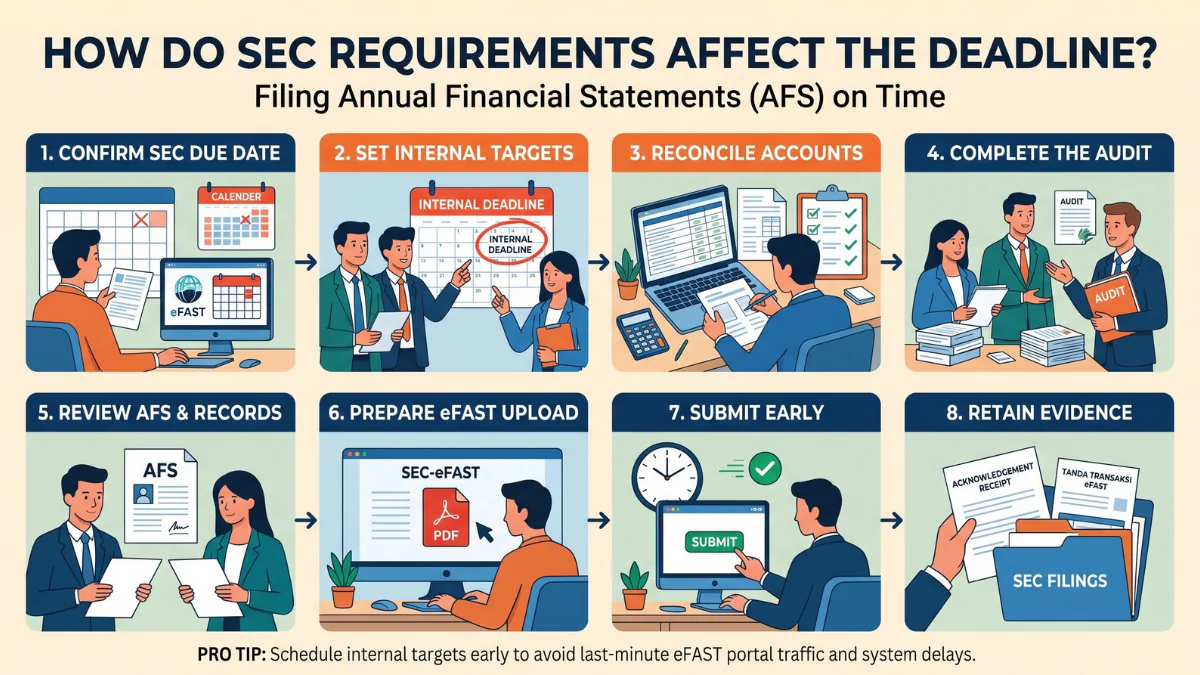
The SEC filing deadline depends on the latest announcement for the relevant reporting period and entity type. Use the following steps to build an internal filing schedule and avoid late submissions.
Step 1: Confirm the Applicable SEC Due Date
Check the latest SEC announcement, reportorial requirement, and eFAST instruction for the company’s fiscal year-end and entity classification. Do not copy a deadline from a previous year without verifying that it still applies.
Step 2: Set the Period-Close Target
Set an internal deadline for closing the books before the SEC due date. Complete transaction cut-off procedures and post all material entries by this date.
Step 3: Complete Account Reconciliations
Reconcile bank accounts, receivables, payables, inventory, taxes, and other material balances. Escalate unresolved reconciling items before the financial statements move to audit.
Step 4: Complete the Audit
Coordinate with the external auditor and management to provide supporting schedules, resolve audit queries, and approve required adjustments. Delays in audit completion can reduce the time available for SEC filing preparation.
Step 5: Review the AFS and Corporate Records
Management and the corporate secretary should verify the final AFS, company profile, fiscal year-end, reporting period, and corporate information. Resolve any conflicting details before uploading the documents.
Step 6: Prepare the eFAST Submission
Confirm that the filing account is active and that the AFS files meet the required format, orientation, image quality, and submission type. Check that the correct company profile and reporting period are selected.
Step 7: Submit Before the External Deadline
Assign a filing owner to complete the eFAST submission before the verified SEC due date. Set the internal target earlier than the external deadline to allow time for corrections, rejected files, or system issues.
Step 8: Retain the Filing Evidence
Save the acknowledgement, transaction reference, confirmation page, uploaded files, and supporting records immediately after submission. Escalate any missing confirmation, rejected upload, or incomplete filing status.
For calendar-year and non-calendar-year entities, calculate every internal milestone from the company’s actual fiscal year-end. Recheck the latest SEC announcement, official filing guidance, and eFAST notice on the submission date because the SEC may issue new instructions or deadline extensions.
What Documents and Information Are Required for SEC Annual Financial Statement Filing?
The SEC annual financial statement filing normally requires the final statement of financial position, income statement, cash flow statement, statement of changes in equity, notes, and the auditor’s report when applicable. Finance teams must also verify the company name, SEC registration details, address, fiscal year, reporting period, signatures, certifications, and current eFAST file specifications
Use one controlled, approved version of the AFS for submission, supported by reconciliations, audit adjustments, working papers, and management sign-off. Before upload, confirm the company profile, period covered, file orientation, image quality, naming format, submission type, and eFAST account access because incorrect or incomplete files may be rejected or treated as not filed.
Keep the AFS checklist separate from the GIS, beneficial ownership information, and BIR requirements, including BIR eAFS guidance. Assign a separate owner and review status to each submission, retain the confirmation and transaction reference, and use financial reporting software to support audit trails, reconciliations, approvals, and controlled final exports.
How Can You File Annual Financial Statements Through SEC eFAST?
SEC eFAST procedures and interface requirements may change. Follow the current SEC user instructions and notices, and distinguish the actions performed by your team from the validations performed by the platform.
- Confirm applicability and source guidance: Record the entity type, reporting period, required form, deadline, and SEC source reviewed.
- Close and reconcile the books: Complete cut-off, bank, receivable, payable, inventory, tax, intercompany, and other relevant reconciliations.
- Complete audit and management review: Resolve audit adjustments, obtain the final report, and document management approval.
- Check corporate information: Compare legal name, registration details, address, officers, and other master data with the authoritative corporate record.
- Prepare the submission file: Apply the current SEC file format, naming, signature, and document specifications. Do not assume last year’s format remains valid.
- Validate access and roles: Confirm that the eFAST account, authorised users, contact details, and internal approval route are available before the due-date window.
- Upload and review the platform response: Check validation messages carefully. A successful upload screen is not a substitute for reviewing the transaction status and any SEC instruction.
- Complete any applicable payment or transaction step: Use only the current official eFAST instructions for fees, payment references, or related actions.
- Retain acknowledgement and references: Store the submission reference, acknowledgement, timestamp, uploaded version, and reviewer sign-off in the records repository.
- Handle exceptions promptly: If a file is rejected, incomplete, or inconsistent, pause repeated submissions, identify the cause, correct the approved version through the proper process, and retain the exception trail.
The platform may validate file structure or required fields, but it does not replace the auditor’s work, management accountability, legal review, or SEC interpretation. Use official support channels if the current interface or correction process is unclear.
Which Related SEC Reports Should You Track Separately from the AFS?
Related reports may share corporate data with the AFS but remain separate obligations. None substitutes for the annual financial statements.
| Obligation | Purpose | Typical owner | Dependency | Verification |
|---|---|---|---|---|
| Annual Financial Statements | Report financial position and performance for the period | Finance and auditor | Trial balance, audit work, approvals | Check current SEC AFS guidance |
| General Information Sheet | Report corporate information, officers, ownership, and related details | Corporate secretary | Corporate master data and approved records | Check current GIS instructions |
| Beneficial ownership information | Identify beneficial owners where required | Corporate secretary and legal | Ownership records and declarations | Check current SEC rule or notice |
| Other SEC reportorial submissions | Address entity-specific or event-driven information | Compliance, legal, or finance | Relevant corporate or financial records | Verify by entity and current issuance |
Maintain a filing inventory that identifies the form, frequency, responsible department, source records, due-date rule, and evidence location. This prevents teams from assuming that completing the AFS also completes every other SEC reportorial requirement.
How Should Management Evaluate ERP Support for SEC Filing Readiness?

An ERP or accounting platform should support the controls behind SEC filing, not replace legal, audit, or filing responsibilities. HashMicro Accounting Software helps finance teams organise financial data, approvals, reconciliations, and reporting in a more controlled workflow.
Evaluate whether the system can:
- Consolidate entity and reporting-period data without uncontrolled spreadsheet copies
- Trace balances to transactions and supporting documents
- Route reconciliations, adjustments, and approvals to assigned reviewers
- Maintain audit trails and historical versions
- Restrict access by entity, role, and workflow stage
- Track closing, audit, and submission milestones
- Export reports for review against current SEC instructions
- Retain filing references and supporting evidence securely
HashMicro Accounting Software can support bank reconciliation, automated financial reporting, approval workflows, and real-time visibility across finance activities. Request a free consultation to discuss your year-end close process, reporting structure, and controls required for SEC filing readiness.
Conclusion
Meeting the SEC requirements for annual financial statements requires more than preparing the AFS. Companies must verify their entity type, reporting period, audit requirements, eFAST instructions, document accuracy, and filing evidence while keeping SEC obligations separate from BIR requirements.
A controlled year-end workflow helps finance and corporate secretarial teams reconcile records, approve the final statements, submit the correct files, and retain confirmation of acceptance. HashMicro Accounting Software can support this process with audit trails, bank reconciliation, automated financial reporting, approval workflows, and real-time financial visibility.
Book a free consultation with HashMicro Philippines to discuss how your accounting workflow can support more organized AFS preparation and SEC filing readiness
Frequently Asked Questions
The company should check its entity type, fiscal year-end, latest SEC announcement, and current eFAST instructions, then document the source and review date. Do not rely on a prior-year calendar or use a year-specific date unless it has been verified against an official SEC source.
Pause submission, identify the authoritative record, coordinate with finance, the auditor, and the corporate secretary, correct the approved version through a controlled process, and retain the review evidence. Confirm the appropriate regulatory remedy with the SEC or a qualified adviser.
Compare standardized financial data, reconciliation workflows, approval trails, version control, access governance, deadline visibility, and acknowledgement retention. These capabilities support process readiness but do not replace audit, legal, management, or SEC requirements.