










 Limited to 100 registrants

A sanitary permit is one of the first documents a food business needs before it can legally open in the Philippines. Many owners learn this the hard way at city hall, where a mayor's permit application stalls because the sanitary clearance is missing.
The requirement comes from Presidential Decree No. 856, the Code on Sanitation of the Philippines. According to the Department of Trade and Industry, micro, small, and medium enterprises account for 99.59% of registered businesses in the country, and food service is one of the most common entry points for new operators. Every food establishment falls under this permit system regardless of size.
This guide explains what a sanitary permit is, how it differs from a health certificate and other documents, the requirements, the step-by-step application process, fees, renewal rules, and how to stay inspection ready after the permit is issued.
Key Takeaways
A sanitary permit confirms that a food establishment meets the required health and sanitation standards before operating.
Sanitary permit requirements cover both the documents submitted and the physical standards checked during inspection.
The sanitary permit application follows a step-by-step process, from preparing requirements to completing the inspection.
What Is a Sanitary Permit and Which Businesses Need One?
A sanitary permit is a clearance issued by the City or Municipal Health Office confirming that a food establishment meets required sanitary standards. Under PD 856, the Code on Sanitation of the Philippines, food establishments must secure this permit before operating, following an inspection of the premises by a sanitary inspector.
It applies to restaurants, cafes, bakeries, food stalls, carinderias, milk tea shops, catering businesses, commissaries, supermarkets, grocery stores, and other establishments that prepare, handle, store, or sell food. Home-based and online food sellers may also be covered if they prepare or repack food for sale, as the requirement is based on the food-handling activity rather than the type of storefront.
One detail that often catches growing businesses is that the permit is tied to the establishment, not the company. Each branch or location needs its own sanitary permit because every site is inspected separately, so opening a second outlet means going through the process again for that address.
Sanitary Permit vs Health Certificate vs FDA LTO vs Mayor's Permit
These four documents are often confused because they all involve food businesses and local or national agencies. They are different, and knowing which one you actually need saves time and avoids a rejected application.
| Document | What it evaluates | Issued by | Validity | Required for |
|---|---|---|---|---|
| Sanitary Permit | The establishment and its physical premises | City or Municipal Health Office | Generally one year | All food establishments |
| Health Certificate | Individual food handlers | City or Municipal Health Office | Varies, often six months to one year | Every food worker |
| FDA License to Operate (LTO) | The product and facility for manufacturing, repacking, importing, or distributing | Food and Drug Administration | Depends on license type | Manufacturers, repackers, importers, distributors |
| Mayor / Business Permit | The business registration and right to operate | Local government through the Business Permits and Licensing Office | One year | All businesses |
A sanitary permit covers the place, a health certificate covers the person, and an FDA LTO covers certain food products and supply-chain activities. A mayor’s permit allows the business to operate, with a sanitary permit as one of its prerequisites.
The FDA LTO generally applies to manufacturers, repackers, importers, and distributors, while restaurants, food stalls, cafes, and cloud kitchens typically need sanitary permits and staff health certificates instead.
Sanitary Permit Requirements for a Food Business
The requirements fall into two groups: the documents you must submit and the physical standards your premises must meet during inspection.
Document requirements checklist
- DTI registration (sole proprietorship) or SEC registration (corporation or partnership): proves your business is legally registered before you apply for any local permit.
- Barangay clearance: confirms that the barangay where your establishment is located has no objection to your business operating there.
- Lease contract or proof of ownership for the premises: verifies the physical address of the establishment and who is responsible for the space.
- Completed application form from the City or Municipal Health Office: the official form that triggers the inspection and permit issuance process.
- Health certificates for all food handlers: confirms that every person who touches food has passed a medical examination and is fit to handle it.
- Water potability test result: required only if you use a non-utility water source, such as a well, to prove the water is safe for food preparation and cleaning.
Physical requirements from PD 856 Chapter III
The sanitary inspector checks the structure of your establishment against Chapter III of PD 856, which covers food establishments. Prepare these before the inspection:
- Floors, walls, and ceilings that are smooth, durable, and easy to clean: rough or porous surfaces trap food residue and bacteria, which is a contamination risk.
- Adequate ventilation and lighting for food preparation and storage areas: proper airflow prevents moisture buildup and odors; good lighting helps staff spot contamination or spoilage.
- A safe water supply for washing, cooking, and cleaning: water must be potable and available in sufficient quantity for all food-handling activities.
- Proper sewage and waste disposal that prevents contamination: drainage and waste systems must be designed so that wastewater or garbage cannot come into contact with food or food surfaces.
- Handwashing facilities accessible to food handlers: sinks with soap and water must be within easy reach of food preparation areas, separate from food washing sinks.
- Food storage that protects against contamination and pests: food must be stored off the floor, covered, and separated from cleaning chemicals and non-food items.
- Pest control measures to keep insects and rodents out: this includes screened windows, sealed gaps, and a documented pest control program.
The inspection is not a formality. The inspector verifies these physical conditions, so a clean set of documents alone will not get the permit approved if the premises fail.
Step by Step to Get a Sanitary Permit
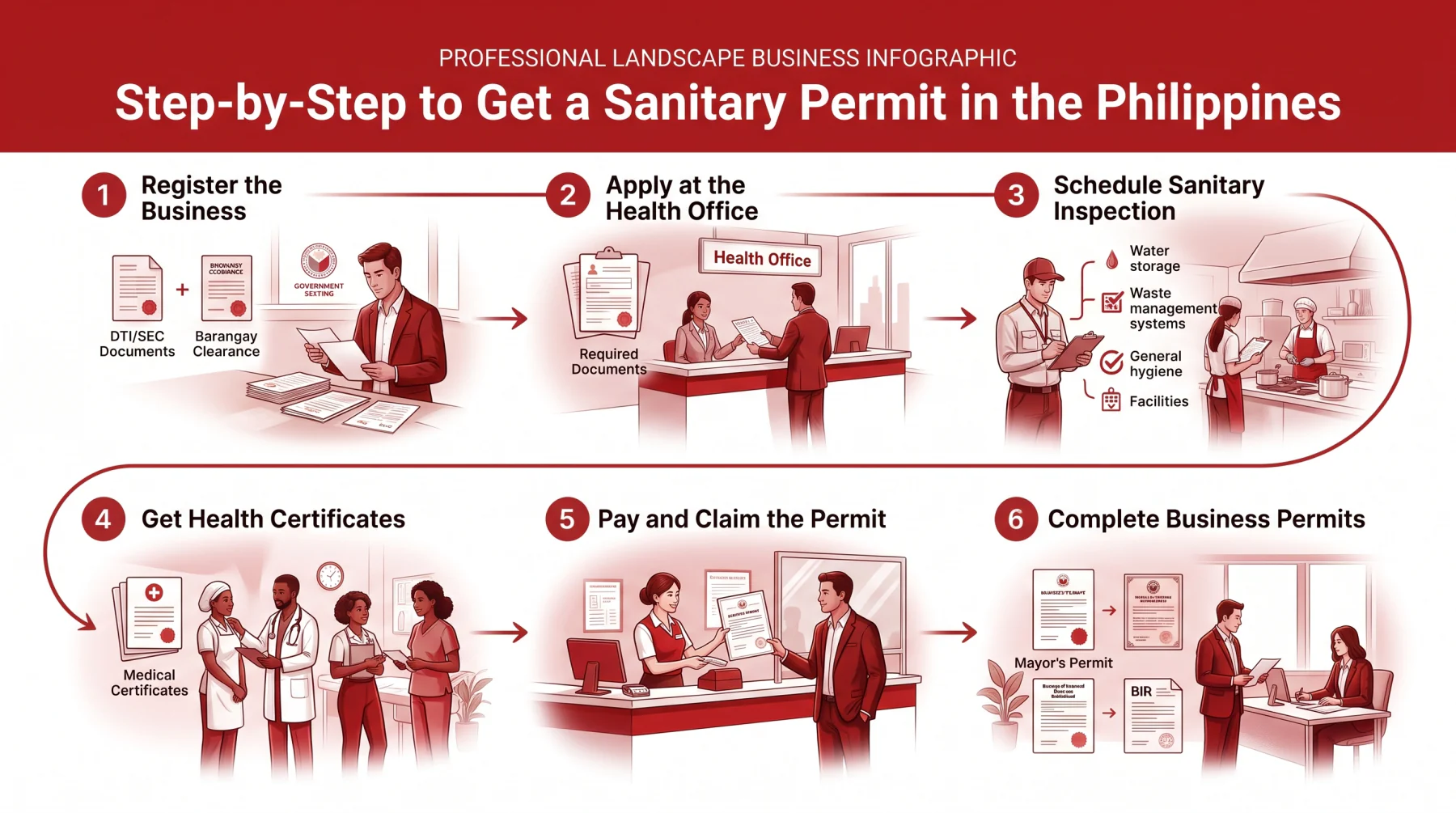
The application follows a specific order, and skipping a step usually means going back to the beginning. Complete each requirement before moving to the next.
Step 1: Complete business registration and barangay clearance first
Register your business with the DTI if you are a sole proprietor, or with the SEC for partnerships and corporations. Then secure a barangay clearance from the barangay hall where the establishment will operate. Both are required on the sanitary permit application form and must come first. This is also the right time to confirm that your location is zoned for food business before committing to a lease or fit-out.
Step 2: Apply to the City or Municipal Health Office
Visit the health office that covers your establishment's barangay, request the application form, and submit it with supporting documents. These typically include your DTI or SEC registration, barangay clearance, a floor plan of the premises, a list of food handlers, and details of your water supply and waste disposal arrangements. Requirements vary slightly between LGUs, so confirm the full checklist with the health office beforehand.
Step 3: Schedule the sanitary inspection of the premises
The health office will assign a sanitary inspector to visit your establishment. The inspection covers water supply, food storage, waste disposal, toilet and handwashing facilities, pest control, and general cleanliness under Chapter III of PD 856. Address potential issues such as drainage, food-contact surfaces, and refrigeration before the inspector arrives, because deficiencies found during the visit require correction before the permit can be issued.
Step 4: Process health certificates for all food handlers
Every person who handles, prepares, or serves food must obtain a health certificate from the local health office, which includes a medical examination and may require laboratory tests depending on the LGU. This process runs in parallel with the establishment inspection, but all certificates must be complete before the permit is released. Track each certificate's expiry date, as they typically need renewal every six months to one year.
Step 5: Pay the fees and claim the permit
Once the inspection passes and all documents are confirmed complete, the health office will advise you of the applicable fees. Pay at the designated cashier. Fee amounts vary by LGU and establishment type. After payment, the sanitary permit is issued and must be displayed visibly inside the establishment throughout its validity period.
Step 6: Use the permit to complete your mayor's permit application
Step 1: Complete business registration and barangay clearance first
Register your business with the DTI if you are a sole proprietor, or with the SEC for partnerships and corporations. Then secure a barangay clearance from the barangay hall where the establishment will operate. Both are required on the sanitary permit application form and must come first. This is also the right time to confirm that your location is zoned for food business before committing to a lease or fit-out.
Step 2: Apply to the City or Municipal Health Office
Visit the health office that covers your establishment's barangay, request the application form, and submit it with supporting documents. These typically include your DTI or SEC registration, barangay clearance, a floor plan of the premises, a list of food handlers, and details of your water supply and waste disposal arrangements. Requirements vary slightly between LGUs, so confirm the full checklist with the health office beforehand.
Step 3: Schedule the sanitary inspection of the premises
The health office will assign a sanitary inspector to visit your establishment. The inspection covers water supply, food storage, waste disposal, toilet and handwashing facilities, pest control, and general cleanliness under Chapter III of PD 856. Address potential issues such as drainage, food-contact surfaces, and refrigeration before the inspector arrives, because deficiencies found during the visit require correction before the permit can be issued.
Step 4: Process health certificates for all food handlers
Every person who handles, prepares, or serves food must obtain a health certificate from the local health office, which includes a medical examination and may require laboratory tests depending on the LGU. This process runs in parallel with the establishment inspection, but all certificates must be complete before the permit is released. Track each certificate's expiry date, as they typically need renewal every six months to one year.
Step 5: Pay the fees and claim the permit
Once the inspection passes and all documents are confirmed complete, the health office will advise you of the applicable fees. Pay at the designated cashier. Fee amounts vary by LGU and establishment type. After payment, the sanitary permit is issued and must be displayed visibly inside the establishment throughout its validity period.
Step 6: Use the permit to complete your mayor's permit application
Step 1: Complete business registration and barangay clearance first
Register with the DTI if operating as a sole proprietor, or the SEC for partnerships and corporations. Then secure a barangay clearance from the barangay where the establishment will operate. Both documents are required for the sanitary permit application, and it is also important to confirm that the location is properly zoned for a food business.
Step 2: Apply to the City or Municipal Health Office
Visit the health office covering the establishment and submit the sanitary permit application with the required documents. These typically include DTI or SEC registration, barangay clearance, a floor plan, food handler details, and water and waste disposal information. Requirements can vary by LGU, so confirm the complete checklist before applying.
Step 3: Schedule the sanitary inspection of the premises
The health office will assign a sanitary inspector to visit your establishment. The inspection covers water supply, food storage, waste disposal, toilet and handwashing facilities, pest control, and general cleanliness under Chapter III of PD 856. Address potential issues such as drainage, food-contact surfaces, and refrigeration before the inspector arrives, because deficiencies found during the visit require correction before the permit can be issued.
Step 4: Process health certificates for all food handlers
Every person who handles, prepares, or serves food must obtain a health certificate from the local health office, which includes a medical examination and may require laboratory tests depending on the LGU. This process runs in parallel with the establishment inspection, but all certificates must be complete before the permit is released. Track each certificate's expiry date, as they typically need renewal every six months to one year.
Step 5: Pay the fees and claim the permit
Once the inspection passes and all documents are confirmed complete, the health office will advise you of the applicable fees. Pay at the designated cashier. Fee amounts vary by LGU and establishment type. After payment, the sanitary permit is issued and must be displayed visibly inside the establishment throughout its validity period.
Step 6: Use the permit to complete your mayor's permit application
The sanitary permit is a required document for the mayor's or business permit at the city or municipal hall. Without it, the Business Permits and Licensing Office will not process your application. Once the mayor's permit is secured, complete your BIR registration with the revenue district office covering your location before opening for business.
Each permit in the main chain is a prerequisite for the next. You cannot skip ahead or apply out of order.
- DTI or SEC Registration: Register your business first: DTI for sole proprietorships, SEC for corporations and partnerships. This is the foundation all other permits build on.
- Barangay Clearance: Once registered, secure a clearance from the barangay where your establishment will operate. The health office and BPLO both require this on their application forms.
- Sanitary Permit: Apply at the City or Municipal Health Office. This requires your DTI or SEC registration and barangay clearance, which is why those come first.
- Run in parallel: Health certificates for all food handlers are processed through the same health office at this stage. They are not part of the sequential chain, but all certificates must be complete before the sanitary permit is released.
- Mayor's / Business Permit: Issued by the city or municipal hall through the Business Permits and Licensing Office (BPLO). The sanitary permit is a required attachment for this application.
- BIR Registration: Register with the Revenue District Office covering your business address before you open. This is the final step before operations begin.
Separate track, not part of the chain above:
FDA License to Operate (LTO): Required only for manufacturers, repackers, importers, and distributors of food products. This is processed through the Food and Drug Administration independently of the local permit sequence above.
This order answers a question most competitors skip: why you cannot apply for a sanitary permit first. The barangay clearance and business registration must exist before the application, because both are requested on the form.

Sanitary Permit Fees and Processing Time
There is no single national fee for a sanitary permit. Each city or municipality sets its own rates through a local ordinance, so the amount you pay in one city can differ from another.
The cost is usually made up of a few components:
The permit fee itself, set by the LGU ordinance
An inspection fee for the sanitary evaluation
A medical exam fee per food handler, for the health certificates
Because the rates are local, do not rely on a single figure you read online. The accurate source is your own LGU's citizen's charter or the published revenue code, not a general article.
Processing time also varies. After a passing inspection and complete documents, the permit is typically released within a few days to a few weeks. The timeline lengthens when the inspection finds violations that need correction or when the application is missing documents.
Renewal, Expiry, and Operating Without a Sanitary Permit
Sanitary permits are generally valid for one calendar year and are renewed alongside the business permit at the start of the year. The exact filing window and any surcharge for late renewal are set by each LGU, so confirm the schedule with your city or municipal health office rather than assuming a national deadline applies to your location.
Operating without a valid sanitary permit carries real consequences. Under PD 856, violations can result in fines, forced closure of the establishment, or criminal liability. The health office has the authority to order a business to stop operating until the permit is secured, and establishments found with violations during an inspection are typically given a correction period followed by a re-inspection.
The practical takeaway is to track two expiry dates separately: the sanitary permit itself and each worker's health certificate. These dates do not align, and a single expired health certificate can create problems during a routine inspection even if the establishment permit is current.
Why Requirements Differ by LGU and How to Confirm Yours?
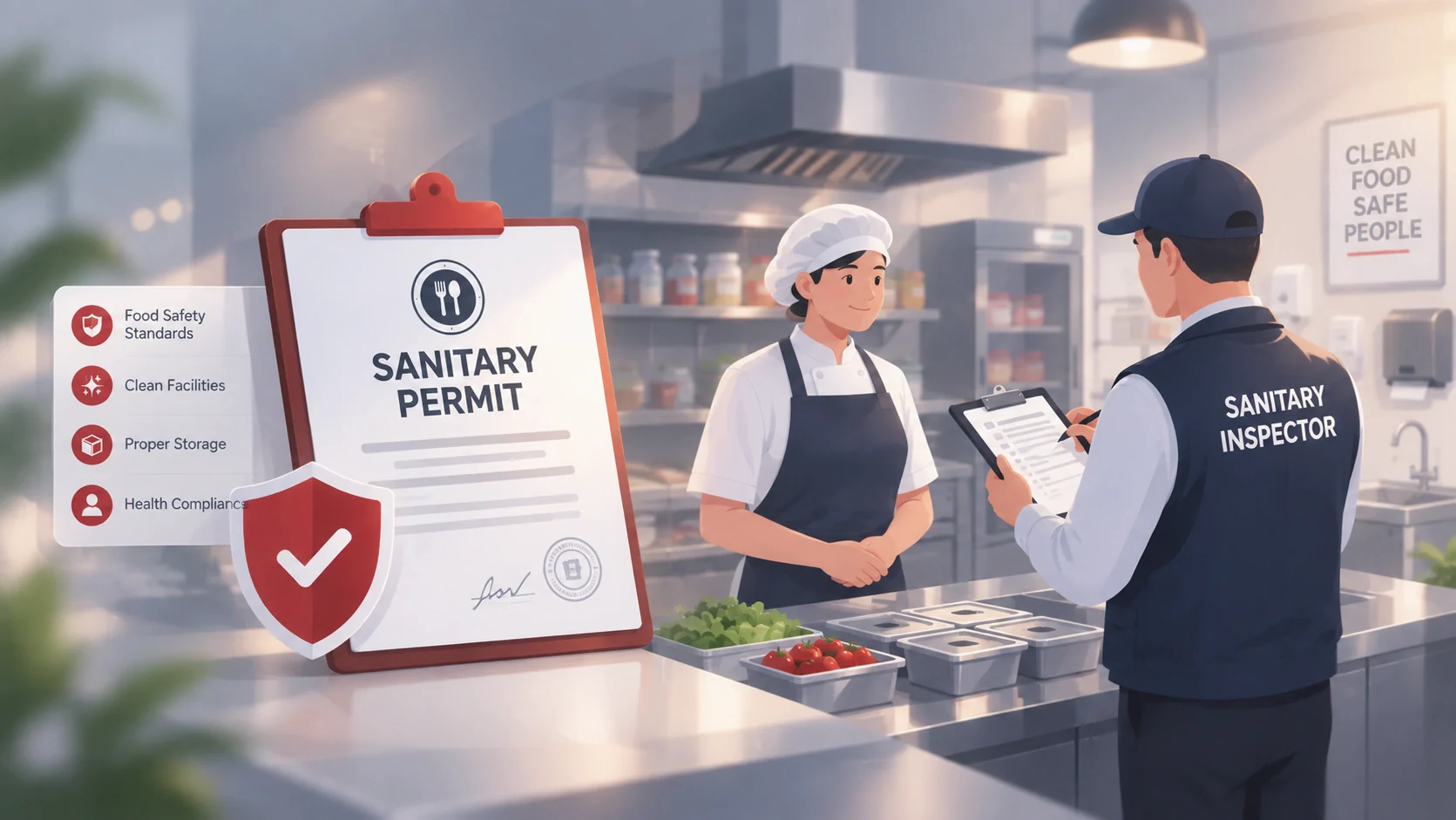
Sanitary permits are issued by the City or Municipal Health Office under PD 856, but each LGU sets its own fees, forms, requirements, and processing timelines. As a result, requirements can differ between cities even under the same national law.
Differences may include floor plan formats, additional clearances, inspection procedures, and processing times. Some LGUs may issue permits within a few days, while others require more time depending on their procedures and workload.
To confirm your specific requirements before you begin:
- Check the citizen's charter published by your LGU, it must legally state the processing time, fees, and documentary requirements
- Contact the Business Permits and Licensing Office (BPLO), which coordinates business registration requirements across city departments
- Visit or call your local City or Municipal Health Office directly
Some LGUs publish their full procedure online. Makati City, for example, posts its own step-by-step guide, and many cities publish their citizen's charters on their official government websites. Always confirm against the LGU that covers your actual business address, not the nearest or most convenient office.
Staying Inspection Ready After the Permit Is Issued
Getting the permit is not the finish line. Health certificates expire on different dates, the permit itself expires at year end, and an inspection can arrive without notice. The challenge grows quickly for operators managing several branches across different LGUs.
Keep a record of the permit expiry date and every worker's health certificate expiry date, and store copies of all documents where they can be produced during a surprise inspection. Maintaining the physical standards from Chapter III is just as important as the paperwork, because a clean file does not help if the kitchen fails a spot check.
This is where a system helps. HashMicro's retail and inventory software lets you track document expiry dates and store permits in one place, so nothing lapses quietly. It does not issue or process permits, but it keeps the compliance paperwork organized.
Conclusion
A sanitary permit is more than a document to collect at city hall. It is the establishment-level clearance that confirms your food business meets the sanitary standards required by PD 856.
The path is straightforward when you follow the right order: register the business, secure the barangay clearance, apply for the sanitary permit, process health certificates, then attach everything to the mayor's permit. The parts that trip up most owners are the LGU-specific fees and renewal dates, so confirm both with your own city or municipality.
Keep permit records and expiry dates organized across business operations. Book a free demo to see how the system can simplify compliance management.

FAQ about Sanitary Permits
No. A sanitary permit evaluates the establishment and its premises, while a health certificate evaluates an individual food handler. Both are issued by the City or Municipal Health Office, but they cover different things.
There is no single national fee. Each LGU sets its own rates through a local ordinance, so the cost varies by city or municipality. Confirm the amount in your LGU's citizen's charter or published revenue code.
A sanitary permit is generally valid for one calendar year and is renewed alongside the business permit at the start of the year. The exact window is set by each LGU.
No. The sanitary permit is a prerequisite for the mayor's or business permit, so the business cannot legally operate until the permit is issued.
Generally yes. The requirement follows the food handling activity, not the storefront, so a home kitchen that prepares or repacks food for sale can be subject to the same sanitary standards.
Under PD 856, operating without a sanitary permit can lead to fines, closure of the establishment, or criminal liability. The health office can order the business to stop operating until the permit is secured.