




A customer orders online, the spreadsheet says the item is in stock, and the shelf says otherwise. For many Philippine businesses, that gap is a weekly problem, and it widens the moment a second warehouse or a second sales channel comes into play.
The Philippine Statistics Authority Philippine Statistics Authority counted 1.24 million MSMEs in the country, or 99.6% of all registered businesses. A large share of them still run inventory on spreadsheets, which holds up until order volume rises and manual updates fall behind.
Zoho Inventory is one of the tools that comes up most often as the fix, with a free plan, affordable paid tiers, and solid coverage of the basics. This Zoho Inventory review walks through the features, pricing in USD and pesos, what verified users report, and four alternatives worth comparing for the Philippine market.
Key Takeaways
Zoho Inventory is a cloud-based inventory and order management platform that fits best inside the Zoho ecosystem, where it syncs natively with Zoho Books, Zoho CRM, and Zoho Analytics.
Shopee Philippines and Lazada Philippines are not natively supported, so local sellers rely on third-party connectors that add roughly ₱570 to ₱1,710 per month.
Pricing begins at $29 per month on annual billing, around ₱1,653, and scales by order volume, users, and warehouses rather than by features alone.
What Is Zoho Inventory? A Quick Overview Before You Buy
Zoho Inventory is a cloud-based inventory and order management platform from Zoho Corporation. It handles purchase orders, sales orders, stock tracking across multiple warehouses, and e-commerce integrations from one dashboard.
In 2026, it holds a 90% user satisfaction rating from 527 verified reviews across Capterra. That places it among the better-rated tools in its category.
The best fit is a business already running other Zoho products, since Zoho Books and Zoho CRM connect natively with no re-entry or duplicate records. Sellers on Shopify, Amazon, eBay, or Etsy also get native integrations, and Philippine SMBs handling under 500 orders a month can get real value from the free or Standard plan.
Zoho Inventory Key Features: What You Actually Get on Each Plan
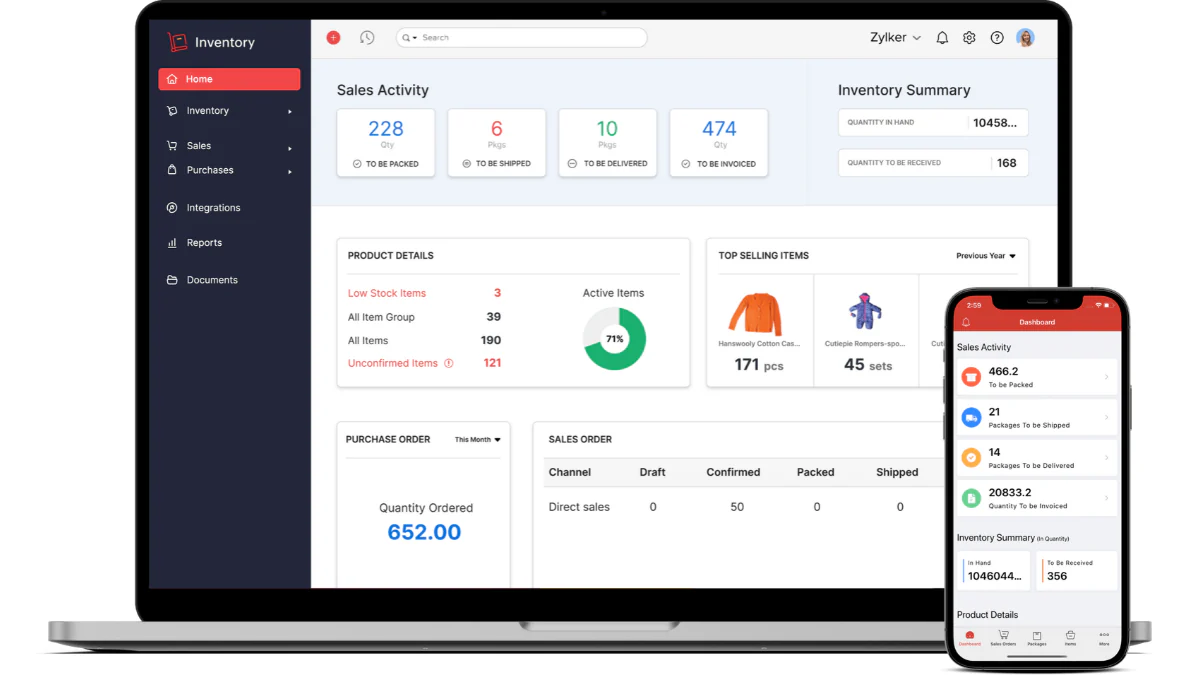
Zoho Inventory covers the core of inventory work without much fuss. Below is what each feature actually delivers and which plan tier unlocks it.
1. Order Management
Zoho Inventory handles purchase orders and sales orders in one place. You can create, track, and fulfill across multiple channels without switching tools.
Backorders and dropshipping are both supported. A distributor processing 200+ purchase orders a month can automate PO-to-sales-order conversion and cut hours of manual entry.
2. Multi-Warehouse Management
You can run several warehouse locations, with the limit set by your plan. Free covers 1 warehouse, Standard 2, Premium 4, and Enterprise 10 or more.
For a retailer with a main hub in Metro Manila and a branch in Cebu or Davao, Standard is the entry point. Stock transfers between locations are built in, and each warehouse can carry its own reorder rules.
3. Batch and Serial Number Tracking
This unlocks from the Standard plan onward. You can assign serial numbers to individual units or lot numbers to batches, with expiry dates handled through FIFO allocation.
It matters most for food distributors, pharmaceutical importers, and electronics sellers. Those businesses need traceability from receipt all the way to delivery.
4. Barcode and RFID Support
Your team can scan items in and out using a mobile device or a dedicated scanner. Label printing comes with all paid plans, while RFID starts at Premium.
The workflow is simple: scan a shipment at receiving and stock levels update right away. That removes manual counting and keeps errors down during peak season.
5. Ecommerce Integrations
Zoho Inventory connects natively to Shopify, Amazon, eBay, and Etsy. These integrations are included in every plan at no extra setup cost.
Shopee Philippines and Lazada Philippines are not supported natively. Connecting them needs a third-party service such as Commercium or SKUPlugs, which adds roughly $10 to $30 a month on top of your plan.
6. Zoho Ecosystem Integration
If you already use Zoho Books, Zoho CRM, or Zoho Analytics, everything links natively. A confirmed sales order flows straight into Zoho Books with no export and no re-entry.
This is where Zoho Inventory pulls ahead of standalone tools. A business already standardised on Zoho gets the most value here.
7. Ease of Use and Setup
Capterra reviewers in 2026 point to an easy learning curve and clean order management. The 4.5 out of 5 ease-of-use score lines up with that feedback.
Setup runs in four steps: create your account, add warehouses, import your product list, then connect your sales channels. Most small teams are operational within a day, and the iOS and Android app covers barcode scanning and order management on the go.
Zoho Inventory Pros and Cons
Zoho Inventory carries a 90% user satisfaction rating in 2026. The overall score is strong, though the details decide whether it fits a Philippine operation.
What Zoho Does Well
- A free plan that is genuinely usable. You get 50 orders, 2 users, and 1 warehouse at no cost, which is one of the better free tiers in this category.
- An affordable Standard plan. At $29 per month on annual billing, roughly ₱1,653, it sits within reach of most PH SMBs.
- Native Zoho ecosystem sync. Zoho Books, CRM, and Analytics connect without manual exports or duplicate entry.
- Solid international channel support. Shopify, Amazon, eBay, and Etsy integrations come included on every plan.
- A capable mobile app. The iOS and Android versions handle barcode scanning and order updates from the warehouse floor.
Where It Falls Short
- No native Shopee or Lazada connection. Third-party connectors cover the gap but add around ₱570 to ₱1,710 per month.
- A tight free plan order cap. Fifty orders a month disappear quickly once a Shopee campaign or peak season starts.
- Customization takes effort. Capterra reviewers describe report and automation setup as confusing without guidance.
- Thin analytics on lower tiers. Zoho Analytics is a paid add-on and does not come with Standard.
- Timezone gaps in support. Users outside the US report slower response times.
How Much Does Zoho Inventory Cost in 2026?
All figures below come from Zoho's official pricing page, checked on 15 October 2026. Peso amounts use ₱62.92 per USD as of the same date, so confirm the live rate with your bank before you subscribe.
| Plan | Annual billing / Monthly | Peso Equivalent | Orders | Locations | Users |
|---|---|---|---|---|---|
| Free | $0 | ₱0 | 50 | 1 | 1 |
| Standard | $29 | ≈₱1,825 | 500 | 2 | 3 |
| Premium | $79 | ≈₱4,971 | 3,000 | 4 | 5 |
| Plus | $129 | ≈₱8,117 | 7,500 | 6 | 10 |
| Enterprise | $249 | ≈₱15,668 | 15,000 | 10 | 10 |
All figures come from the Zoho official pricing page, verified 15 October 2026. Peso amounts use ₱62.92 per USD. Prices exclude local taxes.
Free Plan at ₱0
The free tier is a real starting point rather than a demo. You get 50 orders a month, 1 user, and 1 location without paying anything.
It suits a solo seller testing the platform or a micro business with steady low volume. A single Shopee flash sale can burn through 50 orders in two days, so plan around that before you build your workflow on it.
Standard Plan at ₱1,825 a Month
This is where most small Philippine businesses start. The plan covers 500 orders a month, 3 users, and 2 locations.
Batch and serial tracking are included from this tier onward. For a Shopify seller or a Zoho Books user in Metro Manila, the cost sits comfortably inside a monthly software budget.
Premium Plan at ₱4,971 a Month
Premium lifts the ceiling to 3,000 orders a month, 5 users, and 4 locations. RFID support also unlocks at this level.
It fits a distributor adding branches or a retailer running stock across Luzon and the Visayas. Most businesses move here when Standard order limits start blocking fulfilment.
Plus and Enterprise Plans
Plus costs $129 a month, around ₱8,117, and covers 7,500 orders, 6 locations, and 10 users. Enterprise costs $249 a month, around ₱15,668, for 15,000 orders and 10 locations.
At this spend, compare total cost of ownership against platforms with local implementation teams. Support response times and onboarding help often matter more than the licence fee at enterprise volume.
The Real Cost for Shopee and Lazada Sellers
Most pricing breakdowns skip the part that affects Philippine sellers the most. Shopee PH and Lazada PH have no native Zoho Inventory integration.
Connecting them requires a third-party connector that sits outside Zoho's price list. Budget roughly ₱629 to ₱1,888 a month for that layer, equivalent to $10 to $30.
Add-On Costs
- Extra user: $7.50 a month, about ₱472
- Extra 500 orders a month: $7.50 a month, about ₱472
- Extra location: $10 a month, about ₱629
- Advanced autoscans, 50 scans: $8 a month, about ₱503
- Advanced warehousing: $124.17 a month, about ₱7,813
- Free trial: 14 days across paid plans
4 Best Zoho Inventory Alternatives for Philippine Businesses
Zoho Inventory does its job well, but it is not built for every Philippine operation. If the Shopee and Lazada gap, support timing, or per-seat pricing is holding you back, these four options deserve a serious look.
1. inFlow Inventory
inFlow is built around warehouse floor work rather than ecommerce dashboards. Its barcode inventory, pick and pack workflow, and offline-capable desktop client suit teams that move physical stock all day.
Pricing starts at $129 per month on annual billing, or $161 billed monthly, and includes 2 team members. There is no free plan, only a trial, so the entry cost sits well above Zoho Standard.
Best for: PH distributors and workshops that need strong warehouse execution and do not sell on marketplaces.
Watch out for: extra team members are a paid add-on, which gets expensive for larger floors.
2. Cin7
Cin7 targets brands selling across many channels at once. It handles retail, wholesale, and ecommerce inventory in one place with a deep integration library.
The Standard plan costs $349 per month and covers 5 users, 2 integrations, and 6,000 sales orders a year. Pro and Advanced climb to $599 and $1,199 per month, and there is no free tier.
Best for: multi-channel brands past the ₱50 million revenue mark with dedicated ops staff.
Watch out for: the price jump is steep, and implementation usually needs a consultant.
3. Odoo Inventory
Odoo Community is open source and free to self-host, which makes it the cheapest serious option on paper. The inventory app covers multi-warehouse, lots and serials, barcode, and replenishment rules.
The real cost sits in hosting, configuration, and maintenance. Marketplace connections for Shopee or Lazada need custom modules or third-party apps.
Best for: teams with an in-house developer or a trusted local Odoo partner.
Watch out for: no vendor support on Community, so every issue becomes your problem.
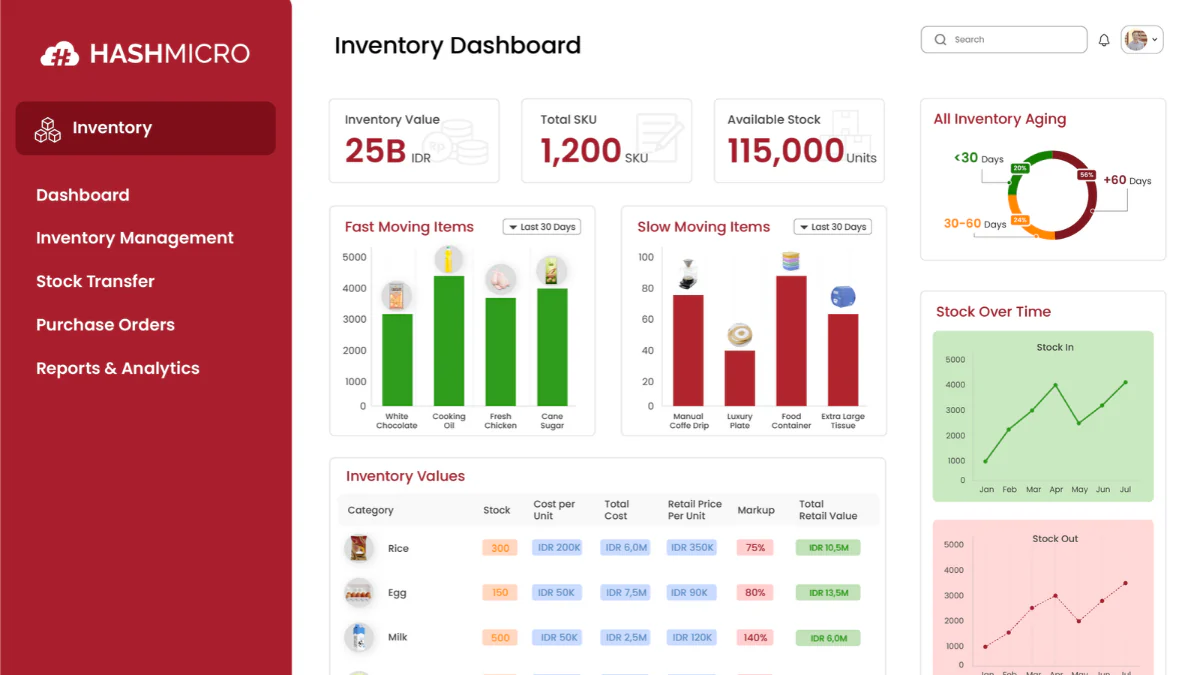
4. HashMicro Inventory Software
HashMicro takes a different approach from the other three. Instead of a standalone inventory app, it delivers an integrated inventory management system, so a single stock movement updates your books, your purchase plan, and your sales records at the same time.
What the Inventory module covers:
- Multi-warehouse inventory management with real-time stock levels, product variants, and low stock alerts
- Receipt, delivery, and internal transfer management with bin and rack location control
- Batch and serial number tracking for food, pharmaceutical, and electronics traceability
- Stock take and cycle count with an adjustment approval workflow and a full audit trail
- Stock valuation, stock movement history, and aging or slow-moving stock reports
- Demand forecasting, reorder point automation, and seasonal trend analysis
- AI-powered stock insights that surface stockout and overbuying risk before it costs you
Where it pulls ahead for Philippine teams:
- Compliance is built in, not bolted on. The platform is BIR certified and holds ISO 27001 certification, so your stock and accounting records hold up under audit without manual workarounds.
- Support does not sleep. Technical support runs 24/7 across a support portal, email, phone, and live chat, and every client is assigned a dedicated account manager.
- It connects to the rest of your operation. Inventory links natively to accounting software, purchasing, sales, POS, and manufacturing inside the same platform.
- Scale is proven. More than 3,000 companies and 875,000 users run on HashMicro across Asia Pacific.
A free consultation is the fastest way to find out which side you fall on. The Philippine team will walk through your current stock workflow and show you what an integrated setup would actually change.

Conclusion
Zoho Inventory works best when your stack is already Zoho. The native sync with Zoho Books and Zoho CRM removes hours of re-entry each week, and Standard at ₱1,825 a month stays affordable for a growing SMB.
The math shifts once Shopee and Lazada carry your revenue. Neither connects natively, so a third-party connector adds roughly ₱629 to ₱1,888 a month that belongs in your comparison from day one.
For Philippine teams that have outgrown that setup, HashMicro is the closest alternative worth a look, with inventory sitting inside a full ERP system alongside accounting, purchasing, and sales so one stock movement updates everything at once.
Book a free consultation and the Philippine team will map your current workflow and scope an integrated inventory management software setup for your business.
FAQ about Zoho Inventory
At approximately ₱57/USD: the Standard plan (annual billing) costs around ₱1,653 per month. Premium is roughly ₱4,503/month, Plus is ≈₱7,353/month, and Enterprise is ≈₱14,193/month. Always confirm the current exchange rate and check Zoho's official pricing page before subscribing.
Yes, from the Standard plan onward. The free plan supports 1 warehouse only. Standard gives you 2, Premium gives 4, and Enterprise supports 10 or more. Stock transfers between warehouses are built in, and each location can have its own reorder settings.
It depends on your sales channels. For PH SMEs on Shopify, Amazon, or the broader Zoho ecosystem, it's a strong fit. For businesses selling primarily on Shopee and Lazada, the missing native integration adds connector costs that reduce the value of the lower-tier plans. Do the full cost calculation before committing.
For Philippine enterprises needing dedicated local support, unlimited users, and no connector fees for local marketplace channels, HashMicro Inventory is purpose-built for the PH market. For retail inventory management specifically, see our dedicated comparison guide. You can request a free demo at hashmicro.com/ph.
Zoho is ISO 27001-certified and GDPR-compliant. Data is encrypted using AES-256, and Zoho operates multi-region data centers for redundancy. Your data is retained even if you downgrade from a paid plan to the free tier, nothing is automatically deleted when you change plans.
Yes. The mobile app is available on both iOS and Android. It supports barcode scanning, real-time stock lookup, and order management on the go. Mobile access is available on all plans, including the free tier.