






Assets such as equipment, vehicles, computers, furniture, and machinery do not usually lose their value all at once. Instead, businesses spread the cost of these assets across the years they are expected to be used. This process is called depreciation.
Straight-line depreciation is one of the simplest and most widely used ways to calculate that cost. It assigns the same depreciation expense to every accounting period, making it easier for finance teams to plan expenses, monitor asset value, and prepare consistent reports.
For Philippine businesses managing many fixed assets, understanding this method is important because it helps keep asset records, book value, and depreciation schedules organized from year to year. The Philippines has adopted IFRS Standards as Philippine Financial Reporting Standards (PFRSs), so businesses should align depreciation policies with the applicable reporting standards and company accounting policy.
Key Takeaways
Straight-line depreciation spreads an asset's depreciable cost evenly over its useful life. The formula is: (Asset Cost - Salvage Value) / Useful Life.
This method works best for assets that provide relatively consistent value over time, such as office furniture, equipment, fixtures, and certain machinery.
A depreciation schedule helps businesses track annual depreciation expense, accumulated depreciation, and remaining book value.
Manual calculations can work for a few assets, but companies with many assets should use asset management software to maintain accurate asset records and depreciation schedules.
What Is Straight-Line Depreciation?
Straight-line depreciation is an accounting method that records the same depreciation expense for a fixed asset in each period of its useful life. Instead of assigning higher expense in the early years or adjusting based on asset usage, this method divides the depreciable amount evenly.
For example, if a machine has a depreciable cost of PHP 500,000 and a useful life of five years, the business records PHP 100,000 as depreciation expense each year.
This method is called straight-line because the asset's book value declines at a constant rate. If shown on a graph, the decrease forms a straight downward line from the asset's original value to its salvage value.
How Straight-Line Depreciation Works
Straight-line depreciation starts with three main inputs:
1. Asset cost: The total amount paid to acquire and prepare the asset for use. This may include the purchase price and other necessary costs directly related to making the asset operational.
2. Salvage value: The estimated remaining value of the asset at the end of its useful life. Some assets may still be sold, reused, or disposed of for a residual amount after years of use.
3. Useful life: The estimated period during which the asset will provide economic benefit to the business. This can be measured in years, months, or accounting periods, depending on company policy.
Once these values are defined, the business subtracts salvage value from asset cost. The result is the depreciable cost. That amount is then divided evenly across the asset's useful life.
Straight-Line Depreciation Formula
The standard straight-line depreciation formula is:
Where:
Asset cost is the recorded cost of the fixed asset.
Salvage value is the estimated residual value at the end of useful life.
Useful life is the expected number of years the asset will be used.
Annual depreciation expense is the depreciation recorded each year.
If a business needs monthly depreciation, the annual depreciation amount can be divided by 12:
This makes it easier to record depreciation consistently in monthly accounting periods.
How to Calculate Straight-Line Depreciation
To calculate straight-line depreciation, follow these steps:
Identify the asset cost. This is the recorded cost of the asset when it becomes ready for use.
Estimate the salvage value. This is the amount the company expects the asset to be worth at the end of its useful life.
Determine the useful life. This should follow the company's accounting policy and the expected period of asset use.
Subtract salvage value from asset cost to get the depreciable cost.
Divide the depreciable cost by the useful life to get the annual depreciation expense.
Straight-Line Depreciation Example in the Philippines
Suppose a company in the Philippines buys production equipment for PHP 600,000. The company estimates that the equipment will have a salvage value of PHP 60,000 after five years.
The calculation would be:
- Annual Depreciation Expense = (PHP 600,000 - PHP 60,000) / 5
- Annual Depreciation Expense = PHP 540,000 / 5
- Annual Depreciation Expense = PHP 108,000
This means the company records PHP 108,000 as depreciation expense every year for five years.
For monthly reporting:
- Monthly Depreciation Expense = PHP 108,000 / 12
- Monthly Depreciation Expense = PHP 9,000
So, the company may record PHP 9,000 in depreciation expense each month, assuming it recognizes depreciation monthly.

Straight-Line Depreciation Schedule Table
A depreciation schedule shows how the asset's value changes over time. It helps businesses monitor annual depreciation, accumulated depreciation, and book value.
| Year | Beginning Book Value | Annual Depreciation | Accumulated Depreciation | Ending Book Value |
|---|---|---|---|---|
| 1 | PHP 600,000 | PHP 108,000 | PHP 108,000 | PHP 492,000 |
| 2 | PHP 492,000 | PHP 108,000 | PHP 216,000 | PHP 384,000 |
| 3 | PHP 384,000 | PHP 108,000 | PHP 324,000 | PHP 276,000 |
| 4 | PHP 276,000 | PHP 108,000 | PHP 432,000 | PHP 168,000 |
| 5 | PHP 168,000 | PHP 108,000 | PHP 540,000 | PHP 60,000 |
The ending book value reaches PHP 60,000, which is the estimated salvage value. The asset should not be depreciated below this value under the assumptions used in the example. For a full walkthrough of how to build and structure this table, see this guide on the depreciation schedule.
When Should Businesses Use Straight-Line Depreciation?
Straight-line depreciation works best when an asset delivers relatively equal value throughout its useful life and does not lose most of its worth right after purchase. It also suits businesses that need simple, predictable expense allocation, since the depreciation amount stays the same each period and makes forecasting easier.
Consider straight-line depreciation in these situations:
- Assets with steady usage: office furniture, fixtures, tools, and buildings that are used at a similar level each year.
- Predictable expense planning: finance teams need a fixed annual charge to forecast expenses and keep reporting consistent.
- Simpler bookkeeping: the calculation stays the same every period, so it is easier to review, audit, and explain.
- Long useful life: assets such as computers and machinery that stay productive over several years without a sharp early drop in value.
This method is less suitable for assets that lose value quickly or deliver more benefit in their first years. For those cases, compare it with accelerated approaches such as the double declining balance method.
How to Record Straight-Line Depreciation in Journal Entries
Depreciation is usually recorded as an expense while also increasing accumulated depreciation.
| Account | Debit | Credit |
|---|---|---|
| Depreciation Expense | PHP 108,000 | - |
| Accumulated Depreciation | - | PHP 108,000 |
Depreciation expense appears on the income statement. Accumulated depreciation is a contra-asset account that reduces the asset's carrying value on the balance sheet.
If the company records depreciation monthly, the journal entry would use PHP 9,000 instead of PHP 108,000. Monthly depreciation is one of the most common adjusting journal entries businesses record at the end of each period.
Advantages and Limitations of Straight-Line Depreciation
Straight-line depreciation is the simplest method to apply, but its simplicity is also where its weaknesses come from. The table below pairs each advantage with the limitation that comes with it, so you can judge whether the method fits your assets.
| Advantages | Limitations |
|---|---|
| Easy to calculate, since it only needs asset cost, salvage value, and useful life. | Depends heavily on estimates, especially salvage value and useful life. |
| Supports consistent reporting because the depreciation expense stays the same every year. | May not reflect actual usage when an asset loses value faster in its early years. |
| Easier to explain to managers and stakeholders than more complex methods. | May oversimplify performance, since two assets with the same cost and useful life can still decline differently. |
| Works well for assets that deliver similar value each year. | Requires regular record updates when an asset is sold, scrapped, damaged, impaired, or reclassified. |
| Simplifies asset planning because future depreciation expense and book value are easy to estimate. | May not fit every accounting or tax situation, so policies should be confirmed with qualified accounting professionals. |
Straight-Line Depreciation vs Double Declining Balance Method
Straight-line depreciation records the same expense every year. The double declining balance method records higher depreciation in the earlier years and lower depreciation later.
| Factor | Straight-Line Depreciation | Double Declining Balance |
|---|---|---|
| Expense pattern | Equal each year | Higher in early years |
| Best for | Stable-use assets | Assets that lose value quickly |
| Calculation | Simple | More complex |
| Book value decline | Even decline | Faster early decline |
| Reporting style | Predictable and steady | Accelerated depreciation |
Straight-line depreciation is usually easier for general planning and reporting. Double declining balance may be more appropriate when an asset provides greater value or loses value faster during its earlier years.
Common Mistakes When Calculating Depreciation
Straight-line depreciation looks simple, but most errors happen before the formula is even applied. Wrong input values, outdated asset records, and inconsistent reporting periods are the usual causes, and they carry over into the balance sheet and income statement for years. Knowing where the method usually breaks makes it easier to catch problems during review instead of during an audit.
- Forgetting to subtract salvage value. Depreciation should be based on depreciable cost, not always the full asset cost.
- Using an unrealistic useful life. If useful life is too short, depreciation expense may be overstated. If it is too long, expense may be understated.
- Failing to stop depreciation at salvage value. In the example above, the asset should end at PHP 60,000, not zero, because salvage value was included in the calculation.
- Keeping inconsistent monthly and annual records. If depreciation is calculated annually but reports are prepared monthly, the monthly depreciation amount should be applied consistently.
- Not updating depreciation when assets change status. When assets are sold, scrapped, transferred, or disposed of, skipping the update creates mismatches between asset registers, accounting records, and management reports.
How Asset Management Software Helps Manage Depreciation More Accurately
How-Asset-Management-Software-Helps-Manage-Depreciation-More-Accurately
How-Asset-Management-Software-Helps-Manage-Depreciation-More-Accurately
How Asset Management Software Helps Manage Depreciation More Accurately
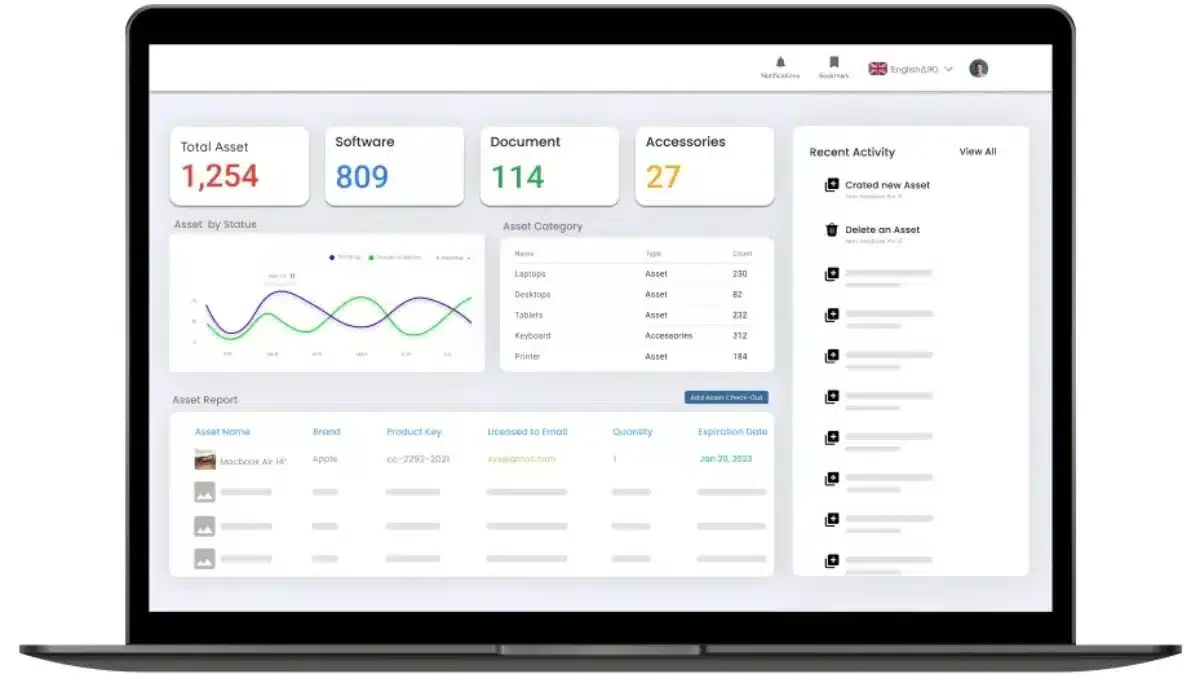
Straight-line depreciation is simple for one asset, but it becomes harder to manage when a business owns many assets across departments, branches, categories, and useful lives. These can lead to inconsistent asset names, duplicate records, missed updates, and incorrect book values.
HashMicro helps businesses organize fixed asset records, monitor depreciation schedules, and maintain visibility over asset value in one system. This supports finance teams that need cleaner asset data, consistent depreciation tracking, and more reliable reporting preparation.
Relevant HashMicro Asset Management Software features include:
- Asset registration: stores fixed asset details such as asset category, acquisition cost, location, custodian, and asset status in one system.
- Depreciation and book value tracking: helps teams monitor depreciation schedules, accumulated depreciation, and remaining book value more clearly.
- Asset movement tracking: records asset transfers between locations, departments, or custodians to keep asset records updated.
- Asset physical verification: supports asset checks by comparing recorded assets with actual location, condition, custodian, and count results.
- Asset disposal and sale lifecycle: manages asset retirement, disposal, or sale workflows with status tracking and approval control.
- Asset reporting and audit trail: gives finance and asset teams better visibility when reviewing asset value, depreciation history, and record changes.
You can request a consultation with HashMicro to identify gaps in your fixed asset records, depreciation schedules, and book value tracking.
Conclusion
Straight-line depreciation is a simple method for spreading the cost of a fixed asset evenly across its useful life. It uses asset cost, salvage value, and useful life to calculate a consistent depreciation expense each period.
This method is useful for businesses that need predictable reporting and straightforward asset tracking. However, companies still need accurate asset records, realistic useful life estimates, and organized depreciation schedules to avoid reporting errors.
For businesses managing many fixed assets, HashMicro's Asset Management Software can help track asset details, monitor depreciation schedules, and keep book value information organized across the company.

FAQ Around Straight-line Depreciation
Straight-line depreciation spreads an asset's depreciable cost (acquisition cost - salvage value) evenly across its useful life, so every full period carries an identical charge. It is also known as the fixed-instalment method. Example: equipment costing PHP 600,000 with a PHP 60,000 salvage value and a five-year life depreciates at PHP 108,000 per year, or PHP 9,000 per month.
Subtract salvage value from asset cost to get the depreciable cost, then divide by useful life in years. For equipment costing PHP 600,000 with a PHP 60,000 salvage value over five years: (600,000 − 60,000) ÷ 5 = PHP 108,000 per year, or PHP 9,000 per month. In a spreadsheet, the same result comes from =SLN(600000, 60000, 5).
It works well for office furniture, fixtures, buildings, and equipment with predictable usage because it records the same expense each period. It is less suitable for assets that lose value quickly in the early years or assets whose wear depends heavily on production volume, such as vehicles, computers, or high-use machinery.
Straight-line amortization spreads the cost of an intangible asset evenly over its useful life. It uses the same logic as straight-line depreciation, but applies to non-physical assets such as software licenses, patents, trademarks, or franchise rights.
That would be true in full years, but the first and last years usually are not. When an asset is acquired or disposed of mid-year, the charge is prorated by the months it was in use, so those years are smaller. The amount also changes prospectively if you revise useful life or salvage value, and depreciation stops entirely once book value reaches salvage value, even if the asset is still in service.
The National Internal Revenue Code allows a reasonable allowance for depreciation computed under the straight-line method, the declining-balance method, the sum-of-the-years-digits method, or another method prescribed by the Secretary of Finance. Straight-line is the most widely used because it is the easiest to support during a BIR examination. Your book method under PFRS and your tax method do not have to be identical. You reconcile any difference in the income tax return.