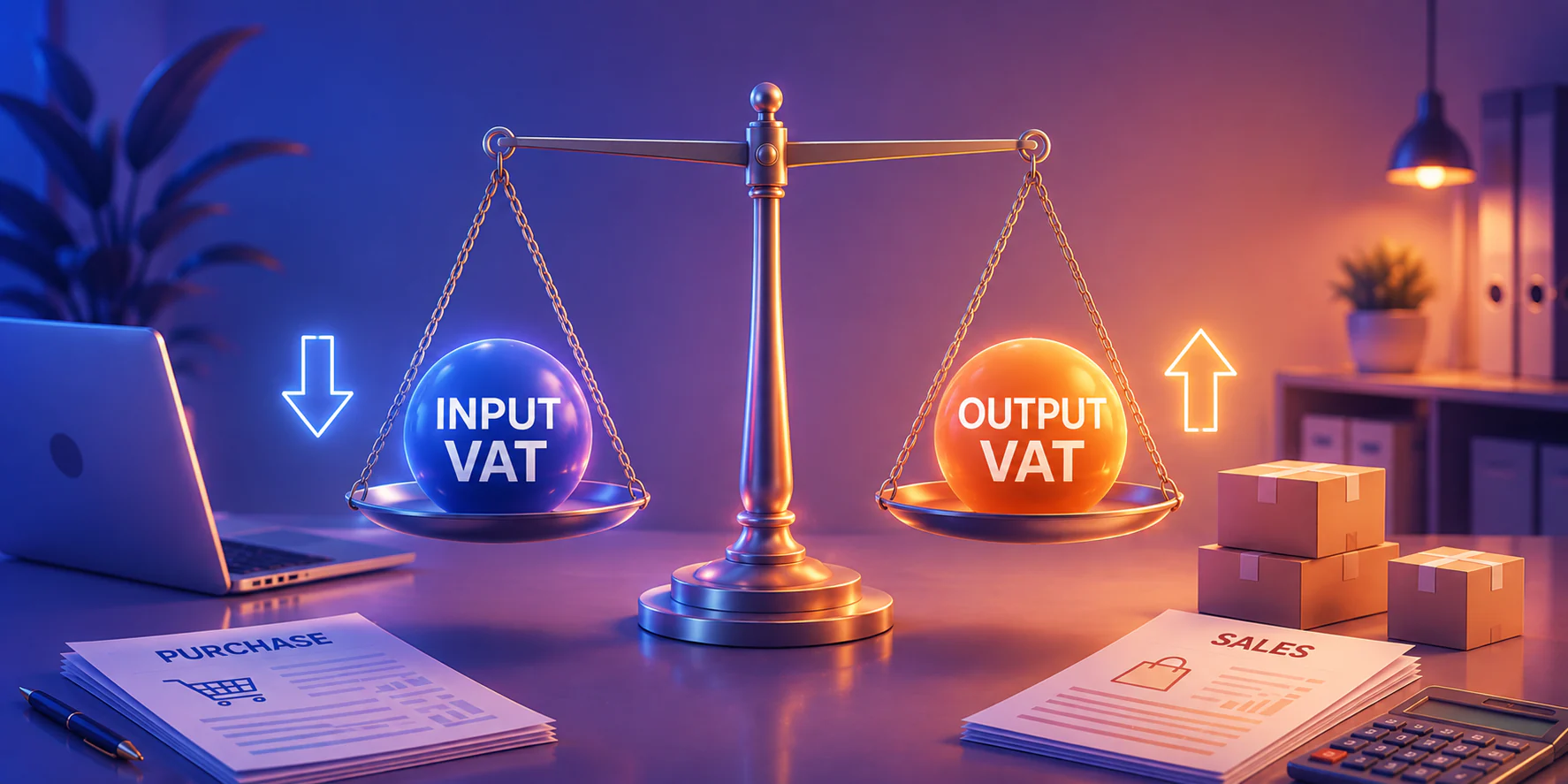







Many Philippine businesses close sales on time but still struggle to pay suppliers, salaries, and rent. The cause is rarely poor performance. It is unpaid invoices sitting on 30, 60, or even 90-day payment terms while daily expenses continue to arrive.
That gap is not unique to one company. The Asian Development Bank estimates a global trade finance gap of around USD 2.5 trillion, with small and medium enterprises among the most affected, according to its 2023 Trade Finance Gaps, Growth, and Jobs Survey. It is what pushes finance teams to look into invoice factoring, a funding option that converts outstanding invoices into immediate working capital instead of waiting for customers to settle.
This article explains how invoice factoring works, what it truly costs, the risks worth checking first, and a practical checklist for choosing a provider that fits your cash flow needs.
Key Takeaways
Invoice factoring turns unpaid invoices into cash without adding debt. A business sells eligible receivables to a provider and receives most of the value upfront.
The provider assesses your customer, not just your business. Funding depends on whether each invoice is approved, undisputed, and backed by delivery evidence.
The real cost sits beyond the headline rate. Service fees, the reserve held back, and recourse terms all shape what factoring actually costs you.
Preparation determines the terms you are offered. An ageing report, clear ownership of collections, and a reconciliation trail make your receivables easier to verify.
What Is Invoice Factoring and What Does It Change?
Invoice factoring is a financing arrangement in which a business sells eligible unpaid invoices to a factoring provider in exchange for early payment. Three parties are involved, including the seller that issued the invoice, the provider that advances the money, and the customer that owes payment.
Factoring changes the timing and administration of receivables, not their underlying quality. It does not increase sales, validate an unapproved invoice, or turn an uncollectible debt into profit. Unlike a conventional loan, the assessment focuses mainly on the receivable and the customer expected to pay it.
This control view is valuable whether or not the company proceeds with accounts receivable financing. A reliable record of changes and approvals also strengthens the business’s audit trail.
How Does Invoice Factoring Work From Invoice to Settlement?
How Does Invoice Factoring Work From Invoice to Settlement?
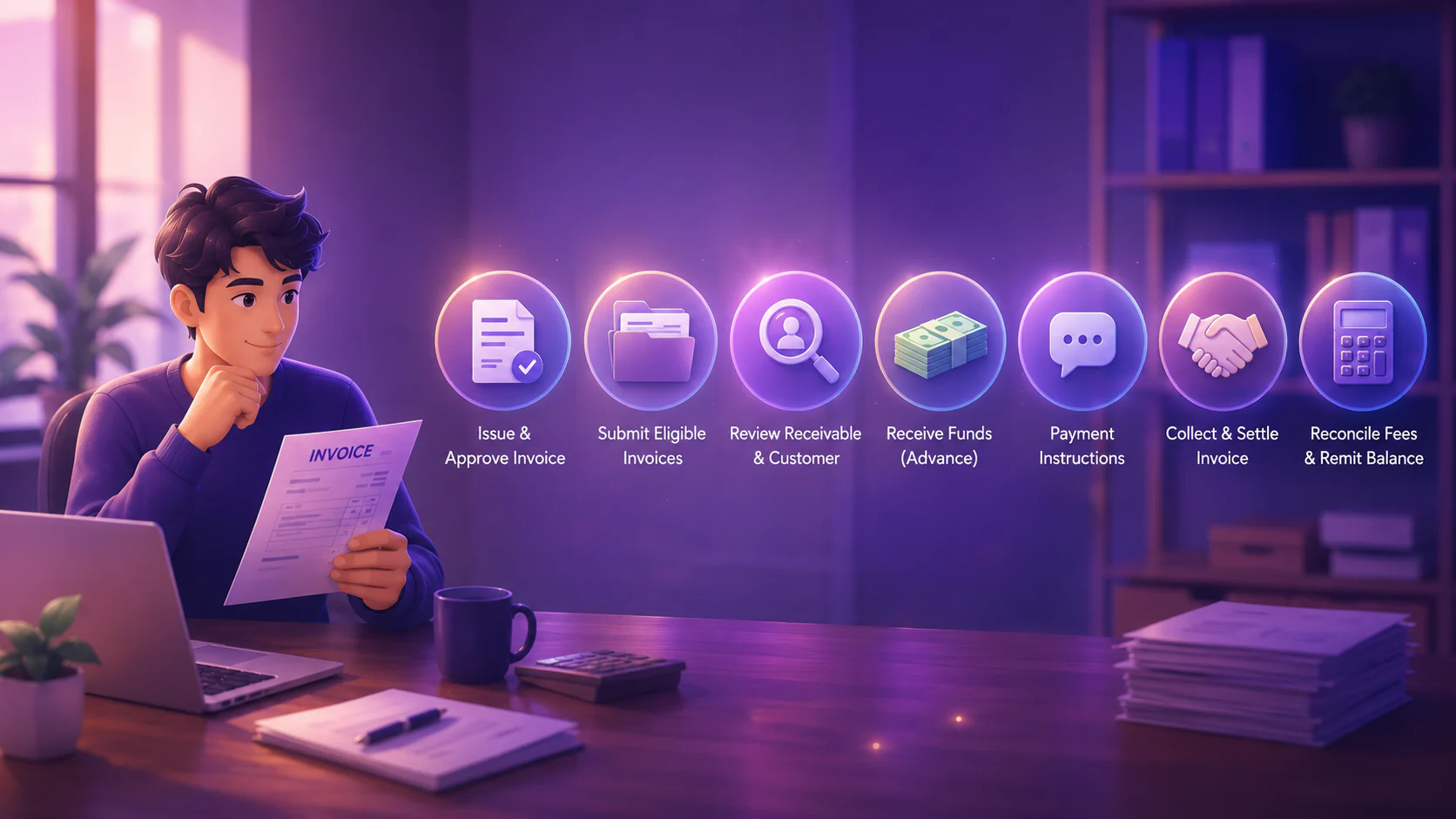

The invoice factoring process generally begins after a business issues an eligible invoice and ends when the customer settles it. The provider reviews the invoice and customer, makes funds available under the agreed terms, and then reconciles the customer payment, reserve, and charges. Actual procedures vary by provider and contract.
- Issue and approve the invoice. The seller creates an invoice after delivery or service completion and confirms its invoice number, amount, due date, customer, purchase order or delivery evidence, and approval status.
- Submit eligible invoices. The seller sends invoices and supporting records to the factoring provider. Eligibility may exclude invoices with disputes, unusual payment terms, related-party issues, or missing documentation. A proforma invoice also falls outside scope, because it is a preliminary quotation rather than a final demand for payment.
- Review the receivable and customer. The provider reviews the invoice, customer payment history, concentration exposure, documentation, and any dispute notes. This is a review of the receivable, not a guarantee that every submitted invoice will be funded.
- Receive funds under the agreed structure. If accepted, the provider makes an advance or other agreed payment to the seller. The amount, timing, reserve treatment, and charges are contractual.
- Give payment instructions where applicable. In disclosed or notification arrangements, the customer may be told where or to whom to pay. In other arrangements, customer communication may be handled differently. Confirm the exact process before invoices are submitted.
- Collect and settle the invoice. The customer pays on or before the due date, subject to its normal payment process. The seller and provider should track payment status, partial payments, deductions, and collection activity.
- Reconcile fees and remit any balance. After settlement, the provider deducts applicable charges and resolves any reserve or remaining balance according to the agreement. The seller should reconcile each movement to the underlying trade receivables.
Consider a service company that invoices a corporate customer after completing a project milestone. If the customer disputes part of the work, the dispute still needs evidence-based resolution before the invoice can settle.
Funding does not remove the need to establish invoice validity, manage customer communication, or follow the contract's recourse and reserve rules. The same applies to late, rejected, or partially paid invoices. Document how your team handles customer deductions and partial payments before the first invoice is submitted.
Invoice Factoring Cost Example in PHP
To see how invoice factoring affects cash flow, consider a Philippine business as an example, with a ₱500,000 invoice due in 60 days. The factoring provider approves an 80% advance, holds a 20% reserve, and charges a sample factoring fee of 2.5% of the invoice value.
| Component | Calculation | Amount |
|---|---|---|
| Invoice value | - | ₱500,000 |
| Initial advance | 80% x ₱500,000 | ₱400,000 |
| Reserve held | 20% x ₱500,000 | ₱100,000 |
| Factoring fee | 2.5% x ₱500,000 | ₱12,000 |
| Reserve released after fee | ₱100,000 - ₱12,000 | ₱87,500 |
| Total cash received | ₱400,000 + ₱87,500 | ₱487,500 |
In this example, the business receives ₱400,000 upfront instead of waiting for the customer to pay after 60 days. Once the customer settles the invoice, the provider releases the remaining reserve after deducting the factoring fee. The total cash received is ₱487,500 before any additional provider-specific charges.
Actual factoring costs may vary depending on the provider, customer credit quality, invoice age, dispute status, recourse terms, service fees, and supporting documents such as purchase orders, delivery proof, and aging reports.
Which Types of Invoice Factoring Fit Different Risk Profiles?
The practical difference between types of invoice factoring is not simply the headline funding amount. Labels differ among providers, so the contract governs the obligation
| Cost Structure | Practical trade-off | Customer visibility |
|---|---|---|
| Recourse factoring | The seller may remain responsible for specified non-payment outcomes. | May be disclosed or confidential. |
| Non-recourse factoring | The provider may accept specified credit-loss exposure, but exclusions can still apply. | May be disclosed or confidential. |
| Disclosed or notification factoring | The customer is informed of payment instructions or the provider’s role. | Visible to the customer. |
| Confidential or non-notification arrangement | The seller may retain more direct customer-facing administration. | Not generally disclosed at the outset, subject to terms. |
| Selective or spot factoring | The business submits selected invoices rather than the entire ledger. | Depends on the agreement. |
| Whole-ledger arrangement | The provider assesses a wider receivables portfolio. | Depends on the agreement. |
These dimensions stack rather than replace each other, so one agreement can be non-recourse, confidential, and selective at the same time. Decide which risks your team is willing to retain, then ask the provider about each one separately.
- Customer default and fraud: Confirm who absorbs the loss when a customer fails to pay or an invoice is later challenged as invalid.
- Dispute handling: Confirm who investigates a disputed invoice and whether funding is withdrawn while the dispute stays open.
- Collection ownership: Confirm who chases payment, how promises to pay are recorded, and when escalation begins.
- Reserve release: Confirm what triggers the release of retained funds and what can delay it.
- Concentration and termination: Confirm the limit on a single customer's share and the notice period for ending the agreement.
When Should a Business Consider Invoice Factoring?
A business may consider invoice factoring when its eligible receivables are sound but customer payment timing creates a recurring funding gap. Where invoices are incomplete, frequently disputed, or poorly collected, investigate the process cause first.
Potential signals for further assessment include:
- Long customer payment cycles that conflict with near-term supplier, payroll, or operating commitments.
- Seasonal purchasing or delivery patterns that create predictable working-capital pressure.
- Growth that increases approved receivables faster than the business can convert them to cash.
- A high share of cash tied to a manageable set of creditworthy, properly documented customers.
- A need for more disciplined cash forecasting and clearer ownership of collections.
Treat these as prompts for analysis. A business with frequent disputes usually has a billing or credit-control problem that financing will not solve. A company that needs permanent capital for expansion should compare longer-term options instead of relying on short-term receivables funding.
Use a simple internal readiness gate before approaching providers:
| Decision outcome | What the evidence suggests | Immediate action |
|---|---|---|
| Investigate factoring | Approved invoices, credible customer payment history, clear documentation, and a forecastable timing gap. | Prepare a provider information pack and compare structures. |
| Improve receivables controls first | High disputes, incomplete approvals, unclear collection ownership, or unreliable invoice data. | Fix invoicing, approval, dispute, and collection workflows. |
| Evaluate another capital option | The need is long-term, receivables are weak, or customer concentration is excessive. | Review the capital requirement and risk profile with advisers. |
A practical scorecard can include days sales outstanding, overdue balance by customer, disputed-invoice value, top-customer concentration, average approval delay, and the date of a forecast cash shortfall. These are internal decision inputs, not industry benchmarks. Good accounts receivable software can make those inputs more accessible, but finance ownership and data discipline still matter.
What Are the Costs, Risks, and Contract Limits?
Invoice factoring cost has several moving parts. It is built from the advance, the reserve held back, the service fee, and any charge triggered by a late or disputed invoice. Risk and contract terms shape that figure just as much as the headline rate. Finance leaders should compare the total against the cash-flow problem being solved rather than the amount released on day one.
Use this worksheet in provider discussions:
| Cost or risk item | Trigger or calculation basis | Timing | Responsibility and review question |
|---|---|---|---|
| Advance or initial funding | Eligible gross invoice value under the agreement. | At funding. | Confirm what reduces eligibility and whether funding can change after review. |
| Reserve or holdback | Amount retained until settlement or another contractual event. | Held and released as agreed. | Who controls release, and what can delay it? |
| Factoring fee | Defined service or financing charge. | As stated in the contract. | What is the calculation basis, minimum, and billing frequency? |
| Administration or verification charge | Invoice, customer, document, or service activity. | Per event or period. | Which activities create an additional charge? |
| Overdue or late-payment charge | Customer payment after the agreed trigger. | If triggered. | Does the seller bear the cost and how is the trigger communicated? |
| Recourse obligation | Specified non-payment, dispute, dilution, or eligibility event. | If triggered. | Is repayment, invoice replacement, or reserve deduction required? |
| Renewal or termination condition | Minimum term, volume, notice period, or exit event. | At renewal or exit. | What commitments remain after termination? |
Settlement follows a simple sequence. Start with the gross invoice value, deduct the reserve retained, add the funds already received, then deduct provider charges and adjust for what the customer actually pays. Take the real amounts and the order of calculation from the provider agreement.
Price is only part of the exposure. Concentration makes a portfolio fragile when one delayed buyer can hold up the whole facility. Confidentiality terms and collection conduct also shape how customers experience the arrangement, and both sides need proof that an invoice is real rather than financed twice. Before signing, get written treatment of disputes, deductions, collection escalation, and late payment, then have Philippine legal, tax, and accounting professionals review the agreement.
How Can You Evaluate an Invoice Factoring Provider?
A defensible provider evaluation covers both financing terms and receivables governance. Use seven criteria: eligibility, risk allocation, total cost, customer communication, collection operations, reporting and data handling, and contract flexibility. Require provider evidence and compare it with internally generated receivables data.
| Criterion | Question for the provider | Evidence the finance team should request or prepare |
|---|---|---|
| Eligibility | Which invoices, customers, industries, and documents qualify? | Eligibility policy; invoice ageing; delivery and approval evidence. |
| Risk allocation | What happens after late payment, dispute, dilution, or customer insolvency? | Contract clauses; recourse examples; dispute workflow. |
| Total cost | What charges, reserves, minimums, and exit conditions apply? | Full fee schedule; sample settlement statement; termination clauses. |
| Customer communication | Will customers be notified, and who manages the conversation? | Notification template; escalation process; relationship-owner plan. |
| Collection operations | Who follows up, records promises to pay, and resolves deductions? | Collection responsibilities; service levels; internal collection records. |
| Reporting and data handling | What data is needed and how are transactions reported and protected? | Data requirements; report samples; access-control and retention terms. |
| Contract flexibility | Can the business factor selected invoices, change limits, or exit reasonably? | Volume commitments; concentration limits; notice and renewal provisions. |
Assign an internal weight to each criterion and mark evidence as complete, partial, or missing. This avoids allowing a strong funding offer to overshadow a weak dispute process or unclear customer-notification plan.
A company that prioritises confidentiality should test the notification process and overdue triggers carefully. A business with customer concentration should focus on concentration limits, eligibility, and what occurs when its largest buyer is delayed. An enterprise that needs audit-ready controls should test the report fields, reconciliation process, user access, and approval history before implementation.
How Can ERP Improve Invoice Factoring Readiness?
How Can ERP Improve Invoice Factoring Readiness?
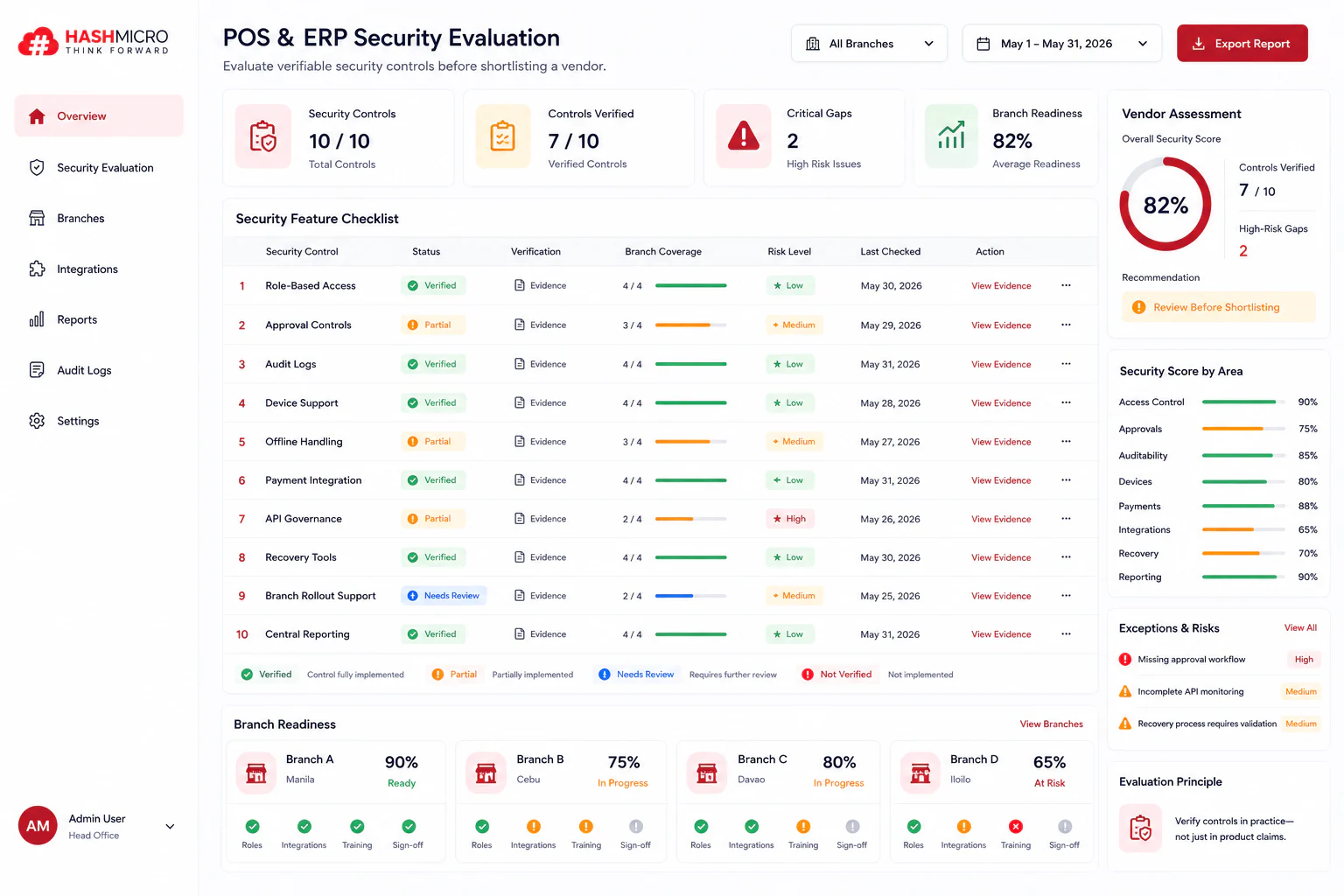
An ERP shortens the internal invoice factoring assessment by putting accounts receivables data and the controls behind it in one place. Approval and pricing still rest with the provider, but the finance team stops assembling evidence from spreadsheets and email threads.
For example, a finance team can use an ERP workflow to review:
- Invoice date, due date, customer, amount, and outstanding balance.
- Approval status and supporting records tied to delivery or service completion.
- Dispute status, reason codes, credit notes, and collection ownership.
- Reconciliation between customer receipts, provider statements, reserves, and fees.
Governance matters as much as visibility. A controller should be able to trace who changed an invoice status, who approved a credit note, and whether a collection action was recorded. That audit trail is what a provider asks for when it verifies that an invoice is genuine and not already financed elsewhere.
HashMicro's accounting and ERP capabilities can hold that record in one place, from invoice approval through to settlement reconciliation. What works depends on how the business already runs. Map out who owns credit review, when an invoice becomes eligible for funding, and how disputes are documented. Settle those questions before you rely on system reports in a provider discussion.

Invoice Factoring Alternatives to Compare
Factoring is one route to closing a cash gap, and invoice financing is the option it is most often confused with. The right choice depends on what causes the gap, how strong the receivables are, and what the business is willing to change in its customer terms.
| Option | May suit a business when | Key question |
|---|---|---|
| Improve collections and invoice controls | Late payment is driven by billing errors, missing approvals, or inconsistent follow-up. | Can internal process changes release cash without financing? |
| Customer-payment policy changes | Terms, deposits, milestone billing, or credit limits need review. | Will the commercial change affect sales relationships or competitiveness? |
| Bank working-capital facility | The business has suitable credit capacity and needs flexible liquidity. | What security, covenants, repayment source, and total cost apply? |
| Supplier-term negotiation | Cash pressure comes from a mismatch between receivables and payables timing. | Can payment terms be adjusted without disrupting supply? |
| Invoice factoring | Eligible approved invoices create a timing gap and the business accepts the contract structure. | Do the risk allocation, customer impact, and total cost fit the need? |
Work out the root cause before comparing options, because a billing problem and a genuine timing gap call for different responses. Whichever route you take, document the assumptions and expected cash effect so management can review the decision against actual results.
A Finance Leader’s Invoice Factoring Checklist
Work through this checklist with finance, sales, and operations before you approach a provider. Each item is something a provider will eventually ask about, so preparing the answers early keeps the discussion short.
- Confirm invoice eligibility. Check that each invoice is approved, undisputed, still outstanding, and backed by delivery or service evidence.
- Produce an ageing report. Break it down by customer and include overdue balances, deductions, promised payment dates, and your current days sales outstanding.
- Measure customer concentration. Identify any single customer whose delay would hold up your cash flow, and note how much of the ledger they represent.
- Name the process owners. Document who handles invoicing, credit approval, collections, disputes, and communication with the provider.
- Build a cash-flow forecast. Show when the funding gap opens, how large it gets, and how long it lasts.
- Compare providers against the criteria above. Use the evaluation table in the previous section so you are scoring every offer on the same terms.
- Have the agreement reviewed. Ask Philippine legal, tax, and accounting professionals to read the contract before you sign it.
- Agree how settlement is recorded. Decide where customer payments, provider statements, fees, and reserves will be reconciled in your finance system.
Invoice factoring works best when the receivables are sound and the only real problem is timing. It cannot fix late invoicing, loose approvals, or inconsistent collections, and financing a weak ledger simply carries those weaknesses forward at a cost.
Conclusion
Invoice factoring works best when the receivables are sound and the only real problem is timing. It cannot repair late invoicing, loose approvals, or inconsistent collections, and financing a weak ledger simply carries those weaknesses forward at a cost. Compare the total contract cost against the cash-flow gap you are actually closing, not the amount released on day one.
Start from a reliable picture of what is owed, by whom, and on what terms. That picture is easier to defend when invoice status, ageing, disputes, and settlement records all sit in one system rather than across separate spreadsheets. If your receivables data is still scattered, review your ERP requirements with HashMicro's team before you approach a provider.
Frequently Asked Questions
Responsibility depends on the factoring agreement, including whether the arrangement is with or without recourse and how disputes are defined. Verify who manages the customer conversation, who bears repayment or reserve consequences, and what evidence is required to challenge a dispute. Philippine legal or accounting interpretation should be reviewed against authoritative sources.
Some providers may offer selective or spot factoring, while others may require broader portfolio participation. Compare eligibility rules, customer concentration limits, minimum volumes, reserve treatment, and whether selecting invoices changes customer communication or contract obligations.
Prepare customer and invoice master data, ageing reports, approval and delivery evidence, dispute records, payment history, customer concentration analysis, collection ownership, and a cash-flow forecast. Clean records support assessment but do not guarantee approval, pricing, or a particular funding structure.
ERP software can improve visibility into invoice status, customer exposure, ageing, disputes, collection activity, reconciliation, and cash-flow forecasts. It does not replace provider due diligence or remove credit and contract risk. Review data quality, approval controls, audit trails, and reporting ownership before relying on system outputs.