







A contractor can have the crew, the equipment, and a client ready to sign, and still be unable to join the bid. The blocker is usually documentation: the PCAB license is not yet released, the nominated Authorized Managing Officer does not meet the experience requirement, or the financial statements do not support the category being applied for.
PCAB license requirements are therefore better treated as a business readiness exercise than a last-minute errand, since under Republic Act 4566 as amended by Presidential Decree 1746, contractors and specialty contractors must hold a PCAB license before engaging in the contracting business. Before filing, confirm the current checklist, forms, and category requirements through the official.
Key Takeaways
A PCAB license is required before a contractor, subcontractor, or specialty contractor can operate in the Philippines.
Documents fall into six groups, from business registration and tax records to financial capacity and safety compliance.
The AMO needs at least two years of managerial construction experience, while the STE must be a licensed professional with at least three years.
Applications are filed through the PCAB Online Licensing Portal, and renewal follows a fixed fiscal-year deadline.
What Is a PCAB License and Who Needs One?
A PCAB license is the accreditation that allows a construction firm to operate as a contractor in the Philippines. It records who the firm is, who manages it, and which categories of construction work it is cleared to take on.
The coverage is wider than many firms expect. PCAB states that under RA 4566 as amended by PD 1746, no contractor, subcontractor, or specialty contractor may engage in the contracting business without a license, which also covers joint ventures, foreign contractors entering a single project, and owners who plan to build on their own instead of awarding the work.
So the real question is not whether a license applies, but which type fits your setup. A locally owned firm that contracts continuously follows a different route from a consortium formed for one bridge package, and matching your situation to the correct route early is what keeps a filing from being returned.
PCAB License Types and Government Project Registration
PCAB does not issue one universal license, so the first decision is which route matches your setup. The table below sets out the main options and what to watch for in each.
| License or registration | Who it is for | What to note |
|---|---|---|
| Regular License | Domestic construction firm operating as a continuing contractor | CIAP describes this as issued to a domestic construction firm with at least 60 percent Filipino equity. Verify the current position on foreign equity before relying on it. |
| Special License | Joint venture, consortium, foreign contractor, or project owner for one specific undertaking | Scope is limited to the project or undertaking approved in the license. |
| Registration and Classification for Government Projects | Contractors that want to qualify for government infrastructure projects | CIAP treats this as separate from the regular license, with a three-year validity for government project qualification. |
Within the regular license, firms are also assigned a category that signals the scale of work they are cleared for, covering E and Trade through D, C, B, A, AA, AAA, and AAAA. Category placement follows financial capacity, construction inventory, and the experience of key personnel, which is why financial documents and personnel qualifications carry so much weight during the application.
Classification is the other half of the picture, since it describes the kind of work you can take across general engineering, general building, specialty, and trade classifications. A license that is issued correctly but classified wrongly still leaves you unable to bid for the projects you actually want, and if you come across mentions of a Pakyaw license for small-scale work, confirm how that is currently handled in the official PCAB checklist before treating it as your route.
PCAB License Requirements by Category

PCAB license requirements are not one long list for one person to finish. They fall into document groups, and each group already belongs to someone in the company, whether that is the corporate secretary, the accountant, HR, or the technical lead.
Assigning the groups early is what keeps the filing moving, since the slowest item is almost always financial rather than clerical. Below are the groups to prepare and what each one is really being checked for.
1. Business registration
Prepare the DTI certificate for a sole proprietorship, or the SEC registration with articles and by-laws for a corporation, partnership, or OPC. This establishes the firm's legal identity, and the registered name must read exactly the same across every other document you submit.
2. Tax and employer records
Prepare the BIR Certificate of Registration, along with SSS, PhilHealth, and Pag-IBIG registration evidence where applicable. These show that the firm is an operating and compliant employer rather than a registered shell.
3. Financial capacity
Prepare audited financial statements, the income tax return, bank verification authority, tangible asset documents, and the receivables and construction-in-progress schedules where applicable. This group drives the category assessment, so it deserves the earliest start in the timeline.
4. AMO qualification
Prepare the nomination, affidavit, proof of managerial authority, and seminar or examination evidence, including COSH where required. PCAB needs a clear answer on who holds management authority over the contracting business.
5. STE qualification
Prepare the valid PRC identification card, construction experience affidavit, undertaking, and active contact details, and keep the nominee ready for an interview. This group establishes the technical capability standing behind the license.
6. Safety compliance
Prepare the COSH certificate or equivalent construction safety seminar evidence. CIAP describes COSH as a 40-hour seminar covering occupational safety, health, practices, and processes in construction.
7. Integrity and authority
Prepare the affidavit of attestation, authority to verify documents, authorized representative affidavit, and integrity pledge where applicable. These allow PCAB to verify your submissions without an authority gap stalling the review.
8. Application forms
Prepare the contractor information forms, classification forms, and the current PCAB digital templates. PCAB has advised mandatory use of revised templates effective 15 September 2026, so download fresh copies rather than reusing last year's files.
Consistency across these groups matters as much as completeness. A business name that reads one way on the SEC certificate and another way on the BIR registration will surface as a verification issue, and audited statements cannot be rushed because they follow your accounting cycle rather than your filing schedule.
AMO and STE Requirements Explained
PCAB asks for two nominees because they answer two different questions. The Authorized Managing Officer speaks for management authority, while the Sustaining Technical Employee speaks for the firm's technical capability.
| Role | Function | What to confirm before filing |
|---|---|---|
| AMO | Represents management authority over the contracting business | Senior executive status, two years of managerial or supervisory construction experience, firm nomination, documented managerial powers, seminar or examination evidence, COSH where required |
| STE | Supports the technical capability of the firm | Licensed professional status, three years of experience, valid PRC identification, experience affidavit, undertaking, working phone and email |
CIAP describes the AMO as a senior executive with at least two years of experience managing or supervising construction project management, nominated by the firm and holding actual managerial authority.
The STE must be a licensed technical professional with at least three years of relevant experience, and CIAP is clear that a non-board passer is not eligible, although the AMO may also serve as STE if that person meets both sets of qualifications.
How to Apply for a PCAB License
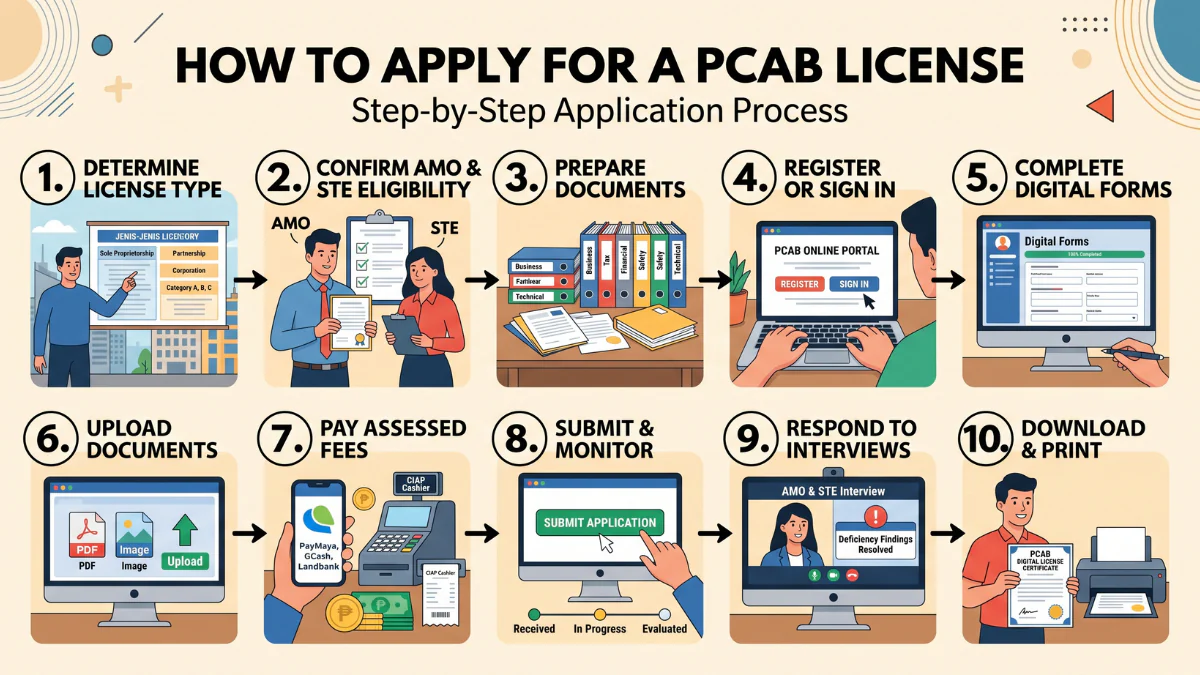
Applications run through the PCAB Online Licensing Portal, and the sequence below follows the flow described in the CIAP FAQ. Work through it in order, because skipping ahead is what usually sends a firm back to the start.
1. Determine the license type and application category
Decide whether you need a regular license, a special license, or registration for government projects. Confirm as well whether the filing is a new application or a renewal.
2. Confirm AMO and STE eligibility first
Check the qualifications of both nominees before preparing anything else. This is the step most likely to invalidate the rest of your work if it is handled late.
3. Prepare the document set by group
Organize the submission into business, tax, financial, safety, technical, and authority documents. Assigning each group to its existing owner keeps the preparation moving in parallel.
4. Register or sign in to the portal
Create or access the account that will hold the application. Keep it under a company email rather than a personal one so the record survives staff changes.
5. Complete the digital forms using the current templates
Download and fill out the revised PCAB templates for your category. Older template versions are a common deficiency finding.
6. Upload the supporting documents
Upload each file in the required format and within the stated file-size limits. Check that scans are complete and legible before submitting.
7. Pay the assessed fees
Settle the assessed amount through the available channels, which include PayMaya, GCash, Landbank LinkBiz, the CIAP cashier, and manager's cheque where applicable. Keep the payment reference with your application record.
8. Submit and monitor the status
Submit the application and track it through the portal status page. Assign one person to watch it so updates are not missed.
9. Respond to deficiency findings or interview requests
Act quickly on any deficiency notice or interview request for the AMO or STE. Each delay in responding extends your own timeline more than the review itself.
10. Download and print the license certificate
Once approved, download the digital license certificate and keep both digital and printed copies. Store it with your bidding and accreditation documents.
Two timing rules are worth building into your schedule. CIAP indicates that corrections are possible within 24 hours of submission, after which the filing is treated as final, and that processing for online applications runs to 20 business days excluding AMO and STE interviews. Treat the 20 days as indicative rather than guaranteed, since any deficiency finding resets your own clock.
New, Renewal, Upgrade, and Change Applications
PCAB licensing is a recurring obligation rather than a one-time filing. As the business grows, takes on larger projects, changes the type of work it handles, or replaces construction workforce, a different application type comes into play, so it helps to know which one applies before the need becomes urgent.
| Application type | When it applies | What to prepare for |
|---|---|---|
| New Regular License | First-time contractor license | The full document set and pre-submission review |
| Renewal of Regular License | License approaching expiry | Updated financial statements and current personnel records |
| Category Upgrade | Firm wants to qualify for larger projects | Stronger financial and equipment documentation; confirm current thresholds in the official forms |
| Additional or Revision in Classification | Firm adds or changes the type of work it takes | Evidence that capability matches the new classification |
| Change of AMO | The designated AMO leaves or changes role | CIAP notes that application types not available in the portal are filed by email |
| New or Renewal of ARCC | Qualification for government infrastructure projects | Can run alongside the regular license or follow after approval |
| Special License | Project-specific or undertaking-specific contracting | Scope documents for the approved undertaking |
License Validity and Renewal Timing
A contractor's license runs on a fiscal-year basis rather than from the date it is granted. Republic Act 4566 provides that the Board issues the license permitting the applicant to engage in business as a contractor "for the remaining part of the fiscal year," which means an approval secured late in the cycle still expires with that cycle.
Renewal timing follows the same rule. Under the same Act, a license may be renewed by filing a renewal application with the registrar "not later than June thirtieth of each fiscal year," together with the annual renewal fee, so the renewal window is fixed regardless of when the license was first issued.
For planning purposes, treat 30 June as a standing internal deadline and start assembling updated financial statements and personnel records well ahead of it. Confirm the current filing channel and fee with PCAB before each renewal, since licensing issuances are updated periodically.
Managing PCAB Compliance After Approval
Approval changes the nature of the work. Instead of assembling documents, the team now has to keep them current, since license validity and category, AMO and STE profiles, COSH and safety certificates, audited financial statements, project classifications, portal submissions, and payment proofs all need an owner and a review schedule.
The usual difficulty is not effort but location. Financial statements sit in the accounting software, project history sits with operations, and personnel certificates often live in one person's folder, so when a renewal or category upgrade comes up, the firm spends weeks rebuilding records it already has.
Keeping these records in one place is what makes the next filing easier than the last one. HashMicro's construction software connects project records, accounting data, procurement documents, and approval trails in a single system, so the team preparing a PCAB submission can pull current financial figures and complete project history without chasing files across departments.
It still falls to your team to file with PCAB, but the preparation stops being a scramble. With records, owners, and review dates visible in one place, renewals and upgrades become a scheduled task rather than a last-minute search.

Conclusion
PCAB license requirements become manageable once they are handled in sequence. Confirm the license type that fits your ownership and target projects, verify AMO and STE eligibility before filling out any form, prepare your business, tax, and financial records as one complete set, then file through the portal with the current templates and keep the 30 June renewal deadline on your calendar.
The firms that find this process smooth are usually the ones whose records stay in order all year. If project data, financial reports, and document approvals are still spread across spreadsheets and shared folders, that is the part worth fixing first, because every future renewal, upgrade, and classification change will draw on the same records.
To see how an integrated construction and accounting system can keep your compliance records ready before the next filing window, schedule a free consultation with our expert team.
FAQ about PCAB License Requirements
They fall into six groups: business registration from DTI or SEC, tax and employer records such as BIR, SSS, PhilHealth, and Pag-IBIG, financial documents including audited statements and tax returns, AMO qualification documents, STE qualification documents, and safety plus authority documents such as COSH and the required affidavits.
Contractors, subcontractors, and specialty contractors must secure one before engaging in the contracting business. Joint ventures, consortiums, foreign contractors, and project owners undertaking their own construction apply through the special license route.
The AMO represents management authority and needs at least two years of managerial or supervisory construction experience. The STE represents technical capability and must be a licensed professional with at least three years of experience. One qualified person may hold both roles.
A regular license is valid for one fiscal year, from 1 July to 30 June of the following year, unless suspended, invalidated, cancelled, or revoked. A special license is cancelled when the approved project or undertaking is completed.
Yes. A regular license qualifies a contractor for private projects. Government infrastructure projects require a separate registration and classification, which carries a three-year validity.
Yes. Applications are filed through the PCAB Online Licensing Portal, where contractors can register, complete digital forms, pay fees, submit, track status, and download the license certificate.