







A barangay business permit may look like a simple local requirement, but delays often happen when the business address, supporting documents, or barangay-specific checklist are not prepared correctly. For companies opening a shop, office, restaurant, warehouse, service site, or home-based business, one missing document can lead to repeated visits and delayed approvals.
This is especially important for businesses with multiple branches, because a clearance prepared for one location should not be treated as valid for another barangay or LGU. This guide helps finance, operations, and compliance teams prepare the right documents early, understand where barangay-level requirements fit in the wider permit process, and confirm the latest rules with the correct barangay office before submission.
Key Takeaways
A barangay business permit is tied to a specific location, so one branch’s clearance should not be reused for another site.
Requirements, fees, and processing steps can differ by barangay, making early checklist confirmation essential.
Businesses should track every site, document owner, renewal date, receipt, and unresolved issue in one register.
A barangay-level document and a Mayor’s Permit may be connected, but they are not always interchangeable.
What Is a Barangay Business Permit and Why Does the Location Matter?
A barangay business permit or barangay clearance is a local document used to support business activity within a specific barangay. It usually identifies the business, the applicant, and the operating address, which is why the covered location should be checked carefully before submission.
Location matters because each branch, store, warehouse, office, or service site may fall under a different barangay or LGU process. A company with a head office in Makati, a store in Quezon City, and a warehouse in Pasig should treat each site as a separate local requirement, with warehouse management helping oversee warehouse operations.
For better internal control, the business should record the exact document name, covered address, issue date, payment reference, and renewal instruction stated by the issuing office. A scanned copy alone is not enough, so teams should maintain a location register that shows whether the document supports a new application, renewal, address change, or change in business activity.
Which Businesses and Locations Should Prepare a Barangay Business Permit?
The need for a barangay-level document depends on the operating location, business activity, application type, and rules followed by the local office. For this reason, businesses should screen each site separately instead of relying only on the company’s registered address, a previous year’s practice, or a permit issued for another branch.
| Location or situation | Likely review point | Local confirmation needed |
|---|---|---|
| Retail branch or restaurant | The premises and customer-facing activity may be reviewed under the barangay covering the site. | Confirm the document name, current checklist, and whether a new or renewal application applies. |
| Corporate or satellite office | The office address may be treated separately from the head office. | Ask whether the office activity requires a barangay-level document and which representative may apply. |
| Warehouse or distribution site | Storage, dispatch, and operational activity may create a separate location record. | Confirm whether the warehouse needs its own application and what proof of occupancy is accepted. |
| Service or project location | A field, repair, or service site may have different local treatment from a permanent branch. | Confirm whether the activity is covered by the premises owner, the business, or another local process. |
| Home-based operation | Residential premises may have additional local considerations. | Ask the barangay or LGU whether the activity and address require business documentation. |
| Change of address or activity | Existing records may no longer describe the actual operation. | Confirm whether a new application, amendment, or supporting document is required. |
The company should create one location register that records every site where employees, inventory, customers, equipment, or business services are present. Each entry should include the barangay and city or municipality, application type, assigned document owner, central reviewer, latest office guidance, and evidence collected.
What Documents Are Commonly Required for a Barangay Business Permit?

Barangay business permit requirements can vary based on the business structure, operating address, activity, renewal status, and local form used by the issuing office. The documents below are commonly prepared in advance so the team can reduce back-and-forth requests and avoid missing basic application details.
1. Proof of Business Identity or Registration
This document helps identify the entity, sole proprietor, or registered business applying for the barangay-level document. It is often prepared by the owner, company secretary, or authorised administrator for new applications, changes, and some renewals.
2. Valid ID of the Applicant or Authorised Representative
A valid ID helps verify the person submitting the request, receiving the document, or transacting on behalf of the business. The accepted ID type and copy requirement may differ by office, so the team should check this before assigning a representative.
3. Proof of Address or Occupancy
Proof of address connects the application to the operating premises, such as a store, office, warehouse, service site, or home-based location. Depending on the site, the office may ask for a lease record, utility bill, tax declaration, owner certification, or another document that supports occupancy.
4. Lease or Property Document
A lease or property document supports the business’s right to use the premises stated in the application. For leased or shared spaces, a property management system can help businesses organize property records and related documentation.
5. Existing Permit or Clearance for Renewal
For renewals or updates, an existing permit or clearance helps show prior local documentation and continuity of the business location. The branch administrator or compliance owner should prepare the original, copy, or reference number based on what the local office asks for.
6. Authorisation Letter or Company Authority
An authorisation letter shows that a representative is allowed to file, follow up, or receive documents for the business. Legal, the corporate secretary, or an authorised manager should prepare the wording, signature, supporting ID, and notarisation if the office requires it.
Before submission, the business should maintain a central compliance checklist that records the location, barangay, application type, document owner, issue date, submission status, payment reference, and unresolved exceptions.
How to Get a Barangay Business Permit
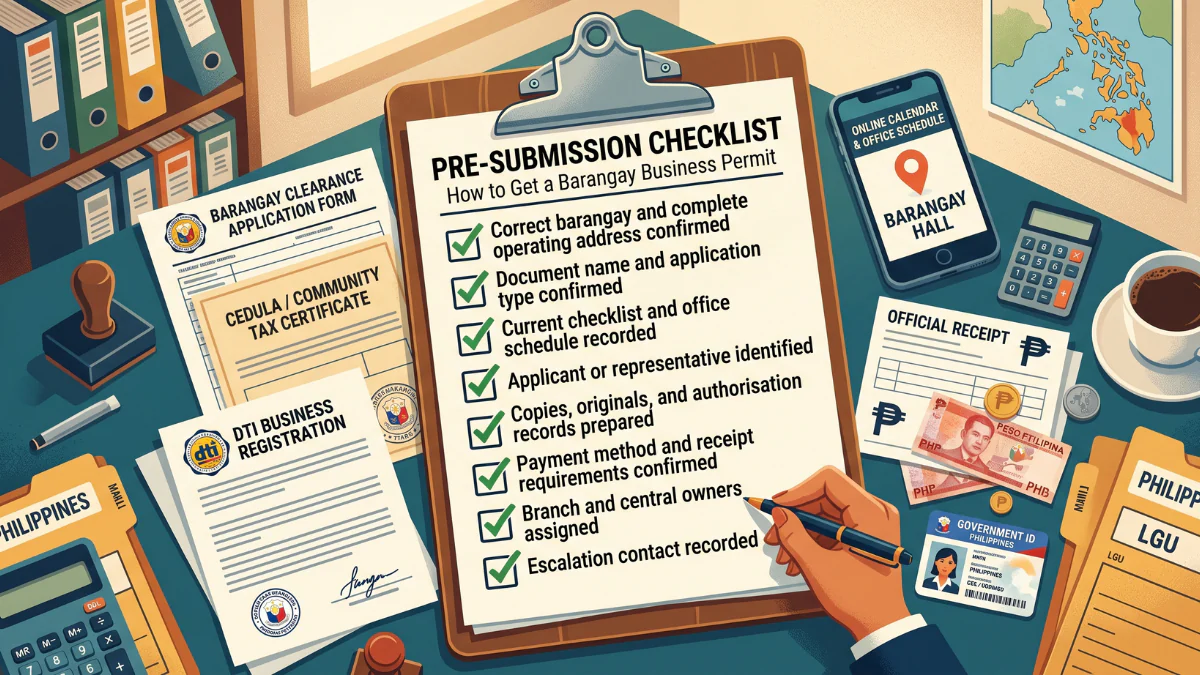
The following process is a practical framework for learning how to get a barangay business permit. Local offices may use different forms, channels, schedules, or release procedures, so treat each step as a control point rather than a guaranteed national sequence.
- Confirm the correct barangay and document name: Match the application to the actual operating site. Record the full address, business activity, and whether the request is for a new application, renewal, or change.
- Check the current local requirements: Contact or review the relevant office’s current instructions. Ask about the checklist, office hours, fees, payment methods, appointments, and release process.
- Prepare and review documents: Gather identity, registration, occupancy, lease, prior permit, and authorisation records that the office confirms. Check names, addresses, signatures, and dates before dispatching staff.
- Complete the application or request form: Use the form instructed by the barangay or LGU. Avoid copying assumptions from another branch or another locality.
- Submit through the instructed channel: The office may specify in-person submission or another available channel. Keep a submission reference, receiving copy, or other evidence where provided.
- Respond to clarifications or inspection-related requests: If the office asks for additional information or a site-related action, assign an owner and record the deadline and response.
- Pay confirmed fees: Pay only the amount and through the method confirmed by the issuing office. Request and retain the official receipt or payment evidence.
- Collect or receive the issued document: Check the business name, address, covered activity, issue date, and any stated validity or conditions before accepting the document.
- Store the document and receipt: Upload or file the final document, receipt, confirmation notes, and exception history against the correct location record.
Pre-submission checklist
- Correct barangay and complete operating address confirmed
- Document name and application type confirmed
- Current checklist and office schedule recorded
- Applicant or representative identified
- Copies, originals, and authorisation records prepared
- Payment method and receipt requirements confirmed
- Branch and central owners assigned
- Escalation contact recorded
For multiple branches, standardising location-level workflows can reduce missed handoffs. However, the workflow should preserve local exceptions instead of forcing every barangay into one template.
The Difference Between Barangay Clearance vs Business Permit and Mayor’s Permit
A barangay clearance or barangay business permit, a wider business-permit process, and a Mayor’s Permit may be connected, but they should not be treated as the same document. Each one can serve a different purpose, come from a different office, and apply to a different stage of local business registration.
| Document or process | Main purpose | Typical issuing authority | Covered location | Sequence and renewal relevance | Local variation |
|---|---|---|---|---|---|
| Barangay clearance or barangay business permit | Supports or records business activity within a barangay. | Relevant barangay office or authorised local office | Specific premises within that barangay | May be requested as part of a wider local application or renewal. | Name, checklist, fee, and release method can vary. |
| Broader business-permit process | Coordinates local permissions and records needed to operate a business. | City or municipal LGU, often involving several offices | Business location within the city or municipality | May include barangay-level documentation among other requirements. | Forms, steps, and dependencies differ by LGU. |
| Mayor’s Permit | A city or municipal permit associated with local business operations. | City or municipal government | The registered or operating premises covered by the LGU | Timing and prerequisites must be confirmed locally. | It should not be assumed to replace a barangay-level document. |
| Personal clearance | Relates to an individual rather than the business entity or premises. | Relevant issuing office | Person-specific | Should not be assumed to satisfy business-document requirements. | Purpose and acceptance depend on the transaction. |
How Much Does a Barangay Business Permit Cost and How Long Does It Take?
There is no single barangay business permit fee or processing time that applies across the Philippines. The cost and timeline may vary depending on the barangay, business activity, premises, application type, and completeness of documents.
Before setting a budget or sending a staff member, check the current fee, accepted payment methods, office hours, appointment rules, required appearance, release method, and receipt requirements. For businesses handling digital transactions, a payment gateway can help facilitate online payments.
Record who provided the confirmation, when it was given, and what checklist or fee schedule was shared. If the barangay gives updated instructions, revise the location record instead of relying on last year’s file.
How Should Businesses Manage Renewal, Expiry, and Site Changes?

Renewal and expiry tracking should start from the issued document and the instructions given by the local office. Do not assume that every barangay follows the same annual renewal rule, because the wording and next action may differ by location.
1. Record the location and barangay
Each permit or clearance should be tied to the exact operating address it covers. The branch or operations team should keep the address record, barangay name, and source of local confirmation in the location register.
2. Save the document name and number
The document name and reference number help the team identify whether the record is a barangay clearance, barangay business permit, or another local document. The compliance or administrative owner should store the issued copy under the correct site record.
3. Track the issue date and stated validity
Use the issue date and validity wording written on the document as the main reference for review timing. If the document does not clearly state the next renewal action, the document owner should ask the local office before setting a deadline.
4. Set the next review or renewal date
A controlled renewal process should begin before the recorded review date. The central compliance or administration team should set reminders early enough to review the business name, representative, activity, address, and supporting documents.
5. Keep fee and payment evidence
Finance should keep the official receipt, proof of payment, and any confirmation related to fees. This helps the business reconcile permit-related payments and avoid repeat payments caused by missing evidence.
6. Review site or activity changes
If a branch moves, adds a new activity, changes occupancy, or starts using a warehouse, the old permit should not be reused automatically. Operations and facilities should create a new local confirmation task and attach the updated lease, address record, or activity evidence.
7. Manage exceptions and escalations
Any missing document, unclear instruction, or delayed release should be logged with an owner and next action. A central owner should keep the email, call note, or written confirmation so the issue can be followed up properly.
Businesses can monitor renewal records through a shared register, workflow tool, or ERP system. HashMicro’s business-management software can help teams centralize location records, document owners, reminders, receipts, and exception reporting, while the barangay office remains the source of truth for the application itself.

Practical Controls for Finance and Operations Teams
A barangay permit process becomes harder to manage when each branch keeps its own spreadsheets, email threads, and folder copies. To keep the process under control, teams should use a document management system to organize permit records and establish clear ownership for each site.
For multi-location businesses, the goal is not to make every barangay follow one process. The goal is to make each local requirement, responsible owner, document status, payment record, and next action easy for finance and operations teams to track.
Branch or site team: checks the premises, local office, checklist, and submission status.
Operations: maintains the location inventory and tracks changes in address, activity, or site usage.
Finance: manages budget approval, payment evidence, and receipt reconciliation.
Compliance or administration: monitors review dates, document completeness, and unresolved exceptions.
IT or systems owner: manages access rights, reminders, user permissions, and reporting structure.
HashMicro ERP can help businesses centralize location records, document ownership, payment evidence, and renewal reminders in one controlled system. With clearer visibility across branches, finance and operations teams can manage local permit requirements more confidently without relying on scattered spreadsheets.
Conclusion
Managing a barangay business permit starts with understanding that the requirement is tied to the actual operating location, not only to the company’s registered head office. Businesses should prepare the right documents, verify the current local checklist, and keep clear records for every branch, warehouse, office, or service site.
For companies with multiple locations, a structured register helps finance, operations, and compliance teams track document ownership, payment evidence, renewal dates, and unresolved exceptions. This reduces the risk of missed submissions, repeated follow-ups, and using one local document for a site it does not cover.
HashMicro ERP can help businesses manage operational records, document responsibilities, reminders, and approval visibility in one centralized system. To see how the system can support your permit tracking and wider business operations, schedule a free consultation with our expert team.

Frequently Asked Questions
Coverage depends on the local jurisdiction and the document issued. Assess each operating site, confirm requirements with each relevant barangay, and retain location-specific evidence rather than assuming one document covers all branches.
Record the new checklist, confirm the change with the issuing office, identify the responsible document owner, retain the confirmation and receipt, and update the location-level compliance register.
Use shared ownership: operations or the branch team confirms local requirements, finance controls payment and receipts, and a central compliance or administrative owner monitors deadlines and exceptions. The final model should match the company’s authority structure.
They generally serve different purposes and may be issued by different local authorities. Local procedures may connect them differently, so confirm the required sequence and terminology with the relevant local government office.