



















Businesses in the Philippines use books of accounts to record transactions and support financial and tax reporting. The Bureau of Internal Revenue (BIR) requires business taxpayers to keep bookkeeping records appropriate to their activities. Its BIR Registration of Books of Accounts service covers manual, loose-leaf, and computerized books.
Registration depends on the type of book. RMC No. 4-2026 requires permanently bound loose-leaf books of accounts and computerized books of accounts to be registered through the Online Registration and Update System (ORUS), except in the limited circumstances stated in the circular. Its deadline extensions applied to 2026 registrations only and should not be used as 2027 deadlines.
This guide explains the types of BIR books of accounts and how businesses can register and maintain them according to current BIR requirements.
Key Takeaways
BIR books of accounts record and organize business transactions to support accurate financial reporting, tax filing, and audit compliance.
BIR book registration requires businesses to follow the correct procedures, deadlines, and document requirements based on their chosen book format.
A sample table illustrates how VAT-registered businesses record cash sales and inventory purchases, using illustrative account codes and VAT entries rather than an official BIR template.
What Are BIR Books of Accounts?
BIR books of accounts are accounting records that document a business’s sales, purchases, receipts, payments, and account balances. They help businesses prepare tax returns and financial statements, reconcile transactions, and respond to tax audits.
Unlike invoices, which record individual sales, books of accounts organize and summarize business transactions. The BIR requires taxpayers to maintain bookkeeping records appropriate to their business activities.
Why do businesses need books of accounts?
Books of accounts help businesses trace transactions and explain the figures they report. For example, a sales invoice can be matched to its accounting entry, payment record, and tax return. The exact records depend on the business and its accounting process.
How Many Books of Accounts Are Required by BIR?
There is no fixed number of books of accounts for every business. The appropriate set depends on the transactions it needs to record:
- Business activity: A service provider may keep different records from a retailer that buys and sells inventory.
- Transaction volume and payment methods: Frequent sales, supplier purchases, and cash or bank payments may call for more detailed records.
- Inventory and branches: Businesses with stock or multiple branches need records that clearly capture those activities.
- Tax and accounting setup: VAT status, accounting method, and the choice of manual, loose-leaf, or computerized books can affect the records a business maintains.
A small service provider may need a simpler set than a multi-branch retailer. Businesses should choose books that reflect their actual transactions and confirm the applicable registration requirements with the BIR or a Philippine accounting professional.
Common BIR Books of Accounts

Businesses may use different books of accounts depending on their transactions and accounting requirements. Common categories include the following, although the exact set must be confirmed based on the taxpayer’s circumstances.
General Journal
The General Journal records accounting entries that do not belong to a specialized book. These may include general transactions, adjusting entries, accruals, corrections, depreciation, and other accounting adjustments.
General Ledger
The General Ledger organizes and summarizes transactions by account, such as Cash, Accounts Receivable, Inventory, Sales, Purchases, Accounts Payable, and Expenses. It helps businesses review account balances, monitor financial activity, and prepare financial statements.
Cash Receipts Book
The Cash Receipts Book records money received by the business through cash or bank transactions. Entries may include cash sales, customer payments, bank deposits, and other business receipts, helping track incoming funds.
Cash Disbursements Book
The Cash Disbursements Book records payments made by the business through cash or bank transactions. Common entries include supplier payments, rent, payroll-related payments, utility bills, and other operating expenses.
Sales Book
The Sales Book records sales transactions involving goods or services. It helps businesses organize sales information separately from other accounting entries and monitor revenue generated during a reporting period.
Purchases Book
The Purchases Book records purchases from suppliers, including inventory, raw materials, and other business-related items. It helps businesses organize supplier transactions and monitor purchasing activities.
Manual, Loose-Leaf, and Computerized Books of Accounts
Businesses may use different formats for maintaining their books. Each format has separate process and documentation considerations.
Manual Books
Manual books are permanently bound books where transactions are recorded by hand. Each entry should include the date, reference, description, and debit and credit amounts. According to the BIR Checklist 2025, registration requires Form 1905 and a new set of permanently bound books.
Loose-Leaf Books
Loose-leaf books contain printed or computer-generated pages that are later bound permanently. Businesses must obtain a Permit to Use Loose-Leaf Books before printing or using them. The application may require a sample format, sworn statement, and Form 1900 for manual applications.
Computerized Books
Computerized books are maintained using accounting software. Businesses must keep the required electronic records and register through ORUS under RMC No. 4-2026, subject to applicable exceptions. BIR CAS or CBA documents are required only when applicable, using accounting software alone does not complete BIR registration.
The table below compares how each book format is maintained and the main registration requirement for each one. Form 1905, Form 1900, sample printouts, sworn statements, and CAS or CBA documents serve different applications and should not be treated as requirements for every format.
| Format | How records are kept | Key registration consideration |
|---|---|---|
| Manual books | Entries are written in permanently bound books. | Register a new set within the applicable period and before using it for subsequent registration. A new set is not required every year solely because the year changes. |
| Loose-leaf books | Entries are printed or computer-generated as loose-leaf pages and later permanently bound. | Obtain the applicable Permit to Use before printing or using the books. Register the permanently bound books through ORUS within the applicable deadline. |
| Computerized books | Entries are generated and maintained through a computerized accounting system or computerized books of accounts. | Register the books through ORUS and keep the required electronic records and any system documentation applicable to the taxpayer. |
How to Register Books of Accounts in BIR
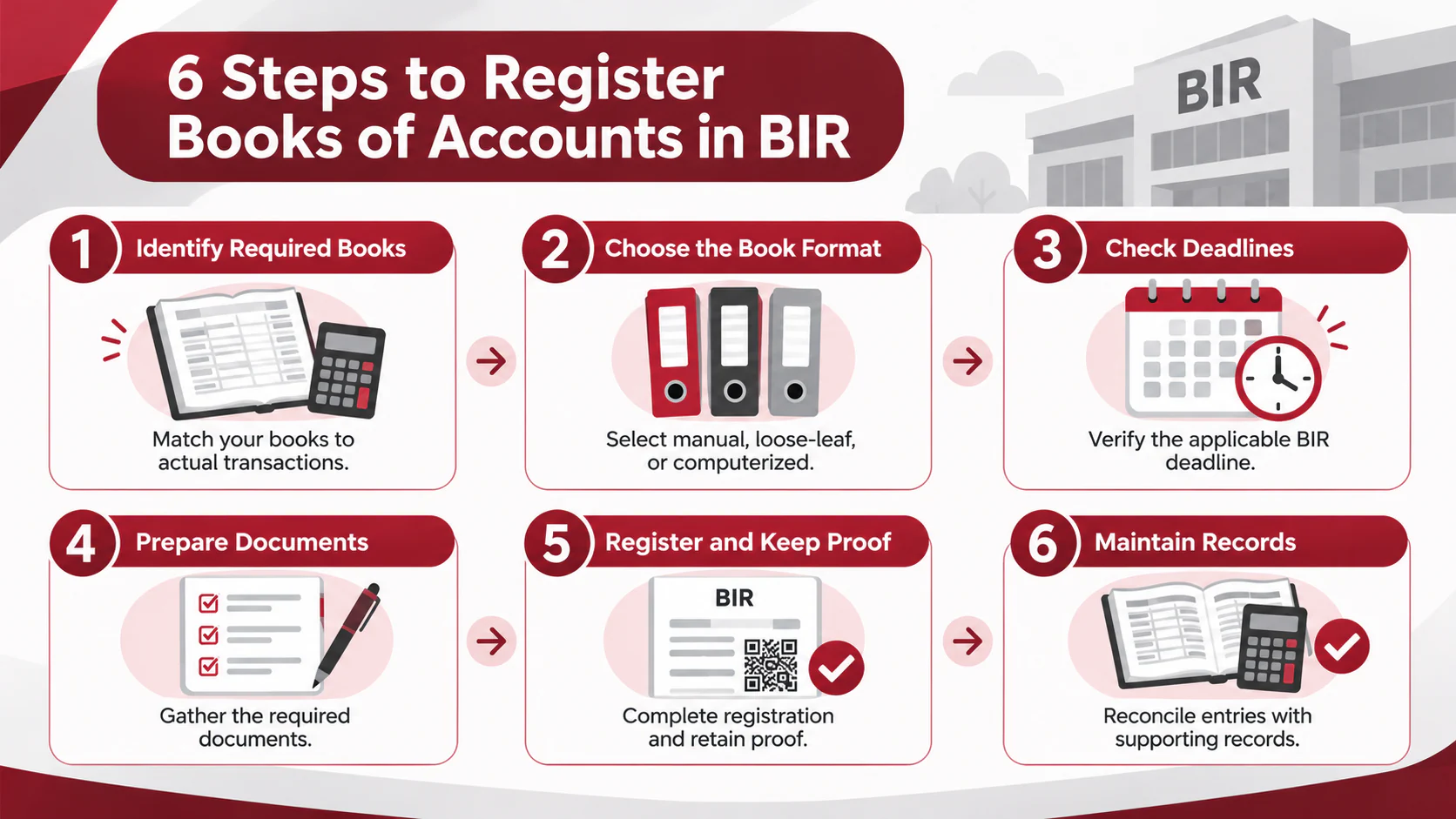
Registering books of accounts with the BIR involves more than selecting a format and submitting an application. Each format has its own approval requirements, deadlines, and supporting documents.
The following steps outline how businesses can complete the registration process and maintain their accounting records in line with current BIR procedures.
Step 1: Identify the books you need
Match your books to actual sales, purchases, payments, adjustments, and branch transactions. Do not assume every business needs the same number of books or copy a generic sample without checking your activities.
Step 2: Choose a format and complete any prior approval
Manual, loose-leaf, and computerized books have different requirements. Obtain a Permit to Use before printing or using loose-leaf books. For computerized books, check which CAS or CBA documents apply, software setup alone does not complete BIR registration.
Step 3: Check the current deadline and registration channel
BIR guidance sets different schedules, permanently bound loose-leaf books are generally registered within 15 days after the taxable year ends, and computerized books within 30 days. Manual books follow a different schedule. Confirm any extension before relying on an older deadline.
Step 4: Prepare only the documents for your application
Use the relevant part of the BIR Checklist 2025. Forms, permits, affidavits, and sample printouts are not required for every format. Book registration is also separate from invoice or receipt registration; incomplete applications may be returned.
Step 5: Register and keep proof
RMC No. 4-2026 addresses ORUS registration for permanently bound loose-leaf and computerized books. Retain the confirmation, QR Code stamp, permit, or documents received through an authorized manual process.
Step 6: Maintain and reconcile the books
Match entries with invoices, payments, supporting records, and tax returns. Before changing your accounting system or book format, check whether the registration needs updating.
ORUS Registration for Books of Accounts
ORUS is the BIR’s Online Registration and Update System. After successful ORUS registration, the BIR generates a QR Code stamp that can be validated online. Under RMC No. 4-2026, taxpayers must:
Permanently bound loose-leaf books: Attach the QR Code stamp to the first page.
Computerized books: Print and keep the stamp for record purposes.
Manual books: Follow RMC No. 91-2024, which also requires taxpayers registering through ORUS to attach the printed stamp to the first page.
If ORUS is unavailable due to downtime or technical errors, registration for books covered by RMC No. 4-2026 may be processed manually at the relevant Revenue District Office. Taxpayers must provide either an official BIR unavailability advisory or a screenshot of the error message.
Separately, loose-leaf invoices, receipts, and other accounting records that are not available in ORUS continue to follow manual processing. This procedure is different from the registration requirements for permanently bound loose-leaf books of accounts.
BIR Books of Accounts Sample
The table below shows how a VAT-registered business might record a cash sale and an inventory purchase on account. The account codes and VAT12 tax code are illustrative, and the table is not an official BIR template.
| Date | Reference | Description | Quantity | Transaction amount | Account code | Account | Tax code | Debit | Credit |
|---|---|---|---|---|---|---|---|---|---|
| Jan. 5, 2027 | SI-2027-001 | Cash sale | 10 units | ₱1,120.00 | 1000 | Cash | VAT12 | ₱1,120.00 | — |
| Jan. 5, 2027 | SI-2027-001 | Cash sale | 10 units | ₱1,120.00 | 4000 | Sales | VAT12 | — | ₱1,000.00 |
| Jan. 5, 2027 | SI-2027-001 | Output VAT | 10 units | ₱1,120.00 | 2100 | Output VAT | VAT12 | — | ₱120.00 |
| Jan. 8, 2027 | PI-2027-001 | Inventory purchased on account | 5 units | ₱560.00 | 1300 | Inventory | VAT12 | ₱500.00 | — |
| Jan. 8, 2027 | PI-2027-001 | Input VAT | 5 units | ₱560.00 | 1400 | Input VAT | VAT12 | ₱60.00 | — |
| Jan. 8, 2027 | PI-2027-001 | Amount owed to supplier | 5 units | ₱560.00 | 2000 | Accounts Payable | VAT12 | — | ₱560.00 |
These entries show how each transaction is divided among accounts, including output VAT on the sale and input VAT on the purchase. A business may also need to record customer or supplier references, branch information, supporting document numbers, running balances, and the preparer’s name.
The final format, tax treatment, and supporting documents should reflect the taxpayer’s actual transactions and applicable BIR requirements. An accountant or tax adviser should review the records before they are used.
Loose-Leaf Books of Accounts
Loose-leaf books contain printed or computer-generated entries that are later permanently bound. Before printing or using them, a business must obtain the applicable Permit to Use Loose-Leaf Books. The permit application may require a sample format, a printout, and a sworn statement, depending on the application process.
Keep the approved permit, the bound books, and proof of registration. Check that entries are complete and that the number of pages can be accounted for. Under RMC No. 4-2026, the QR Code stamp from ORUS registration is affixed to the first page of the permanently bound books.
Computerized Books of Accounts
Computerized books are generated through an accounting system. Before registration, review the books and reports the system produces, its electronic files, sample printouts, user access controls, and backup procedures. Check which CAS or CBA documents apply to the business; those documents should not be treated as identical requirements for every taxpayer.
Computerized books are registered through ORUS under RMC No. 4-2026, subject to its stated exceptions. Print and keep the resulting QR Code stamp for your records. Using accounting software does not, by itself, complete the business’s BIR registration obligations.
Conclusion
Books of accounts should match how businesses in the Philippines record their transactions. Before registering, identify the required books and determine whether the business uses manual, loose-leaf, or computerized formats.
Before registering, determine whether the business uses manual, loose-leaf, or computerized books. Check the requirements and deadlines that apply to that format, then keep proof of registration and reconcile the records with transaction documents.
Want to see how transaction records can be managed in one system? Schedule a free demo to review an accounting workflow that fits your business needs.

FAQ about Books of Accounting BIR
There is no single number that applies to every business. The appropriate books depend on the taxpayer’s business activity, transaction types, accounting method, registration status, and selected format.
Common categories include the General Journal, General Ledger, Cash Receipts Book, Cash Disbursements Book, Sales Book, and Purchases Book. The final set must be confirmed for the taxpayer’s circumstances.
Identify the relevant books and format, prepare the applicable BIR form and supporting documents, complete ORUS registration where required, and retain the QR Code, permit, or acknowledgement.
Manual books are recorded in physical books. Computerized books are generated and maintained through a computerized accounting system or computerized books of accounts, with additional requirements for system documentation and electronic records where applicable.
Yes, ORUS is the main online registration channel for certain book types. RMC No. 4-2026 states that permanently bound loose-leaf books and computerized books should generally be registered through ORUS, subject to applicable exceptions.
A BIR books of accounts sample is an illustrative layout showing how transaction details and accounting entries may be organized. It is not automatically an official BIR template.
They may require system, CAS, CBA, electronic file, printout, and registration documentation depending on the taxpayer’s circumstances. Confirm the current BIR requirements before implementation.