









 Limited to 100 registrants
A yard management system business case starts with five measures: gate-to-dock time, driver wait time, appointment adherence, dock utilisation, and trailer dwell time.
A YMS coordinates appointments, gate activity, trailers, and dock assignments through shared real-time status across gate, yard, and warehouse teams.
This article covers the YMS workflow, features, benefits, compliance requirements, and how to choose the right system for Australian operations.
Key Takeaways
A yard management system coordinates appointments, gate activity, trailers, dock assignments, and departures through shared real-time status.
YMS, WMS, and TMS are connected systems with distinct ownership, not interchangeable software categories.
A credible business case starts with baseline measures such as gate-to-dock time, dwell time, and appointment adherence.
For Australian operations, YMS can support CoR and fatigue-management records, but does not replace legal review.

What Is a Yard Management System (YMS)?
A yard management system coordinates vehicle appointments, gate activity, trailers, yard movements, dock assignments, and departures, spanning from before arrival until the vehicle exits the site.
Consider an inbound carrier arriving at an Australian distribution centre: the gate operator validates the appointment, the yard team directs the trailer into position, and receiving confirms dock capacity.
This differs from relying on spreadsheets, radio calls, or an isolated appointment calendar, none of which provide shared trailer position and exception visibility across gate, yard, and warehouse teams.
The scope required depends on:
- Site scale: number of sites, gates, dock doors, and operating shifts
- Volume: daily inbound and outbound vehicle movements
- Asset mix: trailer, container, and carrier variety
- Appointment rules: tolerance for unplanned arrivals
- Connections needed: with WMS, TMS, ERP, and reporting systems
For an internal business case, the question is whether receiving capacity, dispatch commitments, and transport execution can be coordinated from reliable operational data.
Understanding how this connects to broader operations often starts with a warehouse management system already in place.
How Does a Yard Management System Work?
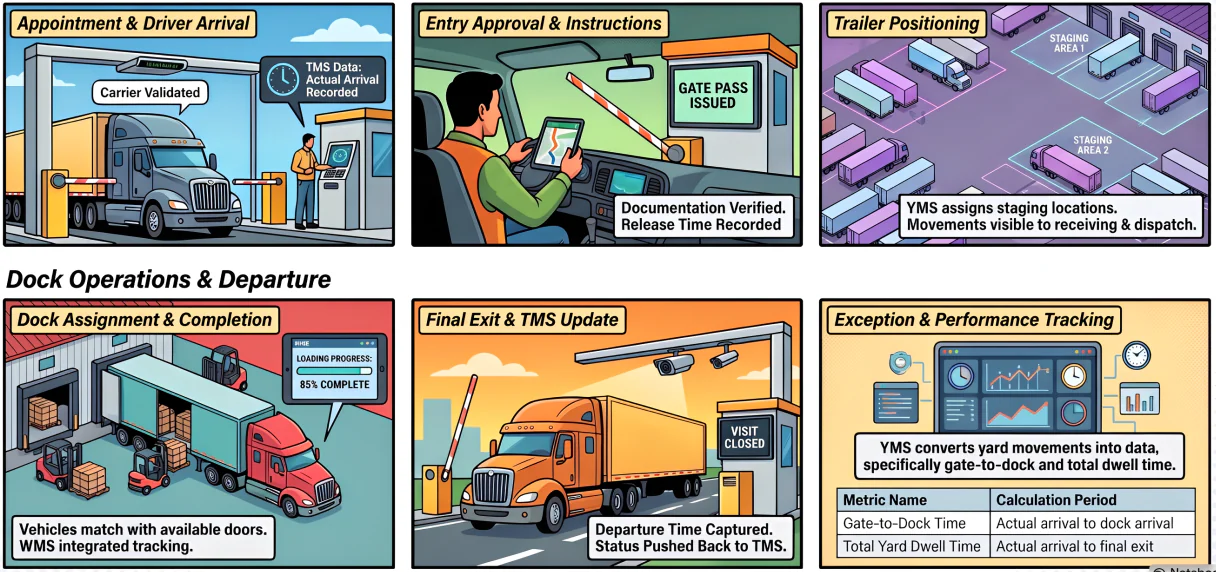
A YMS converts physical yard events into assigned tasks and connected-system updates. At each stage, the responsible team should know what changed and what it owns.
- Appointment created: records the carrier, load, and time window, with TMS or ERP supplying the booking details
- Driver arrives: validates the appointment and records actual arrival time, shared with warehouse and transport
- Entry approved: issues instructions and records gate release time, with exceptions returned if documentation is unresolved
- Trailer positioned: assigns a staging location and records movement, visible to receiving and dispatch
- Dock assigned: matches the vehicle with an available door, with WMS receiving expected workload where integrated
- Loading or unloading completed: records completion and releases the dock, with WMS confirming progress
- Vehicle exits: captures departure time and closes the visit, with TMS receiving departure status
Gate-to-dock time is calculated from actual arrival to dock arrival. Total yard dwell time runs from arrival to exit.
A well-designed workflow also defines exception ownership. Unplanned arrivals and unavailable docks should create a visible action, not an untracked phone call.
Reliable data exchange here depends on solid system integration between the YMS and the systems it feeds.
Key Features of a Yard Management System
The most important features address specific coordination problems. Evaluate who will use each capability and what integration it requires.
1. Gate Management and Driver Check-In
Gate management replaces duplicated entry and paper logs with a controlled arrival workflow. The outcome is a more traceable entry process, though performance still depends on accurate pre-arrival data.
2. Dock Door Scheduling and Assignment
Dock assignment helps supervisors match arrivals with door availability, equipment, and labour capacity. It requires current dock and workload status, otherwise it just digitises an unreliable schedule.
3. Appointment Scheduling
Appointment scheduling gives carriers and site teams a common view of expected arrivals. It supports workload planning, but discipline also requires carrier communication for early or late arrivals.
4. Trailer Tracking and Yard Positioning
Trailer tracking records where a trailer is located and what movement should occur next, reducing reliance on memory and manual searching.
5. Real-Time Yard Visibility Dashboard
A visibility dashboard displays arrivals, queues, dock status, and exceptions in one view. Its accuracy is limited by the timeliness of source data.
6. Carrier and Driver Communication
Communication tools issue appointment confirmations, arrival instructions, and change notifications so carriers can act on current information without repeatedly contacting site staff.
Businesses should assess accessibility, consent, and fallback procedures rather than assuming every driver will use the same channel.
7. WMS and TMS Integration
This connects yard events with warehouse work and transport execution. Integration design must establish data ownership and error handling.
Site teams that also manage fleet scheduling benefit from a connected transportation management system feeding appointment data directly into the yard.
Yard Management System Benefits
The main benefits are better operational visibility, more predictable handoffs, and clearer use of yard capacity. A credible case connects each outcome to a defined KPI and accountable owner.
| KPI | Calculation | Typical owner |
|---|---|---|
| Gate-to-dock time | Dock arrival minus site arrival | Yard or operations manager |
| Total yard dwell time | Site exit minus site arrival | Operations manager |
| Appointment adherence | On-time arrivals ÷ completed appointments | Transport or scheduling manager |
| Dock utilisation | Occupied dock time ÷ available dock time | Warehouse manager |
| Trailer search time | Location request to confirmed identification | Yard supervisor |
| Driver wait time | Time waiting before next authorised action | Transport and site operations |
| On-time departure | On-time departures ÷ scheduled departures | Dispatch or transport manager |
Improved gate control and trailer visibility can reduce manual status checks and help teams respond sooner to conflicting assignments.
These benefits are not automatic. Poor workflow compliance or missing timestamps can make KPI results misleading.
Consistent tracking here also strengthens supply chain visibility across inbound and outbound movements.
Turning these KPIs into a live, always-on view of yard performance takes more than manual reporting. See how connected analytics makes that possible below.






"A gate-to-dock time that improves on paper means nothing if it just shifts the congestion to the dock instead of solving it."
Yard Management System vs WMS vs TMS: What's the Difference?
YMS, WMS, and TMS control different operational domains. A YMS coordinates vehicles between the gate and dock. A WMS controls inventory inside the warehouse. A TMS plans transport movements.
| Area | YMS | WMS | TMS |
|---|---|---|---|
| Domain | Gate, yard, docks | Warehouse storage | Transport execution |
| Assets | Vehicles, trailers, docks | Inventory, bins, tasks | Shipments, routes, loads |
| Primary users | Gate staff, yard controllers | Warehouse supervisors | Transport planners |
| Core events | Arrival, positioning, exit | Receipt, putaway, picking | Booking, route, delivery |
| Typical KPI | Dwell time, dock utilisation | Inventory accuracy | On-time delivery |
For example, a TMS creates a supplier appointment linked to a purchase order. The YMS records arrival and assigns a dock. The WMS receives readiness and begins putaway planning.
The decision is not simply YMS versus WMS versus TMS. Identify which application owns each event and how quickly status must pass between systems.
Businesses relying on multiple carriers often benefit from clearer visibility into 3PL coordination as part of this decision.
Yard Management Compliance and Australian Industry Context
Yard management software can support operational records, but it does not guarantee compliance. Businesses must determine which laws apply and have compliance personnel review procedures.
1. Chain of Responsibility (CoR) and Yard Management
Under the Heavy Vehicle National Law framework, Chain of Responsibility duties can apply to parties whose activities influence heavy-vehicle transport safety.
Applicability should be checked against current NHVR Chain of Responsibility guidance and relevant state requirements.
A YMS may support this by recording arrivals, queue status, and exceptions. It does not prove every duty was met or replace training and supervision.
2. Fatigue Management and Driver Wait Times
Uncertain queues and long site visits can affect transport schedules and driver planning. A YMS can make wait-time data visible so exceptions can be escalated.
Businesses should align these workflows with current NHVR fatigue management guidance and site-specific controls.
3. Australian Industry Use Cases
A manufacturing site may align raw-material arrivals with receiving capacity. A retail distribution centre may coordinate inbound stock with outbound dispatch peaks. A 3PL may require customer-specific permissions.
The applicable controls should be based on the organisation's own risk assessment, not a generic software template.
When Does Your Business Need a Yard Management System?
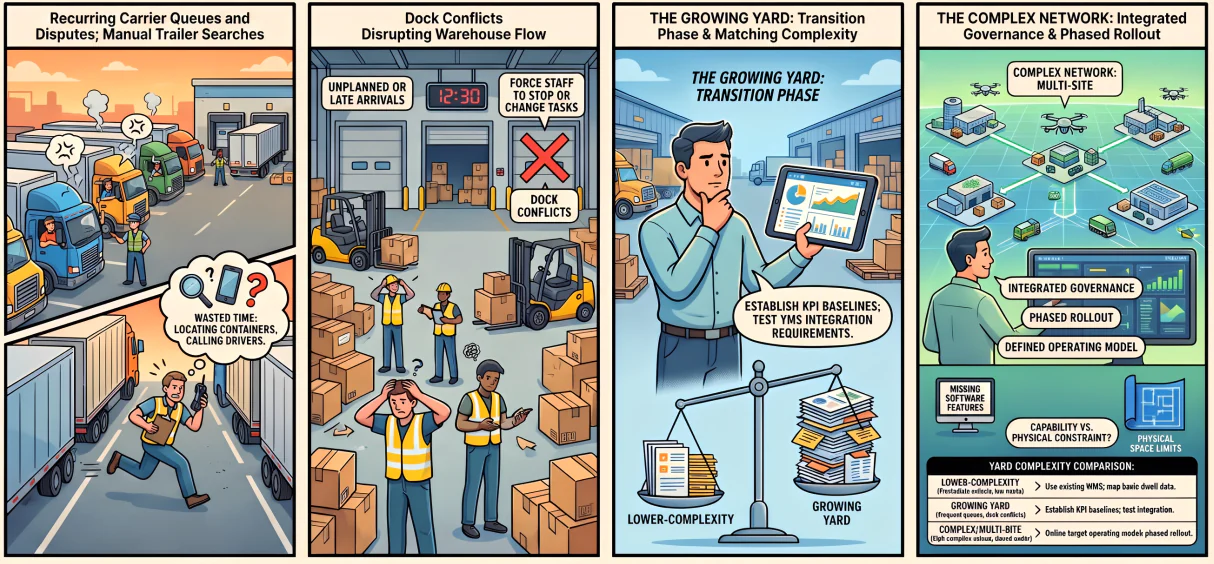
A dedicated system warrants evaluation when yard complexity repeatedly affects throughput. A lower-complexity site may first benefit from standardised processes.
- Lower-complexity yard: predictable arrivals and few docks may mean existing WMS capability is sufficient. Map the workflow and measure basic dwell data first.
- Growing yard: carrier queues and dock conflicts may justify dedicated capability. Establish KPI baselines and test integration requirements.
- Complex or multi-site network: high exception volume and shared assets suggest integrated YMS governance. Define the target operating model and phased rollout.
Indicators worth investigating include:
- Recurring carrier queues or detention-related disputes
- Frequent unplanned, early, or late arrivals
- Dock conflicts that disrupt warehouse work
- Manual searches for trailers or containers
- Repeated driver calls for current instructions
- Limited visibility across sites or shifts
These signals do not automatically prove new software is required. Determine whether the cause is missing capability or a physical constraint.
The WMS Foundation That Makes YMS Work
A YMS depends on data it does not own. Location names, SKU references, and dock structures usually live in the WMS or ERP first.
If that foundation is inconsistent, a YMS inherits the mess. A dock labelled two different ways across systems creates the same confusion whether it is tracked on paper or in software.
Before adding yard-specific tools, confirm that basic location and inventory records in the warehouse automation layer are accurate and consistently maintained.
A stable WMS foundation is what lets a YMS add real coordination value, rather than digitising the same inconsistent data faster.
How to Choose a Yard Management System for Australian Operations
Selection should begin with operating requirements rather than a feature demonstration.
- Document current workflows. Map arrivals, check-in, staging, and departure across every shift.
- Establish baseline data. Define current gate-to-dock time and appointment adherence using agreed formulas.
- Set system boundaries. Confirm which data is owned by ERP, WMS, TMS, and the proposed YMS.
- Assess integrations. Review interface methods and error handling when a connection is unavailable.
- Validate user workflows. Include gate staff, drivers, and warehouse supervisors in scenario testing.
- Review governance and scale. Examine permissions and support for future locations.
- Request a scoped proposal. Provide site, workflow, and integration requirements, not just a headline price.
Demonstrations should test realistic scenarios, such as a late carrier or unavailable dock, not just the ideal workflow. Once selected, define a target operating model with clear task ownership and escalation paths.
Start with a representative site with a clear problem and baseline, and clean carrier and dock reference data before data migration. Gate teams also need workflows that stay practical during peak periods.
After launch, compare results against the approved baseline, since a shorter gate-to-dock time only matters if it doesn't simply shift congestion to the dock instead of resolving it.
Conclusion
A yard management system can provide a shared execution layer for appointments, gates, trailers, and departures. Its value is strongest when coordination failures are clearly identified.
Begin with measurable bottlenecks and confirm how users will handle everyday exceptions. Include compliance stakeholders early.
Ready to assess whether yard management software fits your operations? Book a consultation with HashMicro to review your sites and requirements.

Frequently Asked Questions About Yard Management Systems
A yard management system is the operational layer used by gate, yard, warehouse, and transport teams to coordinate vehicle appointments, arrivals, trailer positions, dock assignments, loading or unloading status, and departures. It replaces fragmented status updates with a shared workflow and record of each handoff.
A YMS controls vehicle and trailer flow between the gate and dock, while a WMS controls inventory and work inside the warehouse. The YMS can send an arrival and dock assignment to the WMS, which then creates or prioritises receiving work and returns receipt-completion status.
It depends on yard complexity. Existing WMS functions may be adequate for a site with predictable arrivals, few docks, and limited trailer staging. Dedicated YMS capability warrants evaluation when appointment volume, dock conflicts, or multi-site coordination require deeper gate-to-dock visibility.
Site scheduling, queues, loading practices, and records may be relevant to Chain of Responsibility duties where an organisation'"'"'s activities influence heavy-vehicle transport safety. A YMS can support timestamps and exception records, but it does not guarantee compliance on its own.
Cost depends on the number of sites, users, gates, and docks, as well as hardware, integrations, workflow configuration, and ongoing support. Request a scoped quote based on documented operational and technical requirements for a consistent comparison.