









 Limited to 100 registrants

Closing the books means locking the accounting period after all adjustments and reconciliations are finished. This ensures financial reports are reliable and prevents unnecessary changes.
Month-end close is the process of reviewing, reconciling, and finalising financial transactions before closing the books at the end of each month. It also supports compliance, cash flow management, and financial reporting.
This guide explains what month-end close is, why it matters, and the key steps and best practices for Australian businesses.
Key Takeaways
The month-end close process helps businesses keep financial records accurate and support timely reporting.
A structured month-end close timeline helps finance teams complete key tasks on schedule and reduce reporting delays.
A three-phase month-end close checklist helps businesses prepare, complete, and review the close more efficiently.

What Is the Month-End Close Process?

The month-end close process is how finance teams review, reconcile, and finalise financial transactions before closing the books each month. It helps keep financial records accurate and complete.
Closing the books means locking the accounting period after all adjustments and reconciliations are finished. This ensures financial reports are reliable and prevents unnecessary changes.
A consistent month-end close also makes quarter-end and year-end reporting easier by keeping financial records up to date.
Why Month-End Close Matters for Australian Businesses
A well-managed month-end close does more than keep financial records accurate. It also supports compliance, improves decision-making, and strengthens financial control across the business.
1. Supports Financial Compliance
A consistent month-end close helps businesses meet Australian reporting requirements, including BAS, GST, and annual financial reporting.
2. Improves Cash Flow Visibility
Accurate financial records provide a clear view of cash flow, receivables, and payables, helping businesses make better financial decisions.
3. Builds Confidence in Financial Reporting
Reliable month-end reports give management, investors, and stakeholders accurate information to support planning and decision-making.
4. Strengthens Audit Readiness
A structured close process creates accurate records and supporting documentation, making audits faster and reducing reporting errors.
"A strong month-end close is not about closing faster. It's about producing financial data you can trust."
Who Is Responsible for Month-End Close?
Month-end close is a shared responsibility across the finance team. Depending on the business, HR and operations may also provide information needed to complete the process.
Finance staff usually prepare journal entries, reconciliations, payroll adjustments, and financial reports. Financial controllers or CFOs review the results and approve the final reports.
Business sizes may vary, but every task should have a clear owner and deadline. This helps keep the month-end close process accurate and on schedule.
Month-End Close Timeline: A Day-by-Day Calendar
One of the most consistent gaps in month-end close guidance is the absence of a practical timeline. The following schedule assumes a ten-business-day close cycle, which is achievable for most small to mid-sized Australian businesses with a clear process in place.
| Day | Tasks |
|---|---|
| Day 1–2 | Collect financial data and confirm transaction cut-off dates. |
| Day 3–4 | Reconcile bank accounts, credit cards, payables, and receivables. |
| Day 5–6 | Reconcile GST, payroll, and fixed assets, then record journal entries. |
| Day 7–8 | Review the general ledger, check balances, and prepare financial reports. |
| Day 9 | Review variances and prepare management reports. |
| Day 10 | Complete the final review, approve the close, and distribute reports. |
Australian timing note: For businesses lodging monthly BAS statements, the deadline is usually the 21st of the following month. GST reconciliation should therefore be completed early enough to allow time for reviewing and lodging the BAS before the due date. See the ATO's BAS lodgment due dates for the latest requirements.
Adjust this timeline to suit your business's reporting deadlines, transaction volume, and month-end cut-off procedures. Businesses with higher transaction volumes may benefit from starting data collection before the end of the month.
The Month-End Close Checklist: A 3-Phase Approach
A structured month-end close helps finance teams complete tasks in the right order while reducing delays and errors. The process can be divided into three key stages: preparation, execution, and review.
1. Prepare Before Month-End
Good preparation makes the month-end close faster and more accurate. Before the period ends, confirm schedules, gather financial data, and resolve any outstanding issues.
Confirm the month-end close schedule and deadlines.
Sync data from ERP, payroll, bank feeds, and expense systems.
Collect required information from HR, sales, and operations.
Review prior-month adjustments and unresolved transactions.
Communicate transaction cut-off dates.
2. Complete the Month-End Close
During the close, finance teams record adjustments, reconcile accounts, and prepare financial reports. This ensures the books are complete before they are closed.
Record revenue, accruals, prepayments, and depreciation.
Reconcile bank accounts, GST, payroll, payables, receivables, and fixed assets.
Review all balance sheet accounts.
Prepare the Profit & Loss, Balance Sheet, and Cash Flow Statement.
3. Review and Finalise
Once the books are closed, review the results, share reports, and identify improvements for the next reporting period.
Analyse key financial variances.
Distribute reports to management and stakeholders.
Update budgets and forecasts with actual results.
Review the process and identify improvements for the next close.
Month-End Close Best Practices
Strong processes help finance teams complete the month-end close more efficiently while reducing errors. The following best practices can improve accuracy, accountability, and reporting consistency.
1. Build a Shared Close Calendar
Create a shared month-end close calendar with clear deadlines so everyone knows what needs to be completed and when.
2. Assign Clear Task Ownership
Assign each checklist item to one responsible person to improve accountability and prevent tasks from being overlooked.
3. Set Firm Close Deadlines
Establish a fixed month-end close deadline and monitor progress to keep reporting on schedule.
4. Hold a Mid-Close Check-In
Schedule a short review around Day 5 to identify delays, resolve issues, and keep the close on track.
5. Standardise Journal Entries
Use consistent journal entry templates and approval workflows to improve accuracy and speed up reviews.
6. Keep Supporting Documents Organised
Maintain reconciliation schedules and supporting records in one place to simplify audits and future month-end closes.
6 Common Month-End Close Mistakes — and How to Avoid Them
1. Starting close without pre-close preparation in place.
Teams that begin execution without confirmed data from HR, sales, and operations spend the first two days chasing inputs instead of processing them. The fix is a pre-close checklist with confirmed sign-off deadlines from every contributing department.
2. Relying on manual spreadsheet processes for reconciliation.
Manually exporting data, copy-pasting transactions, and matching lines by hand is slow and error-prone. A single copy error in a reconciliation spreadsheet can propagate through to the financial statements without being detected until the audit. Accounting systems with bank-feed integration and sub-ledger reconciliation tools significantly reduce this risk.
3. Missing BAS and GST reconciliation before closing.
Australian businesses that complete their month-end close without reconciling GST can lodge a BAS based on figures that do not match the general ledger. Corrections require an amended BAS, which invites ATO scrutiny and creates additional work for the finance team. GST reconciliation should be a formal, documented checklist item—not an assumption that the accounting system handles it automatically.
4. No clear task ownership.
When close tasks are assigned to teams rather than individuals, accountability gaps are common. If two people both believe the other is responsible for a reconciliation, neither completes it. A named owner for every task, visible in a shared tracker, eliminates this problem.
5. Skipping the post-close retrospective.
Teams that finish close and immediately move on to the next period tend to repeat the same mistakes every month. A 30-minute retrospective after close completion creates a feedback loop that systematically reduces close time and recurring errors over successive periods.
6. Using email chains for approvals.
Approval workflows conducted over email produce no reliable audit trail, make it difficult to confirm who approved what and when, and frequently result in delays when emails are missed or buried. Workflow-based approvals within an accounting system create a documented, reviewable record and typically complete faster than email chains.
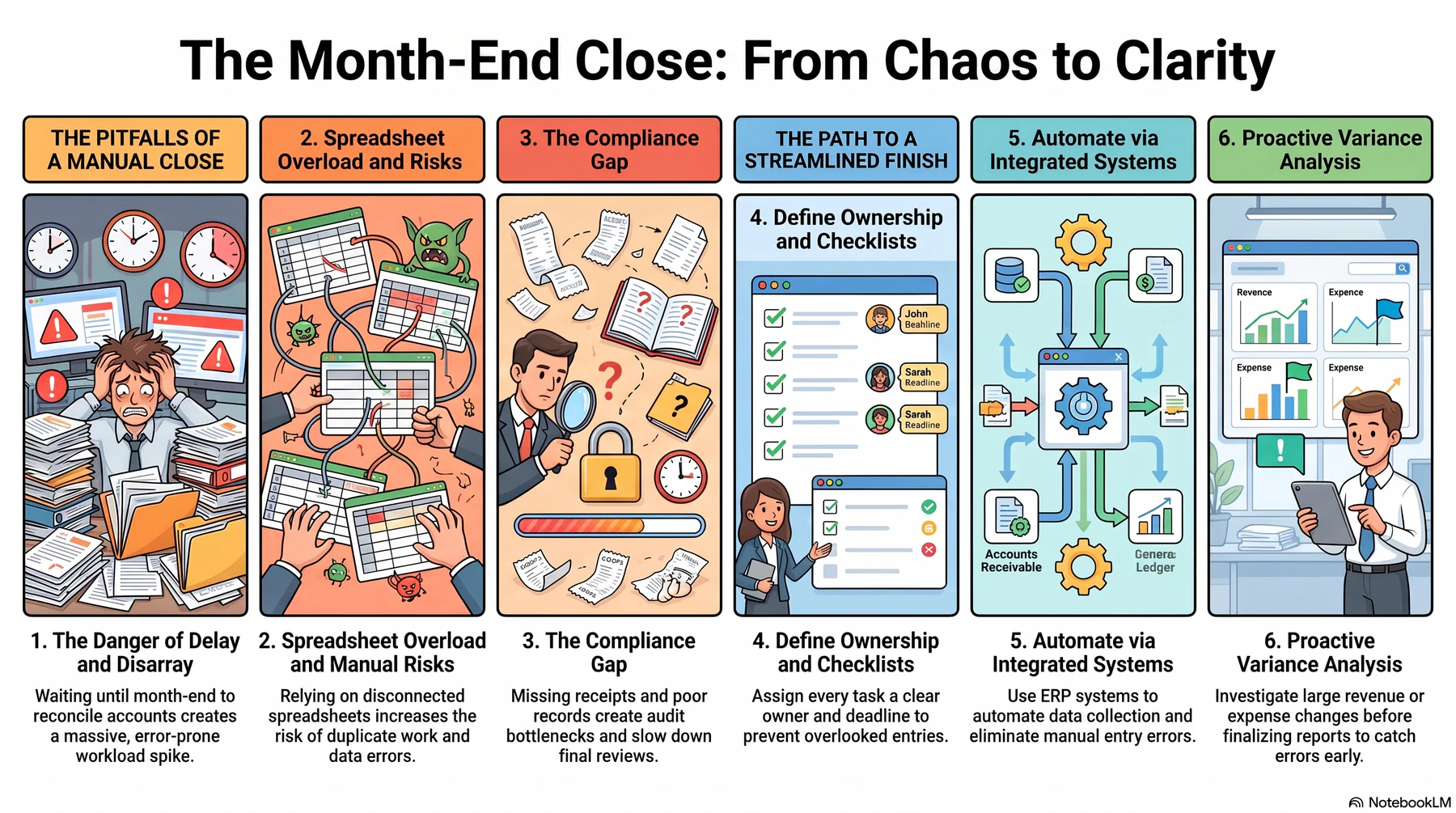
A well-planned month-end close can still be affected by avoidable mistakes. The following are some of the most common issues and simple ways to prevent them.
1. Delaying Account Reconciliations
Waiting until the last minute to reconcile accounts can delay the entire close process. Reconcile accounts regularly throughout the month to reduce the workload.
2. Missing or Incorrect Journal Entries
Incomplete accruals, prepayments, or depreciation entries can lead to inaccurate financial reports. Use a standard checklist to ensure all required entries are recorded.
3. Relying on Manual Spreadsheets
Managing the close with multiple spreadsheets increases the risk of errors and duplicate work. An integrated accounting or ERP system helps automate data collection and reporting.
4. Unclear Task Ownership
When responsibilities are not assigned, important tasks can be overlooked. Give each task a clear owner and deadline to keep the close on schedule.
5. Ignoring Variances
Large changes in revenue, expenses, or account balances should always be investigated. Reviewing variances helps identify errors before reports are finalised.
6. Keeping Poor Supporting Records
Missing receipts, reconciliations, or supporting documents can create compliance issues and slow audits. Store all records in a central location to make reviews easier.
How Accounting Software Speeds Up Month-End Close
Accounting software helps finance teams complete the month-end close faster by automating repetitive tasks and reducing manual work. Instead of relying on spreadsheets, businesses can reconcile accounts, record journal entries, and generate reports from one system.
Key features to look for include:
Automated BAS and GST reporting: Simplifies tax reporting and reduces manual calculations.
Bank feed integration: Automatically imports and matches bank transactions.
Multi-entity support: Makes it easier to manage multiple business entities.
Real-time financial reporting: Provides up-to-date financial data throughout the month.
Workflow automation: Streamlines approvals, journal entries, and recurring tasks.
HashMicro Accounting Software supports bank reconciliation, GST and BAS management, journal entry workflows, and financial reporting for Australian businesses managing monthly close processes.
HashMicro also includes Hashy AI, which helps finance teams access real-time financial insights, review key metrics, and analyse month-end data through simple AI-powered queries.






Conclusion
A consistent month-end close process helps Australian businesses maintain accurate financial records, meet compliance requirements, and make better business decisions.
Clear responsibilities, standardised workflows, and regular reviews also reduce errors and improve reporting efficiency.
If your finance team still relies on spreadsheets and manual processes, consult with our experts for free to discover how HashMicro Accounting Software can automate month-end close, simplify compliance, and improve financial reporting.

Frequently Asked Questions
The month-end close process is how businesses review, reconcile, and finalise financial transactions before closing the books each month. It helps ensure accurate financial reporting and compliance.
Most businesses complete the month-end close within 5–10 business days. The timeline depends on business size, transaction volume, and whether the process is manual or automated.
The main steps include collecting financial data, recording journal entries, reconciling accounts, reviewing balances, preparing financial reports, analysing variances, and obtaining final approval before closing the books.
Month-end accounts payable involves recording supplier invoices, reconciling outstanding balances, posting any required accruals, and confirming the accounts are accurate before closing the books.
A closing journal entry is an accounting adjustment made at the end of the month to record items such as accruals, prepayments, depreciation, and payroll. It helps ensure financial statements are accurate before the books are closed.