







 Limited to 100 registrants

Mining operations generate large volumes of geological, equipment, production, safety, and environmental data. However, teams often struggle to convert that information into timely operational decisions.
AI in Mining helps companies analyse complex data, predict equipment or production issues, and recommend suitable actions. Australian mining businesses can apply these capabilities across exploration, maintenance, processing, logistics, safety, and rehabilitation.
The technology delivers the most value when it connects with reliable operational systems and established engineering controls. Therefore, adoption should focus on measurable problems rather than AI capability alone.
Key Takeaways
AI in mining analyses operational data to support safer and more efficient decisions.
AI supports exploration, maintenance, production, safety, logistics, and environmental monitoring.
Successful adoption requires reliable data, connected systems, human oversight, and cybersecurity.
Integrated ERP and AI coworkers can turn predictions into operational actions.
What Is AI in Mining?

AI in Mining refers to artificial intelligence used to analyse mining data, predict outcomes, detect anomalies, recommend actions, and automate controlled tasks. It may use machine learning, computer vision, optimisation models, natural language processing, or generative AI.
Mining applications can draw from geological surveys, fleet telemetry, maintenance histories, production records, images, environmental sensors, and commercial systems. AI then identifies patterns that may take employees much longer to find manually.
Artificial intelligence does not replace geological, engineering, safety, or operational expertise. Instead, it gives specialists additional evidence for planning and helps teams monitor complex conditions at greater speed.
A mining management software platform can provide the operational foundation for these applications. It connects site activity with assets, inventory, procurement, workforce records, and financial reporting.
How Is AI Used Across the Mining Value Chain?
Mining companies can apply artificial intelligence from early exploration through closure and rehabilitation. The practical value depends on the available data, operating environment, and decisions involved.
Mineral Exploration and Geological Analysis
AI can analyse geological maps, drilling results, geochemical samples, geophysical surveys, and satellite imagery. These models help geologists identify patterns and rank areas for further investigation.
For example, machine learning can compare prospective locations with the characteristics of known mineral deposits. Geologists can then direct fieldwork and drilling towards targets with stronger supporting evidence.
AI-generated targets still require professional interpretation and physical validation. Geological uncertainty, limited samples, and local conditions can affect the reliability of model outputs.
Mine Planning and Production Optimisation
Mining teams can use AI to compare production schedules, equipment capacity, ore characteristics, workforce availability, and processing constraints. Optimisation models can then recommend plans that balance output, cost, and operational limits.
A planning model may identify how a delay at one pit could affect haulage, crusher utilisation, stockpile composition, and shipment commitments. Managers can assess alternatives before approving schedule changes.
Planning systems should display their assumptions and constraints clearly. Engineers need enough information to determine whether a recommendation remains practical under actual site conditions.
Autonomous Haulage and Remote Operations
Autonomous and remotely operated equipment can reduce employee exposure to hazardous areas. AI supports vehicle navigation, obstacle detection, dispatch coordination, and equipment interaction within controlled operating zones.
Remote operation centres also give specialists a broader view across fleets and mine sites. However, safe deployment requires defined operating boundaries, reliable communications, exclusion controls, and tested emergency procedures.
Human operators must retain authority over abnormal situations. Equipment should move into a safe condition when sensors, communications, or decision systems become unavailable.
Predictive Maintenance and Asset Reliability
Predictive maintenance models analyse vibration, temperature, pressure, oil condition, operating hours, fault codes, and previous failures. The system can detect unusual behaviour before an asset experiences an unplanned breakdown.
Maintenance planners can use these alerts to inspect equipment and schedule work around production needs. As a result, the company may reduce emergency repairs and avoid replacing components too early.
Prediction accuracy depends on complete maintenance records and reliable sensor data. Teams should also track false alarms because unnecessary interventions can increase costs and disrupt production.
Mineral Processing and Ore Quality Control
AI can help processing teams monitor feed characteristics, recovery rates, reagent use, energy consumption, throughput, and product quality. Models may recommend adjustments when ore properties or plant conditions change.
Computer vision can also inspect material size, conveyor conditions, flotation behaviour, or product quality. These applications give operators additional information without removing their responsibility for plant control.
Processing recommendations should remain within approved engineering limits. A higher throughput target should not override equipment protection, product specifications, or environmental controls.
Worker Safety and Hazard Detection
Computer vision and sensor systems can detect proximity risks, restricted-area entry, missing protective equipment, fatigue indicators, unstable conditions, or unusual environmental readings. Alerts can help supervisors respond before exposure becomes more serious.
AI can also analyse incident and near-miss records to identify recurring patterns. Safety teams can use these findings to improve controls, training, and work planning.
Mining companies should not rely on AI as their only safety measure. Physical safeguards, trained employees, site procedures, engineering controls, and accountable supervision remain essential.
Mining Logistics, Inventory, and Supply Planning
Mine sites depend on fuel, tyres, spare parts, explosives, consumables, and specialist equipment. AI can forecast demand using maintenance schedules, asset usage, supplier lead times, production plans, and current stock.
Connected inventory management systems can help planners identify shortage risks across remote locations. The business can then transfer stock, adjust reorder timing, or escalate supplier requirements before work stops.
Logistics models can also compare delivery routes, freight capacity, weather conditions, and site priorities. Therefore, purchasing and operations teams gain a more realistic view of when critical materials will arrive.
Environmental Monitoring and Mine Rehabilitation
AI can analyse water quality, dust, noise, vegetation, land disturbance, energy use, and emissions data. Remote sensing and image analysis can also help environmental teams monitor changes across large areas.
For example, a model may identify unusual readings or vegetation patterns that warrant field inspection. Specialists can then investigate the cause and decide whether corrective action is necessary.
Environmental decisions still require verified measurements and professional review. Models should support monitoring programs rather than replace sampling, regulatory reporting, or rehabilitation expertise.
What Business Outcomes Can AI Support in Mining?
AI should connect with a defined operational result rather than a general technology objective. The table below shows how mining applications can support measurable business outcomes.
A company should define its baseline before introducing the model. Otherwise, managers may see an impressive technical result without knowing whether operations actually improved.
Financial value also needs careful interpretation. An avoided failure may create substantial value, while a small increase in prediction accuracy may deliver little operational benefit.
How Should Mining Companies Prioritise AI Use Cases?

Mining companies should rank potential applications through a consistent evaluation process. The following actions help separate practical opportunities from projects with weak operational foundations.
1. Define the Operational Problem and Baseline
Describe the current issue in operational terms, such as repeated conveyor stoppages, unstable recovery, or frequent emergency purchases. The problem should have a responsible owner and a measurable starting point.
Teams should document current performance, decision delays, and existing controls. This baseline provides a fair reference for later evaluation.
2. Assess Potential Operational Value
Estimate how the proposed use case may affect availability, throughput, cost, safety, compliance, or environmental performance. The assessment should consider both direct savings and avoided disruption.
Managers should also check how often the decision occurs. A modest improvement in a frequent process may create more value than a sophisticated model used only occasionally.
3. Evaluate Data and System Feasibility
Review whether the required data exists, remains accurate, and covers enough operating conditions. Teams should inspect sensor reliability, maintenance codes, timestamps, asset identifiers, and integration options.
Historical data may reflect outdated equipment or procedures. Therefore, technical teams should confirm that previous patterns still represent current operations.
4. Consider Safety and Operational Risk
Classify the consequences of incorrect recommendations, missed warnings, and unavailable systems. Higher-risk applications require stricter testing, approval controls, redundancy, and fallback procedures.
The Australian Government’s Guidance for AI Adoption provides practices for responsible AI governance. Mining companies should apply these principles alongside industry obligations and site-specific safety requirements.
5. Define Human Control and Success Criteria
Specify which actions AI may recommend, prepare, or complete. Engineering, safety, commercial, and workforce decisions should retain appropriate human authority.
Success criteria should include model accuracy and operational outcomes. The company should also define the error rate or risk level that would trigger investigation, retraining, or suspension.
How Ready Is Your Mining Operation for AI?
Readiness depends on business ownership, data, infrastructure, workforce capability, safety controls, and cybersecurity. A weakness in any area can limit the value of an otherwise capable model.
1. Business Case and Accountable Ownership
Each initiative needs a named operational owner who can approve decisions and remove workflow barriers. Technology teams should support delivery without becoming solely responsible for the business result.
The business case should explain the problem, baseline, expected outcome, cost, risk, and review timetable. Clear ownership also prevents pilots from continuing without a decision about expansion or closure.
2. Data and Sensor Readiness
Useful models require accurate timestamps, consistent identifiers, reliable measurements, and complete event records. Missing failure codes or changing sensor settings can create misleading patterns.
Data teams should document each source, unit, owner, collection frequency, and quality rule. These controls make errors easier to trace when an output appears unusual.
3. OT, IT, and Site Connectivity
Mining AI may need data from operational technology, enterprise applications, field equipment, and remote sites. The architecture must handle limited connectivity without creating unsafe dependencies.
Local processing may suit applications that require fast responses or must continue during a network outage. Central platforms can support broader reporting, model management, and cross-site analysis.
4. Workforce Capability and Operator Trust
Operators and engineers need to understand what the system does, where it may fail, and how to challenge a result. Training should use realistic site scenarios rather than abstract technical explanations.
Trust grows when employees can inspect evidence and report errors. Involving frontline users during design also helps the workflow fit actual operating conditions.
5. Safety and Human Control
Safety-critical uses need defined authority, operating limits, override controls, and tested fallback procedures. AI should not weaken an existing control merely to increase automation.
The system should clearly distinguish advice from an approved instruction. Employees must know who can accept, reject, or escalate each recommendation.
6. Cybersecurity and Vendor Risk
Connections between operational and enterprise systems can introduce additional attack paths. The Australian Signals Directorate advises that OT security should prioritise safety, protect valuable operational data, segment networks, manage supply chain risk, and recognise the role of people. Review the operational technology cybersecurity principles.
Vendor reviews should cover hosting, data access, model updates, incident response, audit logs, subcontractors, and exit arrangements. Mining companies should also confirm how operations will continue if a supplier becomes unavailable.
How to Measure AI Success in Mining
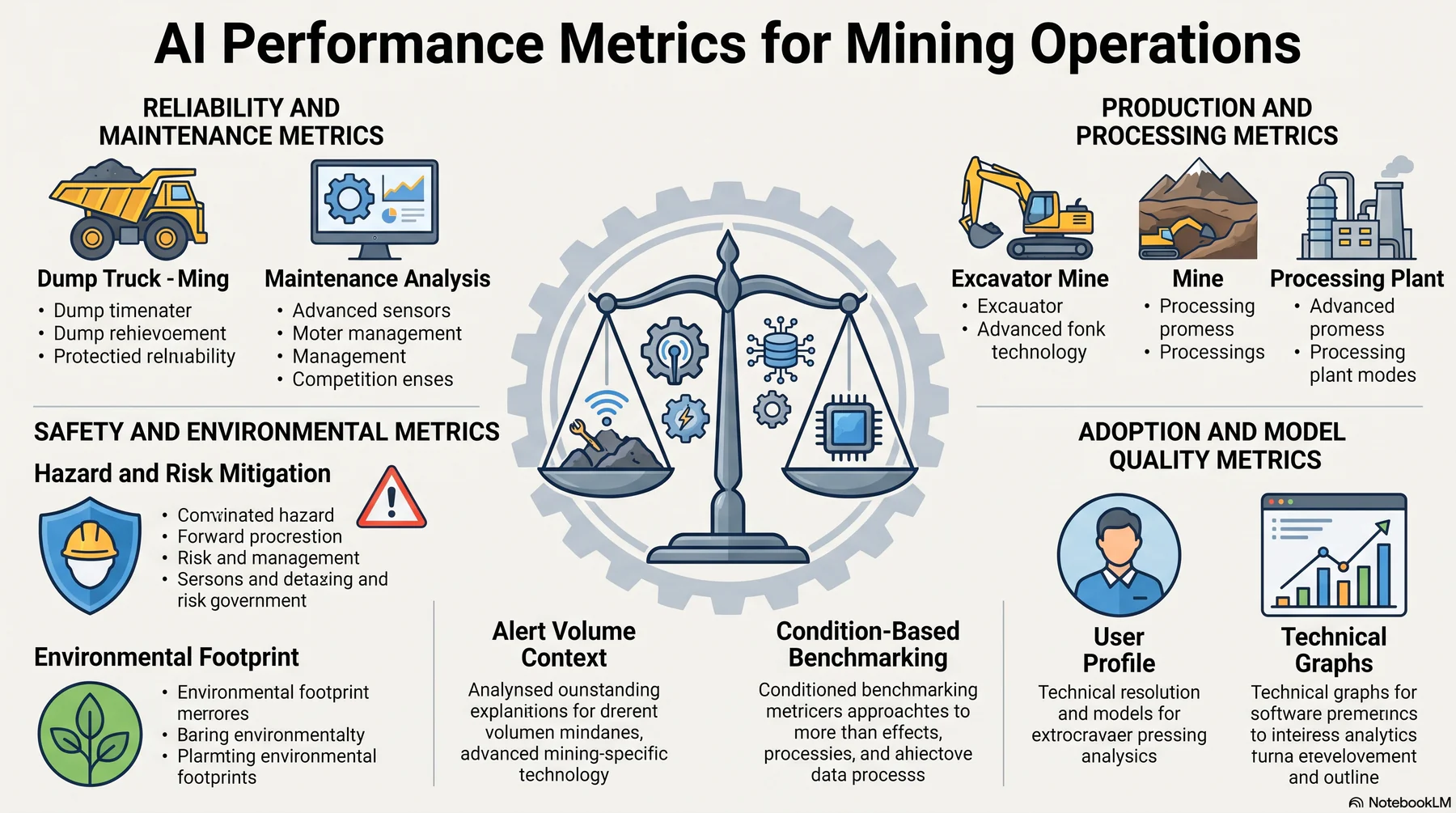
A mining AI initiative should report technical accuracy alongside operational performance. The following metric groups help managers evaluate whether the system creates practical value.
1. Reliability and Maintenance Metrics
Relevant measures include equipment availability, mean time between failures, mean time to repair, planned maintenance ratio, and unplanned downtime. Maintenance teams can also track emergency work and component replacement.
Model measures should include missed failures, false alarms, warning lead time, and alert acceptance. A high accuracy percentage can conceal serious missed events if the data contains few actual failures.
2. Production and Processing Metrics
Production measures may include tonnes moved, schedule adherence, throughput, recovery, cycle time, energy use, and equipment utilisation. Processing teams can also review grade consistency and reagent consumption.
Managers should compare results against operating conditions, not only calendar periods. Weather, ore characteristics, shutdowns, and equipment changes can distort a simple before-and-after comparison.
3. Safety and Environmental Metrics
Safety evaluation may cover hazard alerts, response time, exposure duration, near misses, and control completion. Environmental measures can include water, dust, energy, emissions, rehabilitation, and exception response.
Teams should avoid treating alert volume as the main success measure. More alerts may reflect better detection, excessive sensitivity, or worsening conditions.
4. Adoption and Model-Quality Metrics
Adoption measures include active users, recommendation acceptance, workflow completion, override frequency, and time saved. User feedback can reveal whether the system fits site practices.
Model monitoring should assess drift, missing data, confidence, false positives, false negatives, and performance across operating conditions. A review process should investigate material changes before they affect decisions.
How Integrated ERP and AI Coworkers Support Mining Operations
Specialist AI may identify a problem, but mining teams still need to plan work, obtain parts, assign people, approve costs, and record the result. Integrated ERP connects predictions with the operational and financial workflow required to act.
Turning AI Predictions Into Maintenance Actions
A predictive maintenance alert can create an inspection request or draft work order against the correct asset. The workflow can include the predicted fault, supporting readings, risk level, and recommended completion window.
Maintenance planners can then review the evidence and schedule suitable work. The resulting inspection and repair records also provide feedback for future model improvement.
Connecting Work Orders With Spare Parts and Procurement
A maintenance task may fail to prevent downtime if the required component is unavailable. Connected systems can check stock across sites, identify reserved quantities, and compare expected delivery dates.
When inventory cannot meet the requirement, an integrated procurement management system can prepare a request for review. Buyers retain control over supplier selection, pricing, and commercial commitments.
Coordinating Workforce, Approvals, and Follow-Ups
ERP workflows can connect maintenance requirements with employee availability, contractor qualifications, site access, and approval authority. This reduces the need to coordinate every activity through separate emails and spreadsheets.
Automated follow-ups can remind supervisors about inspections, approvals, and overdue work. Escalation rules ensure that critical tasks reach the appropriate manager.
Improving Cost, Compliance, and Performance Visibility
Integrated records connect production and maintenance activity with labour, purchasing, inventory, and asset costs. Managers can compare an operational decision with its full financial effect.
Audit trails also record who reviewed, approved, and completed each action. This context supports internal controls, incident reviews, and evidence-based reporting.
Where AI Coworkers Fit Into Mining Workflows
An AI coworker provides a conversational interface for connected operational information. Employees can ask about overdue maintenance, unavailable parts, supplier delays, approval bottlenecks, or cost variances without manually assembling several reports.
HashMicro AI Coworker serves as an integrated AI layer across mining ERP data and workflows. It can surface insights, prepare authorised tasks, and direct follow-ups while human employees retain control over engineering, safety, and commercial decisions.
Conclusion
AI in Mining can support exploration, production, maintenance, processing, safety, logistics, and environmental monitoring. However, reliable adoption requires clear operational problems, quality data, accountable ownership, secure infrastructure, and defined human authority.
Mining companies should start with a controlled use case that has measurable value and manageable risk. Technical accuracy should always be evaluated alongside reliability, cost, safety, environmental, and workforce outcomes.
HashMicro connects asset, inventory, procurement, workforce, and financial data in one operational ecosystem. Its AI Coworkers work from this connected business data to support repeatable tasks, surface relevant information, and help mining teams respond faster while keeping safety-critical decisions under human oversight.
Explore how HashMicro’s AI Coworkers can support your operations through a free consultation on AI for the mining industry.
Turn Mining Data Into Operational Action
Connect production, asset maintenance, inventory, procurement, workforce, and financial data with HashMicro Mining Software and Hashy OS.
Frequently Asked Questions
Generative AI can summarise maintenance histories, retrieve operational records, prepare reports, and help employees query connected mining data using natural language. Employees should verify generated content before using it for engineering, safety, environmental, or commercial decisions.
Small and mid-sized mining companies can begin with a focused use case such as maintenance alerts, spare-parts forecasting, production reporting, or document search. A limited scope makes costs, risks, and operational results easier to evaluate.
A model may work across several sites when equipment, operating conditions, processes, and data definitions remain similar. However, each location should validate the model because geology, climate, fleet configuration, and workforce practices can affect accuracy.
Authorised engineering judgement should take priority when specialists identify a technical, safety, or operational concern. The company should record the disagreement and investigate whether poor data, unsuitable assumptions, or model drift caused the conflict.
The fallback process should define manual controls, responsible employees, communication channels, safe-state requirements, and recovery criteria. Mining companies should test this process regularly so essential work can continue safely during a system outage.